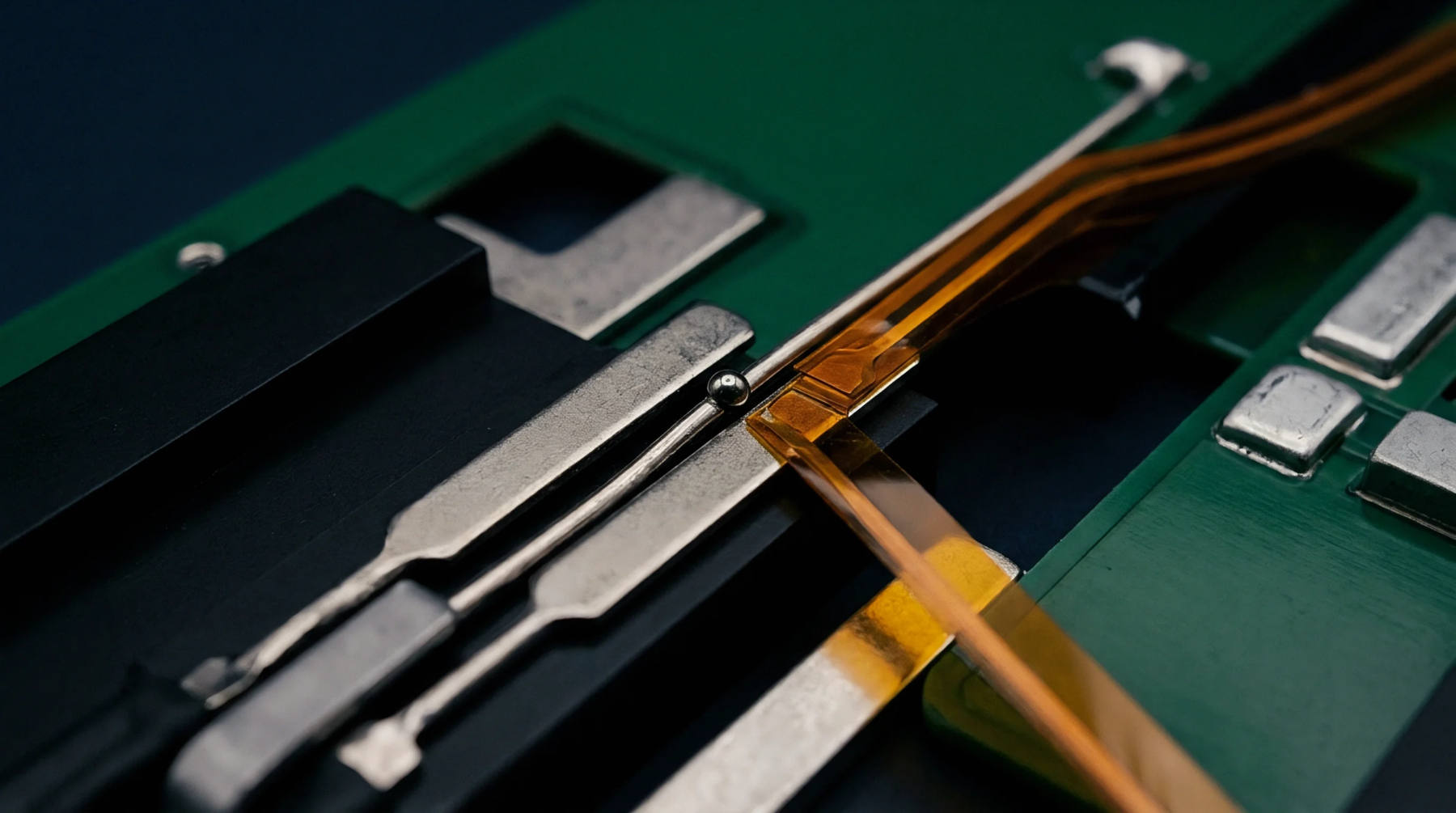
Electrical Separation
Physical prevention of current conduction between independent electrical nodes through the placement of insulating barrier materials secures signal integrity in sensitive electronic architectures. Termed dielectric isolation, this construction topology suppresses galvanic coupling, high-voltage flashover and ground loops across measurement circuits, transducers and semiconductor dies. Designers incorporate solid dielectric layers, including silicon dioxide, ceramic substrates, polyimide films or encapsulating potting resins, to interrupt continuous conductive pathways.
The condition holds until applied potential exceeds the intrinsic dielectric breakdown field of the insulator material, at which point avalanche breakdown or arcing permanently compromises insulation resistance.
Barrier Implementation
Integrated circuit sensors employ oxide barriers to separate active junction regions from the handling substrate, eliminating parasitic latch-up and reducing stray substrate capacitance. At the transducer packaging level, isolation requires high-integrity ceramic standoffs or glass-to-metal seals separating sensing diaphragms from processing electronics. Insulation resistance testers confirm isolation by applying direct-current voltages and measuring leakage currents in the picoampere domain.
Breakdown voltage ratings dictate the physical thickness of the barrier, while dielectric permittivity determines capacitive coupling under alternating-current conditions. Low dielectric constants minimise high-frequency noise transmission across the isolation boundary, protecting low-amplitude sensor signals from external electromagnetic interference.
Metrological Verification
Qualification testing subjects isolated assemblies to high-potential testing, verifying that no breakdown occurs during sustained overvoltage applications. Environmental screening incorporates high humidity and elevated thermal cycles, as moisture absorption severely degrades surface resistivity across creepage distances. Partial discharge detectors verify the absence of micro-voids inside potted barriers, where localised electrical ionization would gradually degrade insulation integrity.
Resistance thresholds between isolated terminals and exterior grounded metal housings typically require values exceeding one hundred megaohms under reference conditions.
Operational Function
Instrumentation channels measuring thermocouples in metal smelters or battery cell voltages in electric powertrains require rigorous galvanic separation. Without verified isolation, common-mode voltages elevate local instrument potentials, distorting analogue-to-digital conversions and damaging input stages. Dielectric barriers absorb these common-mode potentials while transferring true differential signals through optical, capacitive or magnetic transformers.
In industrial plant installations, isolation safeguards front-end electronics against ground potential differences between remote process vessels and central control rooms.