Calculating Desorption Kinetics and Activation Energy in Polymer Microcircuits
Calculating desorption kinetics and activation energy via multi-ramp thermal testing determines safe reflow limits and prevents package popcorning.
Moisture
Polymer encapsulants, epoxy molding compounds, and silicone glob-top structures absorb ambient atmospheric water vapor through hydrogen bonding within the free volume of the matrix. Atmospheric humidity diffuses into the polymer network during storage and assembly, establishing an equilibrium concentration based on ambient temperature, relative humidity, and polymer stoichiometry. Water degrades polymers.
When populated printed circuit boards pass through surface-mount reflow profiles reaching peak temperatures between two hundred forty and two hundred sixty degrees Celsius, trapped moisture vaporizes rapidly. The localized vapor pressure generated at internal material interfaces often exceeds the ultimate tensile strength of the surrounding polymer matrix.
Mass transport of water through microcircuit encapsulants proceeds via concentration-driven diffusion described by Fickian mechanics under room temperature storage conditions. Polyimide passivations on silicon dies, epoxy die-attach adhesives, and mold compounds exhibit varying saturation limits. Standard epoxy mold compounds reach saturation at zero point three to zero point five percent water absorption by weight, while polyimide die coatings absorb up to two percent by weight.
Water molecules exist within polymers as either unbound free water residing in interstitial voids or bound water hydrogen-bonded to polar polymer groups such as hydroxyls and amines.

Free Volume Entrapment Mechanics
Cross-linked epoxy networks contain atomic-scale gaps that accommodate diffusing gas molecules. Heat drives out trapped solvent. The spatial distribution and total volume of these micro-voids determine the baseline moisture absorption capacity of the packaging material.
Formulations utilizing high cross-link densities exhibit reduced free volume, restricting water molecule mobility across the matrix. The physical absorption rate scales exponentially with environmental temperature according to an Arrhenius relationship, making component storage conditions prior to board assembly critical to yield stability.
Silicone gels reach saturation within hours, whereas thick epoxy mold compounds require weeks of environmental exposure to achieve equilibrium water absorption.
Structural Delamination Vectors
Interfacial failure between copper lead frames and mold compounds occurs when vapor pressure exceeds adhesion strength. Vaporization during high-temperature reflow creates extreme hydrostatic pressure at material boundaries. Moisture creates severe internal pressure.
If the interfacial shear strength falls below the pressure generated by expanding steam, micro-cracking initiates at die corners and lead-frame shoulders. Interfacial delamination voids component warranties. This failure mechanism, commonly termed popcorning, destroys internal wire bonds, cracks silicon dies, and introduces atmospheric paths for ionic contaminants that cause latent field failures.
When thermal ramp rates exceed the mass transfer capability of the encapsulant, accumulated interfacial steam pressure fractures the mold matrix and destroys gold wire bonds.

Kinetics
Desorption processes across cross-linked polymer matrices follow thermal activation relationships governed by concentration gradients and localized binding energies. Evaluating the rate at which water and volatile organic compounds escape a microcircuit package requires modeling mass transport using the Polanyi-Wigner equation. The desorption rate depends on the remaining concentration of absorbed species, the operational temperature, the order of the desorption reaction, and the activation energy barrier separating trapped molecules from the vapor phase.
First-order desorption kinetics apply when absorbed water molecules escape independently without recombining inside the polymer matrix. Second-order desorption occurs when diffusing species undergo bimolecular recombination before evaporating from the polymer surface. Most microelectronic epoxy mold compounds and glob-top encapsulants exhibit first-order desorption behavior for unbound moisture, transitioning to higher-order kinetics when thermal breakdown releases bound hydroxyl fragments or residual processing solvents.

Polanyi Wigner Mass Loss Dynamics
Thermal desorption analysis models gas emission as an Arrhenius process dependent on surface concentration. Diffusion follows concentration gradients. The rate of mass change per unit surface area scales with the attempt frequency, known as the pre-exponential factor, and the exponential thermal barrier term.
Activation energy determines thermal sensitivity. Desorption rates accelerate at elevated temperatures. Peak shift reveals reaction kinetics.
Determining whether a specific encapsulant follows first-order or second-order mechanisms requires measuring mass loss or outgassing pressure across multiple linear heating profiles.
The kinetic parameters governing polymer microcircuit outgassing dictate both the time required for complete pre-bake drying and the outgassing behavior during product reflow. Typical kinetic parameters for standard packaging materials appear below.
| Polymer Package Material | Dominant Kinetic Order | Activation Energy Range (kJ/mol) | Pre-exponential Factor Range (1/s) | Diffusion Coefficient at 25C (cm2/s) |
|---|---|---|---|---|
| Biphenyl Epoxy Mold Compound | First Order (n = 1.0) | 42.5 to 48.0 | 1.2e8 to 4.5e8 | 2.1e-9 to 5.4e-9 |
| Anhydride-Cured Epoxy Die Attach | First Order (n = 1.0) | 51.2 to 58.6 | 8.0e9 to 3.2e10 | 8.5e-10 to 1.8e-9 |
| Aromatic Polyimide Die Coating | Mixed Order (n = 1.2) | 62.0 to 71.5 | 6.1e10 to 9.4e11 | 1.2e-10 to 4.3e-10 |
| Methyl Silicone Encapsulant | Second Order (n = 2.0) | 28.4 to 34.1 | 3.5e5 to 1.1e6 | 4.8e-7 to 9.2e-7 |
Kinetic orders define specific physical pathways for species escaping the packaging structure:
- Unbound Interstitial Water Release follows simple first-order kinetics where single molecular desorption events dominate without polymer matrix degradation.
- Hydrogen Bonded Hydroxyl Evaporation demands higher activation energy input, requiring local polymer chain segment motion to liberate bound water molecules.
- Solvent Residue Outgassing exhibits variable kinetic order depending on cross-linking density and remaining unreacted monomer concentration within the cured resin matrix.
Higher heating rates in thermal testing always shift peak outgassing temperatures toward higher values.


Sampling
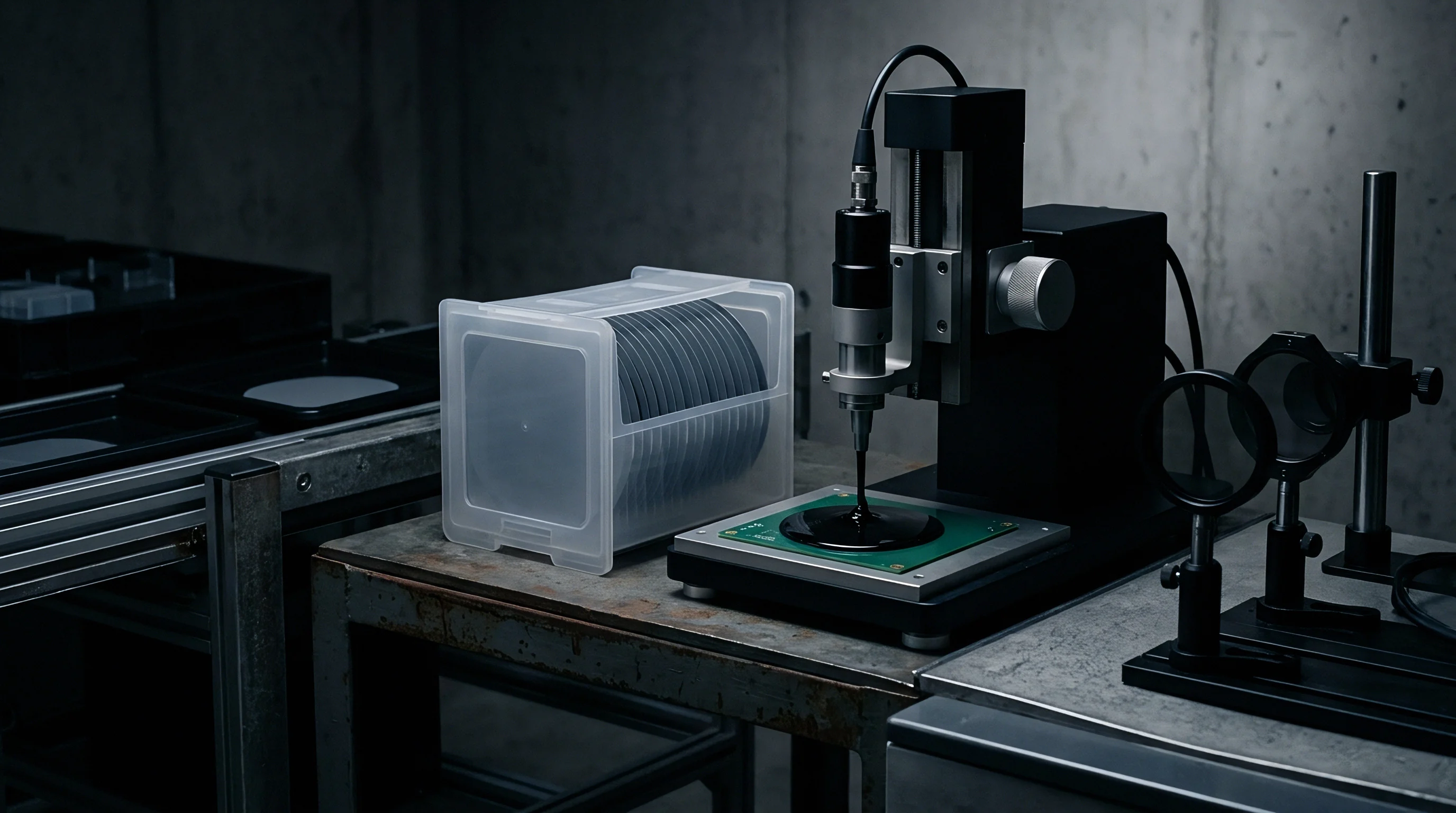
Empirical measurement of outgassing species demands high-vacuum thermal desorption spectroscopy paired with quadrupole mass analysis. Testing polymer microcircuits under controlled ultra-high vacuum conditions isolates evolved atmospheric gases from background chamber contaminants. A component undergoes controlled linear heating while a mass spectrometer measures partial pressures of targeted atomic mass units, generating mass-resolved desorption spectra across temperature.
When Does Polymer Outgassing Disrupt Sensor Baseline Output?
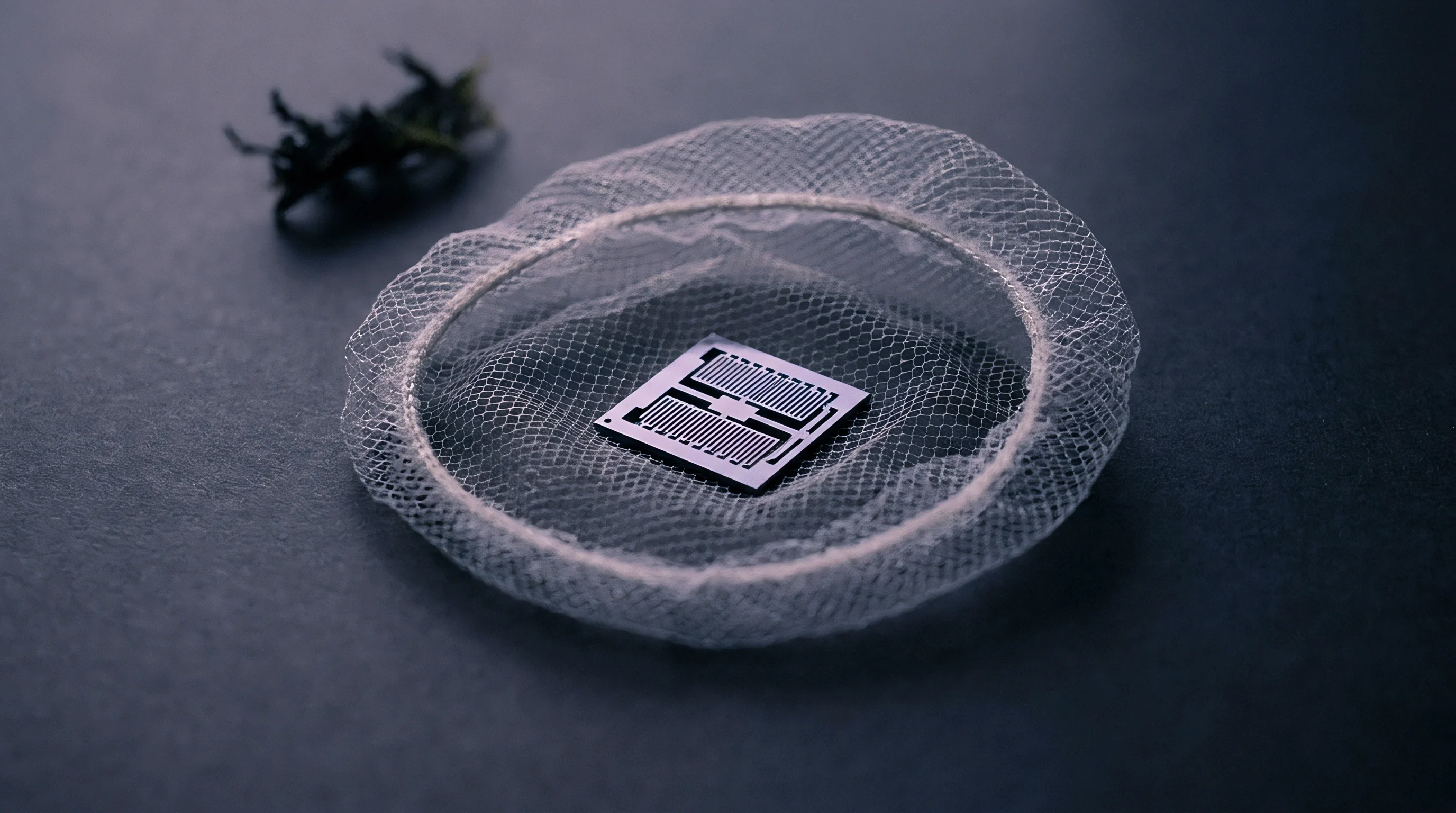
Die-attached humidity units and precision analog integrated circuits suffer operational offsets as residual solvents vaporize during thermal cycles. Outgassed moisture and organic volatiles condense on exposed silicon sensor membranes or optical windows, shifting capacitive baselines and altering sensitivity coefficients. In hermetically sealed microcircuit cavities, desorbed water cannot escape the enclosure, elevating internal cavity relative humidity and initiating wire-bond corrosion over operational lifespans.
Outgassing mechanisms inside sealed package enclosures generate long-term reliability risks through specific contamination modes:
- Capacitive Drift occurs when polar molecules adsorb onto exposed interdigital electrode structures, altering localized dielectric constants.
- Galvanic Corrosion develops when liberated water combines with trace halogen residues on gold-aluminum bond pads, causing bond breakage.
- Optical Clouding manifests when heavy hydrocarbon volatiles condense onto micro-lens arrays or photodiode windows inside clear packages.
- Surface Leakage Paths form across passivated silicon surfaces when adsorbed water layers permit lateral ionic conduction between high-voltage traces.
Alternative physical testing methods include thermogravimetric analysis and dynamic vapor sorption. Thermogravimetric analysis tracks package mass continuously under controlled purge gas flows, offering high mass resolution but lacking specific chemical identification of outgassed species. Dynamic vapor sorption subjects the microcircuit to programmed relative humidity steps at constant temperature, measuring equilibrium sorption isotherm curves necessary to calculate baseline saturation limits.
Component manufacturers frequently claim that elevated baseline offsets resulting from post-reflow moisture release represent nominal package settling rather than permanent material degradation.
Fitting
Linear regression of peak desorption temperatures collected at varying linear ramp rates yields the activation energy and pre-exponential attempt frequency. The Kissinger method provides a reliable mathematical framework for extracting desorption kinetics without knowing the precise order of reaction beforehand. By executing thermal desorption spectroscopy or thermogravimetric runs at four or more heating rates, the temperature corresponding to maximum outgassing shift moves systematically upward with higher heating rates.
Kissinger Mathematical Framework
Slope evaluation of plot coordinates relates heating rates directly to the activation barrier. The Kissinger expression equates the logarithm of the heating rate divided by the square of the peak temperature to the inverse peak temperature multiplied by the activation energy divided by the universal gas constant. Plotting natural log of heating rate over peak temperature squared on the vertical axis against one over peak temperature on the horizontal axis produces a straight line.
Kissinger plotting requires multiple ramp rates. The slope of this fitted line equals negative activation energy divided by the gas constant.
A worked calculation demonstrates activation energy extraction for an epoxy mold compound microcircuit. Assume thermogravimetric analysis runs performed at four linear heating rates produce the measured peak desorption temperatures listed in the theoretical data set below.
| Heating Rate (K/min) | Heating Rate Beta (K/s) | Peak Temperature Tp (C) | Peak Temperature Tp (K) | Inverse Tp (1/K) | Ln(Beta / Tp^2) |
|---|---|---|---|---|---|
| 2.0 | 0.03333 | 150.0 | 423.15 | 0.002363 | -15.497 |
| 5.0 | 0.08333 | 170.0 | 443.15 | 0.002256 | -14.673 |
| 10.0 | 0.16667 | 188.0 | 461.15 | 0.002168 | -14.059 |
| 20.0 | 0.33333 | 208.0 | 481.15 | 0.002078 | -13.450 |
Applying linear regression across the calculated coordinates yields the slope value:
Horizontal coordinate change equals 0.002078 minus 0.002363, yielding negative 0.000285 inverse Kelvin.
Vertical coordinate change equals negative 13.450 minus negative 15.497, yielding positive 2.047.
Line slope equals 2.047 divided by negative 0.000285, which yields negative 7182.5 Kelvin.
Multiplying the negative slope by the universal gas constant of 8.314 Joules per mole Kelvin determines the activation energy:
Activation energy equals 7182.5 Kelvin multiplied by 8.314 Joules per mole Kelvin, producing 59715 Joules per mole, or 59.7 kilojoules per mole.
An activation energy lower than forty kilojoules per mole indicates physical desorption, whereas values above eighty kilojoules per mole confirm chemisorption within the polymer matrix.
Substituting the calculated activation energy back into the Kissinger intercept expression yields the pre-exponential factor A. An activation energy of 59.7 kilojoules per mole represents physical desorption of trapped water molecules bound within the microcircuit epoxy resin. Higher values near one hundred kilojoules per mole indicate chemical degradation or cleavage of polymer chains during thermal stress.
Whether microcircuit encapsulants undergo irreversible structural rearrangement during repeated thermal desorption cycles remains a subject of ongoing laboratory investigation.


Assembly
Sourcing decisions for surface-mount microcircuits require rigorous evaluation of floor life ratings, packaging formats, and baking overhead. Components absorb ambient moisture during freight, warehousing, and feeder setup. Component failure risks escalate when unbaked parts undergo reflow soldering.
Moisture sensitivity levels defined under J-STD-020 dictate allowable floor life before reflow assembly becomes hazardous to manufacturing yields.
Moisture Sensitivity Level Compliance
Standard classification criteria govern floor exposure limits for electronic packages prior to surface-mount reflow. Level 1 packaging offers unlimited floor life at or below thirty degrees Celsius and eighty-five percent relative humidity. Level 3 packaging allows 168 hours of floor exposure before mandatory baking.
Level 5a packaging permits only 24 hours of exposure. Floor life limits require strict monitoring. Dry bags prevent ambient humidity ingress.
Pre-baking adds manufacturing cost and time. Desiccant packs absorb residual package vapor.
Managing moisture risk across assembly lines involves a structured sequence of material handling rules:
- Verify humidity indicator card status inside moisture barrier bags upon initial reel opening.
- Record package exposure clock start time immediately when components enter factory air conditions.
- Seal partially used component reels in fresh moisture barrier bags with calculated desiccant quantities if assembly pauses exceed four hours.
- Bake exposed components at one hundred twenty-five degrees Celsius for twenty-four hours if factory floor life limits expire prior to board placement.
- Feed dry-baked components into pick-and-place lines within fourteen hours to prevent secondary moisture absorption.
Sourcing teams balance package variants against total delivered assembly cost. Standard leaded or ball-grid packages carry different moisture sensitivity ratings depending on encapsulant thickness and mold compound selection. The table below outlines commercial and operational trade-offs across common component delivery formats.
| Package Variant Form | Typical MSL Rating | Floor Life Limit | Factory Bake Overhead Per 10k Parts | Landed Unit Cost Adder (%) |
|---|---|---|---|---|
| Standard QFN / DFN SMD Reel | MSL 3 | 168 Hours | $120.00 (24h Bake Cycle) | +1.5% to +2.5% |
| Thick SOIC / Molded Module | MSL 1 | Unlimited | $0.00 (No Bake Needed) | +4.0% to +8.0% (Material Premium) |
| Bare Die / Wafer-Level CSP | MSL 5a | 24 Hours | $280.00 (Nitrogen Purge Bake) | +5.0% to +10.0% (Handling Overhead) |
| Cabled Environmental Probe | MSL 4 | 72 Hours | $190.00 (Vacuum Oven Bake) | +2.0% to +4.5% |
IPC J-STD-033 mandates that components exposed to ambient humidity beyond their allowable floor life undergo mandatory baking at one hundred twenty-five degrees Celsius for twenty-four hours prior to reflow assembly.
Under standard purchase specifications governed by IPC-A-610, components exhibiting evidence of packaging seal breach upon receipt permit immediate lot rejection without supplier re-testing rights.