Thermo Elastic Stress Instability in Quartz Flexure Accelerometer Arrays under Dynamic Thermal Gradients
Dynamic thermal gradients induce asymmetric flexure stress, driving uncompensated zero-bias drift that requires active thermal balancing and pure wafer quartz.
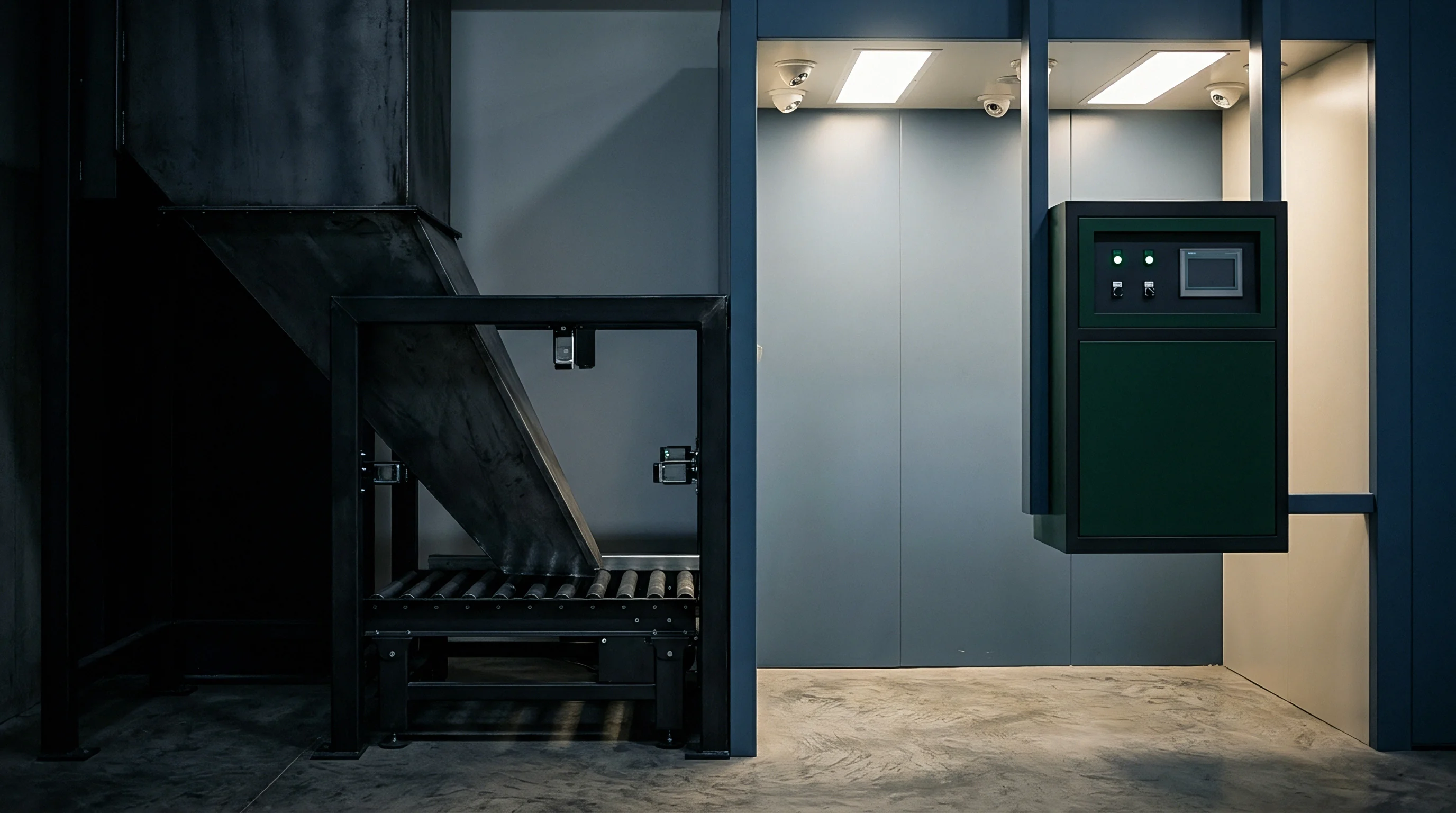
Swell
Single-crystal quartz assemblies subjected to dynamic thermal transients expand unevenly across their crystallographic axes. The material belongs to the trigonal crystal class: thermal expansion parallel to the optical Z-axis measures 7.5 microstrain per Kelvin, but reaches 13.7 microstrain per Kelvin along the perpendicular X-axis. When an accelerometer array encounters rapid thermal flux, spatial temperature differentials establish steep internal gradients.
Heat then moves through the quartz along directional conductivities ranging from 6.8 Watts per meter-Kelvin on the Z-axis to 11.3 Watts per meter-Kelvin along the X-axis.
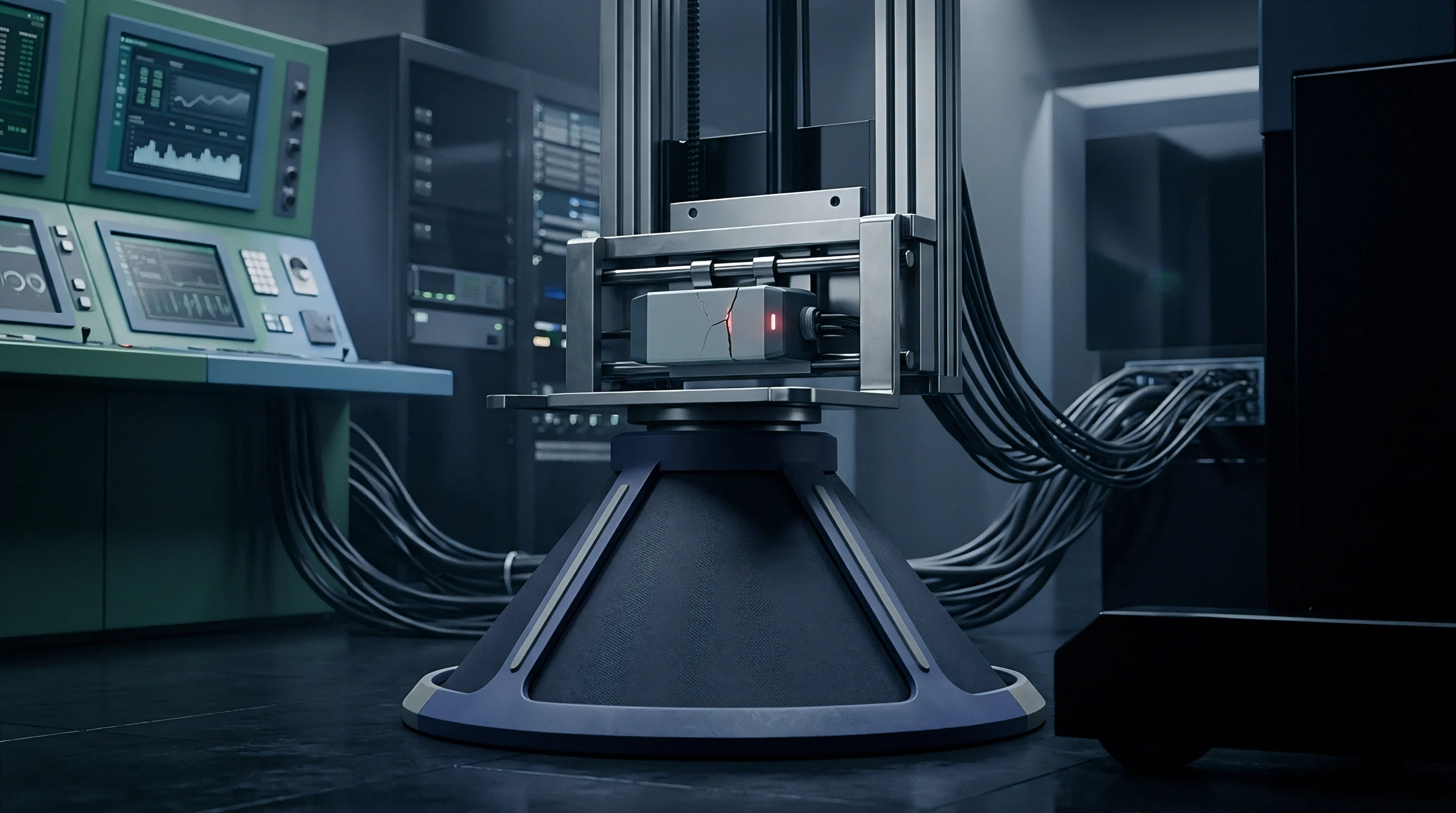
Localized heating on one face of a 50-micrometer thick quartz flexure creates a through-thickness temperature differential that breaks mechanical symmetry. The resulting thermoelastic stress distribution induces a bending moment independent of applied acceleration. This parasitic moment displaces the proof mass, shifting zero-g bias stability by generating a false capacitive signal at the pickoff electrodes.
Because these flexures operate at extreme dimensional sensitivity, nanometer-scale deflections translate directly into milli-g offset errors.
A differential thermal ramp of 1.5 degrees Celsius per minute across a 25-millimeter quartz flexure assembly induces an uncompensated zero-bias drift of 180 micro-g within 45 seconds.
Standard polynomial compensation models assume isothermal conditions across the flexure beam, relying on an integrated temperature sensor placed on the package baseplate. During transient heat flux, however, the temperature registered by the package sensor leads or lags the true flexure temperature by tens of seconds. That lag opens a dynamic hysteresis loop in the reported bias output.
- Differential Flexure Bowing establishes localized curvature along the hinge length, forcing a permanent shift in the mechanical neutral axis during transient thermal propagation.
- Coil Alignment Distortion alters torque generator air gap symmetry, shifting the electromagnetic force factor by perturbing flux density in the permanent magnet gap.
- Pickoff Gap Asymmetry changes capacitive electrode spacing unevenly across the dual pickoff plates, injecting differential capacitance noise into the demodulator front end.
- Mounting Joint Shear generates mechanical strain at the quartz-to-metal interface due to thermal expansion mismatch between quartz and Kovar mounting rings.
Substrate thickness, specific heat capacity, and thermal conductivity together determine how long transient bias errors persist before heat equilibrates across the flexure. Because thermal diffusion proceeds at a finite rate, rapid thermal shocks generate transient thermoelastic stress peaks that exceed steady-state thermal errors by more than an order of magnitude. The exact threshold where non-linear dislocation damping in single-crystal quartz begins to dominate transient thermal relaxation remains unquantified across standard commercial production lots.

Deflection
Thermoelastic strain couples directly into the rebalance feedback loop of the accelerometer array. The sensor pickoff circuit detects proof mass displacement through a high-frequency capacitive bridge driven at 100 kilohertz to 1 megahertz. Differential capacitance changes modify the amplitude of the bridge excitation signal, which is demodulated, filtered, and fed to a precision current driver supplying the torque motor coil.
When dynamic gradients bend the flexure beam thermoelastically, the capacitive pickoff reads this displacement as physical acceleration. The control loop responds by driving current through the torque coil to re-center the pendulum, even as the thermal shock alters flexure stiffness. This feedback creates a spurious acceleration output that tracks the rate of temperature change rather than true motion, skewed by differential capacitance from unbalanced flux.
| Quartz Cut Orientation | Thermal Gradient Rate (deg C/min) | Peak Thermoelastic Stress (MPa) | Zero-Bias Shift Rate (micro-g/deg C) | Thermal Time Constant (s) |
|---|---|---|---|---|
| Z-Cut (Trigonal) | 0.5 | 0.42 | 25.0 | 12.4 |
| Z-Cut (Trigonal) | 2.0 | 1.85 | 112.0 | 11.8 |
| AT-Cut (Symmetrical) | 0.5 | 0.28 | 14.2 | 8.6 |
| AT-Cut (Symmetrical) | 2.0 | 1.15 | 68.5 | 8.2 |
| SC-Cut (Stress Compensated) | 0.5 | 0.11 | 4.8 | 6.1 |
| SC-Cut (Stress Compensated) | 2.0 | 0.48 | 19.3 | 5.9 |
Mechanical stiffness in single-crystal quartz tracks local temperature distributions. The elastic modulus along the flexure bending plane changes at a rate governed by the temperature coefficient of elastic constants. Under dynamic heating, the top surface expands faster than the bottom, generating an internal shear stress field that interacts with both baseplate stiffness and applied mounting torque.
Thermally symmetrical sensor mounts equalize gradient paths across parallel flexure pairs, reducing asymmetric bending moments caused by rapid localized heating.
High-bandwidth digital signal processing behind the analog-to-digital converter cannot strip out thermoelastic error signals that fall within the operational measurement passband. If the accelerometer array operates in a system with bandwidth from direct current to 200 hertz, thermal gradient transients occurring between 0.01 hertz and 2 hertz directly corrupt the integrated velocity solution. Filtering these low-frequency shifts introduces phase lag, degrading dynamic response in the inertial reference unit.
Transient heat flux generates parasitic torque.
Capacitive pickoff electronics exacerbate thermoelastic errors when spatial gradients extend beyond the mechanical assembly into the readout printed circuit board. Temperature gradients across symmetrical demodulation diodes introduce voltage offsets that sum directly into the capacitive bridge signal, with thermal diffusivity setting the overall response timing. The combination of flexure bending stress and electronic offset drift degrades system performance during rapid thermal ramps.
Aligning sensor array thermal time constants with structural mount heat capacities keeps transient stress spikes within raw bias error budgets.

Screening

Which Thermal Ramp Rates Trigger Uncompensated Bias Shifts in High-G Quartz Arrays?
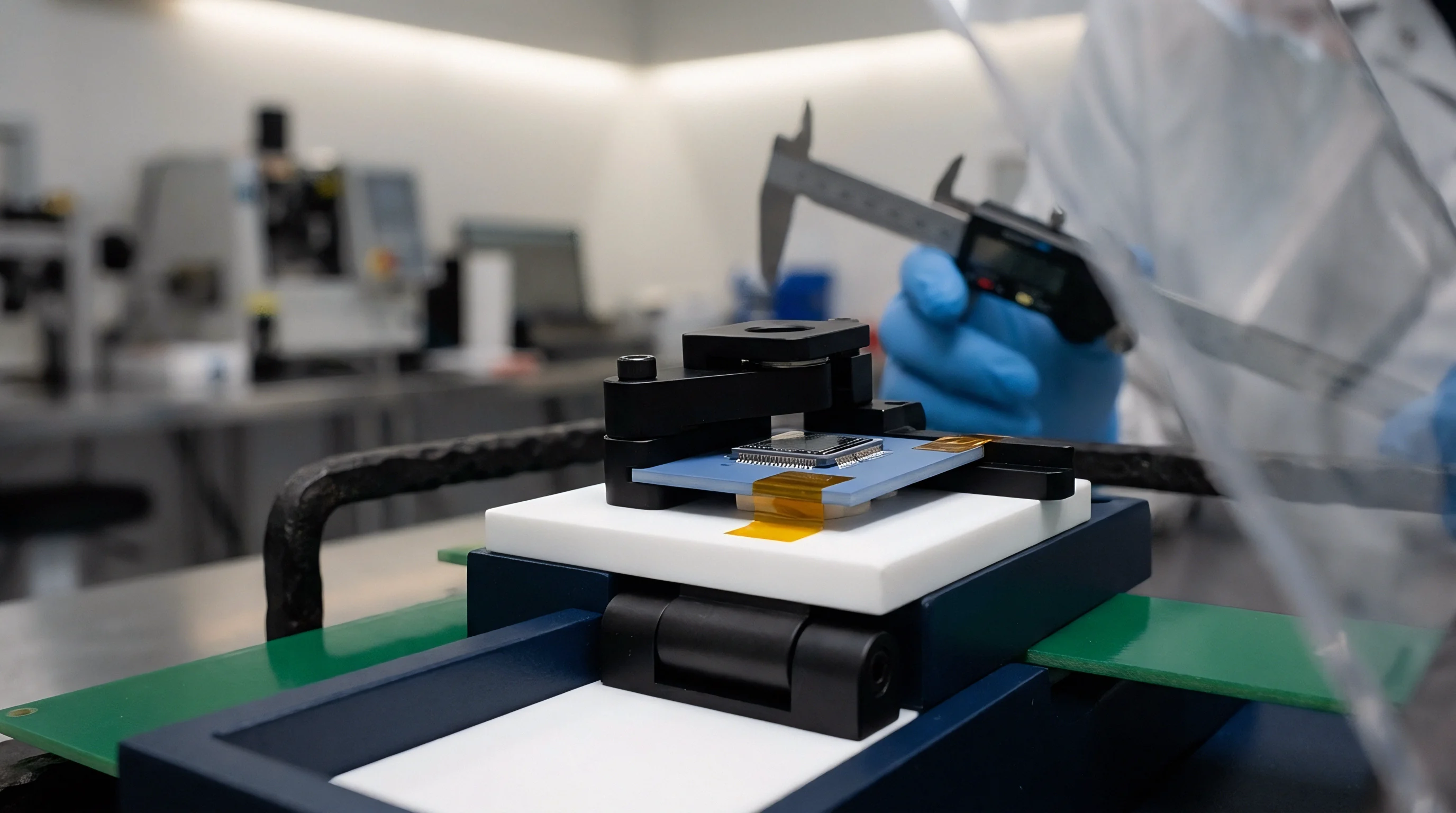
Separating transient gradient effects from static isothermal drift requires dual-axis temperature profiling. Environmental test chambers must be equipped with multi-zone thermoelectric coolers capable of controlled thermal flux rates to isolate gradient-induced thermoelastic stress. Placing thermal sensors directly on the quartz support frame, package header, and flexure clamp exposes internal thermal transport delays.
Testing shows that thermal ramp rates above 0.5 degrees Celsius per minute produce measurable gradient stress in standard 30-g quartz flexure accelerometers. Standard thermal soak testing at fixed temperature steps misses these dynamic instabilities entirely because the sensor structure reaches equilibrium before data acquisition begins.
- Mount the quartz accelerometer array onto a temperature-controlled vacuum fixture to eliminate convective air currents while maintaining conductive heat transfer paths.
- Apply a linear thermal ramp of 2.0 degrees Celsius per minute from negative 40 degrees Celsius to positive 85 degrees Celsius while sampling accelerometer bias outputs at 1 kilohertz.
- Measure temperature differentials between opposite sides of the sensor package using thin-film platinum resistance thermometers attached with high-thermal-conductivity epoxy.
- Compute the time derivative of the package thermal gradient and correlate it against instantaneous zero-g bias deviations to extract dynamic thermal sensitivity coefficients.
- Subject the array to symmetrical reverse thermal ramps to isolate thermal hysteresis from permanent thermoelastic stress relaxation.
| Test Protocol Designation | Applied Gradient Rate (deg C/min) | Sensor Mapping Density | Detection Limit (micro-g) | Qualification Cycle Time (hours) |
|---|---|---|---|---|
| Isothermal Step Scan | 0.0 (Static) | 2 Points (Base/Ambient) | 50.0 | 18.0 |
| Linear Ramp Profiling | 1.0 | 6 Points (Internal/External) | 10.0 | 6.0 |
| Dynamic Thermal Shock | 5.0 | 12 Points (Array Grid) | 2.5 | 2.5 |
| Convective Gradient Sweep | 2.5 | 8 Points (Package Surface) | 5.0 | 4.0 |
| Methods note: All tests performed inside a dry nitrogen purged enclosure at atmospheric pressure to prevent condensation artifacts. | ||||
Dynamic thermal profiling allows engineers to separate linear temperature coefficients from higher-order spatial gradient terms, accounting for residual tension left by quartz etching. Fitting accelerometer bias drift against both local temperature and the time derivative of temperature gives processing algorithms the data needed to suppress transient errors during flight. Omitting dynamic ramp screening during incoming qualification leads directly to uncompensated position drift in guided airborne systems subjected to rapid aerodynamic heating.

Symmetry
Mitigating thermoelastic instability depends on balanced mechanical architecture within the sensor housing. Symmetrical packaging places the quartz flexure element centrally between dual identical ceramic or invar heat sinks. Heat entering the package from external electronics distributes equally across both sides of the flexure, minimizing transverse thermal gradients across the beam thickness.
To counteract parasitic torque, physical arrays utilize differential mechanical architecture. Mounting two identical quartz flexure mechanisms back-to-back in an inverted orientation ensures that gradient-induced bending moments produce equal and opposite bias shifts. Summing the outputs of the paired accelerometers cancels common-mode thermoelastic drift while doubling valid acceleration signals.
Adherence to IEEE Std 1293 mandates dynamic thermal step response testing to verify that quartz pendulum transient bias shifts remain within the specified inertial margin.
Array geometry governs susceptibility to external thermal shocks. Triangular and quad-planar layout configurations offer better resistance to directional gradients than inline linear arrangements. When a thermal wavefront hits a quad-planar array, differential temperature sensing across the four quadrants provides real-time boundary condition data to the dynamic compensation algorithm.
- Thermal Symmetry Verification confirms equal conductive path lengths from package mounting points to both surfaces of the inner quartz flexure frame.
- Coefficient Matching Audit ensures the thermal expansion coefficient of clamping rings matches single-crystal quartz within 0.2 ppm per Kelvin across the full operating range.
- Stress-Relief Feature Evaluation checks for flexural isolation slots etched into the outer quartz support ring to absorb housing strain without transmitting force to the central hinge.
- Encapsulation Vacuum Integrity verifies internal package pressure remains below 10 to the power of negative 3 Torr to eliminate gas convection thermal paths across the capacitive pickoff gap.
Active thermal management complements passive mechanical symmetry. Micro-thermoelectric coolers integrated directly into the sensor substrate maintain zero spatial gradient across the flexure plane during rapid external temperature swings. Dynamic bias transients often stem from internal thermoelastic stress gradients within the sensor package rather than external cable strain.

Yield
Raw material purity and crystallographic perfection govern wafer-level resistance to thermoelastic instability. Synthetic quartz grown via hydrothermal synthesis contains structural defects, including hydrogen-bonded hydroxyl groups, etch channels, and growth twins. Elevated hydroxyl concentrations lower the mechanical quality factor of the quartz and increase internal friction under thermal stress, degrading flexure stability over time.
Wafer qualification standards for inertial-grade quartz flexure arrays enforce strict optical and mechanical thresholds. Specifications mandate synthetic quartz with an infrared absorption coefficient alpha at 3580 wave-numbers below 0.02 reciprocal centimeters, corresponding to pure material with minimal hydroxyl content. Dislocation density must stay below 100 per square centimeter to prevent stress relaxation cracking during dynamic thermal cycling.
Quartz substrate anisotropic expansion coefficients generate internal shear forces under non-uniform thermal flux that static polynomial calibrations fail to correct.
| Quartz Material Parameter | Industrial Grade Threshold | Inertial Grade Threshold | Thermoelastic Failure Mechanism | Yield Impact (% Reject) |
|---|---|---|---|---|
| Hydroxyl Content (Alpha 3580) | > 0.05 cm^-1 | < 0.02 cm^-1 | Enhanced internal damping and thermal creep | 22.5 |
| Dislocation Density | > 500 cm^-2 | < 100 cm^-2 | Micro-fracture propagation along flexure hinge | 18.0 |
| Etch Channel Frequency | > 10 cm^-2 | 0 cm^-2 | Localized stress concentration points | 12.0 |
| Inclusion Defect Size | > 10 micrometers | < 2 micrometers | Asymmetric thermal expansion nucleation | 8.5 |
- Crystallographic Orientation Certificate specifies x-ray diffraction measurements confirming seed orientation tolerance within 3 arcminutes of designated crystal planes.
- Infrared Absorption Report documents spectro-photometric measurement of alpha values to verify low hydrogen content across all wafer ingot slabs.
- Etch Channel Density Audit provides optical inspection counts of etch pits following hydrofluoric acid etching to bound micro-structural dislocation sites.
- Thermal Ramp Screening Dossier certifies batch sample performance under dynamic gradient thermal shock prior to wafer dicing and final assembly.
Landed unit costs climb quickly as thermal gradient tolerances tighten. Standard commercial quartz flexures yield approximately 75 percent through dicing and assembly, but dynamic gradient screening drops final yield below 40 percent for tactical navigation grades. Robust procurement establishes dual-source wafer supply agreements that fix chemical purity metrics at the ingot stage rather than relying solely on packaged sensor bench tests.
Procurement specifications referencing MIL-STD-810H Method 503.7 Clause 4.2 enforce pre-conditioning dynamic thermal shock acceptance criteria, shifting non-conformance liability to the sensor supplier before packaging final assembly lots.