Quantifying Viscoelastic Stress Relaxation in Accelerometer Package Die Attach Adhesives
Quantifying adhesive relaxation requires extracting Prony series via multi-temperature DMA to simulate anchor warpage and prevent uncalibrated bias drift.

Offset
Capacitive microelectromechanical accelerometers register sub-angstrom displacements of suspended proof masses relative to fixed sense electrodes. A polymeric joint anchors the micromachined silicon die to the package substrate. When thermal expansion mismatches between the silicon die (2.6 parts per million per Kelvin) and an alumina leadless chip carrier (6.5 parts per million per Kelvin) or copper leadframe (16.5 parts per million per Kelvin) cool down from a 150-degree curing process, substantial residual stress freezes into the assembly.
While the silicon itself remains purely elastic, the cross-linked adhesive network sheds strain over time through conformational chain rearrangements, dissipating strain energy continuously. This steady decay in boundary shear alters the structural reaction forces acting on the die anchors, warping the sensor cavity and shifting capacitive pickoff gaps without any applied acceleration.
Transduction Coupling across Die Anchorage
Differential capacitance sensing relies on balance across two complementary electrode gaps separated by nominal distances between one and three micrometers. A baseline gap change of ten picometers produces tens of microvolts in unamplified bridge unbalance, appearing directly as an output shift. Stress travels through the thickness of the adhesive layer straight into the silicon substrate, where non-uniform relaxation generates local bending moments along the die perimeter.
Asymmetrical anchor loading transforms uniform substrate compression into out-of-plane die tilt.
Piezoresistive sensing architectures show an even tighter coupling between adhesive relaxation and electrical drift. Four piezoresistors diffused into high-stress regions of flexure beams translate mechanical strain into resistivity variations through the piezoresistive tensor. As residual stress in the die attach adhesive relaxes, strain relief travels up the anchor post into the beam suspension and shifts the baseline resistance across the bridge arms unevenly, degrading zero-bias stability over thousands of operating hours.
- Perimeter Shear Relief occurs when the bond line’s free edges shed shear strain faster than the constrained die center, setting up stress gradients that bow the silicon plate upward over time.
- Asymmetric Anchor Creep drives angular tilt across multi-anchor comb drives, shifting lateral gap balance without altering overall die planarity.
- Fillet Meniscus Relaxation produces localized vertical forces along die sidewalls, twisting peripheral suspension anchors through non-uniform wetting heights.
- Filler Particle Settlement creates micro-scale percolation paths and localized stress concentrations that alter contact stiffness during thermal cycles.
Bias Instability Drift Regimes
Output stability separates into three temporal regimes: short-term settling during the initial 48 hours post-assembly, logarithmic relaxation extending across the first 1,000 operating hours, and steady physical aging persisting over years. The primary acceleration of interest sits inside the logarithmic window, where the rate of change is proportional to the inverse of operating time. Uncalibrated drift in tactical-grade navigation units reaches 5 to 15 milli-g over 5,000 hours when high-modulus epoxies sit under unbalanced anchor geometry.
Overlooking viscoelastic joint dynamics during package design forces costly chassis-level firmware realignments, voids field bias warranties, and condemns high-g shock sensors to premature recalibration cycles.
Modulus
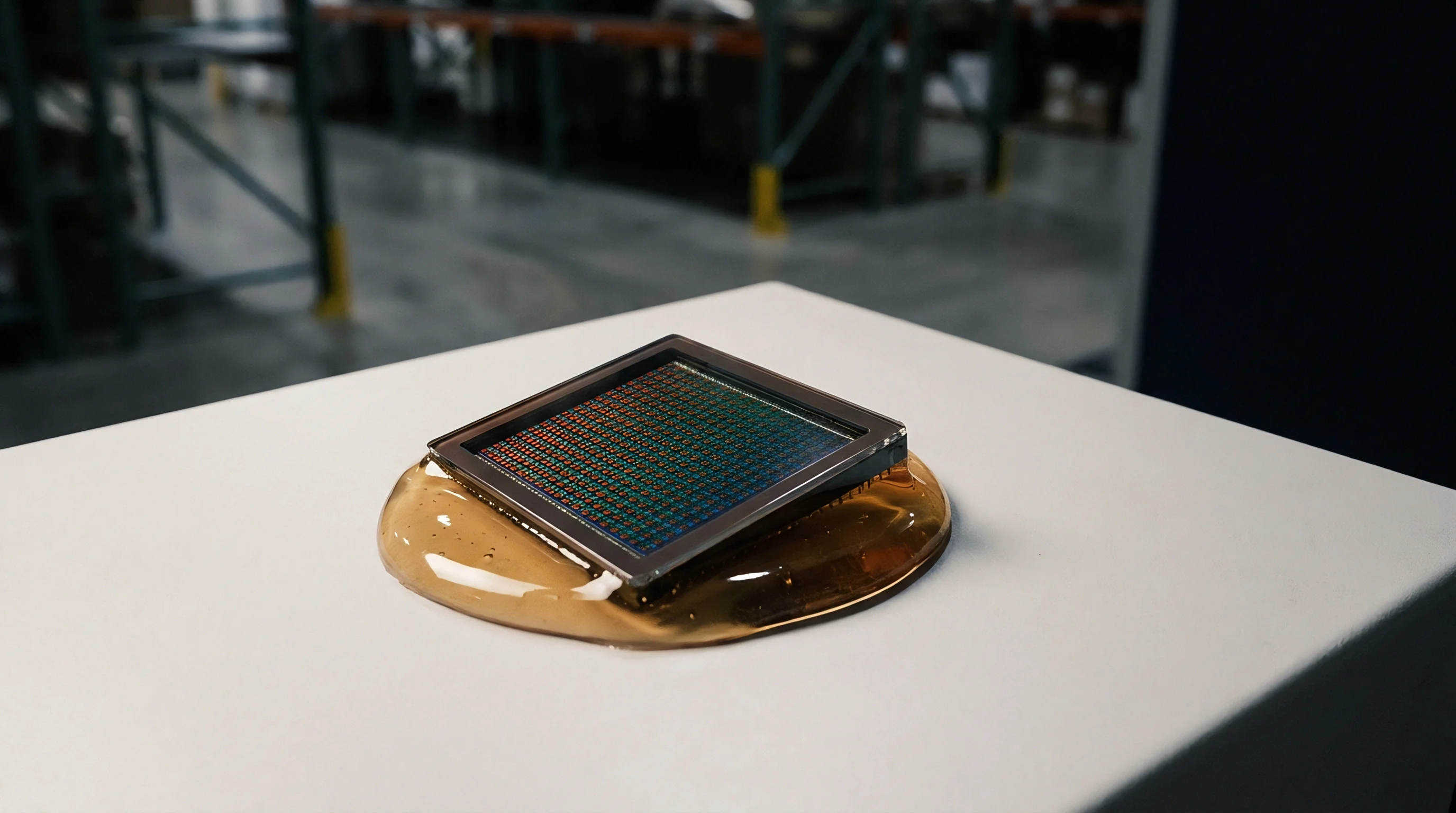
Polymeric adhesives exhibit mechanical properties governed by both elasticity and viscous dissipation. The glass transition temperature marks the boundary between the glassy state, where storage capacity exceeds three gigapascals, and the rubbery plateau, where stiffness drops below fifty megapascals. Automotive and industrial accelerometers operate across minus 40 to 125 degrees Celsius, sweeping directly through this viscoelastic transition zone.
Constitutive Viscoelastic Formulations
Linear viscoelastic behavior holds under infinitesimal strain conditions, typically beneath 0.5 percent strain for filled microelectronic adhesives. Under these conditions, the time-dependent relaxation response is expressed through the hereditary integral formulation of Boltzmann superposition:
Stress at time t equals the convolution of the relaxation function with the history of the strain rate tensor. This relaxation function captures how internal mechanical resistance decays under sustained step strain. In thermoset die attach formulations, elastic springs and viscous dashpots arranged in parallel model the broad spectrum of molecular relaxation times typical of cross-linked networks.

Prony Series Mathematical Structure
Numerical implementation of viscoelastic relaxation in structural models requires discretization into a Generalized Maxwell model, expressed mathematically as a Prony series. The time-dependent shear relaxation is defined by an equilibrium stiffness plus a finite sum of exponential decay terms:
G(t) equals G_infinity plus the sum from i equals 1 to N of G_i multiplied by the exponential of negative t divided by tau_i, where G_infinity is the fully relaxed equilibrium modulus, G_i represents the stiffness weighting of the i-th Maxwell element, and tau_i denotes the associated relaxation time. Because the storage modulus drops three decades, accurately spanning the temporal range from milliseconds to ten thousand hours requires between five and eleven Maxwell branches distributed evenly across logarithmic decades of time.
Extracting these parameters from raw laboratory data follows a sequential protocol structured to minimize mathematical ill-conditioning:
- Define the temporal window of interest from one second to ten million seconds based on product mission profiles.
- Select relaxation times spaced at one decade intervals across the selected temporal window.
- Enforce thermodynamic admissibility by restricting all modulus weights to strictly positive values.
- Perform non-negative least squares fitting on discretized isothermal relaxation test curves.
- Compute the instantaneous modulus by summing all partial moduli with the equilibrium value.
Whether physical aging at temperatures twenty degrees below glass transition permanently alters long-term spectrum weights remains an unresolved issue in polymeric continuum mechanics.
Rheology
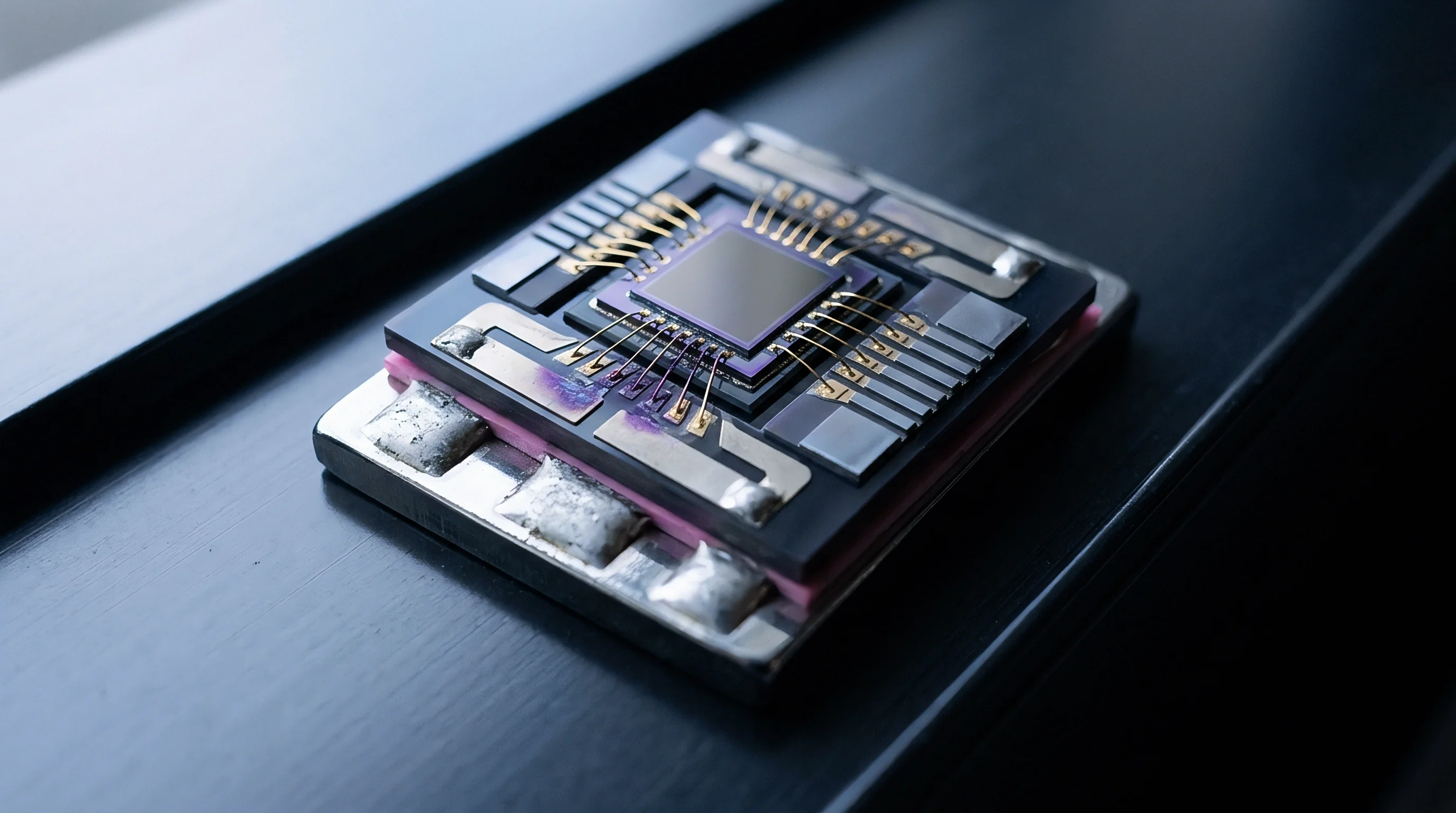
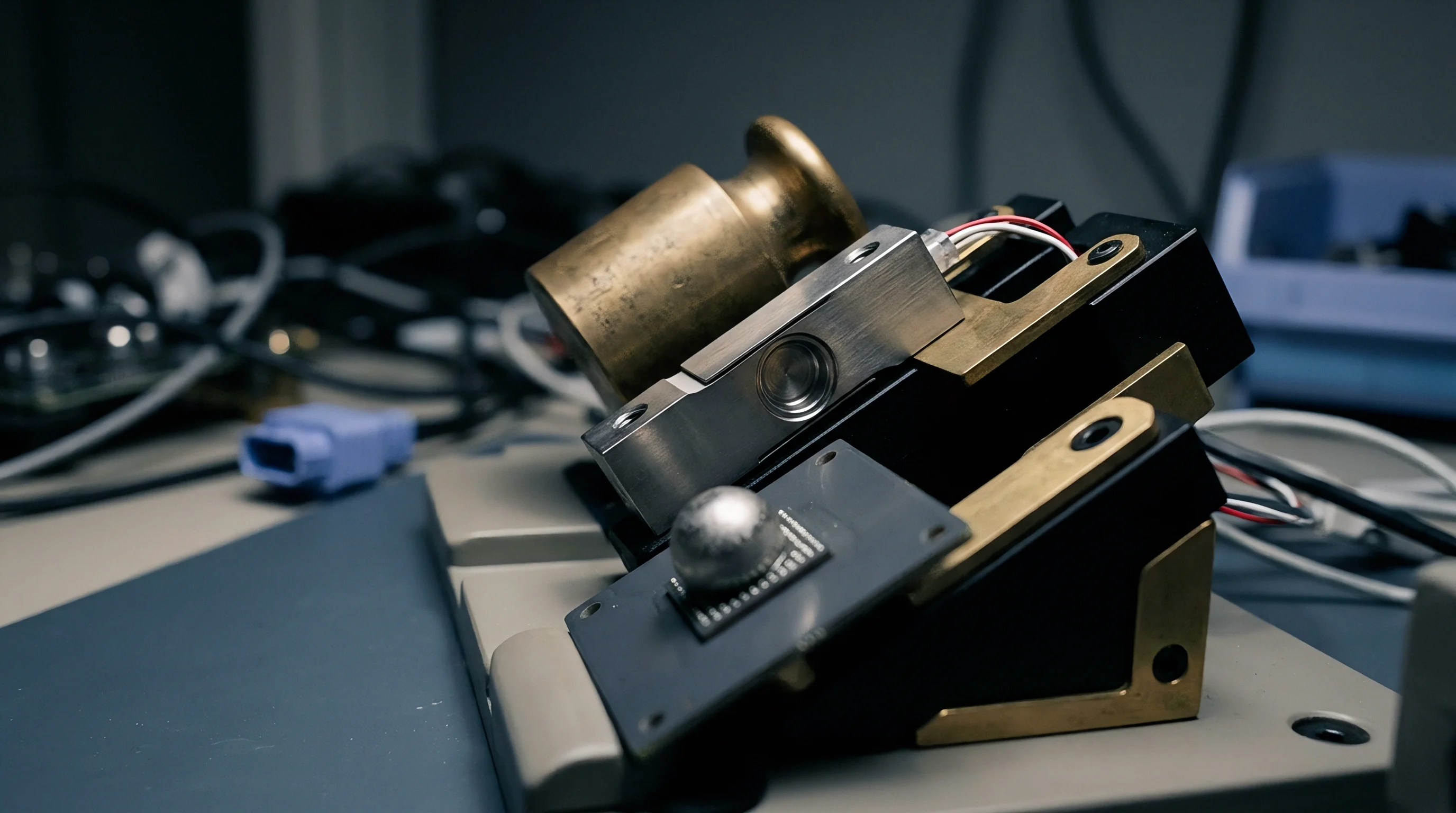
Extracting Prony parameters requires bench characterization across both frequency and time domains. Dynamic Mechanical Analysis (DMA) applies small-amplitude sinusoidal oscillations to cured adhesive specimens under assumed infinitesimal deformation, tracking storage stiffness and energy dissipation against temperature and frequency. The ratio of loss to storage defines the damping factor, indicating peak molecular mobility at the glass transition.
Dynamic Mechanical Characterization Methods
Test configurations for thin-film packaging adhesives include film tension, double lap shear, and torsional rheometry. Lap shear directly replicates the thin bondline stress state beneath a silicon chip, though compliance within the test fixture often obscures short-time relaxation dynamics. Film tension testing on freestanding cured films isolated from release substrates offers higher signal-to-noise ratios, but bulk cure kinetics diverge from thin-film joints subject to copper catalysis and volatile entrapment.
A reliable relaxation master curve demands isothermal dwell times exceeding five times the longest test frequency period.
Frequency sweep tests typically cover 0.01 to 100 Hertz at discrete temperature steps spaced by three to five degrees Celsius across the target operating range. After truncating raw test traces, Time-Temperature Superposition translates high-temperature, short-time data into low-temperature, long-time predictions using horizontal shift factors.
| Test Type | Sample Geometry | Temperature Range (°C) | Frequency / Dwell Window | Strain Limit (%) | Instrument Error Band |
|---|---|---|---|---|---|
| Dynamic Temperature Sweep | Tension film: 20 x 5 x 0.15 mm | -65 to 200 | 1.0 Hz at 2 °C/min | 0.05 | ±1.5% storage modulus |
| Isothermal Frequency Multiplex | Tension film: 15 x 4 x 0.10 mm | -40 to 160 (3 °C steps) | 0.01 to 50 Hz | 0.02 | ±2.0% loss factor tan delta |
| Double Lap Shear Transient | Silicon-to-ceramic bondline: 50 µm | 25, 60, 85, 125 | 0.1 to 36,000 s dwell | 0.10 | ±5.0% shear relaxation G(t) |
| Cantilever Thermal Deflection | Silicon beam: 30 x 3 x 0.4 mm | -40 to 125 (steady soak) | Static dwell up to 500 h | N/A | ±0.2 µm tip displacement |
Does Arrhenius Scaling Hold across Transition?
Shifting isothermal curves to construct a single master curve relies on empirical shift models. Above the glass transition temperature, the Williams-Landel-Ferry relationship models the nonlinear acceleration of free volume expansion. Below the transition zone, the polymer enters a non-equilibrium glassy state where cooperative segmental motion ceases and secondary molecular rearrangements dominate.
In deep-subsea seismology instrumentation where sensor modules dwell at four degrees Celsius under ocean beds for decades, room-temperature accelerated aging models routinely miscalculate package drift because sub-ambient secondary relaxations bypass primary kinetic pathways.
Below glass transition, Arrhenius kinetics govern shift behavior with activation energies ranging from 80 to 140 kilojoules per mole depending on cross-link density. For an industry-standard silver-filled conductive epoxy with a glass transition of 95 degrees Celsius, testing across 25 to 65 degrees Celsius yields an apparent activation energy of 112 kilojoules per mole. If moisture ingress plasticizes the network, this value drops by up to twenty percent.
Because single-activation-energy models cannot reliably span the glass transition boundary, bias drift calculations are routinely bounded using worst-case step-function shift factors.
Proprietary stress-relief diluents are described as eliminating low-temperature creep without altering mechanical response times, yet rheological inspection reveals these compounds simply flatten the loss peak across fifty degrees while increasing room-temperature viscous drift.
Mesh
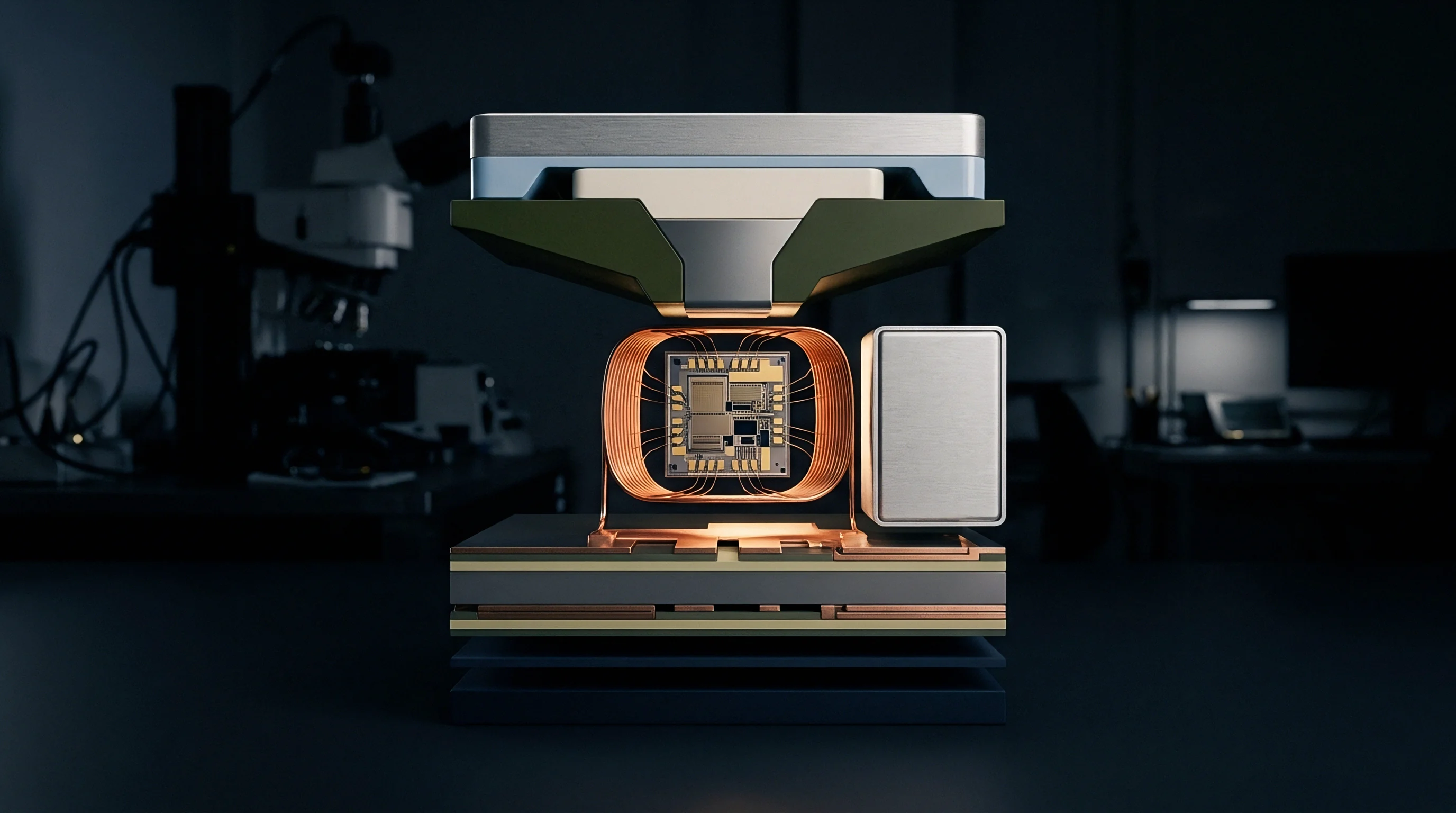
Finite element structural solvers integrate viscoelastic constitutive models by updating hereditary integrals at every integration point through incremental time-stepping routines. Modeling package-induced drift begins by establishing the manufacturing thermal history: curing at 150 degrees Celsius, cooling to 25 degrees ambient, and dwelling under continuous storage. Thermal excursions accelerate this molecular rearrangement, while cure shrinkage establishes the baseline pre-strain.
Solvers compute stress relief as an internal redistribution of strain between dashpot elements and elastic branches.
Finite Element Implementation Schemes
Accurate bias prediction requires resolving steep boundary shear stresses along the adhesive joint edge. Mesh density through the adhesive thickness must contain at least four parabolic continuum solid elements, with high aspect ratio refinement focused within fifty micrometers of the die perimeter. Silicon die sub-assemblies can be simplified with anisotropic elastic properties, while copper leadframes and gold wire bonds apply elasto-plastic limits.
Solver convergence stalls near rubbery transitions. When volumetric compressibility approaches the incompressible limit (Poisson ratio nearing 0.499), standard displacement formulations exhibit volumetric locking. Mixed u-P formulations (displacements coupled with hydrostatic pressure variables) prevent artificial mesh stiffening during high-temperature dwell analysis.
A 50-micrometer thick adhesive bondline subjected to 100 hours of 85 °C dwell exhibits a 42 percent reduction in peak edge shear stress compared to its post-cure state.
Die warpage distorts capacitive gap geometry, as surface curvature across the chip acts directly upon the central anchor of the MEMS element and rotates the outer suspension posts.
| Adhesive Class | Tg (°C) | Initial Peak Shear (MPa) | 1,000 h Residual Shear (MPa) | Relaxation Ratio (%) | Measured Offset Shift (mg) |
|---|---|---|---|---|---|
| High-Tg Rigid Epoxy | 145 | 28.4 | 24.7 | 13.0 | 1.8 |
| Low-Stress Flexible Epoxy | 65 | 12.2 | 4.6 | 62.3 | 8.4 |
| Silver-Filled Silicone | -45 | 1.8 | 1.5 | 16.7 | 0.7 |
| Bismaleimide Hybrid | 110 | 18.5 | 11.8 | 36.2 | 4.1 |
Simulated Die Surface Stress Decay
Numerical integration over thousands of hours demands disciplined control of time increments. Solvers employing automatic time incrementation based on local strain-rate error tolerances provide the only safeguard against numerical dissipation artifacts. An initial step size of 0.01 seconds captures thermal contraction shock, expanding logarithmically to thousands of seconds during steady isothermal dwell.
- Equilibrium Stiffness Floor sets the lower boundary for stress decay, preventing numerical routines from collapsing into total structural failure.
- Thermal Expansion Coupling matches structural strains with thermal gradient inputs, capturing temperature-dependent shifting during ambient cycles.
- Volumetric Relaxation Ratios separate bulk relaxation from deviatoric relaxation, maintaining accurate Poisson behavior under hydrostatic confinement.
- Geometric Nonlinearity Controls track large out-of-plane deflections as the silicon substrate transforms localized shear relief into plate curvature.
Post-processing maps the resolved displacement field of the die anchor surfaces directly into electro-mechanical capacitance solvers. Every micrometer of surface bending recalculates the capacitive transfer curve, translating micro-scale adhesive rheology into system-level output millivolts.
Resin
Formulation chemistry determines both the initial thermal stress budget and the rate of subsequent viscoelastic decay. Formulators adjust backbone chemistry, cross-linker functionality, and particle filler loadings to balance contrasting operational needs. Rigid epoxies provide shear strength and minimal drift under constant ambient conditions, but lock in massive thermal stresses during cool-down.
Elastomeric silicones eliminate packaging-induced thermal stress almost entirely, yet compromise high-g mechanical shock resistance and introduce creep under steady static loads.

Polymer Class Selection Tradeoffs
Conductive die attach adhesives incorporate 70 to 85 weight percent silver flakes to ensure thermal and electrical continuity to the substrate ground paddle. These fillers raise the elastic modulus, building a rigid particulate network that restricts polymer chain mobility and dampens relaxation rates while increasing dispensing viscosity. When moisture diffuses into the polymer matrix during environmental humidity testing, absorbed water molecules break interchain hydrogen bonds, lowering the glass transition temperature, accelerating stress relaxation, and altering zero-bias calibration points.
| Polymer Chemistry | Modulus at 25 °C (GPa) | CTE Below Tg (ppm/K) | 1,000 h Bias Drift Impact | Automotive Grade Track Record | Relative Cost Per Gram |
|---|---|---|---|---|---|
| Silver-Filled Epoxy | 4.5 to 8.5 | 35 to 55 | Low to Moderate (1 to 3 mg) | Established across AEC-Q100 Grade 0/1 | 1.0x baseline |
| Silicone Elastomer | 0.005 to 0.05 | 180 to 300 | Very Low (sub-1 mg) | Limited to non-safety modules (AEC-Q100 Grade 3) | 2.5x to 3.5x |
| Bismaleimide (BMI) | 2.0 to 4.0 | 45 to 65 | Moderate (3 to 6 mg) | Broad adoption in commercial avionics | 1.8x to 2.2x |
| Hybrid Epoxy-Acrylate | 1.0 to 2.5 | 60 to 90 | High (6 to 15 mg) | Specialized industrial applications | 1.4x to 1.7x |
Screening Specifications and Batch Governance
Procurement documents must pin down rheological consistency beyond simple datasheet room-temperature modulus values. Suppliers frequently adjust solvent types or catalyst ratios across manufacturing lots to maintain dispense rheology, inadvertently altering the relaxation spectrum and leaving sourcing contracts to reject uncharacterized chemistry.
Mil-Std-883 Method 5011 mandates baseline outgassing and shear strength but fails to govern viscoelastic relaxation rates, leaving zero-bias stability legally unprotected.
Incoming inspection procedures incorporate differential scanning calorimetry to verify that actual glass transition temperatures match qualification dossiers within plus or minus three degrees Celsius. Sourcing agreements protect measurement stability by incorporating explicit contractual clauses mandating supplier notification of any resin, curing agent, or filler morphology change, binding the adhesive vendor to twenty-four-month re-qualification warranties whenever raw component sources shift.