Viscoelastic Stress Relaxation in Sensor Die Attach Materials
Polymer die attach stress relaxation causes long-term zero offset drift in silicon sensors, requiring thermal pre-conditioning to ensure calibration stability.

Resin
Silicon pressure die bonded to ceramic or metallic substrates experience continuous shear stress from thermal expansion mismatch. As the adhesive cures at elevated temperatures, the polymer cross-links into a rigid matrix. When the assembly cools to room temperature, differential contraction between the die and housing locks residual stress into the joint.
Over time, localized molecular rearrangement relaxes this stress, converting stored elastic energy into viscous deformation and shifting the strain field transferred to the active sensing membrane.
Polymer die attach formulations exhibit distinct viscoelastic phases tied to their glass transition temperature. Below Tg, the adhesive acts mainly as an elastic solid with a high storage modulus. Above it, long-chain polymer segments gain rotational mobility; storage modulus drops by orders of magnitude while loss modulus spikes.
Operating near or within this transition zone accelerates stress relaxation dramatically, though room-temperature operation still produces measurable relaxation through physical aging and secondary molecular transitions far below Tg.
Silicone adhesives exhibit an initial storage modulus below 0.05 GPa at room temperature, keeping thermal stress low while allowing measurable zero-point creep across thermal cycles.
Different die attach chemistries relieve time-dependent strain at very different rates. Silver-filled epoxies combine low thermal resistance with high mechanical strength, but cure shrinkage creates substantial initial stress. Soft silicones limit thermal stress transfer thanks to a low elastic modulus, though sustained mechanical bias causes noticeable creep.
Polyimides remain stable at elevated temperatures, but high cure temperatures lock in severe initial thermal stress. Sintered silver paste eliminates viscoelastic relaxation altogether by replacing the organic polymer with a continuous metallic matrix, though thermomechanical fatigue can still induce microstructural creep.
| Material Class | Glass Transition Temperature (°C) | Storage Modulus Below Tg (GPa) | Coefficient of Thermal Expansion (ppm/K) | Primary Relaxation Time Constant (Hours) |
|---|---|---|---|---|
| Silver-Filled Epoxy | 120 to 180 | 3.5 to 8.5 | 35 to 55 | 150 to 600 |
| Fluorosilicone Elastomer | -110 to -50 | 0.002 to 0.01 | 200 to 350 | 10 to 50 |
| Thermoplastic Polyimide | 220 to 290 | 2.1 to 4.0 | 40 to 60 | 800 to 2500 |
| Sintered Nano-Silver | Not Applicable | 9.0 to 40.0 | 19 to 22 | Not Applicable |
Chemical aging further complicates physical stress relaxation. Unreacted monomers and cross-linking agents left behind by an incomplete cure continue to react in the field. This ongoing post-cure polymerization alters cross-link density, shifting both the storage modulus and glass transition temperature over time.
Absorbed moisture also plasticizes epoxy matrices, lowering the effective Tg and accelerating viscoelastic flow under ambient conditions.
Post-cure zero-point wander often stems from circuit board assembly reflow profiles rather than post-polymerization matrix movement.

Drift
Mechanical stress on a piezoresistive diaphragm decays logarithmically over operating hours. Implanted piezoresistors measure strain through changes in electrical resistivity, reading a net strain state that balances applied fluid pressure against internal stress from the die attach joint. As the adhesive relaxes, that baseline stress shifts, and the sensor electronics register the stress reduction as an uncommanded zero offset change.
Piezoresistive coefficients depend heavily on crystallographic orientation and stress symmetry. Symmetrical shear stress across the four arms of a Wheatstone bridge cancels in the differential output, but asymmetrical relaxation disrupts that balance. Voids in the adhesive, uneven bondlines, and fillet height variations create local stress gradients across the back of the die.
As these local fields relax at unequal rates, offset voltage wanders unpredictably over time and temperature.

Piezoresistive Response and Failure Paths
Relaxation happens quickly during the first hundred hours after thermal assembly, then transitions into a slower decay over years in the field. Temperature spikes temporarily boost molecular mobility, re-exciting relaxation mechanisms; when the assembly cools back to ambient, the baseline stress fails to return to its original level, resulting in thermal hysteresis.
- Zero Offset Drift alters the unamplified bridge baseline without applied pressure, distorting absolute measurement accuracy.
- Span Calibration Shift modifies diaphragm sensitivity by altering static pre-tension across the active piezoresistive zone.
- Thermal Hysteresis Loop creates non-repeatable output paths when cycling between operating temperature extremes.
- Asymmetric Strain Decay induces local bridge imbalance through non-uniform stress relief around perimeter fillets.
Uncalculated relaxation forces a secondary field zero-trim operation across installed sensor assets, doubling effective maintenance expenditure over a five-year deployment window.
Shift
Modeling multi-time-scale relaxation spectra typically relies on multi-term Prony series expansions. Under constant strain, a linear viscoelastic material exhibits a time-dependent relaxation modulus, which the generalized Maxwell model represents through parallel spring-dashpot elements. Summing these exponential decay terms yields a complete mathematical description of stress relaxation across short, intermediate, and long timeframes.
Time-Temperature Superposition simplifies long-term predictions by treating thermal acceleration as equivalent to extended time. The Williams-Landel-Ferry equation models the horizontal shift factor above Tg, while Arrhenius relationships capture the temperature dependence below Tg. Characterizing these shift parameters allows laboratory relaxation data gathered over several weeks to be mapped into reliability predictions spanning years in the field.
Polymer relaxation rates double for every ten-degree Celsius increase when operating within the glass transition dispersion region.

Can Prony Series Models Predict Long Term Zero Shift?
Consider a piezoresistive silicon pressure sensor attached to an alumina ceramic substrate using a silver-filled epoxy. The die attach line features a uniform thickness of 25 micrometers and a cure temperature of 150 °C. Cooling the assembly to 25 °C generates an initial uniform shear strain of 0.35 percent at the die edges due to the CTE difference between silicon (2.6 ppm/K) and alumina (6.7 ppm/K).
The viscoelastic behavior of the cured epoxy follows a two-term Prony series expansion given by:
Modulus Equation: E(t) = E_infinity + E_1 exp(-t / tau_1) + E_2 exp(-t / tau_2)
Where the equilibrium modulus E_infinity equals 1.2 GPa. The first relaxation term parameters are E_1 = 0.8 GPa and tau_1 = 50 hours at 85 °C. The second relaxation term parameters are E_2 = 1.5 GPa and tau_2 = 500 hours at 85 °C. At time t = 0, the total initial storage modulus E(0) equals 3.5 GPa. The initial shear stress at the interface calculates as:
Initial Stress: Sigma(0) = 0.0035 3.5 GPa = 12.25 MPa
Exposing this assembly to a continuous operating temperature of 85 °C for 1,000 hours results in significant stress decay. Evaluating the Prony series at t = 1,000 hours yields:
Modulus at 1,000 Hours: E(1000) = 1.2 + 0.8 exp(-1000 / 50) + 1.5 exp(-1000 / 500) GPa
The term exp(-20) approaches zero, while exp(-2) evaluates to 0.1353. Substituting these values gives:
Relaxed Modulus: E(1000) = 1.2 + 0 + 1.5 0.1353 = 1.403 GPa
The relaxed interface shear stress evaluates to:
Relaxed Stress: Sigma(1000) = 0.0035 1.403 GPa = 4.91 MPa
This stress reduction represents a 59.9 percent decay from the initial mechanical stress state. Assuming a linear strain transfer coefficient where 1 MPa of interface shear stress induces a 0.12 mV/V zero offset shift in the Wheatstone bridge, the initial assembly stress creates an offset of 1.47 mV/V. After 1,000 hours at 85 °C, the residual offset drops to 0.59 mV/V. The uncompensated viscoelastic zero drift equals 0.88 mV/V. For a sensor with a full-scale output of 100 mV/V, this drift corresponds to an uncommanded 0.88 percent full-scale measurement error.
Whether physical aging at room temperature resets the relaxation spectrum during extended zero-power storage remains an open area of inquiry across sensor packaging laboratories.

Bond
Controlling adhesive thickness and voids across the die interface fixes the amount of strain transferred to the sensor. Variations in bondline thickness change compliance across the die plane: a thin line spikes peak shear stress at die corners and speeds stress transfer to the silicon membrane, whereas a thick line dampens thermal stress at the cost of higher creep volume, tilt, and warpage.
Voids in the joint line disrupt local stress fields. Air trapped during dispensing or solvent outgassing during cure leaves unconstrained internal surfaces where polymer chains relax faster than in the constrained bulk material. This asymmetric relaxation warps the silicon diaphragm, producing non-linear zero drift during thermal cycling.
Standard ISO 16750-4 clause 5.1.2 mandates long-term thermal storage testing to verify that baseline signal drift remains within stated product tolerances following extended thermal aging.
Process engineers use stabilization bakes to clear early-stage relaxation before factory calibration. Pre-conditioning drives off residual volatiles, completes cross-linking, and moves the adhesive past its initial steep relaxation phase.
- Dispense die attach adhesive using positive displacement pumps to hold volume tolerance within three percent.
- Place the silicon die with controlled pick-and-place force to establish target bondline thickness and eliminate tilt.
- Execute a multi-stage thermal cure profile featuring a low-temperature solvent ramp followed by a high-temperature cross-linking dwell.
- Perform high-resolution acoustic microscopy to confirm total void area remains below five percent of total die surface area.
- Subject raw bonded assemblies to a post-cure thermal stabilization bake at maximum rated operating temperature for 96 hours.
- Cool assemblies slowly to room ambient conditions at a controlled ramp rate under two degrees Celsius per minute to minimize thermal shock strain.
- Perform initial offset zero-trim programming only after complete thermal stabilization.
Slower cure ramp rates yield lower frozen-in thermal stress than high-temperature rapid snap cures.
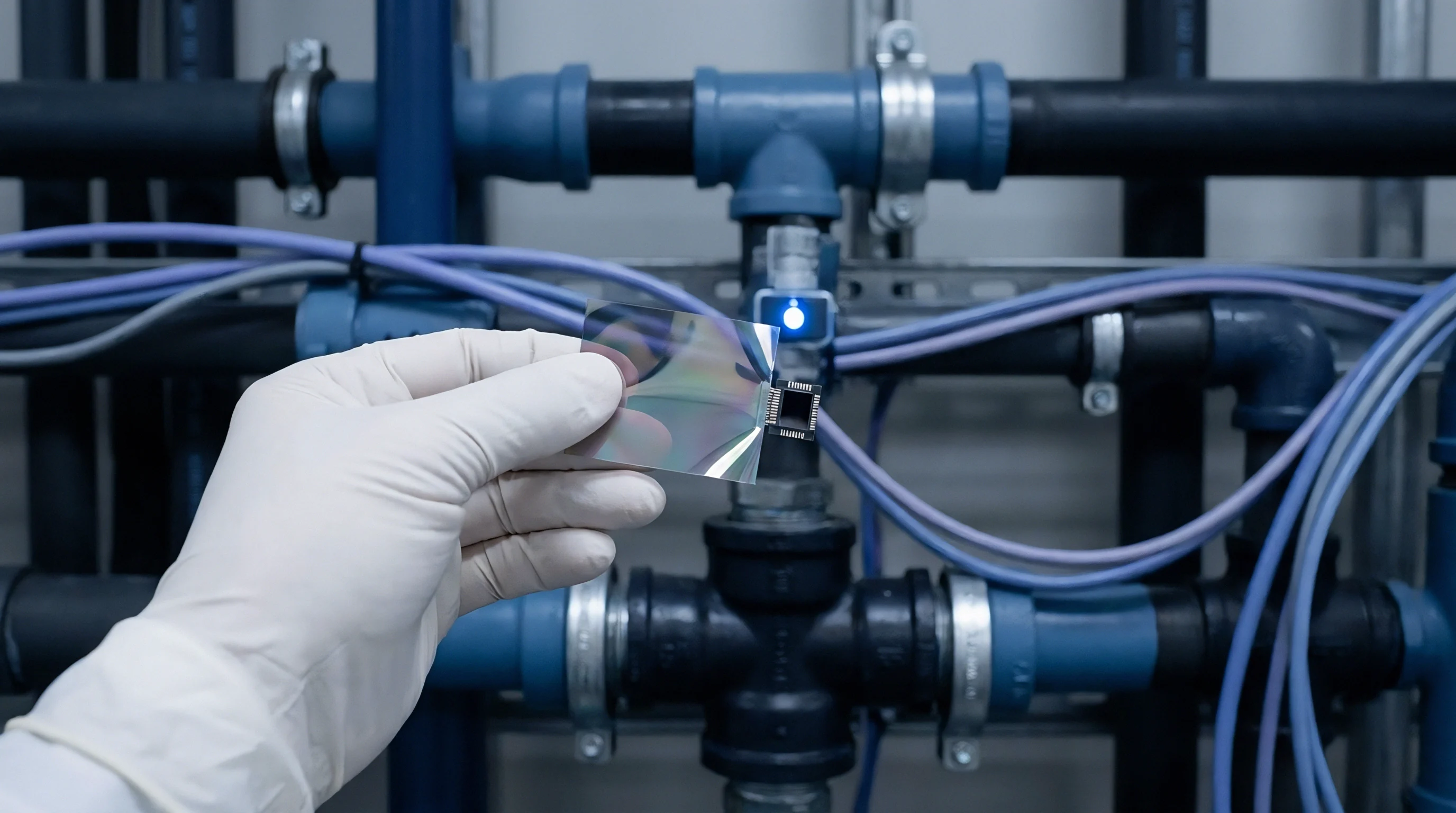
Chamber
Environmental testing subjects sensor assemblies to thermal dwells to accelerate post-cure relaxation. Dynamic Mechanical Analysis measures storage modulus, loss modulus, and loss factor against temperature and frequency, defining the linear viscoelastic region and identifying transition temperatures under realistic mechanical loads.
Accelerated aging profiles use temperature shift factors to compress years of field exposure into laboratory schedules. Without careful verification, aggressive thermal acceleration can push the adhesive past its glass transition temperature, triggering degradation mechanisms that would never occur during rated operation.
| Test Profile Temperature (°C) | Reference Operational Temp (°C) | Calculated WLF Shift Factor (aT) | Equivalent Field Hours per 100 Test Hours | Target Relaxation Domain |
|---|---|---|---|---|
| 70 | 25 | 12.4 | 1,240 | Beta Relaxation / Side Chain Movement |
| 100 | 25 | 86.2 | 8,620 | Alpha Relaxation / Main Chain Mobility |
| 125 | 25 | 340.5 | 34,050 | Glass Transition Onset Domain |
| 150 | 25 | 1,120.0 | 112,000 | Full Viscoelastic Flow Domain |
Raw die attach formulations undergo incoming verification before release to production, as lot-to-lot variations in resin purity, filler particle size, or solvent concentration directly alter the viscoelastic response of the cured joint.
- Differential Scanning Calorimetry confirms cross-linking completeness and determines the glass transition temperature of each incoming lot.
- Thermogravimetric Analysis measures residual solvent concentration and tracks high-temperature thermal decomposition thresholds.
- Rheological Creep Testing measures shear strain accumulation under constant stress over 24-hour periods to monitor batch consistency.
- Fourier Transform Infrared Spectroscopy verifies chemical stoichiometry and detects uncured monomer contamination prior to assembly.
Standard IEC 60749-25 clause 5.2 specifies thermal cycling regimes that alter material compliance data when applied without pre-conditioning thermal bakes.

Grade
Selecting materials for precision pressure transducers requires balancing mechanical compliance against long-term chemical stability. Ultra-low-drift sensors demand die attach adhesives with predictable, minimal stress relaxation. High-modulus epoxies build strong structures, but elevated relaxation stress leads to continuous signal wander; formulations loaded with uniform glass spheres help keep bondlines consistent and minimize spatial stress variation across the die.
Procurement decisions also have to account for the hidden costs of lower-grade die attach compounds. Cheaper adhesives typically suffer from wider Tg and cross-link density tolerances, widening the zero-offset drift band. That variability forces manufacturers into individual temperature compensation cycles and extended burn-in bakes that quickly erode any initial material savings.
Automotive sensor applications requiring zero drift below 0.1 percent full scale across 10,000 service hours specify sintered silver or polyimide die attach systems.
Procurement specifications should define acceptable zero-drift limits after standard thermal stress exposures alongside initial accuracy specs. Standardizing these verification methods ensures components maintain calibration stability over their intended operating life.
Specifying die attach materials by storage modulus alone ignores time-dependent compliance changes that dictate long-term accuracy. High-precision applications require explicit limits on post-cure relaxation spectra, void percentages, and thermal pre-conditioning. Qualifying formulations through dynamic mechanical analysis alongside long-term drift testing protects production lines from unexpected calibration shifts and costly field returns.