Kinematic Extension
Thick plate deformation modeling incorporates transverse shear strain to improve the accuracy of deflection calculations in moderately thick structures. In structural analysis, the Mindlin-Reissner plate theory relaxes the normal-straightness constraint by allowing the normal vector to rotate independently of the mid-surface deflection.
Shear Factor
Introducing shear deformation requires the use of a shear correction factor to adjust the non-uniform shear stress distribution across the plate thickness to a constant value. For homogeneous isotropic plates, a factor of five-sixths is typically applied to match the actual shear strain energy calculated from three-dimensional elasticity theory. Without this correction, the model would overestimate the shear stiffness, leading to incorrect calculations of both deflection and vibrational frequencies.
Numerical Formulation
Finite element solvers frequently utilize this formulation for shell elements because it requires only first-order derivatives of the displacement field, which simplifies the shape functions. It avoids the complex continuity requirements of thinner plate models, though it is susceptible to shear locking when applied to extremely thin plates. Engineers bypass this numerical issue by using selective reduced integration techniques that prevent the elements from becoming artificially stiff in thin regions.
Metrological Relevance
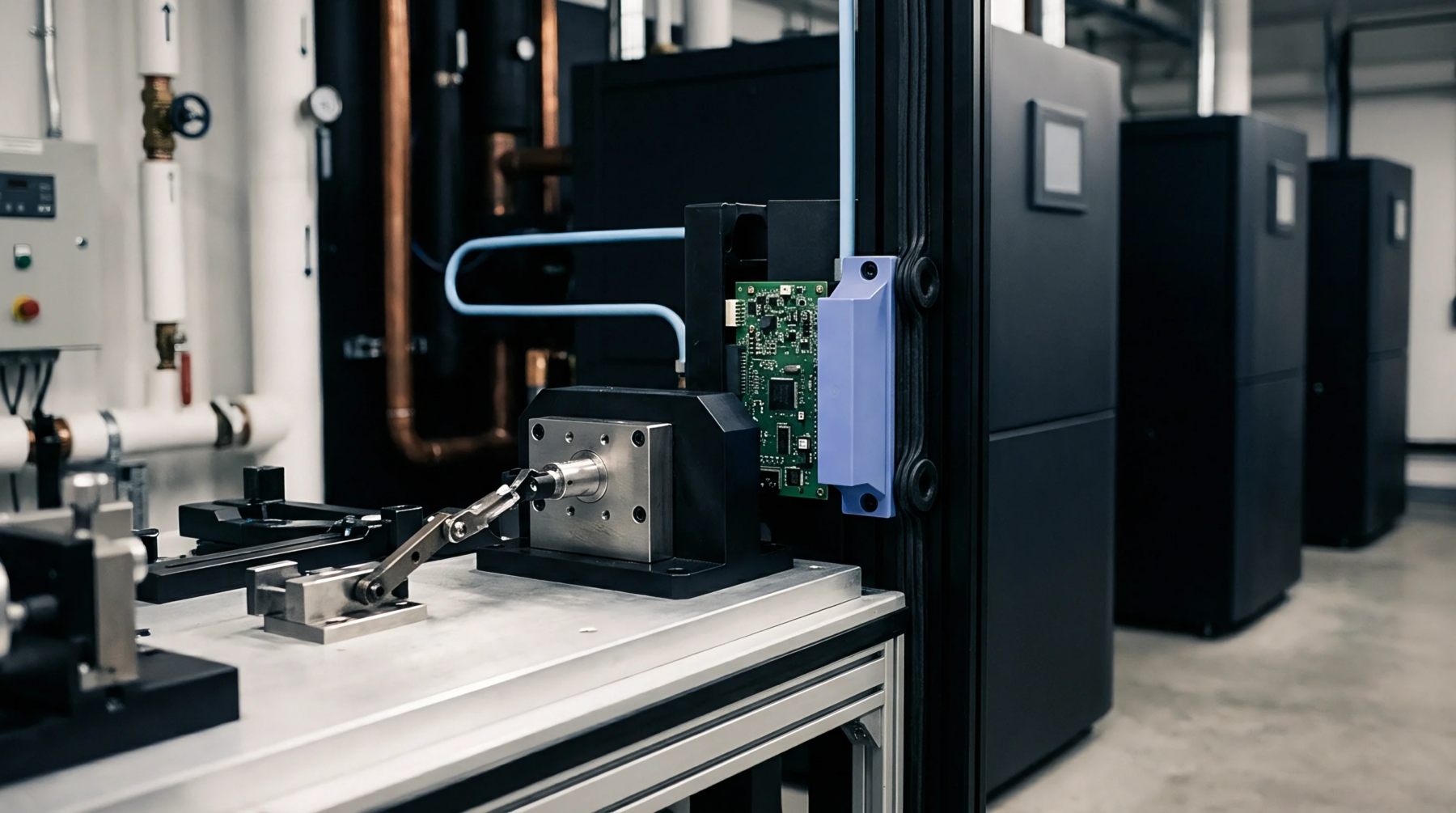
High-frequency vibration testing of multi-layered printed circuit boards requires this shear-deformable theory to accurately predict high-order resonant modes. Since laminates have a relatively low out-of-plane shear modulus due to the soft polymer matrix, shear deformation contributes a non-negligible portion of the total dynamic deflection. Applying this theory allows the test technician to correctly align the simulated vibration frequencies with the physical accelerometer measurements gathered during testing.