Mathematical Representation
Anisotropic plate stiffness evaluation requires a multi-directional mathematical framework to describe how a multi-layered material resists bending. In printed circuit board analysis, the flexural rigidity tensor maps the relationship between the applied bending and twisting moments and the resulting curvatures of the plate. This mathematical entity integrates the elastic moduli and thickness of each individual laminate layer, providing a complete description of the directional bending stiffness.
Physical Interpretation
Constitutive modeling of composite structures utilizes these fourth-order tensor components to account for the asymmetric distribution of glass fabrics and copper traces. When a printed circuit board has a non-symmetric layup, the off-diagonal terms in the flexural rigidity tensor indicate that bending will induce twisting, or that twisting moments will generate bending. Designers must optimize these terms to avoid warpage during the high-temperature assembly processes associated with solder reflow.
Experimental Measurement
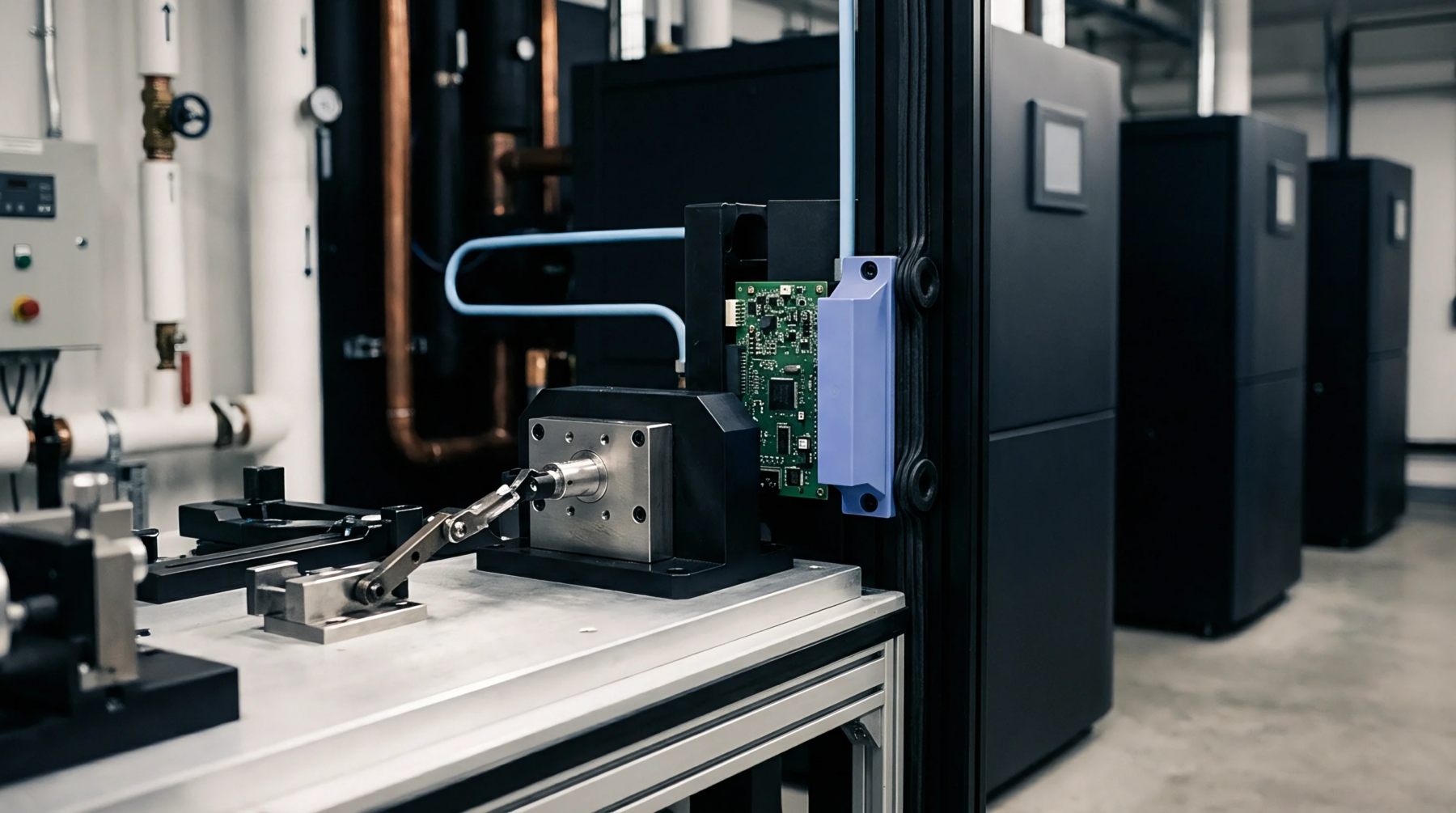
Dynamic mechanical analysis or multi-point bending tests allow engineers to calculate the tensor components by applying known forces and measuring the directional deflections with laser extensometers. During these test cycles, a specimen undergoes sinusoidal loading at specific angles relative to the glass weave orientation, which separates the isotropic resin behavior from the anisotropic fiber reinforcement. Resolving the complete tensor requires at least three independent bending tests along distinct axes, with each run yielding a unique load-displacement curve that is converted into the corresponding stiffness terms through classical lamination formulas.
Numerical Application
Finite element simulation programs ingest these calculated stiffness values to predict how a populated circuit board behaves under shock and vibration. Because a full geometric model of every trace and copper plane is computationally prohibitive, engineers replace the detailed layup with an equivalent homogeneous plate defined by the calculated tensor. This simplified plate model speeds up structural evaluations while maintaining high fidelity in predicting solder joint stress.