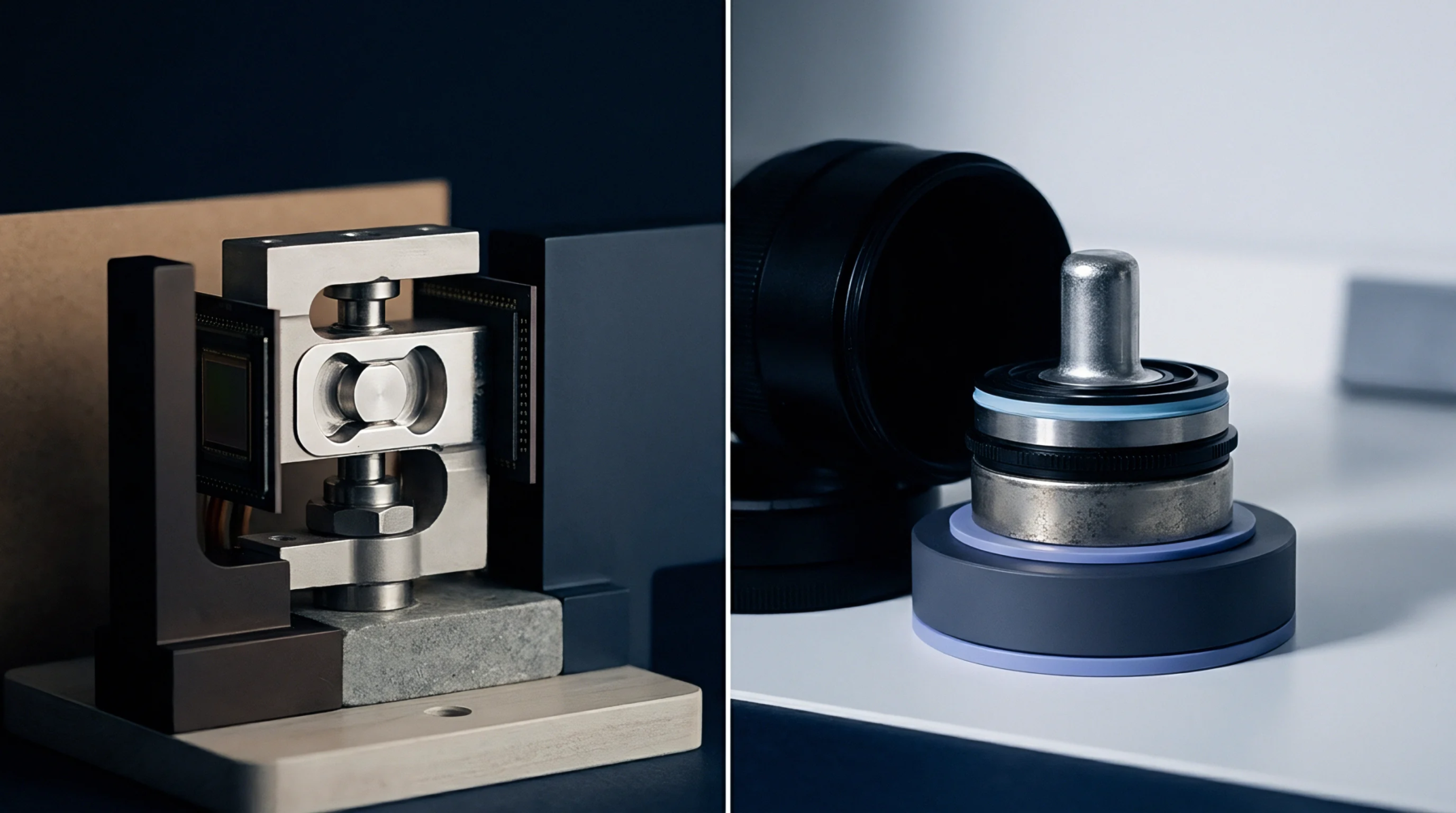
Selecting Valid Kinetic Models for Accelerated Four Week Transducer Qualification
Validating four-week transducer qualification requires deriving activation energies empirically across stepped temperatures to prevent severe drift underestimation.
Cumulative measurement doubt established across a working test station defines the reference boundary against which all calibrated instruments are evaluated. Calibration bench uncertainty quantifies the combined dispersion of values attributed to the reference standards, ambient fluctuations, instrument resolution limits, and connection interfaces within an active testing facility. Its coverage governs direct comparison checks, transfer measurements, and factory acceptance testing for electronic sensors, transceivers, and transducers.
The evaluation ceases to apply once an instrument leaves the controlled bench environment, because unmodeled field installation stresses, broad temperature swings, and process piping dynamics introduce independent metrological deviations.
Evaluation of total measurement variance requires systemic identification of both Type A statistical variations and Type B systematic components following international metrological guidelines. Reference standard certificates provide traceable baseline uncertainty, but ambient thermal drift, power supply fluctuations, cable resistance, and fixture contact resistances compound this baseline. Mathematical combination using root-sum-square techniques yields the combined standard uncertainty across active measurement circuits.
Multiplying this combined value by an expansion factor, typically two to establish a ninety-five percent level of confidence, defines the expanded uncertainty reported on qualification certificates. A bench setup lacking continuous ambient temperature logging underestimates its true uncertainty contribution because temperature coefficients of precision decade boxes, digital multimeters, and pressure controllers cause systemic drift over daily operational cycles.
Verification of calibration station capabilities involves closed-loop interlaboratory comparisons, transfer standard drift monitoring, and gauge repeatability and reproducibility assessments. Metrologists run stable transfer artifacts through repeated test sequences across multiple days and operators to separate bench-induced variance from normal artifact behavior. This verification cycle isolates electromagnetic interference, ground loops, and thermistor aging within test heads that degrade the calibration bench uncertainty.
Environmental loggers confirm that temperature and relative humidity remain strictly inside specified ranges, preventing invalidation of high-precision electrical or physical resistance measurements. If an evaluation reveals that bench uncertainty has expanded beyond its prescribed limits, all calibrations executed since the previous verification point require immediate re-assessment.
Industrial acceptance criteria dictate that the uncertainty of the verification station must remain small relative to the tolerance of the unit under test. Metrology frameworks generally enforce a test uncertainty ratio of four to one, or minimally three to one, ensuring that the calibration process does not falsely accept non-conforming hardware or reject viable instruments. When calibration bench uncertainty constitutes a sizable fraction of the permissible instrument error, guardbanding techniques must compress the acceptable pass band, reducing factory manufacturing yield to protect measurement integrity.
Lead wire resistance, thermocouple effects at terminal contacts, and radio-frequency noise from nearby test electronics constantly challenge these ratios. Maintaining verified calibration bench uncertainty preserves legal and quality traceability, establishing the bedrock upon which component conformity and performance guarantees are substantiated.
Validating four-week transducer qualification requires deriving activation energies empirically across stepped temperatures to prevent severe drift underestimation.
Expertise is a utility, not a secret. sentiention™ publishes its working knowledge as open reference: intelligence layer covering the materials it sources, the markets it enters, and the reference that serves both.