Long Term Drift Partitioning across Environmental Stress between Discrete Transducers and Precalibrated Serial Assemblies
Discrete transducers isolate board stress at the cost of line calibration, while serial assemblies eliminate calibration but absorb package swell drift.


Partition
A four-point bending deflection of seventy micrometers across a forty-millimeter board span shifts the zero-pressure output of an LGA-packaged piezoresistive transducer by forty-two microvolts, altering sensor balance long before temperature or chemical aging affects the die. Evaluating operational stability over five to ten years requires isolating these physical mechanisms ~ from solder creep shifting baseline strain and board flexure reaching the die to trace geometry defining mechanical isolation. In a discrete analog transducer, drift is distributed across the primary sensing element, packaging elastomer, external instrumentation amplifier, and board-level voltage reference.
A precalibrated serial assembly instead houses these error sources within a single overmolded or co-fired ceramic cavity, trading external circuit drift for silicon-level trim aging and package stress.
Discrete sensing chains spread vulnerability across four distinct stages. For the primary sensing element ~ be it an uncompensated foil strain gauge, ceramic capacitive cell, or thin-film platinum resistor ~ drift stems from lattice relaxation, grain boundary migration, and oxidation. The analog front end adds its own errors through input bias currents, shifting offset voltages, and resistor aging; a metal film resistor with 0.1 percent initial tolerance can drift twenty to fifty parts per million per thousand hours at elevated temperatures.
Serial digital assemblies, by comparison, integrate the sensing microstructure alongside an application-specific integrated circuit housing an internal bandgap reference, sigma-delta converter, and non-volatile memory. This shifts the overall error budget from distributed circuit trace dynamics to electromechanical stresses at internal package interfaces.
A surface-mount analog transducer circuit running across eight thousand hours at seventy degrees Celsius shifts sixty percent of its total drift budget through passive component value decay.
How drift spreads across these functional blocks determines how the instrument handles field conditions. Under thermal cycling and humidity, a discrete topology keeps mechanical stress on the sensing diaphragm separate from electrical stress on the signal conditioning IC. A serial assembly, however, couples both stresses onto a shared substrate where mold compound expansion presses directly against the sensing bridge and integrated circuit at the same time.
- Die metallization degradation causes contact resistance to shift across the silicon diaphragm as continuous bias drives electromigration in aluminum-copper tracks.
- Elastomer relaxation degrades the seal compression of internal silicone gel barriers, leaving piezoresistive traces vulnerable to moisture and ionic contamination over time.
- Passive component drift in discrete filter networks shifts analog corner frequencies, permitting high-frequency environmental noise to alias into the measurement band.
- Bond wire intermetallic formation induces voiding at gold-aluminum package interfaces, causing sudden step changes in resistance during thermal cycling.
Evaluating stability between the two architectures requires tracing how environmental energy reaches each node. The budget below allocates five-year drift across physical domains under continuous exposure to industrial operating conditions.
| Domain Source | Discrete Analog Chain | Precalibrated Serial Module | Coupling Mechanism |
|---|---|---|---|
| Sensing Microstructure | 35 percent | 20 percent | Lattice dislocation movement and surface oxidation |
| Package Internal Stress | 15 percent | 45 percent | Mold compound curing shrinkage and hygroscopic swell |
| Analog Signal Conditioning | 30 percent | 15 percent | Operational amplifier offset drift and resistor aging |
| Voltage Reference Stability | 20 percent | 10 percent | Zener or bandgap silicon dopant redistribution |
| Non-Volatile Trim Memory | 0 percent | 10 percent | Charge leakage from floating-gate EEPROM cells |
Decoupling sensor drift from board strain ultimately requires drawing the architectural boundary where mechanical flexure can no longer alter electrical calibration.
Swell
Moisture absorption causes epoxy packaging to expand. Mold compounds in encapsulated serial sensors pull in atmospheric water until balancing with ambient humidity, resulting in volumetric expansion governed by the material’s coefficient of hygroscopic swelling. As this resin matrix expands, it subjects the embedded silicon die to triaxial compressive stress.
Under eighty-five percent relative humidity at eighty-five degrees Celsius, a standard epoxy novolac compound absorbs 0.3 to 0.6 weight percent water, generating in-plane compressive stresses of fifteen to thirty megapascals across the active sensor surface.

Does Mold Compound Expansion Distort Piezoresistive Trims?
Silicide resistors diffused into a silicon diaphragm rely on piezoresistive properties that convert strain into resistance changes. As atmospheric moisture enters the encapsulation, the resulting volumetric expansion disrupts the baseline balance of the internal Wheatstone bridge. Along the 110 crystal axis, silicon exhibits a transverse piezoresistive coefficient of negative thirty-one point two times ten to the negative eleven square meters per newton.
Compressive package stress thus shifts the zero-point voltage regardless of applied pressure, registering on the serial bus as uncorrectable baseline drift.
Because mold compounds behave like mechanical springs whose elastic modulus drops sharply above the glass transition temperature, packaging choice directly dictates moisture immunity. In discrete transducers housed in metal cans with glass-to-metal headers, atmospheric moisture cannot enter the hermetic cavity, leaving the die isolated and restricting long-term drift to weld relaxation and diaphragm fatigue. Choosing plastic surface-mount serial assemblies trades that hermetic isolation for automated pick-and-place compatibility, allowing ambient humidity shifts to translate directly into mechanical stress cycles across the calibrated sensor diaphragm.
Hygroscopic swelling of epoxy encapsulation generates up to thirty megapascals of compressive stress against the active surface of an unvented silicon die.
Thermal aging further complicates this behavior through ongoing post-mold curing shrinkage. At temperatures above sixty degrees Celsius, epoxy matrices continue cross-linking over thousands of operating hours. This ongoing reaction shrinks the polymer matrix and increases compressive preload on the die.
Factory calibration reflects only the stress state forty-eight hours after post-mold cure; over three years in an industrial enclosure, the resin can contract by another 0.05 to 0.15 linear percent, driving offset drift beyond the correction range of internal compensation registers.
Underestimating moisture absorption kinetics frequently triggers field recalibration issues when seasonal humidity shifts move sensor baselines across entire deployment regions.

Registers
Digital sensor assemblies mask underlying analog dynamics behind a bus interface. A host controller reads temperature or pressure via I2C or SPI transactions, acquiring twenty-four-bit integers scaled by internal formulas. The embedded ASIC derives these values using polynomial coefficients written to non-volatile registers during factory trim.
While bus capacitance rounds signal edges, clock stretching masks conversion latency, and internal bit settings dictate active lookup tables, long-term measurement integrity ultimately hinges on floating-gate charge retention and reference voltage stability.

Polynomial Trim Retention under Thermal Cycling
Thermal cycling degrades floating-gate memory over time. Over ten years at elevated temperatures, charge trapped in EEPROM or flash arrays leaks through oxide defects, altering stored coefficients. Even a single-bit corruption in a second-order temperature compensation register can cause calculated readings to drift wildly during thermal swings.
Discrete designs, which rely on external microcontrollers and converters, keep calibration tables in system memory where error-correcting code can guard data integrity.
Auditing digital assemblies for long-term register stability requires thorough qualification before committing parts to board assembly.
- Register map baseline capture records factory calibration coefficients across all internal registers at twenty-five degrees Celsius.
- Thermal soak exposure bakes the unpowered assembly to stress floating-gate oxides and accelerate charge displacement.
- Readback verification compares post-soak register contents against baseline values to catch bit errors or unannounced map revisions.
- Span verification measures full-scale output across three temperature points to isolate calculation drift caused by reference aging.
Serial assemblies often run digital filtering and zero-tracking routines embedded in firmware masks. These algorithms periodically re-zero the baseline on the assumption that slow shifts stem from drift rather than valid static signals. In slow-moving industrial processes, such filtering can mask genuine process changes while failing to correct abrupt shifts caused by package stress.
Baseline variation across humidity cycles is frequently treated as an acceptable environmental response within the scope of published application notes.

Chamber
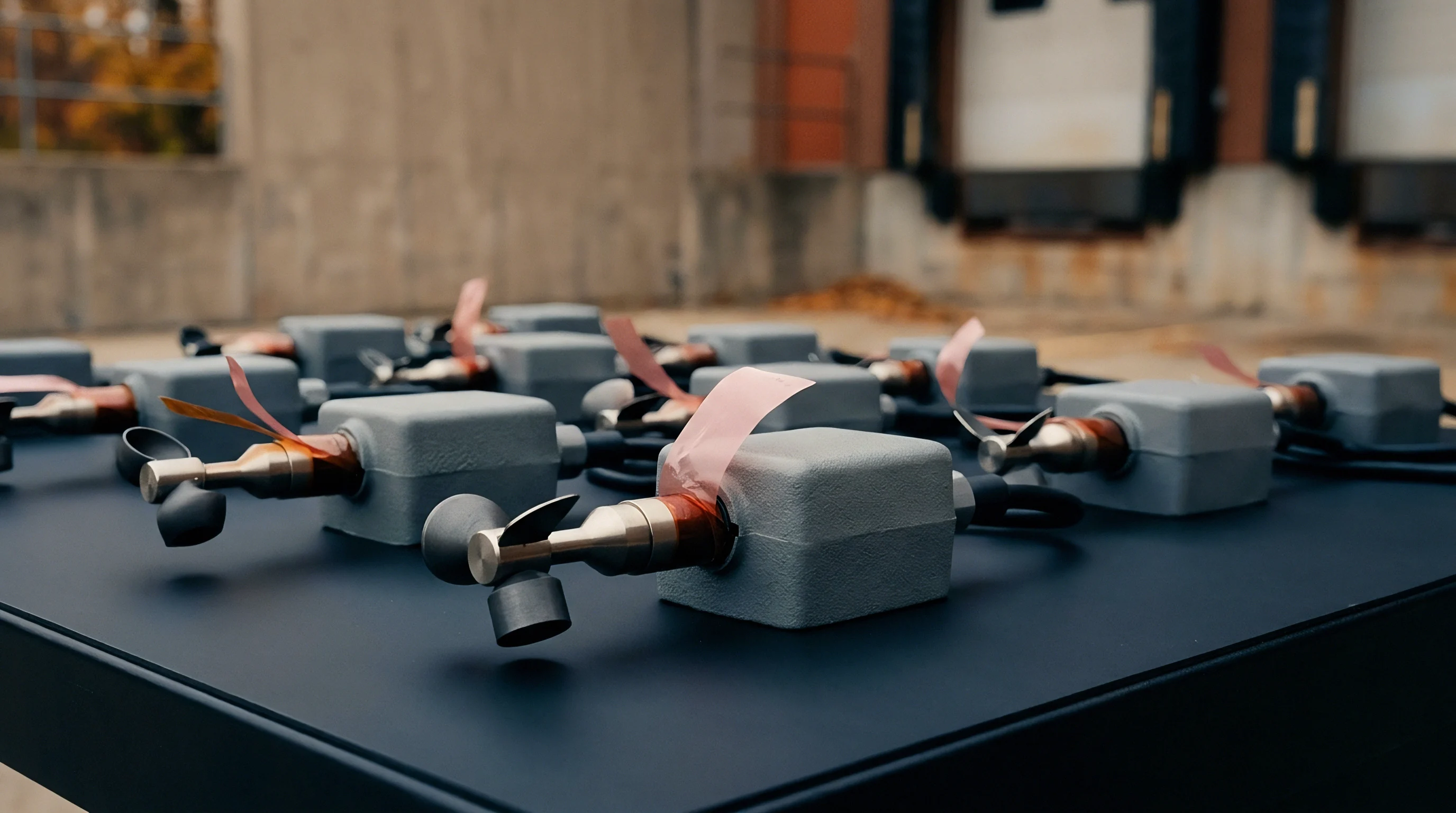
Accelerated environmental testing isolates the distinct mechanisms driving long-term transducer drift. Reliability evaluations split testing into high-temperature operating life, temperature-humidity-bias, and thermal cycling profiles ~ where chamber dwell times set moisture saturation, thermal profiles accelerate chemical decay, and diffusion rates govern metallization shifts. Thermally accelerating a silicone-potted discrete transducer uncovers failure modes vastly different from those seen in transfer-molded serial assemblies.
Could Accelerated Thermal Soak Predict Ten Year Drift?
Arrhenius modeling assumes a single dominant activation energy across the exposure range. Silicon dopant diffusion and thin-film resistor aging exhibit activation energies between 0.7 and 1.1 electron-volts, yielding predictable acceleration factors. Packaging epoxies break this relationship: when chamber temperatures approach or surpass the mold compound’s glass transition temperature ~ typically between one hundred twenty and one hundred fifty degrees Celsius ~ the polymer undergoes a thermodynamic phase change.
Its thermal expansion coefficient triples while its elastic modulus drops by more than an order of magnitude, inducing failure mechanisms that never occur under normal operating conditions.
JEDEC JESD22-A108 defines high-temperature operating life conditions that accelerate silicon lattice defects while risking invalid packaging artifacts above glass transition temperatures.
Evaluating serial assemblies requires separating board-mounting strain from chamber atmosphere effects. During thermal cycling between minus forty and one hundred twenty-five degrees Celsius, solder joints undergo plastic deformation. As SAC305 lead-free solder creeps, it relieves shear stress on the bottom pads of an LGA package, transmitting offset shifts into the silicon substrate through copper trace connections.
Testing discrete sensors in sockets bypasses this solder fatigue coupling, isolating internal transducer drift from board-level assembly dynamics.
- Acoustic microscopy scanning verifies that delamination between mold compound and die has not disrupted stress transmission paths.
- Continuity logging during temperature ramps catches transient solder joint opens caused by thermal expansion mismatches between package pads and board copper.
- Zero-point offset recording tracks permanent baseline shifts after humidity dry-out cycles, distinguishing permanent chemical changes from reversible moisture swelling.
- Insulation resistance screening under continuous bias checks for ionic dendrite formation across closely spaced serial bus traces under condensing conditions.
JEDEC standard JESD22-A101 clause four specifies continuous electrical bias during exposure to eighty-five degrees Celsius and eighty-five percent relative humidity, confirming that damp-heat field failures stem primarily from electrochemical migration rather than pure mechanical deformation.
Parity
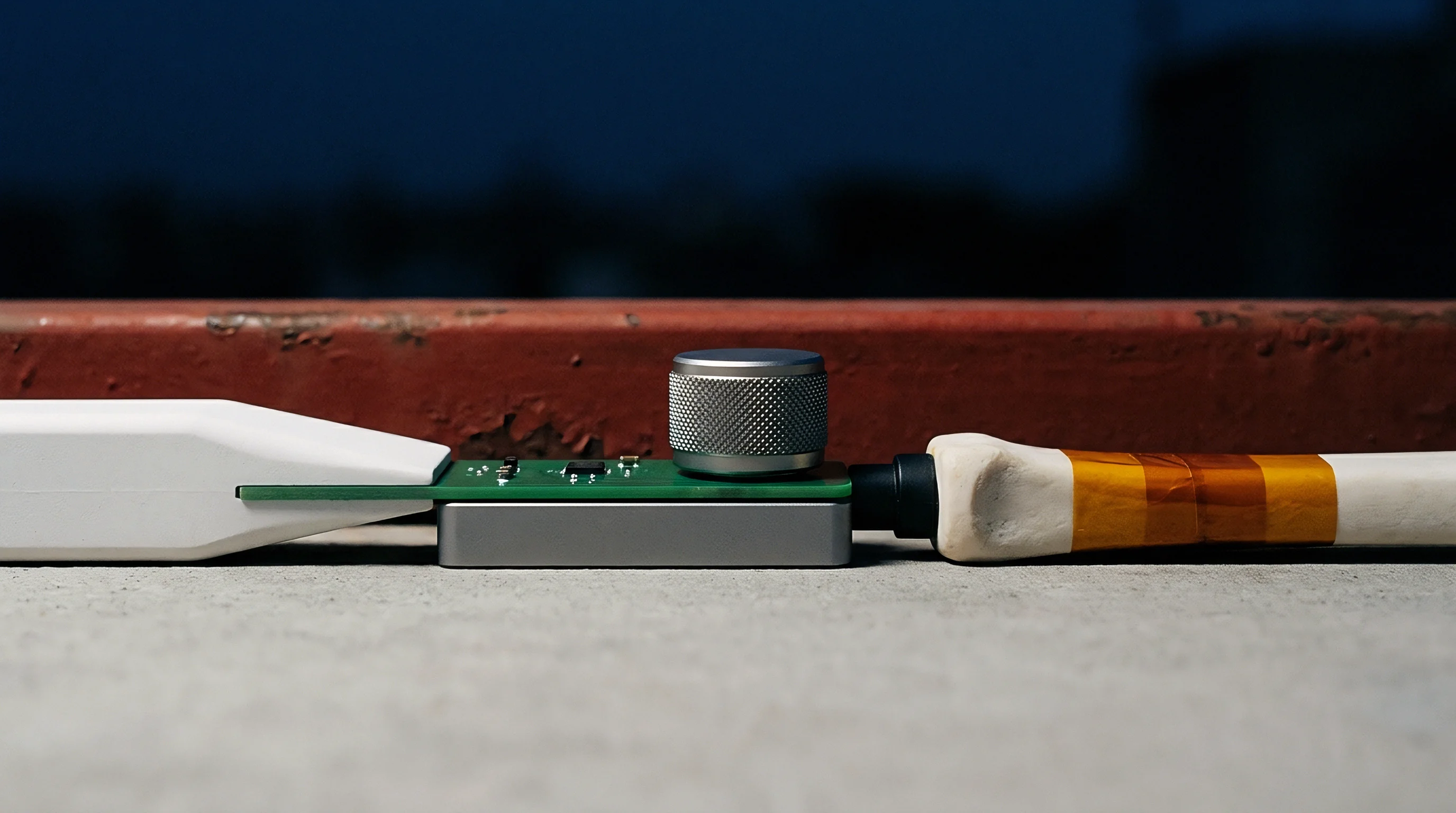
Sourcing decisions must weigh initial component procurement against assembly line integration effort and long-term warranty risk. While calibration test rigs, yield losses, and board layout overhead add up, a discrete transducer element looks cheap on a bill of materials ~ often thirty to forty percent the cost of an integrated serial module. That front-end savings, however, shifts the precision burden onto the manufacturing floor, where costs build up through high-tolerance passives, board real estate, and individual unit calibration runs.
Precalibrated serial assemblies command higher unit prices by handling calibration during chip manufacturing. Automated multi-temperature trimming on wafer probers writes correction factors directly into internal registers, allowing production lines to skip manual calibration fixtures and cut board test times from minutes to seconds. The trade-off is concentrated risk: in harsh environments, a serial assembly packs every potential failure mechanism into a single, non-repairable package.
Discrete transducer designs transfer calibration capital expenditure directly to factory test fixtures, while serial assemblies build that investment into unit piece pricing.
Evaluating total cost of ownership requires balancing unit pricing, supporting board components, placement yields, and test capital across anticipated volume over the product lifecycle.
| Form Factor | Unit Price (10k units) | Board Area Overhead | Factory Calibration Time | Five-Year Drift Risk |
|---|---|---|---|---|
| Discrete Raw Diaphragm | 1.80 USD | 180 square millimeters | 45 to 90 seconds | Low: hermetic isolation prevents environmental package swell |
| Analog Conditioned Module | 4.20 USD | 120 square millimeters | 15 to 30 seconds | Medium: external passive aging dominates baseline accuracy |
| Plastic LGA Serial Assembly | 3.10 USD | 25 square millimeters | 0 seconds (factory trimmed) | High: mold compound swelling and solder creep drive offset |
| Ceramic LCC Serial Assembly | 7.50 USD | 40 square millimeters | 0 seconds (factory trimmed) | Low: co-fired ceramic eliminates hygroscopic expansion |
| Housed Cabled Transmitter | 24.00 USD | 0 square millimeters | 0 seconds (external device) | Very Low: mechanical decoupling from assembly board strain |
At production volumes below fifty thousand units per year, the capital cost of thermal chambers and precision references makes precalibrated serial assemblies economically compelling. Above two hundred thousand units, the price difference over volume justifies investing in custom calibration fixtures, allowing teams to use discrete transducers that deliver superior long-term stability through hermetic isolation.
Whether future digital assemblies can integrate micromachined stress-isolation trenches to equal the drift performance of discrete hermetic sensors remains an open challenge for packaging foundries.