Sub Arcminute Gyrocompassing Dynamics under High Dynamic Thermal Gradients in Solid State Resonant Gyroscopes
Sub-arcminute gyrocompassing under thermal transients demands symmetric fused silica resonators, continuous mode reversal, and differential stem tracking.

Bias
At forty-five degrees latitude, Earth’s fifteen-degree hourly rotation projects a horizontal vector of 10.635 degrees per hour across the local surface. Gyrocompassing systems rely on this horizontal component to locate true north without external aiding. Solid-state resonant instruments ~ whether hemispherical resonator gyroscopes or planar ring designs ~ measure azimuth by detecting the minute Coriolis coupling this motion induces into a secondary vibration pattern.
Holding pointing errors below a single arcminute requires total uncompensated bias stability under 0.003 degrees per hour. Rapid thermal swings disrupt this measurement: transient internal heat flows break the resonator’s mechanical symmetry, producing gradient-driven false rotation signals that obscure the planetary rate vector.
Horizontal Earth Rate Resolution Ceilings
North-finding systems resolve planetary angular velocity by projecting orthogonal sensor axes against the local gravity vector. Azimuth error bounds scale directly as residual sensor drift divided by this local horizontal planetary rate. At mid-latitudes, an uncompensated bias shift of just 0.0031 degrees per hour yields sixty arcseconds of steady-state pointing error; the available horizontal rate peaks at the equator and degrades toward zero near the poles.
Whether operating in force-to-rebalance mode ~ where secondary pickoff signals are continuously nulled to read rate ~ or whole-angle mode, where the standing wave pattern rotates freely to track base angle, internal temperature differentials degrade signal-to-noise margins. Asymmetric damping profiles and localized modulus shifts introduce false Coriolis forces across both operating modes.
Resonator structural symmetry outranks raw material thermal conductivity during rapid external temperature fluctuations.
Asymmetric Heat Transfer Failure Modes
Conduction through mounting structures distorts the acoustic standing wave within solid-state shells, while radiation across internal cavities creates non-uniform heat loads when adjacent electronics dissipate power unevenly. Convection within the enclosure introduces cold spots unless the cavity is evacuated below micro-torr vacuum thresholds. Together, these thermal transfer mechanisms produce localized mechanical strains that pull the shell away from ideal cylindrical or hemispherical symmetry.
- Asymmetric thermoelastic damping creates localized energy dissipation zones around the shell perimeter, causing the standing wave pattern to pull toward lossy axes during rapid temperature changes.
- Thermo-dielectric capacitance drift shifts sensing electrode gaps non-uniformly, injecting false pickoff signals into the primary rebalance demodulator.
- Conductive stem thermal asymmetry transmits non-uniform heat flux from the housing directly into the resonator anchor, driving diametral thermal gradients across the vibrating rim.
- Elastic modulus temperature dependence shifts localized resonance frequencies, splitting the degenerate frequency balance between orthogonal sensing modes.
Because micro-machined shells are mechanically compliant, an unshielded directional heat flux establishes a diametral temperature gradient within seconds. An incident flux of ten watts per square meter causes measurable differential expansion between opposing quadrants, generating both an in-phase rate bias and substantial out-of-phase quadrature error. Static calibration coefficients cannot capture these transients: housing-mounted thermistors decouple from the true core temperature as heat moves through the assembly.
Ignoring these gradient-induced drift vectors during alignment leads directly to multi-mile navigational errors in autonomous vessels before reaching the first tactical waypoint.
Stem
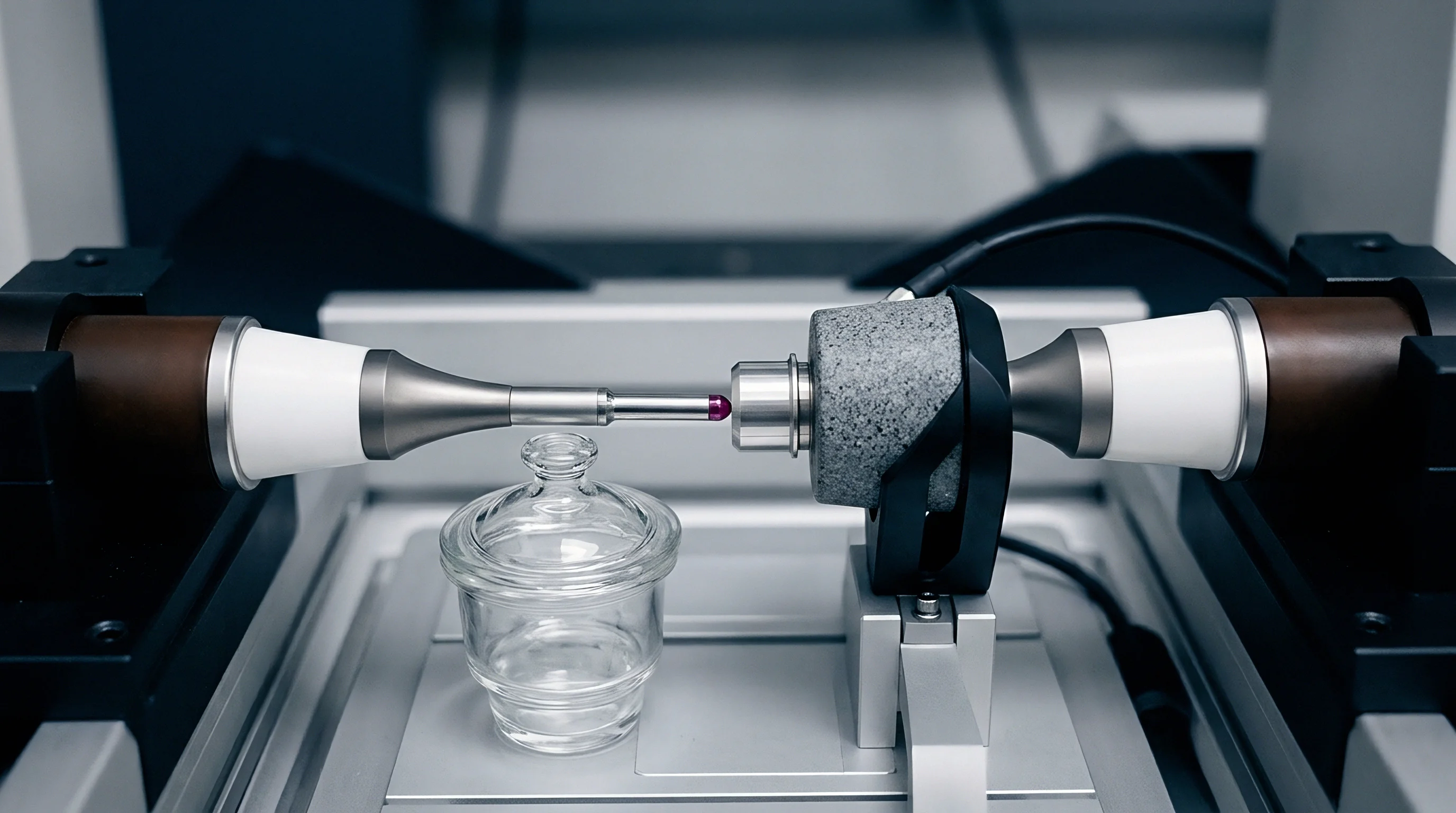
The central stem serves as both the mechanical anchor and the primary thermal conduction conduit between the housing and the vibrating shell. Mounting stresses and thermal expansion mismatches concentrate where this column joins the resonator anchor. High-precision hemispherical and toroidal architectures place this mount along the central symmetry axis to isolate the resonant rim from package strain, but radial temperature differentials across the column defeat that isolation.
Heat entering one side of the stem conducts toward the anchor unequally, producing a tilted thermal field across the resonator root that pushes standing waves off-axis. This asymmetry establishes an anisoelastic compliance distribution that converts simple linear thermal expansion into apparent angular torque.
Substrate Thermoelastic Properties under Gradients
Substrate selection sets the physical boundary for quality factor degradation when external temperatures shift abruptly. High-purity fused silica combines an exceptionally low thermal expansion coefficient with an anomalous positive thermoelastic coefficient: where crystalline substrates soften and drop in resonant frequency as temperatures climb, fused silica stiffens until it nears its softening point. Single-crystal silicon features high thermal conductivity that equalizes internal temperatures rapidly, yet its strong thermoelastic coupling drives down the mechanical quality factor under localized gradients.
Synthetic diamond substrates conduct heat rapidly enough to diffuse localized thermal spikes across the entire anchor assembly almost instantaneously.
| Resonator Substrate | Quality Factor | Thermal Expansion Coefficient (ppm/K) | Thermal Conductivity (W/m·K) | Thermal Frequency Coefficient (ppm/K) |
|---|---|---|---|---|
| High-Purity Fused Silica | 25,000,000 | 0.50 | 1.38 | +80.0 |
| Ultra-Low Expansion Titania-Silicate Glass | 8,000,000 | 0.03 | 1.31 | +65.0 |
| Single-Crystal Silicon (111) | 3,500,000 | 2.60 | 148.0 | -30.0 |
| Chemical Vapor Deposition Diamond | 12,000,000 | 1.00 | 2000.0 | -12.0 |
While silicon exhibits steep thermoelastic damping, fused silica delivers superior quality factors. Ultra-low expansion titania-silicate glass stabilizes dimensions across moderate temperature spans, though lower bulk purity limits acoustic ring-down lifetimes. Diamond delivers unmatched thermal equilibration, shrinking transient temperature slopes across the structural anchor to negligible fractions of a degree.
The high manufacturing expense and challenging etching chemistry of diamond resonators keep fused silica as the dominant substrate for sub-arcminute gyrocompassing missions.
A radial temperature differential of 0.05 degrees Celsius across an uncompensated fused silica rim induces 1.8 milli-degrees per hour of apparent azimuth drift.

Anchor Compliance and Thermal Expansion
Mechanical fasteners transmit localized mounting loads through ceramic isolation pads directly into the central pedestal. When an aluminum or titanium housing expands at twenty-three parts per million per Kelvin, an unisolated fused silica stem experiences intense compressive and shear forces at its bonded joint. Compliant isolation rings fabricated from invar or molybdenum match the expansion coefficient of fused silica, preventing joint slippage and hysteresis.
Adhesive layers introduced at this boundary inject viscoelastic creep that degrades bias repeatability over thermal cycles; direct glass-to-metal solder joints or gold diffusion bonds preserve high structural rigidity while preventing long-term zero-point wandering. Differential expansion between the titanium stem adapter and the fused silica anchor introduces mechanical shear stresses that persist long after the external environment stabilizes.


Mismatch
Standing wave patterns in axisymmetric shells require precise frequency degeneracy between orthogonal vibration nodes. Manufacturing tolerances and material anisotropies create a baseline split between the primary driving mode and the secondary sensing mode, which electrostatic trimming voltages close down to micro-hertz intervals. When steep thermal gradients pass through the shell, localized variations in Young’s modulus perturb this electronic balance.
A differential temperature of 0.01 degrees Celsius between the nodal and antinodal axes of a fused silica hemispherical shell shifts the resonant frequency by approximately 0.8 millihertz, generating phase-shifted velocity components that bleed into the Coriolis demodulation channel.
How Does Radial Heat Flux Distort Standing Wave Symmetry?
Unequal heat flux across the resonator circumference shifts the elastic modulus along distinct azimuths. The acoustic velocity of shear and bending waves increases on the warmer side of a fused silica shell, bending the nodal lines away from their orthogonal ninety-degree spacing. As the nodal geometry warps, the primary drive force couples energy directly into the pickoff electrodes without base rotation, blinding the phase demodulator with quadrature error.
An incoming radial thermal flux acts as an asymmetric acoustic lens, scattering the energy of the standing wave into parasitic higher-order spatial harmonics.
At forty-five degrees north, where the horizontal component of planetary rotation equals 10.635 degrees per hour, take a hemispherical resonator operating at 5000 hertz with a mechanical quality factor of ten million. A 0.5 degree Celsius per centimeter radial gradient across the shell induces an uncompensated frequency split of 1.2 millihertz. Under open-loop or imperfect closed-loop demodulation, this frequency split generates a quadrature leakage signal proportional to twice the product of the split and the primary drive amplitude.
If front-end analog drift shifts the demodulation phase reference by only 0.05 degrees, that quadrature component leaks into the in-phase rate channel, yielding an apparent drift of 0.042 degrees per hour. When projected into an azimuth calculation, this false rate produces eight arcminutes of gyrocompassing pointing error.
Secondary electronic phase shifts mimic mechanical Coriolis force signals during fast thermal transients.

Continuous Mode Rotation Architecture
Force-to-rebalance electronics electrostatically rotate the standing wave pattern through ninety degrees at periodic intervals. This mode-reversal control sequences the standing wave through alternating orientations to cancel spatially fixed bias errors without rotating the physical sensor casing. Electrostatic force electrodes apply parametric excitation and damping terms that rotate the acoustic pattern smoothly without dropping vibration amplitude, while the processing engine swaps the functional roles of the drive and sense electrode pairs synchronously with the rotation.
- Primary mode stabilization locks the carrier vibration amplitude to a fixed mechanical setpoint using automatic gain control loops.
- Secondary quadrature nulling applies real-time electrostatic stiffness tuning to drive modal frequency splits below ten micro-hertz.
- Pattern angle precession commands a ninety-degree electrostatic shift of the standing wave pattern at a repetition frequency of two hertz.
- Differential signal demodulation subtracts the forward-pattern and reverse-pattern rate readouts to cancel out spatial bias vectors induced by uneven thermal profiles.
- Filter convergence confirmation verifies that the bias-free residual rate settles within acceptable noise envelopes before releasing the heading computation.
Mode-reversal algorithms suppress static and slowly changing thermal biases effectively. However, when the thermal slew rate exceeds two degrees Celsius per minute, the spatial gradient shifts faster than the switching frequency can average out the asymmetric stiffness tensor. The residual bias then exhibits an error component proportional to the second time derivative of the localized temperature field.
Whether capacitive actuation arrays can maintain sub-angstrom electrode gaps under non-uniform thermal expansion without introducing parasitic electrostatic stiffness gradients remains an open problem across the industry.

Ramp
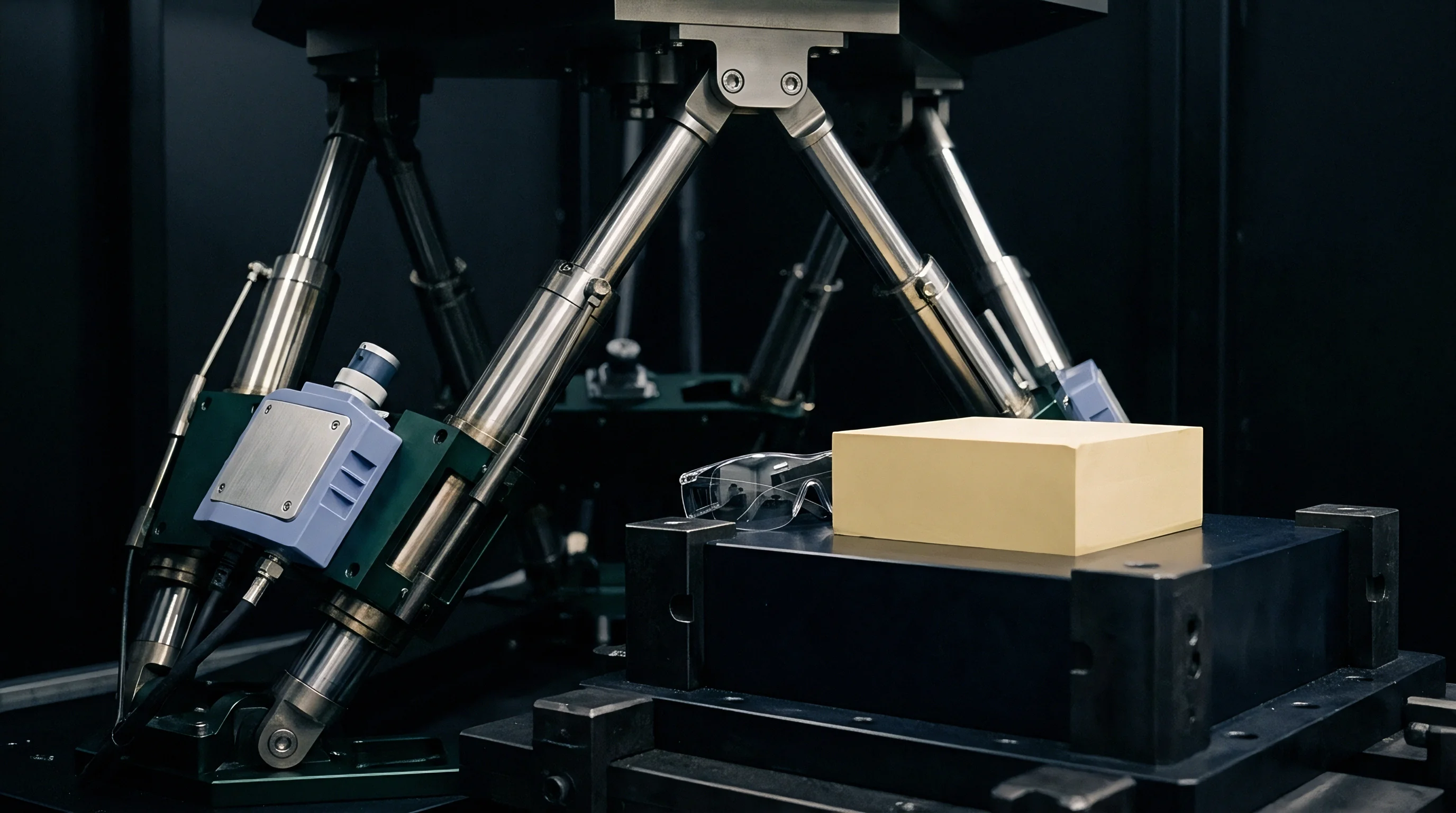
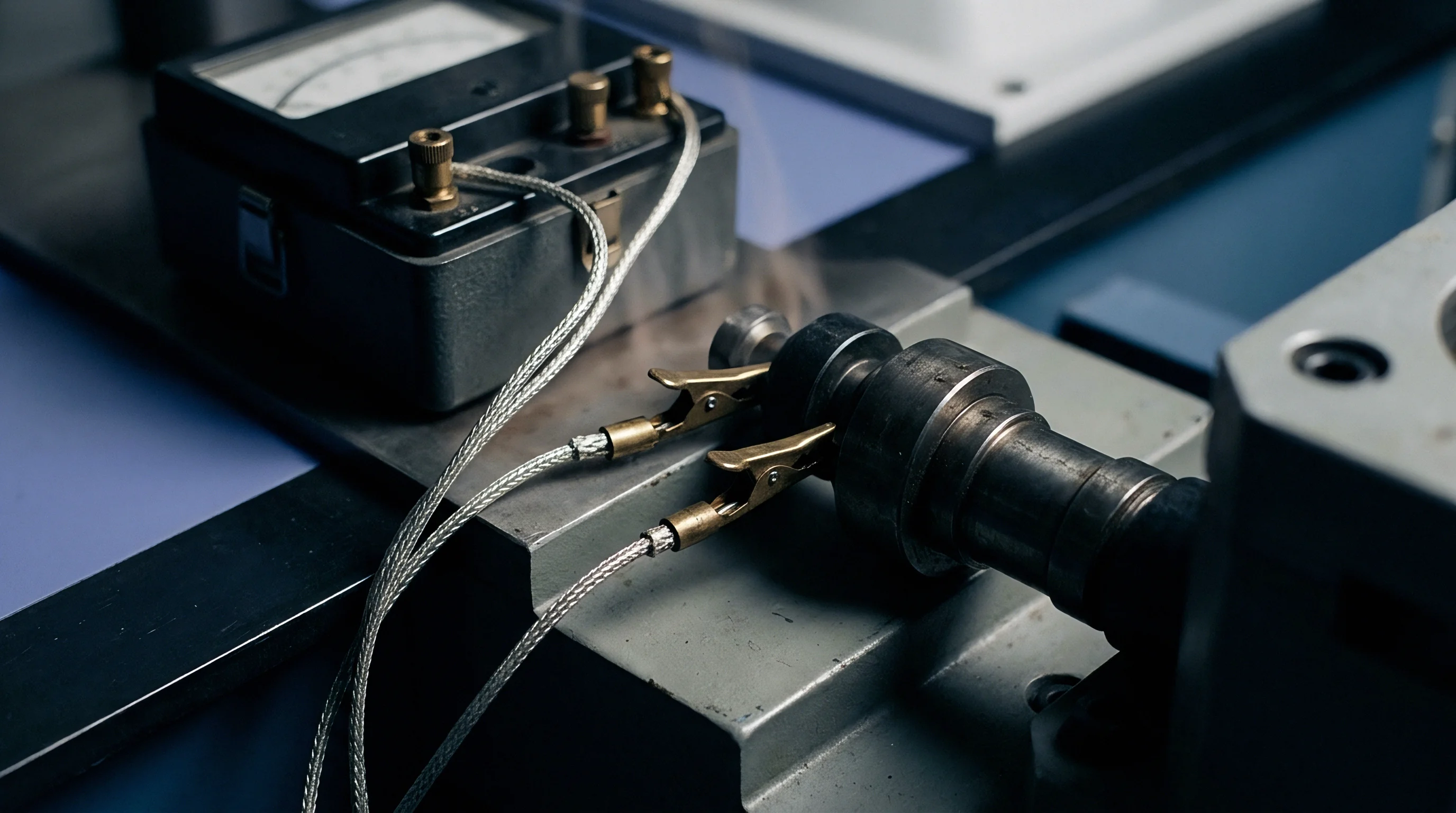
Environmental qualification protocols subject inertial instruments to severe external temperature slew rates exceeding two degrees Celsius per minute. Fast thermal ramps stress the structural symmetry of the inner core before outer protective insulation can attenuate the heat wave. The rate of change of temperature generates internal thermal distributions completely distinct from steady-state hot or cold conditions.
Conduction delays through multi-layer enclosures cause internal chassis structural elements to expand asynchronously, imparting twisting moments across the sensor mountings and driving software filters to complete divergence when reliant solely on static lookup tables.
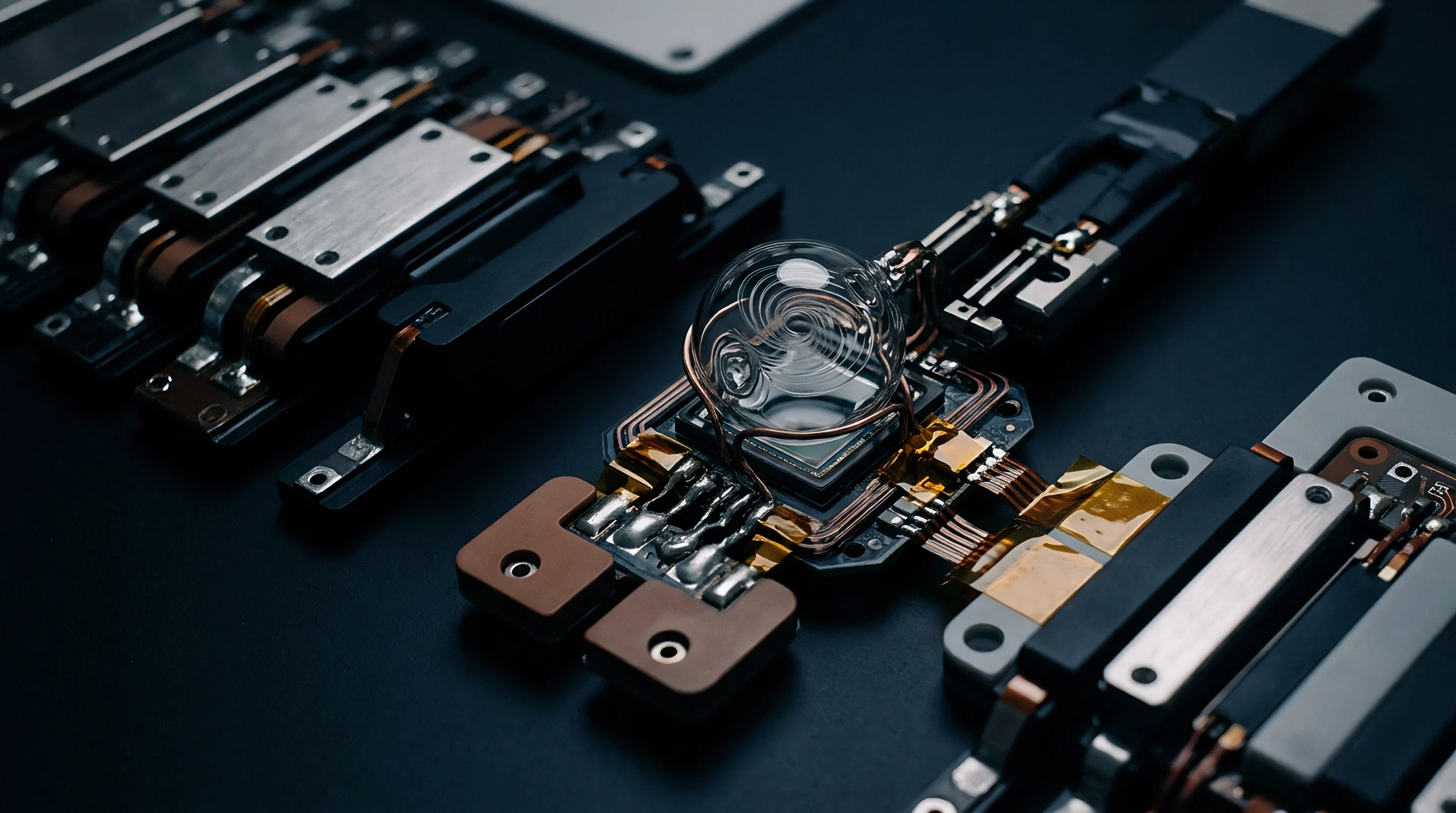
Does Carrier Suppression Eliminate Transient Phase Noise?
Synchronous demodulation circuits track high-frequency velocity pickoff signals against a stable voltage reference. Phase errors between the drive reference clock and the pickoff preamplifier convert the massive quadrature signal into equivalent in-phase rate signals. High dynamic thermal gradients shift operational capacitances, input resistances, and transmission delay times across the analog front end.
Suppressing the carrier wave through differential bridge pickoff topologies reduces the common-mode voltage presented to preamplifier inputs, mitigating phase jitter during temperature ramps.
| Resonator Architecture | Raw Bias Drift (°/hr) | Quadrature Leakage (°/hr) | Heading Uncertainty (arcmin) | Settling Duration (min) |
|---|---|---|---|---|
| Uncompensated Fused Silica Ring | 0.085 | 0.320 | 48.0 | 35.0 |
| Static Polynomial Compensated Ring | 0.024 | 0.095 | 13.5 | 22.0 |
| Thermal Differential Real-Time Model | 0.006 | 0.018 | 3.4 | 12.0 |
| Continuous Mode Reversal Glass Shell | 0.001 | 0.003 | 0.6 | 4.5 |
| Values reflect an ambient transition from minus twenty to plus sixty degrees Celsius at two degrees per minute in an evacuated hermetic housing. | ||||
Static calibration tables fail during transients. A sensor calibrated under slow chamber ramp rates of 0.1 degrees Celsius per minute exhibits low residual bias during slow diurnal shifts, but exposing that same unit to engine bay heat plumes or sudden airborne ascents introduces massive hysteresis loops in the rate output. The sensor output diverges because the instantaneous internal gradient depends directly on the direction and history of the thermal vector.
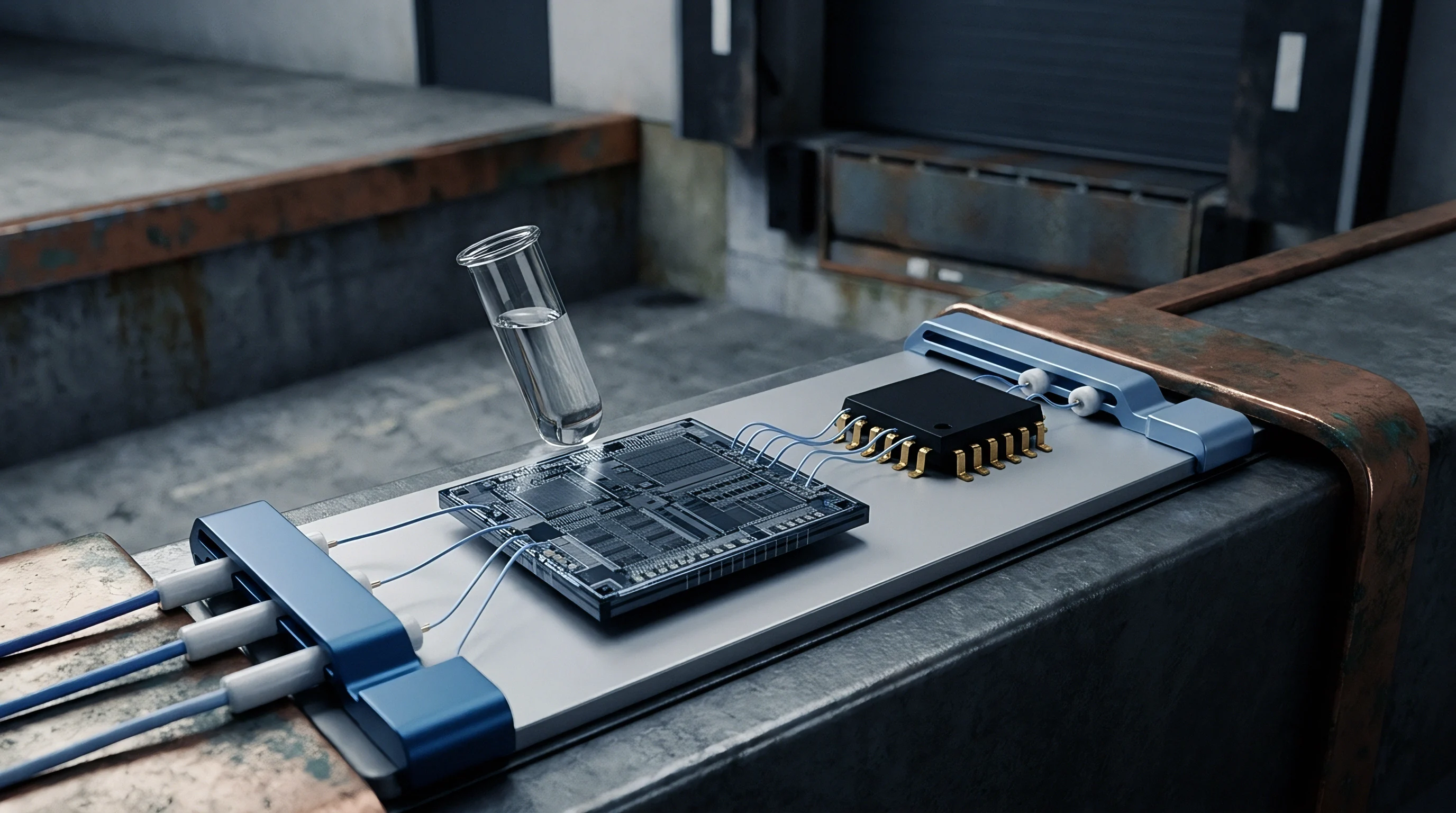
Calibration Polynomial Breakdown during Shock
Static factory look-up tables map sensor offset strictly as a stationary function of housing temperature. Because these traditional polynomials lack temporal derivative terms, they treat temperature as an instantaneous scalar value. During transient heating, a housing thermometer reads fifty degrees Celsius while the inner vibrating mass remains at thirty degrees.
The compensation engine applies an over-calculated stiffness correction based on the hot housing, injecting an artificial bias error into the navigation Kalman filter.
- Spatial differential sensor arrays embed platinum resistance thermometers directly onto opposing quadrants of the resonator mounting plate to capture directional heat flux.
- Temporal derivative filtering injects first and second time derivatives of temperature into the compensation polynomial to account for thermal propagation lag.
- Dual-mode resonance tracking monitors the sum and difference frequencies of the primary and secondary modes simultaneously to extract self-sensing core temperature readouts.
- Kalman state augmentation includes gradient-induced drift states within the primary navigation alignment filter, adjusting observation noise covariance dynamically during temperature swings.
Dual-mode self-sensing provides the most accurate estimation of real-time resonator core temperature. By interrogating the fundamental resonance frequency alongside an out-of-band auxiliary mode, the instrument uses the physical glass shell itself as an ultra-precise thermometer, bypassing the thermal lag inherent in discrete external resistance thermometers. Thermal compensation models calibrated on cooling curves fail when applied to heating cycles.

Allowance
Commercial specifications for navigation-grade inertial units define acceptable heading uncertainty under tightly controlled static lab environments, citing sub-arcminute pointing capabilities derived after six-hour settling periods at constant room temperature. Field deployments rarely grant these calm baseline conditions. When military vehicles, autonomous drilling heads, or naval vessels demand immediate gyrocompassing upon power-up in hostile thermal zones, real operational performance hinges upon gradient tolerance allowances.
Sourcing high-purity fused silica remains difficult, leading systems engineers to evaluate sensor procurements by examining thermal test profiles rather than static bias stability metrics.
MIL-STD-810H Method 503.7 Procedure I-B mandates ten degree per minute thermal ramps that void baseline factory calibration certificates.

Supplier Yield Metrics and Testing Overhead
Wafer-level manufacturing of fused silica and crystalline silicon shells exhibits significant parameter dispersion. Sub-angstrom mass balancing demands precise laser micro-machining or focused ion beam etching on every manufactured unit. When suppliers evaluate production yield against sub-arcminute gyrocompassing specifications under dynamic thermal slew rates, pass rates drop precipitously: a wafer lot displaying ninety percent yield under isothermal test conditions often drops below twenty percent when subjected to two degree per minute thermal stress screening.
Because incoming resonator lots undergo destructive audits, unit procurement pricing for certified high-dynamic resonant gyroscopes reaches levels five to eight times higher than standard tactical-grade inertial sensors.

Contract Language for Environmental Qualification
Procurement documents often cite standard commercial environmental baselines without stipulating transient rate tolerances. Standard specifications such as IEEE 952 define verification methodologies for bias drift, random walk, and scale factor linearity, yet omit standardized dynamic thermal gradient test profiles. Specifying engineers incorporate explicit thermal gradient slew rates directly into delivery contracts, where demanding guaranteed sub-arcminute heading alignment within eight minutes of startup under an external three degree per minute temperature ramp screens out lesser architectures.
Suppliers unable to implement continuous mode reversal or multi-point spatial thermal modeling decline these clauses outright, and inserting ISO 17025 thermal gradient compliance clauses into purchase schedules shifts the financial liability for cold-soak drift screening entirely onto the silicon foundry.