Quantifying Magnetic Drift in Amorphous Alloys under Field Annealing Conditions
Field annealing amorphous alloys establishes directional pair anisotropy, reducing thermal permeability decay and zero-offset sensor drift below one percent per decade.

Foil
Amorphous soft magnetic alloys lack long-range crystalline order, presenting a metastable atomic configuration produced via rapid solidification at cooling rates exceeding one million kelvin per second. Melt-spun ribbons fabricated from iron-based, cobalt-based, or nickel-substituted formulations retain high electrical resistivity and low magnetocrystalline anisotropy. Operational exposure to thermal energy and external magnetic excitation induces subtle atomic rearrangements.
These microstructural modifications alter initial magnetic permeability, coercive force, and zero-field offset over prolonged operating schedules.

Atomic Pair Reorientation Mechanics
Sub-Curie thermal treatment under external magnetic excitation induces uniaxial magnetic anisotropy inside iron-nickel and cobalt-based metallic glasses. Thermal agitation accelerates atomic motion. Mobile atom pairs, primarily iron-iron or cobalt-cobalt nearest-neighbor pairs, align their orbital axes along the local magnetization vector.
This directional pair ordering generates an anisotropy field ranging from 10 to 500 amperes per meter, pinning the local magnetic easy axis in the field direction.
Directional ordering kinetics depend directly on thermal activation energy distributions. When an amorphous element operates at elevated temperatures under continuous bias fields, directional pair reorientation proceeds continuously. The magnetic easy axis rotates toward the applied field vector.
Permeability drops exponentially over time. Uncompensated drift degrades offset stability. The rate of anisotropy evolution scales with ambient thermal stress and magnetic field magnitude.
Cobalt-based amorphous ribbon annealed at 380 degrees Celsius under a 200 kilampere per meter transverse field exhibits a magnetic permeability drift below 0.8 percent per decade of time at operating temperatures up to 105 degrees Celsius.
Free Volume Annihilation and Anisotropy Shifts
Quenched-in structural defects coalesce during prolonged operational heating, altering local atomic packing density and macroscopic coercivity. Rapid quenching traps excess free volume within the amorphous matrix. Thermal aging causes structural relaxation, characterized by excess free volume annihilation and atom packing densification.
Coercivity limits sensor resolution.
Structural relaxation occurs independently of magnetic field direction, raising bulk material density while reducing internal stress concentrations. As free volume dissipates, local atomic coordination numbers shift, altering local magnetostriction constants. The combination of directional pair ordering and free volume annihilation causes irreversible magnetic drift.
High-precision fluxgate cores experience zero-point output shifts when subjected to continuous DC magnetic fields during high-temperature operation. Ignoring microstructural relaxation mechanisms leads directly to uncompensated offset shifts in zero-flux sensors operating above 85 degrees Celsius.


Chamber
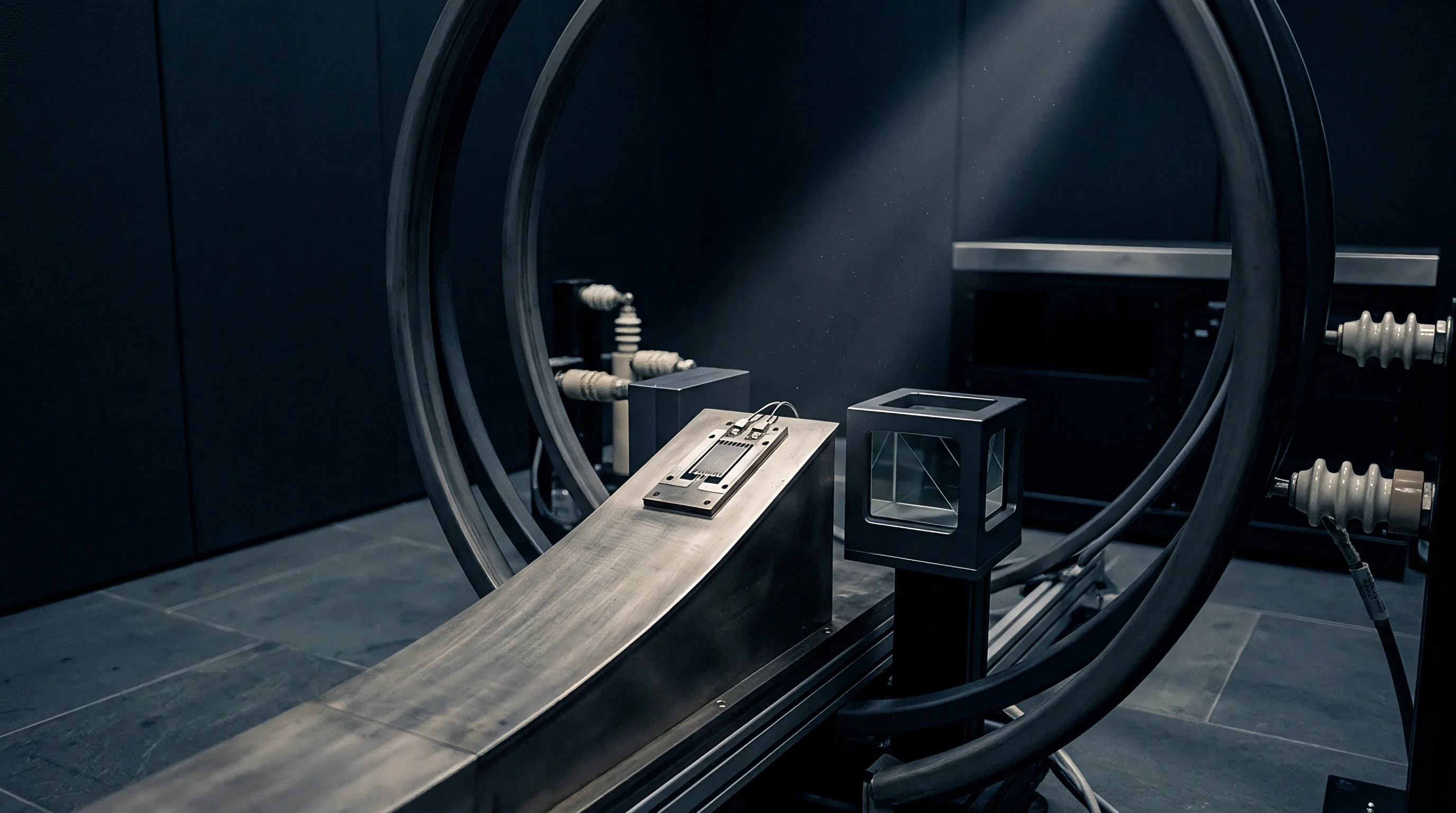
Field annealing equipment delivers thermal energy and uniform magnetizing fields simultaneously across the processing volume. The process environment governs both immediate magnetic performance and long-term microstructural stability. Precise heat control prevents partial crystallization while maximizing induced magnetic anisotropy.

Transverse against Longitudinal Field Profiles
Applying magnetic vector forces parallel or orthogonal to the ribbon axis defines the ultimate magnetic axis. Longitudinal field annealing aligns magnetic domains along the ribbon axis, yielding a square hysteresis loop with high remnant magnetization and low coercive force. Transverse field annealing induces anisotropy perpendicular to the ribbon axis, producing a flat, sheared hysteresis loop characterized by constant permeability over wide field ranges.
Field strength dictates magnetic alignment. Transverse field annealing requires saturation field intensities exceeding 100 kilamperes per meter to overcome internal demagnetizing fields within stacked toroidal cores. Drive coils require active cooling.
Inadequate field uniformity across the annealing hearth causes spatially varying anisotropy fields, resulting in uncompensated permeability gradients along the core ribbon length.
| Alloy Composition | Field Configuration | Annealing Temp (°C) | Soak Duration (h) | Induced Anisotropy Ku (J/m³) | Initial Permeability μi |
|---|---|---|---|---|---|
| Fe73.5Cu1Nb3Si13.5B9 | Transverse Field | 540 | 1.5 | 25 | 120,000 |
| Fe73.5Cu1Nb3Si13.5B9 | Longitudinal Field | 540 | 1.5 | 180 | 15,000 |
| Co66Fe4Ni1Si15B14 | Transverse Field | 370 | 2.0 | 35 | 80,000 |
| Co66Fe4Ni1Si15B14 | Zero Field | 370 | 2.0 | 5 | 30,000 |
| Fe81Si3B14C2 | Transverse Field | 390 | 1.0 | 110 | 6,000 |

Thermal Ramp Calibration and Atmosphere Control
Maintaining an oxygen-free environment during high-temperature processing prevents surface oxidation and preserves core laminations. Inert gas purging using ultra-high-purity argon or nitrogen reduces ambient oxygen levels below five parts per million. Surface oxidation creates localized stress fields, increasing pinning site density and inflating coercivity.
Thermal agitation accelerates atomic motion.
Cooling rate control plays a decisive role in suppressing post-anneal drift susceptibility. Slow cooling rates below two degrees Celsius per minute allow thermal equilibrium pair ordering to form during the cooling phase. Rapid gas quenching freezes high-temperature disorder, increasing subsequent operational drift rates when the core operates near thermal limits.
DC bias shifts domain boundaries. Atmospheric purity prevents ribbon oxidation.
- Oxidative Degradation High thermal exposure without inert shielding forms surface oxide layers, pinning surface domains and raising coercive force.
- Crystalline Phase Precipitation Exceeding crystallization onset temperatures leads to alpha-iron phase nucleation, destroying soft magnetic properties and increasing core losses.
- Incomplete Pair Orientation Insufficient field intensity during thermal soak leaves random directional order, producing inconsistent anisotropy axes across laminations.
- Thermal Stress Inhomogeneity Rapid cooling ramps generate localized internal mechanical stress, inducing unwanted magnetostrictive anisotropy shifts.
Compliance with IEC 60404 standard testing schedules requires continuous temperature logging during longitudinal magnetizing exposure to prevent uncalibrated offset jumps in magnetic metering cores.
Core manufacturers commonly claim that residual permeability variations originate entirely from batch-to-batch alloy composition shifts rather than non-uniform temperature profiles across the annealing hearth.

Decay
Quantifying long-term stability in amorphous magnetic components demands precise tracking of permeability and coercive force changes over operational lifetimes. Long-term drift curves exhibit logarithmic time dependence characteristic of thermally activated relaxation processes across broad activation energy spectra. Standardized testing allows design engineers to extrapolate ten-year performance bounds from short-term environmental chamber data.
Logarithmic Relaxation Models for Long-Term Permeability
Magnetic property shifts follow time-dependent kinetics driven by a spectrum of activation energies ranging from 0.8 to 1.6 electron-volts. The fractional change in magnetic permeability follows a logarithmic degradation law defined by equation term delta permeability over initial permeability equals negative D times log ten of elapsed time over initial time. Relaxation rates decay logarithmically.
The empirical drift rate coefficient D incorporates temperature dependence via Arrhenius relationship metrics.
| Alloy Family | Nominal Composition | Activation Energy Ea (eV) | Drift Rate D (%/decade) | Coercivity Shift ΔHc (A/m per 1000h) | Offset Drift Equivalent (nT/yr) |
|---|---|---|---|---|---|
| Cobalt-Based Amorphous | Co66Fe4Ni1Si15B14 | 1.45 | 0.42 | 0.08 | 45 |
| Iron-Based Amorphous | Fe81Si3B14C2 | 0.95 | 1.85 | 0.65 | 310 |
| Nanocrystalline Fe-Cu-Nb | Fe73.5Cu1Nb3Si13.5B9 | 1.62 | 0.15 | 0.02 | 12 |
| High-Permeability Co-Fe | Co68Fe4Si13B15 | 1.20 | 0.78 | 0.14 | 95 |
Assume a fluxgate core constructed from cobalt-based amorphous ribbon operating in a current sensor assembly at 105 degrees Celsius. The core undergoes continuous DC field exposure of 800 amperes per meter. The initial magnetic permeability equals 80,000.
Applying the logarithmic relaxation equation with an empirical drift coefficient D of 0.006 per decade over an operational lifespan of 10,000 hours yields a calculated permeability reduction of 2.4 percent. For a fluxgate operating with a baseline transfer function of 50 millivolts per millitesla, a 2.4 percent drop in permeability shifts the open-loop sensor sensitivity, creating a zero-point offset error of 120 nanotesla if uncompensated in signal conditioning hardware.
Isothermal Aging Bench Test Protocols
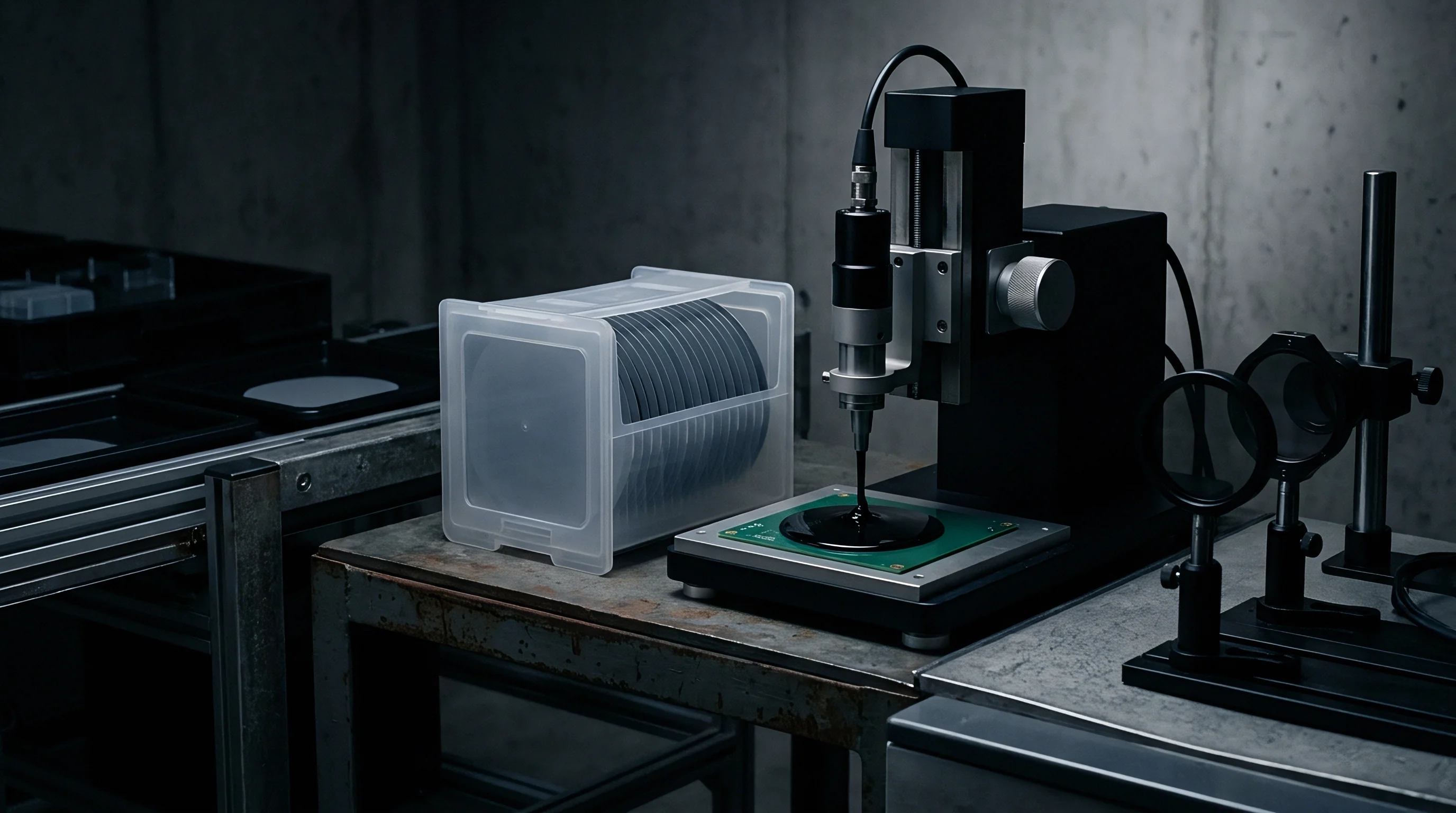
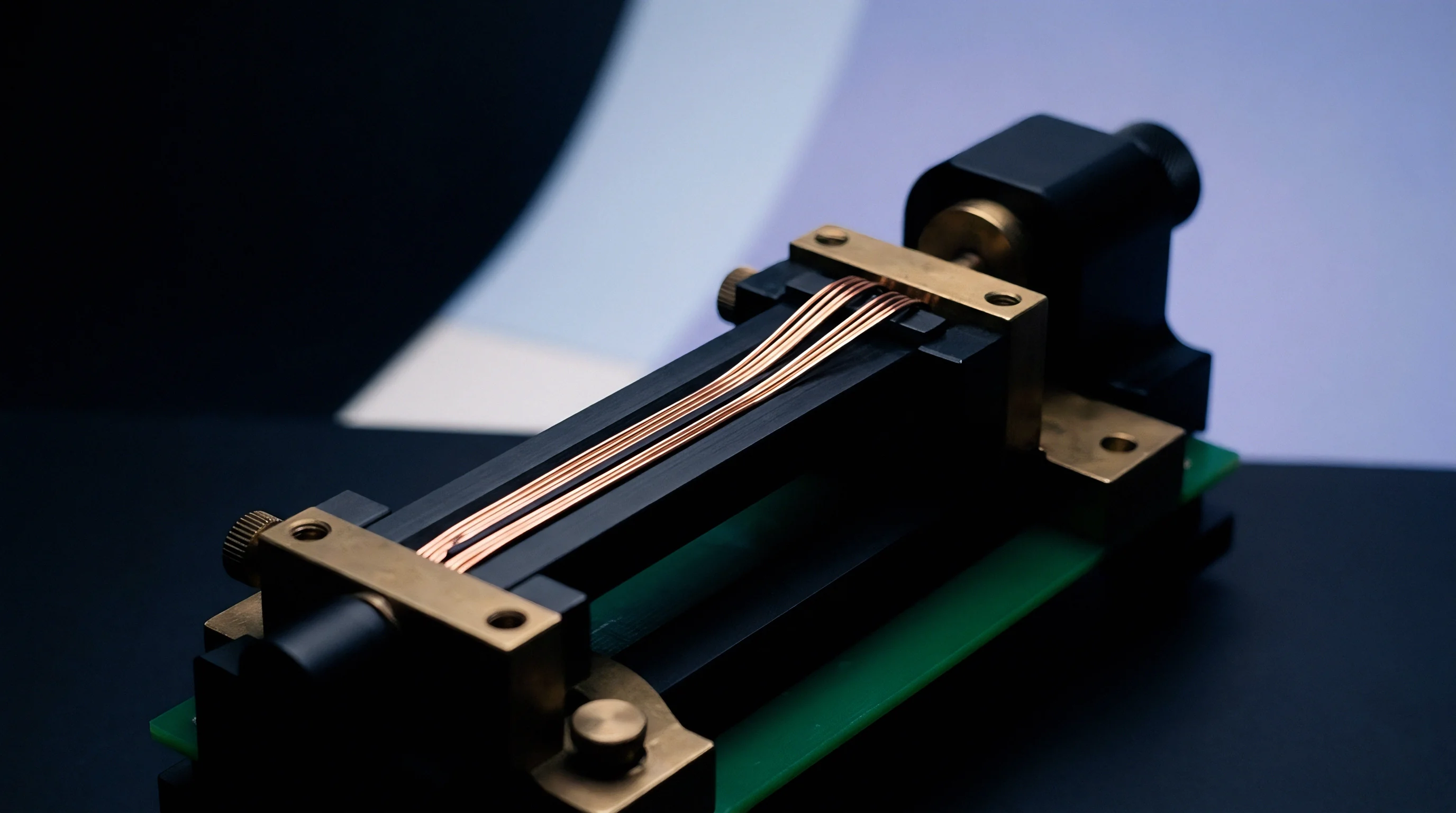
Evaluating sample strips inside high-precision solenoid fixtures yields empirical drift coefficients under controlled bias conditions. Bench testing isolating magnetic drift from ambient noise requires environmental chambers maintaining thermal stability within 0.1 degree Celsius and magnetic shielding attenuating Earth ambient fields below 5 nanotesla. Annealing alters hysteresis loop shape.
Calibration intervals double project costs.
Transverse field exposure during cooling locks domain orientations perpendicular to the principal flux path, preventing thermal domain wall relaxation from distorting sensor linearity.
- Demagnetize the core sample using an exponentially decaying 10 kilohertz AC field profile prior to initial measurement.
- Record baseline low-field initial permeability and coercive force at 25 degrees Celsius inside a zero-field magnetic shield.
- Transfer the core assembly into an environmental chamber preheated to the target aging temperature under a constant DC bias magnetic field.
- Extract the sample at logarithmic time intervals of 1, 10, 100, 500, and 1000 hours, measuring flux density curves within 30 seconds of thermal stabilization.
- Compute the logarithmic drift rate coefficient by fitting the normalized permeability degradation curve against log-time coordinates.
Specification of testing conditions according to IEC 60404-6 Clause 4.2 obligates suppliers to verify magnetic permeability stability over 1000 hours of continuous field exposure before lot sign-off.
Conditioning
Front-end electronics convert raw transducer signals while compensating for core property shifts induced by ambient field exposure. Circuit topologies targeting nanotesla-level offset stability combine closed-loop field cancellation, AC carrier demodulation, and automated core demagnetization routines.

Can Active Demagnetization Suppress Permeability Decay?
Periodic AC excitation sweeps drive amorphous cores beyond magnetic saturation, resetting domain wall configurations to neutral equilibrium states. Demagnetization pulses break metastable domain wall pinning configurations established during extended DC field exposure. Unmatched cores break bridge symmetry.
Magnetic shielding protects sensitive elements.
High-amplitude demagnetization waveforms clear remnant magnetization, but cannot reverse atomic pair reorientation induced by field annealing mechanisms. Active demagnetization restores original hysteresis symmetry while leaving bulk directional pair ordering intact. Circuit designers deploy periodic demagnetization to clear transient overload bias, relying on hardware topology matching to offset long-term directional anisotropy shifts.
Differential Topologies and Carrier Demodulation
Dual-core architectures cancel common-mode offset drift caused by temperature swings and material degradation. Placing two identical transverse-field annealed cores in a differential transformer configuration ensures that bulk permeability drift affects both channels equally. Phase-sensitive carrier demodulation extracts the differential flux signal while rejecting common-mode drift components.
- Ratiometric Carrier Excitation Drive the sensing elements with symmetrical AC current sources to balance core saturation times and cancel even-harmonic offset contributions.
- Closed-Loop Field Compensation Apply secondary feedback winding currents that maintain zero net internal flux, shielding the amorphous ribbon from external DC field stress.
- Periodic Demagnetization Sequences Inject high-amplitude burst excitation during power-up to erase thermal remnant magnetization and re-align pinned domain walls.
- Temperature-Matched Reference Cores Pair the primary sensor core with a dummy unexcited lamination exposed to identical thermal conditions to subtract structural relaxation drift.
Whether high-frequency AC demagnetization pulses permanently alter the activation energy distribution of atomic pair reorientation remains an open question for long-term orbital applications.
Yield
Sourcing amorphous magnetic cores for high-precision instrumentation demands rigorous qualification of thermal and magnetic stability metrics. Raw alloy chemistries and field annealing schedules vary across manufacturing sources, yielding disparate drift behaviors under field operational stress.
Supplier Specification Discrepancies and Core Tolerances
Datasheets often report initial permeability values taken immediately after field processing, omitting long-term drift under continuous bias. A core specified with plus or minus five percent initial permeability tolerance can exhibit twenty percent permeability decay after 5000 operating hours at 125 degrees Celsius under a 1 kilampere per meter bias field. Grain size remains sub-micron.
| Material Specification | Quoted Initial Permeability | Measured Initial Permeability | Quoted 1000h Drift (25°C) | Measured 1000h Drift (105°C) | Recommended RFQ Tolerance Limit |
|---|---|---|---|---|---|
| Cobalt-Based Flat-Loop Core | 80,000 ± 10% | 76,500 ± 4% | < 0.5% | 2.1% | ± 0.8% per decade |
| Iron-Based Square-Loop Core | 15,000 ± 15% | 14,200 ± 8% | < 1.0% | 6.4% | ± 2.5% per decade |
| Nanocrystalline High-Mu Core | 100,000 ± 10% | 102,000 ± 3% | < 0.2% | 0.7% | ± 0.3% per decade |

Acceptance Audits for High-Reliability Sourcing
Incoming quality control tests verify lot-to-lot magnetic drift parameters through accelerated thermal exposure before assembly integration. Sourcing agreements specifying maximum allowable drift rate coefficients prevent uncalibrated sensor degradation in field deployments. Procurement contracts referencing standardized 1000-hour stress testing establish clear grounds for core rejection.
Atomic pair reorientation under continuous magnetic bias shifts the uniaxial anisotropy field over long operating lifetimes.
Procuring ribbon master rolls with verified uniform melt thickness prevents local field annealing variation across manufactured transformer cores.