Micro-Strain Decay Rates in High-Temperature Epoxies under Thermal Soak
High-temperature epoxy bondlines lose shear stiffness during thermal soak, causing continuous micro-strain span decay and zero drift that require time-based derating.


Bond
Strain transfer through high-temperature epoxy adhesive layers degrades during extended thermal exposure. A bonded foil or semiconductor strain gauge relies on shear transmission through an adhesive bondline measuring between 12 and 25 micrometers in thickness. Under isothermal exposure above 150 degrees Celsius, thermoset resin networks undergo simultaneous post-curing, free volume collapse, and oxidative chain scission.
These mechanisms alter the shear modulus and induce continuous zero-point drift alongside span attenuation in bonded transducer systems. Foil strain gauge installations on high-pressure turbine housings or exhaust structures show apparent strain drift rates between 0.08 and 0.45 micro-strain per hour at 200 degrees Celsius during the initial 500 hours of continuous soak.
Specifying high-temperature adhesives demands isolation of mechanical creep from purely chemical degradation. Phenolic-cured epoxies, novolacs, and polyimide-modified formulations exhibit distinct decay signatures when held at target soak temperatures over thousands of operational hours. Novolac epoxies cross-linked with aromatic amines maintain high shear stiffness above 175 degrees Celsius, yet they accumulate brittleness from localized chain stiffening.
The resulting shear lag across the adhesive bondline lowers the effective gauge factor of the assembly over time. Standard calibration certificates generated at room temperature prior to installation capture none of this time-dependent attenuation.
A thin bondline minimizes viscoelastic shear lag across the adhesive interface under steady mechanical load.
Adhesive selection dictates the recalibration schedule of any high-temperature structural monitoring channel. The true strain experienced by the parent component fails to reach the sensing grid when the epoxy matrix loses its elastic rigidity through thermomechanical relaxation. Users who treat strain decay as purely electrical bridge drift miss the permanent mechanical loss occurring across the adhesive boundary.
| Adhesive Chemistry | Soak Temperature (deg C) | Initial Modulus (GPa) | Modulus Retention at 1000h (%) | Zero Drift Rate (micro-strain/hr) |
|---|---|---|---|---|
| Standard Bisphenol-A / Polyamide | 120 | 3.2 | 78 | 0.62 |
| Epoxy-Novolac / Aromatic Amine | 180 | 4.1 | 91 | 0.14 |
| Bismaleimide-Modified Epoxy | 230 | 3.8 | 86 | 0.22 |
| Cyanate Ester / Epoxy Blend | 200 | 3.5 | 89 | 0.11 |
| Polyimide High-Temp Adhesive | 260 | 2.9 | 94 | 0.07 |
Thicker bondlines accelerate strain transmission decay by introducing a larger volume of viscoelastic polymer between the substrate and the carrier backing. Minimizing glue line thickness to twelve micrometers establishes maximum shear transmission fidelity. Bondline thickness variation across a gauge array introduces spatial dispersion in apparent decay rates.
Strict clamping pressures during hot-curing cycles prevent excessive resin pooling and void formation.
Higher glass transition values yield slower decay slopes under moderate thermal loading.
Glass
Does Strain Transmission Follow Arrhenius Scaling?
Polymer physical aging operates as an ongoing non-equilibrium densification process below the glass transition temperature. When an epoxy cures, rapid cooling into the glassy domain traps excess thermodynamic free volume within the cross-linked network. During subsequent thermal soak at elevated operating temperatures, molecular chains slowly rearrange toward equilibrium density.
This volumetric contraction generates internal shrinkage stresses within the constrained adhesive layer, manifesting directly as compressive micro-strain drift on the gauge bridge.
Physical aging dominates drift kinetics during the first 200 hours of thermal exposure. As the cross-link network relaxes, the shear modulus increases slightly while yield stress climbs and fracture toughness drops. Once the thermal soak temperature approaches within 30 degrees Celsius of the glass transition threshold, segmental mobility rises exponentially.
Viscoelastic creep accelerates under applied static load, driving severe shear relaxation.
The glass transition temperature drops when atmospheric moisture penetrates the cured adhesive matrix during operational down-time.
Thermal degradation mechanisms take over when soak periods exceed 1000 hours at temperatures exceeding 180 degrees Celsius. Atmospheric oxygen diffuses into the bond perimeter, attacking aliphatic segments and causing thermo-oxidative chain cleavage. This reaction lowers the glass transition temperature over time, shifting the operational point closer to the rubbery plateau.
The rate of decay switches from a logarithmic physical aging curve to a linear or accelerating chemical degradation curve.
- Primary post-curing densification causes initial rapid zero drift via localized cross-linking completion.
- Secondary free volume reduction drives continuous compressive baseline shift across the first 500 thermal hours.
- Oxidative chain cleavage degrades the core polymeric backbone and reduces ultimate shear strength after long soak periods.
- Interfacial debonding propagation destroys strain transfer efficiency through micro-void coalescence along the metal substrate.
Arrhenius models frequently fail to predict decay kinetics across wide temperature regimes. The effective activation energy changes abruptly when the test temperature crosses physical transition zones. Extrapolating a 150-degree decay rate to forecast 220-degree behavior introduces errors exceeding 300 percent in lifetime span drift calculations.
The exact point where physical densification ceases and chemical chain scission begins remains undetermined for complex modified multi-part formulations.

Slip

Mechanical Strain Loss across Adhesive Boundaries
Transferring mechanical deformation from a metallic component into a sensing element requires high boundary shear stiffness. When the polymer softens or undergoes internal yield, partial displacement occurs within the adhesive itself. This phenomenon, known as shear lag, causes the gauge grid to record only a fraction of the substrate deformation.
The strain transmission factor measures the ratio of sensed strain to actual substrate strain.
Isothermal aging lowers the transmission factor steadily under sustained mechanical loading. A test coupon subjected to 1000 micro-strain of static tension at 200 degrees Celsius shows progressive decay in registered signal. Within 100 hours, the measured output drops by 15 to 45 micro-strain, solely due to anelastic relaxation inside the epoxy binder.
Upon complete unloading, the sensor indicates a false residual compressive strain because the relaxed polymer resists immediate elastic recovery.
| Epoxy Chemistry | Test Duration (hr) | Soak Temperature (deg C) | Span Decay (%) | Apparent Mechanical Drift (micro-strain) |
|---|---|---|---|---|
| Bisphenol-F / Anhydride | 500 | 160 | -3.2 | -65 |
| Cycloaliphatic / Anhydride | 1000 | 190 | -2.1 | -42 |
| Novolac / Dicyandiamide | 1000 | 175 | -1.8 | -38 |
| Triglycidyl p-Aminophenol (TGAP) | 1500 | 220 | -4.7 | -110 |
| Tetraglycidyl Methylenedianiline (TGMDA) | 2000 | 240 | -6.1 | -185 |
Creep compliance functions describe this decay behavior across mechanical loading profiles. In a standard linear viscoelastic regime, the time-dependent compliance increases according to power-law kinetics. For high-temperature epoxies operating near their thermal ceiling, non-linear compliance terms emerge at strains exceeding 1200 micro-strain.
Higher stress levels accelerate the micro-strain decay rate disproportionately.
Interfacial shear stress concentrates heavily at the outer edges of the strain gauge carrier. Thermal expansion mismatches between the metallic structure, the adhesive, and the polyimide or glass-fiber carrier generate persistent baseline stresses. Over hundreds of thermal hours, these interfacial peak stresses cause localized edge delamination, reducing the effective bonding area and permanently attenuating sensor sensitivity.
Ignoring shear boundary relaxation causes test engineers to mistake structural stress relief for sensor drift, leading to false structural health alarms and unbudgeted plant shutdowns.
Bench
Is Isothermal Aging Reversible below Glass Transition?
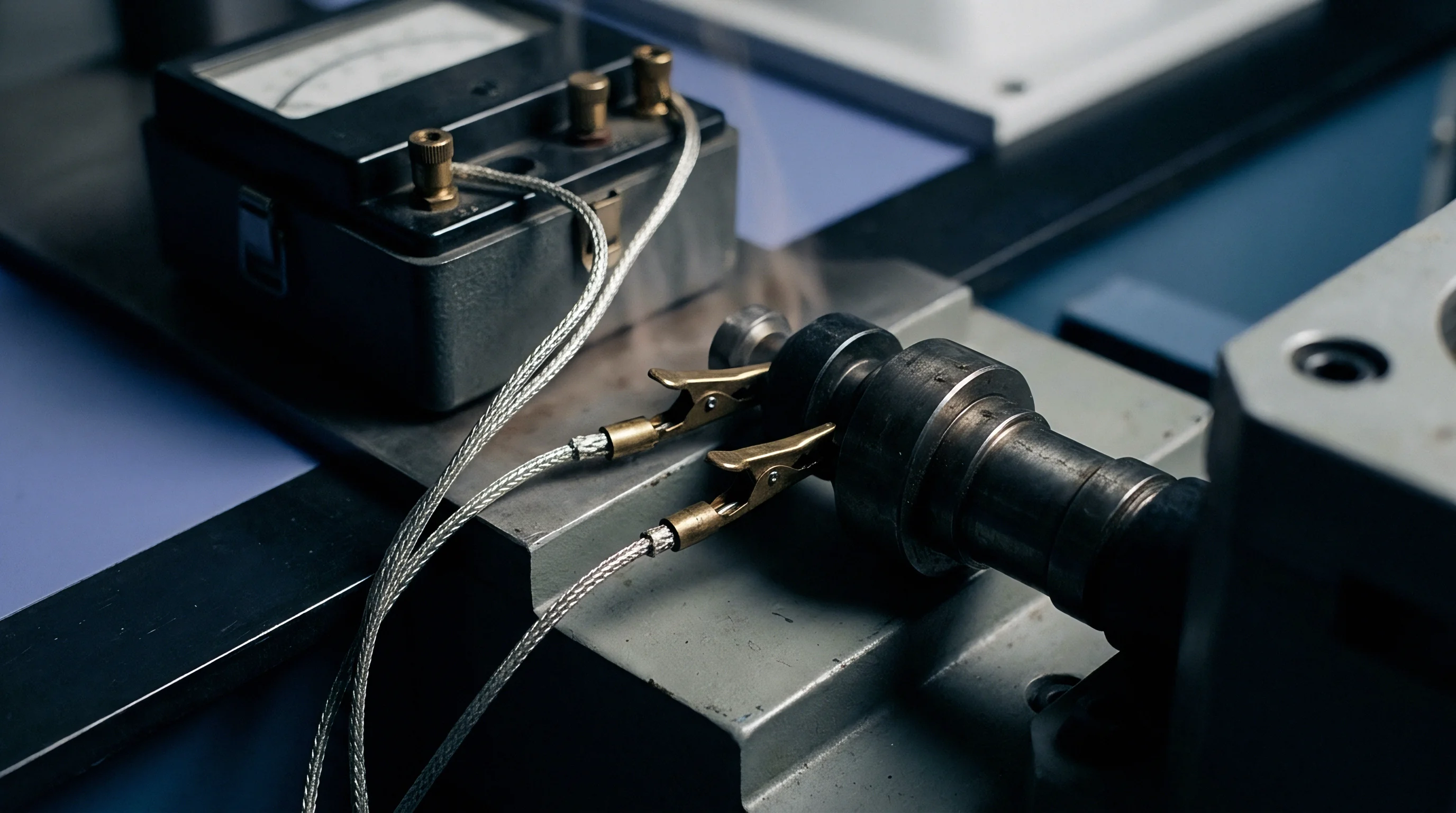
Laboratory quantification of micro-strain decay requires rigid environmental isolation and multi-channel reference compensation. Thermal test chambers must maintain spatial temperature stability within 0.5 degrees Celsius across the test plate. Uncompensated temperature fluctuations introduce apparent thermal output shifts that obscure subtle micro-strain decay trends.
Reference gauges mounted on unstrained dummy coupons fabricated from identical substrate alloys provide essential baseline thermal compensation.
ASTM E251 defines standard testing parameters for evaluating performance characteristics of electrical resistance strain gauges including drift and creep.
Consider a practical verification scenario on a nickel-chromium test bar. The assembly mounts eight high-temperature foil strain gauges using an epoxy-novolac adhesive cured at 180 degrees Celsius for four hours, followed by a post-cure soak at 220 degrees Celsius for two hours. The test puts the bar under a constant four-point bend producing exactly 1500 micro-strain at a stabilized soak temperature of 200 degrees Celsius.
The test runs continuously for 1200 hours while logging bridge voltage, insulation resistance, and lead wire resistance.
- Initial stabilization window captures the first 24 hours of rapid thermo-electric settling and unreacted curing agent burn-off.
- Isothermal creep tracking records mechanical signal relaxation under sustained load at fifteen-minute sampling intervals.
- Periodic unloading cycles measure the accumulating permanent offset drift independently from span loss every 200 hours.
- Insulation resistance verification monitors leakage resistance between the foil grid and the substrate plate below 100 mega-ohms.
A drop in insulation resistance across the adhesive layer distorts Wheatstone bridge balance. At temperatures above 200 degrees Celsius, epoxy resins become mildly conductive due to mobile ionic impurities. An insulation resistance drop from 1000 mega-ohms down to 10 mega-ohms induces an apparent zero shift of approximately 15 micro-strain on a 350-ohm gauge circuit.
Calibration benches must record leakage resistance continuously to separate electrical shunt effects from mechanical adhesive relaxation.
Suppliers frequently state that zero-point baseline wander under thermal soak represents standard bridge wire desoldering rather than adhesive matrix relaxation.
Margin

Derating Schedules and Tolerance Budgets
Compensating for micro-strain decay over multi-year asset deployments demands structured derating factors in structural monitoring systems. An unverified sensor installation that reports within 1.0 percent accuracy during commissioning can drift past 8.0 percent total uncertainty after 3000 hours of thermal soak at 180 degrees Celsius. Procurement specifications must state maximum allowable decay rates per 1000 operating hours under defined thermal boundaries.
Financial risk surfaces when uncompensated decay alters safety margin calculations on critical machinery. Gas turbine validation trials, nuclear steam line assessments, and aerospace exhaust evaluations rely on strain measurements to confirm life-consumption models. If adhesive decay attenuates reported stress amplitudes by 5.0 percent, calculated fatigue life overestimates true component durability by up to 25 percent.
The cost of replacing prematurely cracked turbine hardware far exceeds the price of qualified high-temperature adhesives and traceable burn-in procedures.
Engineering teams manage adhesive decay risk by incorporating mathematical correction kernels within data acquisition firmware. These algorithms apply empirical decay curves derived from chamber testing to adjust live strain readings based on accumulated thermal soak time. Periodic in-situ shunt calibration verifies electrical circuit continuity but cannot identify mechanical bondline softening.
Direct mechanical recalibration using localized load application remains the only method to confirm true span retention.
Procurement documents must incorporate precise contractual acceptance criteria for adhesive lots. A contract clause specifying maximum drift under ISO 10012 compliance binds the resin vendor to verify that batch-specific shrinkage drift does not exceed 0.15 micro-strain per hour at peak rated temperature across a 500-hour validation soak.