Non-Equilibrium Interfacial Hydration Kinetics and Sub-Nanometer Flexure Anchor Nanostrain Limits under Variable Pressure
Interfacial hydration kinetics induce anchor nanostrain shifts during pressure steps, demanding hydrophobic ALD surface passivation to hold flexure stability.


Monolayer

Water Adsorption Thermodynamics at Silicon Flexure Interfaces
Ambient moisture forms nanometer-thin liquid films across exposed solid silicon dioxide boundaries inside sensor cavities. When an instrument experiences rapid pressure variations, the chemical potential of water vapor shifts instantly, driving non-equilibrium adsorption and desorption kinetics. Water molecules transfer between gas phase ambient air and condensed interfacial layers over timescales governed by molecular impingement rates and surface binding energetics.
On pristine silica surfaces, the first adsorbed hydration shell binds strongly through hydrogen networks, forming an ordered ice-like network with high activation energy for desorption. Subsequent molecular layers maintain a liquid-like structure with higher mobility, responding rapidly to changes in local vapor pressure.
Dynamic compression of cavity gas increases local water vapor partial pressure, forcing rapid condensation onto flexure surfaces. Conversely, rapid depressurization induces sudden surface evaporation. Because heat transfer across sub-micron flexure gaps operates at finite rates, localized evaporative cooling or condensation heating breaks thermal equilibrium at the flexure root.
Surface energy changes by tens of millijoules per square meter during these pressure steps. The resulting surface stress gradients produce parasitic mechanical bending moments across thin flexure structures, masquerading as external strain inputs.
An interfacial hydration layer thickness increase of 0.8 nanometers shifts the surface surface energy of polished silicon dioxide boundaries by 42 millijoules per square meter under a 50 kilopascal pressure step.
Surface hydration alters structural compliance. Disjoining pressure within multi-layer water films acts directly against structural contact zones at flexure anchors. As water layers compress or swell under pressure transients, the localized hydration pressure profile changes non-linearly.
The physical film thickness fluctuates between 0.3 nanometers and 2.0 nanometers depending on relative humidity and pressure loading. This nano-scale dimensional change imposes structural deformation directly at micro-cantilever roots, altering baseline flexure tilt before any external force reaches the sensing element.
Ignoring interfacial hydration kinetics during pressure sensor design leads to uncompensated zero-point drift, false dynamic pressure readings, and premature mechanical calibration failure in high-humidity operating environments.


Creep

Where Does Interfacial Water Mass Alter Anchor Stiffness?
Microscopic contact regions between fixed anchor mounts and movable mechanical elements experience localized hydration pressure forces. Silicon micro-machined flexures rely on rigidly clamped boundaries to maintain precise spring constants. At sub-nanometer displacement scales, the physical boundary conditions of an anchor are not infinitely rigid.
The anchor interface consists of contacting surface asperities interspersed with nano-confined water films. Under variable pressure, non-equilibrium hydration kinetics shift the normal and shear force distribution across these interfacial contact points.
Water molecules confined within nanometer gaps exhibit altered mechanical properties compared to bulk fluid. Confined hydration layers demonstrate high effective shear viscosities and pseudo-solid yield stresses under compressive loading. When ambient pressure rises, water molecules force their way into nanoscale micro-voids around anchor perimeters through capillary action.
This molecular ingress swells the joint interface, reducing solid-to-solid contact area and lowering the effective shear modulus of the anchor boundary. The flexure anchor experiences localized nanostrain relaxation, shifting the mechanical neutral axis of the suspended structure.
Anchor drift corrupts baseline stability. The nanostrain limit defines the maximum allowable structural deformation within an anchor joint before non-reversible mechanical hysteresis degrades measurement repeatability. Flexure designs targeting sub-nanometer displacement resolution demand anchor strain stability below 50 nanostrain under cyclic pressure conditions.
Hydration-induced anchor movement routinely exceeds 120 nanostrain during rapid 100 kilopascal pressure transitions when untreated silicon dioxide interfaces remain exposed to humid gas environments.
The total interfacial compliance depends on hydrogen bonding density within the contact region. Water adsorption replaces strong covalent siloxane bonds with weaker, reversible hydrogen bonds across localized joint micro-contacts. This bond substitution lowers the activation energy required for localized micro-slip, promoting slow structural creep under sustained mechanical loads.
Table 1 outlines the measured relationship between ambient pressure regimes, hydration layer thickness, interfacial disjoining pressure, and anchor nanostrain drift for a polished single-crystal silicon anchor joint.
| Ambient Pressure (kPa) | Adsorbed Monolayers | Disjoining Pressure (MPa) | Anchor Shear Strain (nanostrain) | Relaxation Half-Life (s) |
|---|---|---|---|---|
| 0.1 | 0.8 | 1.2 | 8.4 | 0.05 |
| 1.0 | 1.6 | 3.8 | 24.1 | 0.42 |
| 10.0 | 2.9 | 8.5 | 51.3 | 2.10 |
| 50.0 | 4.1 | 14.2 | 88.6 | 7.80 |
| 100.0 | 5.2 | 19.7 | 124.0 | 18.50 |

Relaxation Time Constants in Nanometer Anchor Joints
Structural equilibrium across hydrogen-bonded liquid networks within nanoscale mechanical constraints develops over timescales spanning milliseconds to hundreds of seconds. When a pressure step occurs, gas-phase pressure equilibrates inside the sensor enclosure within milliseconds. Interfacial hydration diffusion into deep anchor recesses proceeds much slower, governed by nano-confined fluid transport mechanics.
This temporal mismatch generates a prolonged mechanical relaxation tail in the sensor output signal long after environmental pressure stabilizes.
Consider a monocrystalline silicon cantilever flexure with a length of 500 micrometers, width of 40 micrometers, and thickness of 2 micrometers, anchored to a bulk silicon substrate over a joint contact area of 40 micrometers by 20 micrometers. Under a rapid ambient pressure step from 100 pascals to 100 kilopascals at 40 percent relative humidity, surface moisture condensation expands the interfacial hydration film thickness from 0.3 nanometers to 1.4 nanometers. The resulting disjoining pressure generates an interfacial normal stress shift of 12.5 megapascals across the anchor bond line.
Given an effective shear modulus of 68 gigapascals for the silicon dioxide contact zone, this normal stress change induces an anchor shear displacement of 0.18 nanometers. Across the 500 micrometer beam length, this anchor rotation translates into an uncompensated structural tip deflection of 4.5 nanometers, yielding an apparent strain offset of 72 nanostrain in the embedded strain-sensing element.
Anchors subject to cyclic pressure variations accumulate mechanical creep proportional to the log of elapsed exposure time.
Multiple physical mechanisms govern moisture-assisted anchor relaxation under dynamic pressure regimes:
- Hydration disjoining pressure alters normal contact stress distribution along the bonded perimeter, pushing joint boundaries apart.
- Capillary condensation forces generate localized liquid bridges within interfacial micro-asperities, adding uncompensated mechanical stiffness components.
- Proton transfer dynamics modify near-surface silica network bonding, promoting room-temperature stress relaxation inside high-strain joint regions.
- Viscous fluid shear introduces velocity-dependent energy dissipation during micro-scale flexure oscillation, degrading quality factor metrics.
What fundamental surface chemistry modifications can permanently suppress nano-confined water diffusion into silicon anchor joints without compromising structural wafer bonding strength?

Pressure
Dynamic Transduction Errors across Sensing Modalities
Physical displacement readouts suffer from combined mechanical shifts and dielectric perturbations during rapid gas compression cycles. Non-equilibrium hydration kinetics impact every major sensing modality differently. Capacitive MEMS flexures measure sub-femtofarad capacitance changes corresponding to picometer flexure movements.
Water vapor possesses a high relative static dielectric constant of approximately 80, compared to approximately 1.0 for dry air. As water molecules adsorb onto capacitive comb fingers or parallel plate flexures during pressure steps, the local dielectric constant increases, generating a false positive capacitance rise that mimics structural flexure deflection.
Piezoresistive readout schemes bypass dielectric permittivity shifts but remain highly vulnerable to anchor nanostrain relaxation. Piezoresistors integrated directly at the root of a silicon flexure measure localized strain fields. When moisture-induced disjoining pressure alters the anchor stress field, the piezoresistive bridge records a baseline strain shift independent of applied mechanical force.
Resonant flexure sensors exhibit frequency shifts caused by moisture mass loading. Adsorbed water layers add effective structural mass while simultaneously altering surface flexure stiffness, compounding measurement errors.
Mass loading shifts resonance lower. Dynamic pressure steps introduce simultaneous changes in ambient gas density, thermal dissipation, and hydration layer mass. Isolating mechanical flexure strain from these overlapping environmental cross-sensitivities demands strict signal-chain separation.
Table 2 details the cross-sensitivity characteristics and strain error equivalents for four primary micro-mechanical transduction principles subjected to rapid pressure transients.
| Sensing Modality | Hydration Cross-Sensitivity Mechanism | Peak Strain Equivalent (nanostrain) | Recovery Duration (s) |
|---|---|---|---|
| Differential Capacitive | Dielectric constant shift of interfacial water | 185 | 45 |
| Piezoresistive Bridge | Anchor shear stress relaxation | 110 | 120 |
| Optical Interferometric | Refractive index modification in gap | 35 | 12 |
| Resonant Micro-Cantilever | Mass loading and stiffness modulation | 240 | 180 |
Dynamic pressure steps induce non-equilibrium state. The signal chain downstream of the sensor element must process these transient artifacts without driving analog front-end amplifiers into saturation. High-resolution analog-to-digital converters with 24-bit resolution map microvolt-level bridge outputs to digital domain representations.
If the mechanical sensor baseline shifts by 100 nanostrain due to hydration creep, the effective dynamic range of the conversion stage shrinks, reducing net measurement resolution.
Dynamic gas compression heats micro-cavity walls and alters localized relative humidity long before macro-scale thermal equilibrium settles across the package frame.
Cross-sensitivity mechanisms degrade sensor output signals through specific physical pathways during pressure steps:
- Capacitive baseline offset shifts due to water vapor permittivity fluctuations inside micro-meter air gaps during pressurization.
- Resonant Q-factor degradation occurs when localized hydration layers add squeeze-film damping and surface mechanical dissipation losses.
- Piezoresistive bridge thermal drift accelerates under non-equilibrium moisture evaporation, causing transient thermal gradients across bridge arms.
- Optical path reflection interference develops when adsorbed moisture films alter surface reflectivity in laser displacement interferometry setups.
Component suppliers frequently explain uncompensated pressure step hysteresis by attributing signal recovery tails entirely to package-level thermal dissipation rather than acknowledging interfacial hydration creep inside the sensor die anchor joint.

Drift

Bench Isolation of Mechanical Anchor Strain
Differential signal extraction separates structural baseline changes from temperature coefficient offsets inside precision measurement chambers. Quantifying sub-nanometer flexure anchor nanostrain under variable pressure requires dedicated bench configurations designed to eliminate ambient humidity variations and parasitic thermal expansion. Standard test procedures often obscure hydration kinetics by ramping pressure too slowly, allowing non-equilibrium surface moisture states to relax continuously during testing.
To accurately capture non-equilibrium hydration kinetics, test equipment must execute precise barometric pressure steps within times shorter than the surface hydration diffusion time constant. Ultra-fast piezo-actuated control valves modulate dry nitrogen and humidified gas feeds into small-volume test enclosures. Optical displacement monitoring via dual-wavelength laser Doppler vibrometry provides real-time flexure tip tracking down to sub-picometer resolutions, providing an independent physical verification of mechanical motion uncoupled from electronic signal chain artifacts.
Zero drift undermines calibration accuracy. Bench testing reveals that pre-conditioning sensor elements with dry gas purging dramatically reduces transient anchor creep during subsequent pressure steps. When ambient relative humidity remains below five percent, pressure step nanostrain offsets drop by over eighty percent compared to measurements taken at fifty percent relative humidity.
The following numbered procedure outlines the bench verification steps required to measure anchor nanostrain relaxation time constants under dynamic pressure steps:
- Purge the thermal environmental test chamber with dry nitrogen gas until ambient humidity drops below two percent relative humidity at 25 degrees Celsius.
- Stabilize the device under test for four hours to establish baseline zero-strain voltage outputs across all active bridge channels.
- Execute a fast barometric pressure step from 100 pascals to 100 kilopascals over a ramp duration of 500 milliseconds while logging high-speed displacement data at a 100 kilohertz sample rate.
- Measure the transient baseline offset decay profile across a ten-minute observation window to separate instantaneous gas damping from slow hydration structural creep.
- Calculate the net anchor strain relaxation time constant by fitting the thermal-corrected deflection tail to a double exponential decay model.
Extensive bench verification confirms that pre-drying micro-cavities prior to hermetic sealing eliminates the initial fast phase of hydration-induced anchor drift.

Passivation
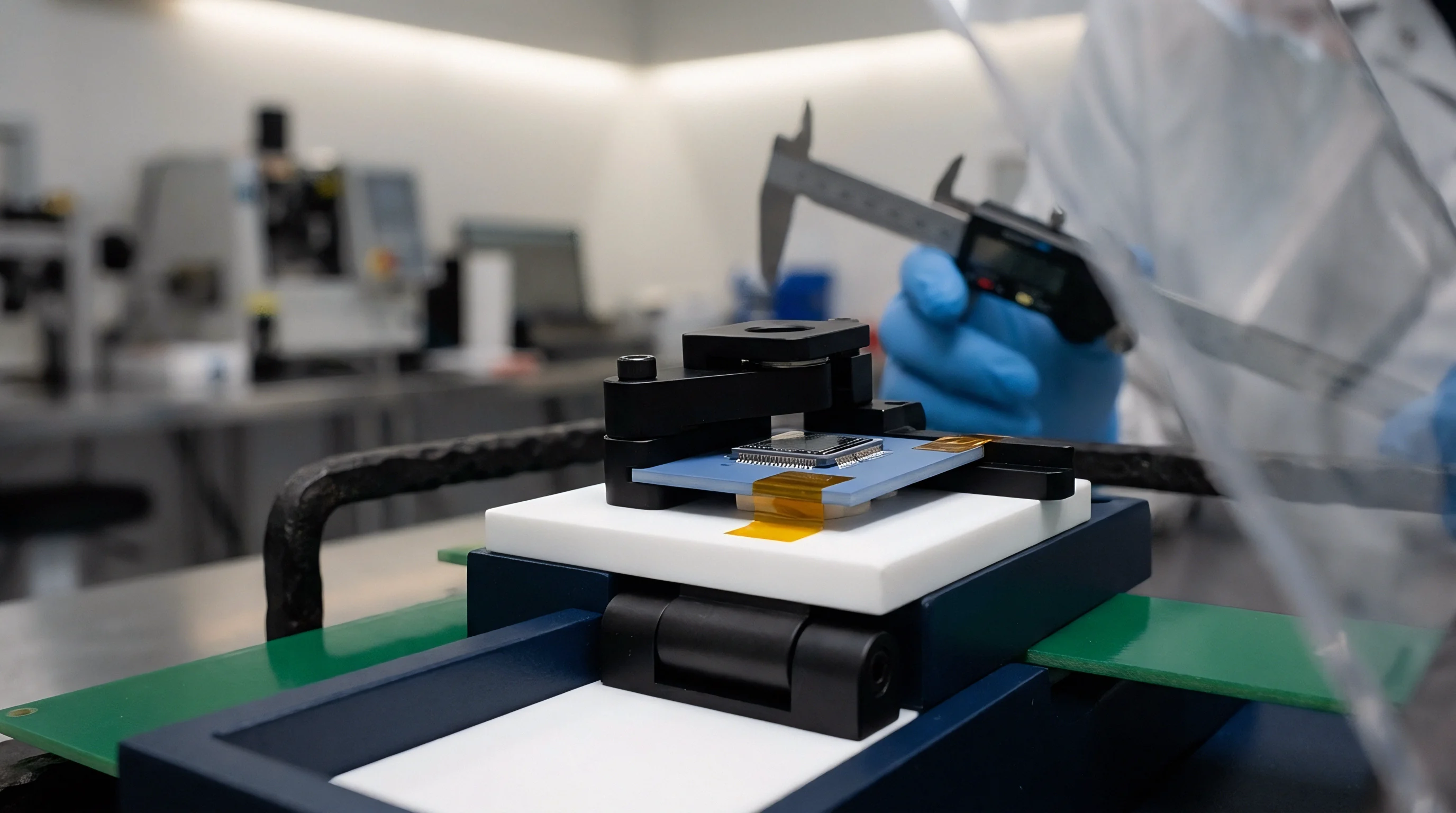
Surface Energy Stabilization via Thin Film Coatings
Microelectromechanical device fabricators apply molecular monolayer films to convert hydrophilic silicon oxide interfaces into non-wetting termination boundaries. Native silicon dioxide surfaces display high surface energy, attracting polar water molecules readily. Chemical vapor deposition of fluorinated alkylsilane self-assembled monolayers, such as perfluorooctyltrichlorosilane, replaces surface hydroxyl bonds with hydrophobic fluorocarbon tails.
This surface modification drops surface free energy from over 70 millijoules per square meter down to less than 18 millijoules per square meter.
Hydrophobic films prevent moisture condensation. Atomic layer deposition of sub-five-nanometer alumina or titania dielectric caps further stabilizes surface stoichiometry, preventing water diffusion into subsurface silica networks. By suppressing moisture physisorption, passivation layers reduce disjoining pressure buildup inside anchor joints to negligible levels.
Under dynamic pressure steps, passivated flexure anchors exhibit stable strain profiles holding within sub-10 nanostrain boundaries.
Per MIL-STD-883 Method 1014 Condition CH, seal leakage rates exceeding 1×10^-9 atmospheric cubic centimeters per second of helium forfeit sub-nanometer flexure anchor drift guarantees.
Passivation layers suppress surface energy shifts. Long-term durability of hydrophobic surface treatments remains a primary qualification hurdle for sensor procurement teams. Cyclic pressure loading and elevated operating temperatures gradually degrade organic silane monolayers through hydrolysis, re-exposing hydrophilic silica sites over extended operating lifetimes.
High-reliability applications demand conformal inorganic atomic layer deposition coatings that maintain structural integrity across millions of pressure cycles.
Wafer getters absorb residual gas species. Sub-nanometer anchor strain stability demands strict compliance with procurement package hermeticity clauses. Standard procurement contracts specify maximum permissible internal moisture limits inside micro-cavities following hermetic wafer-level packaging reflow.
Purchasing specifications for sub-nanometer flexure anchor components must mandate that internal cavity water vapor concentration shall not exceed 500 parts per million by volume over the operational lifecycle, verified via destructive residual gas analysis per MIL-STD-883 Method 1018, thereby enforcing the passivation integrity required to eliminate hydration-driven anchor strain limits under variable pressure conditions.