Constitutive Characterization of Non Equilibrium Volumetric Aging in Thermally Cycled Micro Transducer Encapsulants
Non-equilibrium volumetric aging in micro-transducer encapsulants drives continuous piezoresistive drift; thermal pre-conditioning stabilizes free volume.
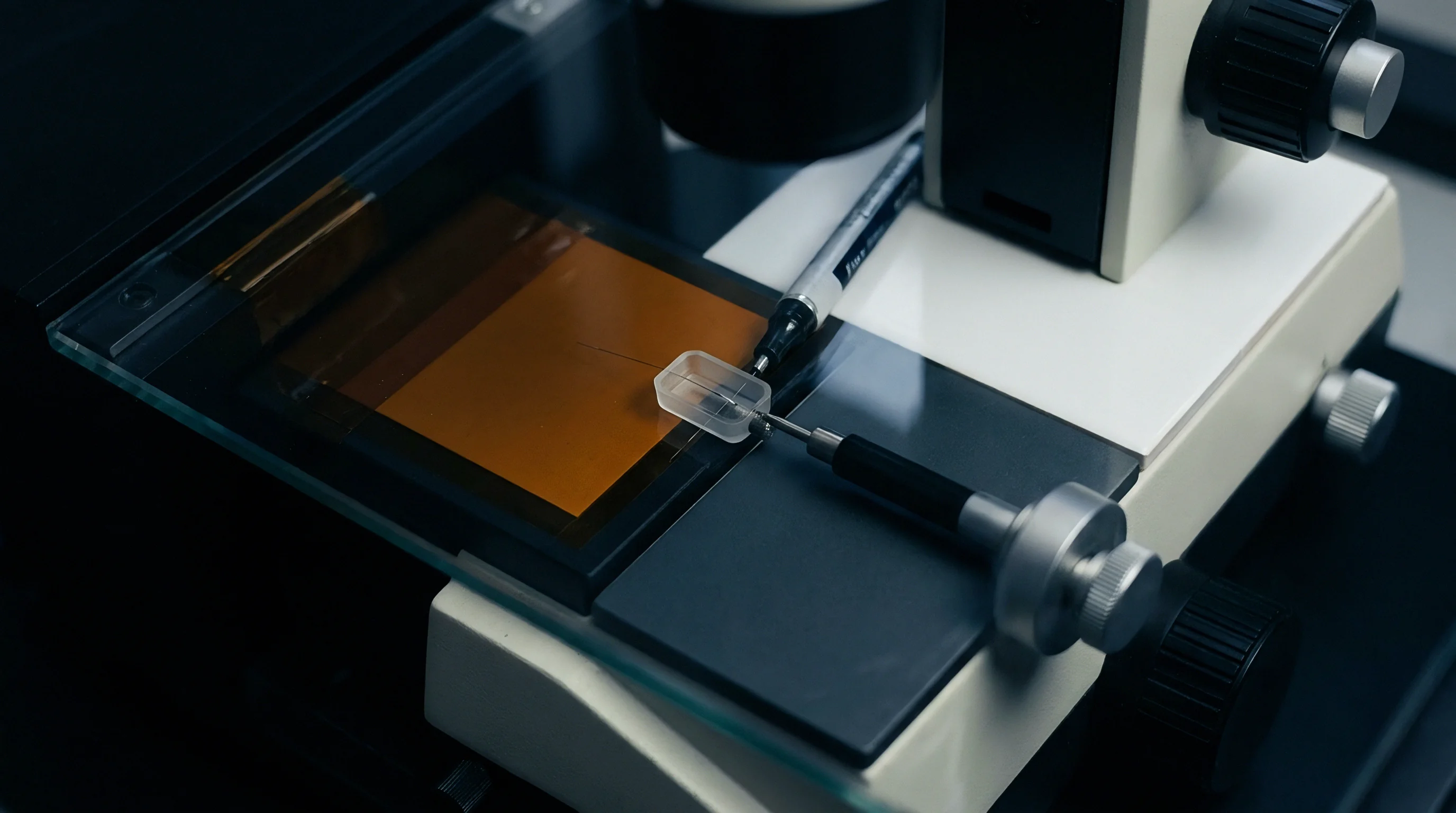

Shrink
Thermal curing cross-links the polymer but leaves an unstable matrix frozen into the transducer package. Once cooled below its glass transition temperature, the encapsulant sits out of thermodynamic equilibrium, holding excess volume, excess enthalpy, and higher free energy than its relaxed state. In MEMS pressure transducers, acoustic sensors, and strain gauge bridges, that trapped volume gradually collapses toward structural equilibrium.
Even at ambient storage temperatures, the resulting physical aging causes subtle densification across the package, altering the background stress field imposed on the silicon die.
How fast that structure relaxes depends on how far the operating temperature sits below the glass transition point, as well as the packaging line’s thermal profile. Quenching parts quickly locks in substantial excess free volume, providing a strong driving force for subsequent contraction. Over months in the field, the shrinking polymer matrix exerts compressive stress that flexes the transducer diaphragm underneath.
Piezoresistive bridges register that parasitic compression as zero-point offset drift and span non-linearity, skewing output signals even when applied pressure has not changed.
The non-equilibrium glassy state ensures that an encapsulant continuously densifies over time under ambient operating temperatures.
Evaluating volumetric relaxation requires isolating time-dependent structural contraction from ordinary thermal expansion. Epoxies and liquid silicone chemistries relax along very different timescales under constant temperature. Over time, physical restructuring changes the mechanical coupling between the leadframe or housing, the glob-top or gel, and the silicon sensor.
Left unaddressed, that slow contraction can drive baseline drift rates high enough to consume up to forty percent of a transducer’s allowable error budget within its first year of operation.
- Free volume trapping occurs during rapid quench steps after high-temperature curing, freezing an artificial spatial array between polymer chains.
- Isothermal densification proceeds over thousands of operating hours as polymer chain segments reorient into denser molecular packing configurations.
- Parasitic strain coupling transmits isotropic volume reduction into anisotropic shear and normal stress components across the sensor die surface.
- Zero-point offset instability manifests as continuous voltage drift on the transducer bridge circuit directly linked to evolving package stresses.
Calibrating transducers without accounting for this initial volumetric decay routinely produces out-of-spec field returns once packages relax during storage or early service.
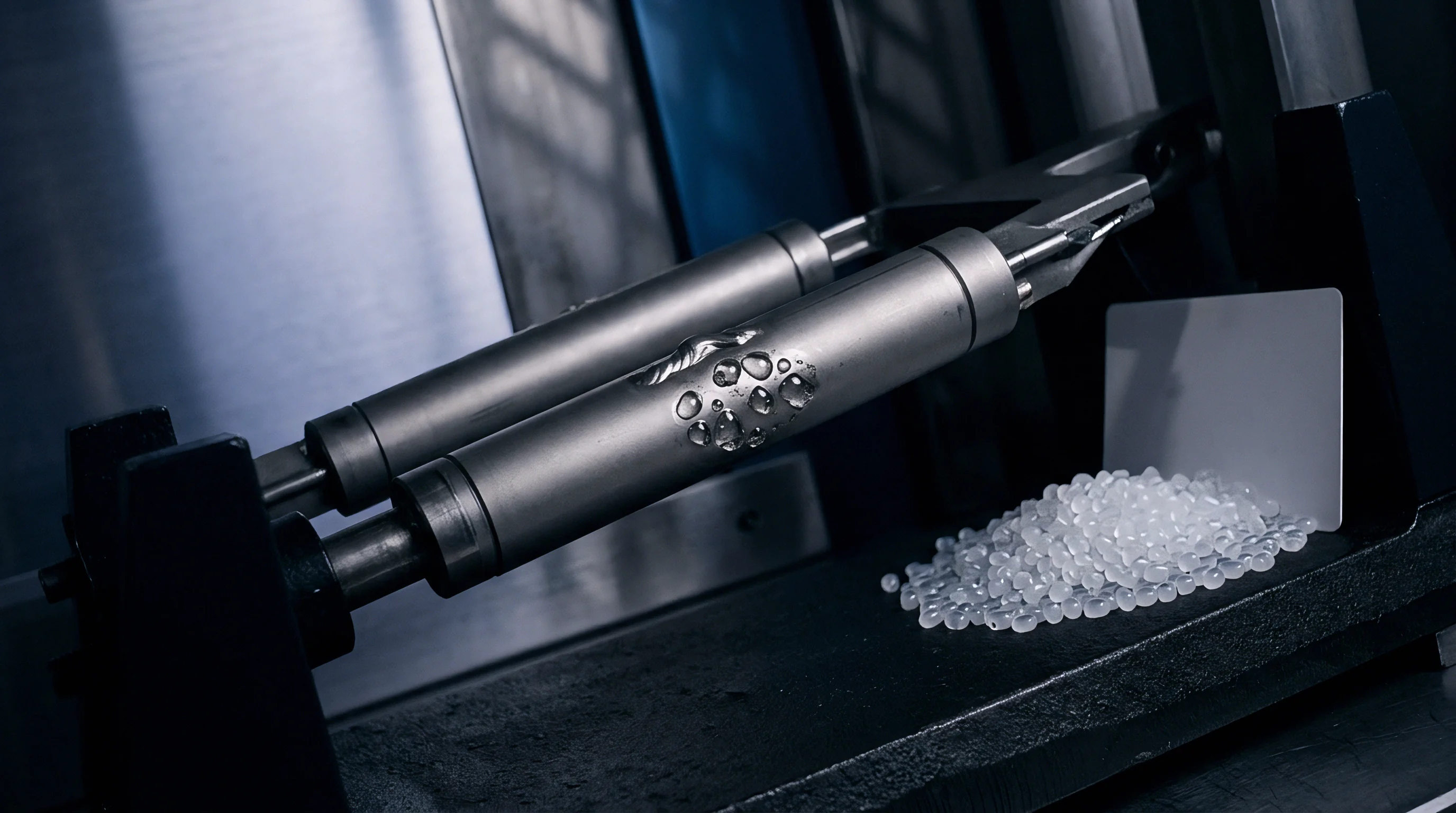
Formulation
Describing volumetric aging mathematically requires non-linear viscoelastic formulations that account for thermal history and memory effects. The Tool-Narayanaswamy-Moynihan framework models this behavior by tracking relaxation through a fictive temperature, defined as the temperature at which the equilibrium liquid would have the same volume or enthalpy as the glass. The system’s non-linearity arises because relaxation times depend on both actual temperature and this evolving fictive temperature.
In phenomenological formulations, relaxation time blends thermal activation and structural state using an explicit non-linearity parameter. The Kohlrausch-Williams-Watts stretched exponential captures the wide spread of relaxation times across cross-linked networks. As the encapsulant experiences temperature changes, the internal stress tensor updates through hereditary integrals, where the hydrostatic stress generated by shrinkage alters the die’s piezoresistive coefficients and shifts offset readings.
| Encapsulant Polymer System | Glass Transition Temperature (°C) | Activation Energy H/R (kK) | Non-Linearity Parameter x | KWW Exponent β |
|---|---|---|---|---|
Plugging these constitutive equations into finite element models gives a clearer view of the stress field developing around piezoresistive elements over time. Stress tensor components evolve non-linearly through thermal excursions. Epoxies typically have pronounced non-linearity parameters, shifting their relaxation kinetics during modest temperature swings.
Fluorosilicones exhibit lower activation energies, which slows physical aging but comes with much higher thermal expansion.
Substrate constraints begin to distort bulk relaxation behavior once encapsulant thickness falls below two hundred micrometers. In these thin layers, chain mobility near the silicon surface differs markedly from that of bulk material. Adhesion promoters and surface energy alter the local glass transition and reshape the decay of fictive temperature.
The resulting stress gradients across piezoresistive traces unbalance the Wheatstone bridge unevenly, undermining the temperature compensation routines in signal conditioning circuitry.
Post-cure heat treatments are often assumed to stabilize encapsulant dimensions before calibration, yet physical aging continues to alter package geometry during subsequent storage and operation.


Hysteresis
Cycling across operational limits produces asymmetric paths in an encapsulant’s volumetric state. During cool-down below the glass transition, structural contraction lags the temperature drop, locking in excess volume. Reheating traces a distinct, non-coincident path, yielding pronounced hysteresis in both enthalpy and volume.
Each temperature cycle partially erases prior aging history while accelerating relaxation kinetics through specific transition windows.
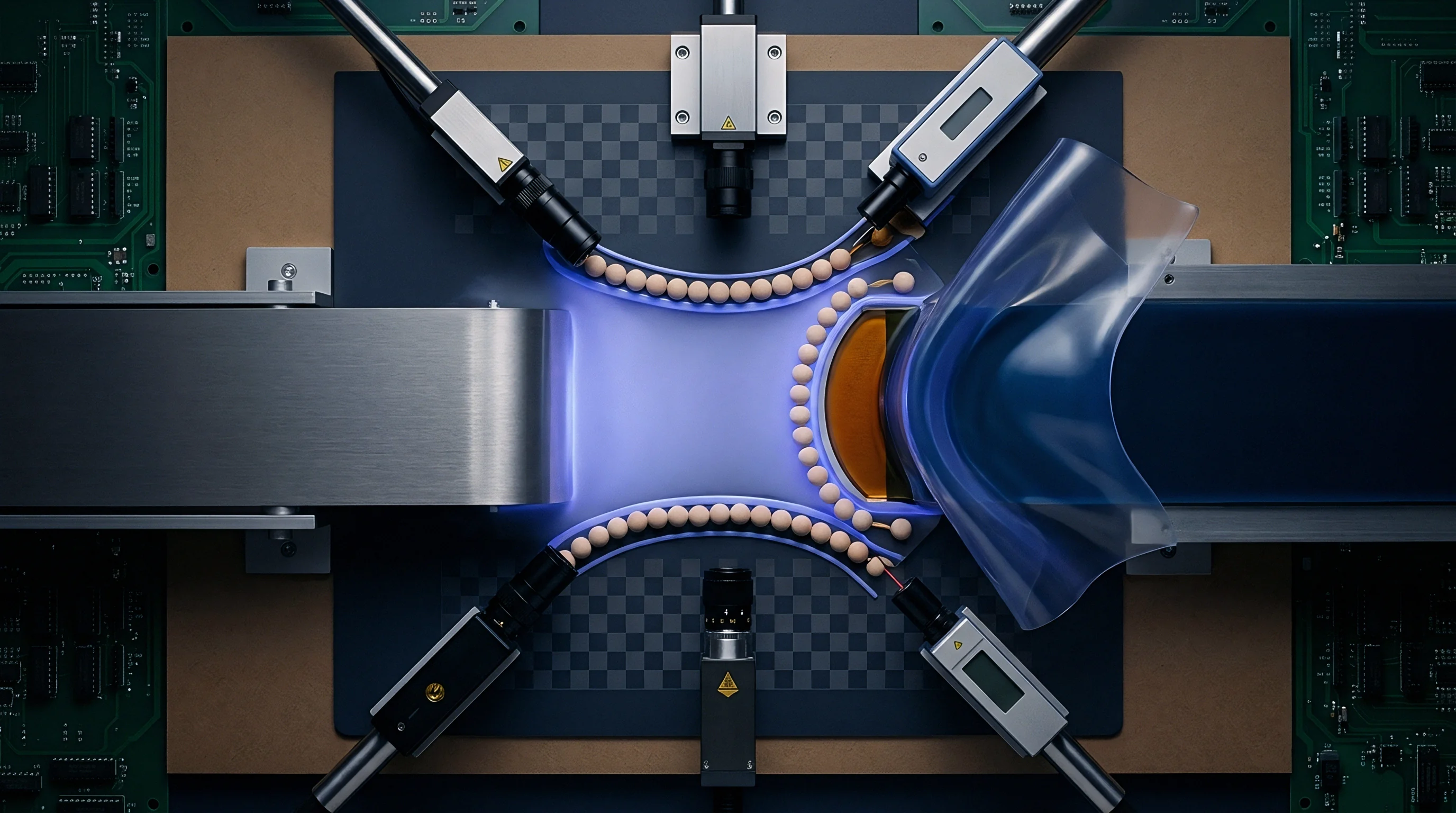
When Does Thermal Cycling Accelerate Structural Relaxation?
Wide temperature swings drive the polymer through rejuvenation zones where added thermal energy temporarily restores chain mobility. As cooling begins from peak temperature, the material ages along a fresh trajectory, relaxing faster than it would under steady room-temperature storage. Zero-point drift curves frequently register sharp step changes right after excursions to -40 °C, followed by prolonged logarithmic drift once returned to room temperature.
A thermal excursion down to -40 °C introduces an immediate zero-point shift of 0.18 percent full-scale output in un-aged epoxy-encapsulated pressure transducers.
Non-monotonic volume recovery under shifting thermal profiles makes die strain difficult to predict. Rapid temperature changes set up thermal gradients across the package: the outer shell chills first and vitrifies into a rigid glass, while the core stays warm and expanded. This mismatch locks in residual shear stresses that outlast the return to thermal equilibrium.
Isothermal aging data alone cannot capture the strain that accumulates under cyclic field conditions. Thermal expansion mismatch acts alongside ongoing volumetric relaxation to nudge piezoresistive offsets outside calibration limits. Tracking this recovery hysteresis calls for high-resolution optical dilatometry or embedded stress sensors that resolve sub-micron dimensional shifts through dynamic temperature ramps.
Whether physical aging kinetics in high-temperature epoxies ever taper off enough to prevent measurable offset drift over multi-year deployments remains an open question.

Screen
Incoming lot inspection must verify relaxation behavior before resins reach packaging lines. Standard product documentation lists initial density, glass transition temperature, and bulk thermal expansion, but omits aging parameters entirely. Screening resin shipments for physical aging helps protect precision transducer runs from latent calibration drift caused by batch-to-batch variation.
- Sample preparation requires molding polymer specimens into standardized geometric disks with controlled cooling rates matching the production encapsulation line.
- Differential Scanning Calorimetry measures enthalpy recovery peaks at the glass transition threshold after isothermal aging intervals of 24, 72, and 168 hours.
- Pressure-Volume-Temperature dilatometry quantifies isothermal contraction kinetics under hydrostatic pressure steps spanning 0.1 to 10 MPa.
- Thermo-Mechanical Analysis evaluates long-term baseline drift rates under continuous low-frequency thermal modulation.
Enthalpy recovery measured via differential scanning calorimetry offers an efficient proxy for volumetric relaxation. The area under the endothermic peak at the glass transition scales with aging time, and plotting that recovery against logarithmic time yields the aging parameter needed for constitutive simulation. Resins whose recovery slopes exceed established thresholds are rejected during incoming inspection.
Standard IEC 60749-25 mandates thermal cycling test profiles but leaves volumetric relaxation drift limits to individual component specification documents.
Traceable lot screening limits unexpected calibration shifts across finished production runs. Optical dilatometry measures linear shrinkage without loading soft gels or thin curing epoxies with probe force. Paired with calorimetric enthalpy data, these optical measurements provide realistic parameter sets for predictive calibration models.
Under ISO/IEC 17025 accreditation requirements, encapsulant qualification files must include raw differential scanning calorimetry curves, sample cooling rates, and calculated fictive temperature values alongside lot acceptance certificates.
Grade
Material formulation sets the practical floor for long-term calibration stability. Available grades range from commodity unfilled epoxies to specialized, heavily filled formulations optimized for low stress. Adding silica lowers the overall polymer volume fraction, directly scaling back the shrinkage caused by structural aging.
At the same time, filler geometry, surface coupling agents, and particle size distribution dictate mechanical modulus and local stress concentrations around sensitive silicon features.
- Unfilled glob-top epoxies present high volumetric aging drift, making them suitable only for commercial applications with coarse tolerance requirements.
- Highly filled mold compounds contain up to 88 percent silica mass fraction, minimizing physical aging contraction at the expense of higher mechanical stiffness.
- Soft silicone gels decouple package stress through extremely low shear moduli, protecting diaphragms while introducing ingress vulnerabilities to volatile organic compounds.
- Polyimide stress buffers applied directly to silicon wafers shield piezoresistors from encapsulant aging strain, adding processing steps to lower long-term drift.
| Encapsulant Grade | Silica Loading (% mass) | Annual Zero-Drift (% Span) | Uncertainty Contribution (% Span) | Relative Unit Material Cost |
|---|---|---|---|---|
Weighing piece-part resin cost against sensor accuracy highlights real lifecycle trade-offs. Cheap formulations lower upfront bill-of-materials costs, but force wider field error bands or routine re-zeroing. Premium materials with dense silica loading damp volumetric aging enough to sustain narrow accuracy windows across multi-year deployments without manual recalibration.
Spinning a thin polyimide buffer over the sensing bridge adds a compliant layer that absorbs shrinkage forces before they reach the piezoresistors. The two-tier construction protects the active circuit from direct contact with rigid mold compound, holding zero-point drift in check without resorting to low-yield specialty encapsulants.
Matching the encapsulant’s coefficient of thermal expansion to the silicon substrate matters more than minimizing polymer fraction when devices must operate over broad temperature ranges.

Tariff
Uncontrolled volumetric aging introduces real commercial exposure into supply contracts and long-term warranty commitments. If field units drift outside published accuracy specifications, manufacturers absorb the expense of recalls, onsite recalibration, and brand erosion. Evaluating that operational exposure means weighing factory burn-in fallout against the warranty reserves needed to handle field replacements.
A 50,000-unit annual run of industrial differential pressure transducers shows the financial split. Standard unfilled epoxy runs $0.15 per part, whereas a low-stress filled resin costs $0.65. Specifying the premium compound adds $25,000 to the bill of materials for the year.
With the cheaper epoxy, volumetric aging leads to a 3.5 percent failure rate from calibration drift over three years. At $180 per warranty claim to dispatch a technician and process a replacement unit, those failures generate $315,000 in warranty expenses. The premium grade drops that failure rate to 0.1 percent, trimming total warranty claims across the same period to $9,000.
Inline pre-conditioning can accelerate this initial relaxation before final calibration, cutting early drift without a change in resin chemistry. Soaking assembled transducers in ovens at 85 °C for 96 hours before laser trimming and zero-setting consumes power and ties up work-in-progress inventory, but cuts subsequent volumetric drift by over sixty percent.
Pre-conditioning transducer packages for 96 hours at elevated temperatures cuts initial post-calibration drift by more than sixty percent.
Factoring non-equilibrium aging into calibration limits prevents unnecessary fallout at the final test station. Trimming Wheatstone bridges only after thermal stabilization delivers tight, defensible error limits that hold up through years of severe thermal cycling in industrial service.
Accounting for physical aging in the sensor’s baseline error budget turns theoretical datasheet ratings into field performance that actually holds up. Quantifying volumetric relaxation yields better field reliability, clearer recalibration schedules, and lower lifetime warranty claims.