Time Temperature Superposition Master Curve Construction for High Temperature Die Attach Polyimides
Master curves predict polyimide die attach relaxation by shifting oscillatory modulus data across temperatures, bounded by silver filler percolation limits.


Window
Viscoelastic linearity sets the measurement boundary. High-temperature die attach polyimides experience severe cyclic stress when silicon carbide and gallium nitride devices cycle between ambient conditions and 250°C. Predicting adhesive stress relaxation across thousands of power cycles demands time-temperature superposition, which exchanges high-frequency laboratory testing for multi-year relaxation predictions. This mathematical translation operates correctly only when applied within the linear viscoelastic region of the cured resin system.
Storage modulus tracks elastic load resistance. When an oscillatory strain exceeds the linear limit, molecular chains slip irreversibly, producing strain-softening effects that distort horizontal shift factors. The laboratory technician determines this linear threshold through isothermal strain sweeps performed across the entire thermal span, recording storage modulus and loss modulus as strain amplitude increases from 0.005 percent to 2.0 percent.
The critical strain amplitude represents the point where storage modulus departs from its low-strain plateau by more than five percent.
The linear viscoelastic threshold contracts as ambient test temperatures approach the polymer glass transition.
Strain sweeps establish the linear limit. In crosslinked bismaleimides and aromatic polyimide pastes filled with metallic conductive particles, the linear region narrows drastically at elevated temperatures. A specimen exhibiting linear response up to 0.5 percent strain at 25°C contracts to less than 0.03 percent strain once the test chamber reaches 280°C. Executing multi-frequency sweeps at a fixed strain amplitude chosen for room-temperature convenience drives high-temperature data into non-linear viscoelasticity.
Non-linear data sets produce invalid master curves that miscalculate service stress relaxation by full orders of magnitude.

Linear Strain Limits in Viscoelastic Characterization
Oscillatory deformation testing maps storage modulus decay across stepped frequency intervals. Polyimide specimens mounted in dynamic mechanical analyzers undergo small-amplitude sinusoidal oscillations. The technician monitors the phase angle between the applied cyclic force and resulting specimen displacement.
For high-temperature die attach adhesives, this phase angle remains small at low temperatures, reflecting glassy elastic behavior, before rising toward forty degrees inside the glass transition zone.
Higher temperatures shrink the linear region. To prevent testing artifacts, the experimental protocol applies a variable-strain profile across temperature steps. The technician programs the analyzer software to decrease commanded strain as temperature climbs, maintaining stress levels within transducer sensitivity while remaining below the contraction boundary of linear viscoelasticity.
This adjustment prevents structural perturbation of the polyimide backbone during characterization runs.
Modulus values drop across glass transitions. Unfilled polyimide matrices exhibit storage modulus drops of two to three decades through the glass transition zone. Silver-filled formulations retain higher rubbery plateau values due to mechanical particle-particle reinforcement, but the polymeric interphase undergoes identical relaxation kinetics.
Maintaining measurement accuracy through this transition requires verified transducer torque calibrations spanning five orders of magnitude.
Oscillatory Test Bounds for Power Packaging
Accelerated thermal mechanics govern stress relaxation at silicon carbide die interfaces. A typical power module qualification protocol demands ten thousand hours of continuous thermal endurance at junction temperatures of 200°C or higher. Direct mechanical testing over such timeframes stalls product qualification cycles.
Oscillatory frequency sweeps between 0.01 Hz and 100 Hz provide accessible short-term data that time-temperature superposition shifts into synthetic multi-decade master curves.
Frequency boundaries encounter equipment limitations at both extremes. At frequencies exceeding 50 Hz, inertial contributions from the sample clamp fixture create phase angle distortions. At frequencies below 0.05 Hz, thermal drift inside the environmental test chamber corrupts the slow cycle acquisition, extending test times and exposing thin polyimide film specimens to excessive isothermal post-cure.
Sourcing specifications mandate sweep intervals restricted between 0.1 Hz and 30 Hz, utilizing discrete logarithmic spacing to optimize data density without risking chamber thermal wander.
Formulation vendors explain that modulus divergence at elevated test temperatures reflects normal batch variations rather than an intrinsic failure of time-temperature equivalence.

Shift
Master curve construction translates mechanical spectra across logarithmic frequency coordinates. Selecting a reference temperature anchors the curve, with all isothermal frequency segments translated horizontally by a factor designated as aT. When temperature steps fall within fifty degrees above the glass transition, free volume theory dictates the rate of structural relaxation.
Activation energy determines master curve slope. Below the glass transition, molecular motion shifts from cooperative segmental motion to localized sub-chain relaxations. This transition alters the shifting mathematics, requiring an Arrhenius formulation in place of the standard Williams Landel Ferry expression.
Misapplying the Williams Landel Ferry model beneath the polymer glass transition generates unphysical curvature that understates adhesive relaxation rates in field service.
A shift factor uncertainty of 0.25 logarithmic decades at 250°C alters predicted 10,000-hour stress relaxation by 42 percent.
Horizontal shifts follow thermal activation energy. Construction of the master curve requires aligning storage modulus, loss modulus, and loss factor curves simultaneously using identical horizontal shift values. A set of shift factors that aligns storage modulus while scattering loss modulus indicates multiple relaxation mechanisms with differing temperature dependencies.
Such behavior invalidates simple time-temperature superposition.
Kinetic Equations across Polyimide Glass Regimes
The Williams Landel Ferry relationship captures free volume expansion above glass transitions. The equation calculates the horizontal shift factor using two empirical constants, C1 and C2, referenced to a defined baseline temperature. For high-temperature polyimides, the baseline temperature sits conveniently at the operational junction rating of 200°C or 250°C. The constants vary according to crosslink density and backbone rigidity.
Vertical adjustments account for density changes. Thermal expansion alters polymer chain packing density and entropic elasticity across wide thermal intervals. The master curve construction applies a vertical shift factor, designated as bT, calculated from the ratio of specimen density and absolute temperature between the test point and reference state.
Neglecting vertical shifts in filled adhesives leads to systematic overestimation of relaxed moduli at ultra-low equivalent frequencies.
Secondary relaxations follow pure Arrhenius behavior. Below the glass transition, beta and gamma relaxations associated with phenyl ring rotation and imide carbonyl motions proceed according to fixed thermal activation barriers. These sub-glass mechanisms show linear logarithmic shift relationships against reciprocal absolute temperature.
Table 1 demonstrates kinetic shift parameters and coefficient bounds across prominent die attach polyimide chemistries.
| Polyimide Chemistry Base | Glass Transition Temperature (°C) | Activation Energy Below Tg (kJ/mol) | C1 Constant Above Tg | C2 Constant Above Tg (K) | Valid Superposition Window (°C) |
|---|---|---|---|---|---|
| Bismaleimide Addition-Cured | 285 | 145 ± 8 | 14.2 | 58.4 | 150 to 320 |
| Polyimide Siloxane Thermoplastic | 215 | 112 ± 6 | 17.1 | 51.6 | 100 to 260 |
| Pyromellitic Dianhydride (PMDA-ODA) | 380 | 185 ± 12 | 12.8 | 65.2 | 200 to 420 |
| Benzophenone Tetracarboxylic (BTDA-ODA) | 310 | 160 ± 10 | 13.6 | 60.1 | 180 to 350 |
Rheological Simplicity in Thermoset Construction
Superposition validity depends on identical temperature dependence across all underlying relaxation modes. Materials satisfying this constraint are rheologically simple. Polyimides formulated with reactive diluents or phase-separating flexibilizers frequently display rheological complexity, where distinct chemical segments relax under differing activation energies.
Cole-Cole plots verify rheological simplicity. Plotting loss modulus directly against storage modulus across all test temperatures eliminates the frequency axis entirely. If the material exhibits rheological simplicity, data points from all isothermal runs merge onto a single smooth, continuous arc.
Scattering or branching in Cole-Cole projections demonstrates that multiple relaxation processes operate independently, invalidating simple horizontal shifting.
Unchecked extrapolation compounds long term errors. Master curve algorithms rely on cross-checking techniques to confirm validity before life-prediction data enters structural finite element simulations. The following criteria identify breakdown points where mathematical superposition ceases to represent physical material behavior:
- Thermoreversible phase changes alter molecular volume through crystallization or domain rearrangement, disrupting monotonic free volume scaling across temperature steps.
- Secondary relaxation crossovers activate localized ester or aliphatic chain motions that deviate from main backbone glass transition kinematics.
- Percolation matrix distortion impedes affine deformation when rigid particle networks constrain surrounding polymer segment mobility.
- Chemical post-cure advancement creates irreversible bonds during thermal testing sweeps, shifting modulus curves independently of physical viscoelastic relaxation.
Whether an empirical vertical correction factor reflects true thermodynamic internal friction or merely disguises non-viscoelastic particle contact mechanics remains unproven across extended high-temperature aging durations.

Flake
Silver particulate suspensions alter mechanical dissipation within cured polyimide adhesives. High-temperature die attach adhesives incorporate metallic silver to establish electrical conduction and thermal dissipation, with filler loadings reaching 70 to 85 weight percent. This dense particulate loading fundamentally modifies the mechanical response of the surrounding polyimide binder.
Rigid inclusions distort local matrix strain. As an external cyclic load stresses the adhesive bond, rigid silver flakes resist deformation, amplifying local shear strains in the thin polymer ligaments separating adjacent particles. Strain localization accelerates physical relaxation within the interphase region, causing the composite adhesive to depart from the viscoelastic properties of the neat polyimide resin.
Rigid metal particulates do not relax under thermal stimulation at temperatures where the host polymer matrix flows.
Polymer chains disentangle under continuous stress. In unfilled polyimides, long-term stress relaxation allows molecular chains to slide past one another until reaching rubbery equilibrium. In silver-filled pastes, the rigid particle network creates an internal mechanical stop.
The adhesive modulus drops during initial relaxation, then arrests as metallic particles lock against each other under compressive and shear components.

Percolation Mechanics in Particle Suspensions
Conductive packaging adhesives incorporate seventy to eighty-five weight percent metallic filler. At these high loadings, silver flakes exceed the percolation threshold, establishing continuous physical networks throughout the bondline. Particle interactions transition from hydrodynamic suspension flow to frictional contact mechanics.
Metallic particles contact under packing pressure. When thermal cycling drives the polyimide through its glass transition, the resin softens by two orders of magnitude, but the silver skeleton maintains an elastic modulus near seventy gigapascals. The master curve reflects a composite relaxation spectrum dominated by the polymer matrix at short equivalent times and by the silver contact network at extended relaxation durations.
Silver flakes introduce rigid contact mechanics. Particle-to-particle friction contributes an internal damping mechanism that does not obey time-temperature superposition. Friction between flakes depends on normal contact forces and surface topography rather than molecular thermal activation.
Applying standard shift factors to heavily filled systems shifts non-thermal friction along with thermal relaxation, introducing systemic errors into low-frequency master curve plateaus. Sourcing engineers categorize these particulate mechanics into three distinct behavioral regimes:
- Dilute suspension regime maintains unhindered polymeric flow below fifty weight percent filler, permitting classical time-temperature superposition without vertical distortion factors.
- Percolation contact regime initiates interparticle conduction between fifty and seventy weight percent filler, creating localized strain concentrations that require empirical vertical master curve scaling.
- Jamming network regime locks metallic particles into rigid load-bearing paths above seventy-five weight percent filler, invalidating standard horizontal shift models through frictional non-viscoelastic resistance.
Thermo Oxidative Aging Disruptions to Superposition
Continuous exposure to two hundred fifty degrees Celsius initiates chemical chain modification. Time-temperature superposition assumes that temperature accelerates molecular relaxation without altering the baseline chemical architecture of the specimen. In high-temperature die attach applications, prolonged exposure to elevated temperatures drives post-curing and thermo-oxidative degradation concurrently with viscoelastic relaxation.
Oxidation alters baseline polymer chain mechanics. When polyimide formulations experience oxygen exposure at temperatures above 200°C, radicals attack imide rings and aliphatic bridges, causing chain scission alongside oxidative crosslinking. Scission reduces the molecular weight and depresses storage modulus, while oxidative crosslinking stiffens the network and shifts the glass transition upward.
These competing chemical processes alter the polymer relaxation spectrum permanently.
Thermo-oxidative scission shifts the baseline upwards. A multi-day dynamic mechanical testing protocol heats thin specimens repeatedly through high-temperature sweeps. If the resin undergoes chemical crosslinking during characterization, high-temperature isothermal sweeps show higher moduli than freshly cured material.
Shifting these post-cured data points along the frequency axis creates a distorted master curve that predicts false stiffness retention for long-term field applications.
Overestimating die attach compliance through flawed master curves leads directly to unpredicted silicon carbide die fractures during thermal power cycling.
Bench
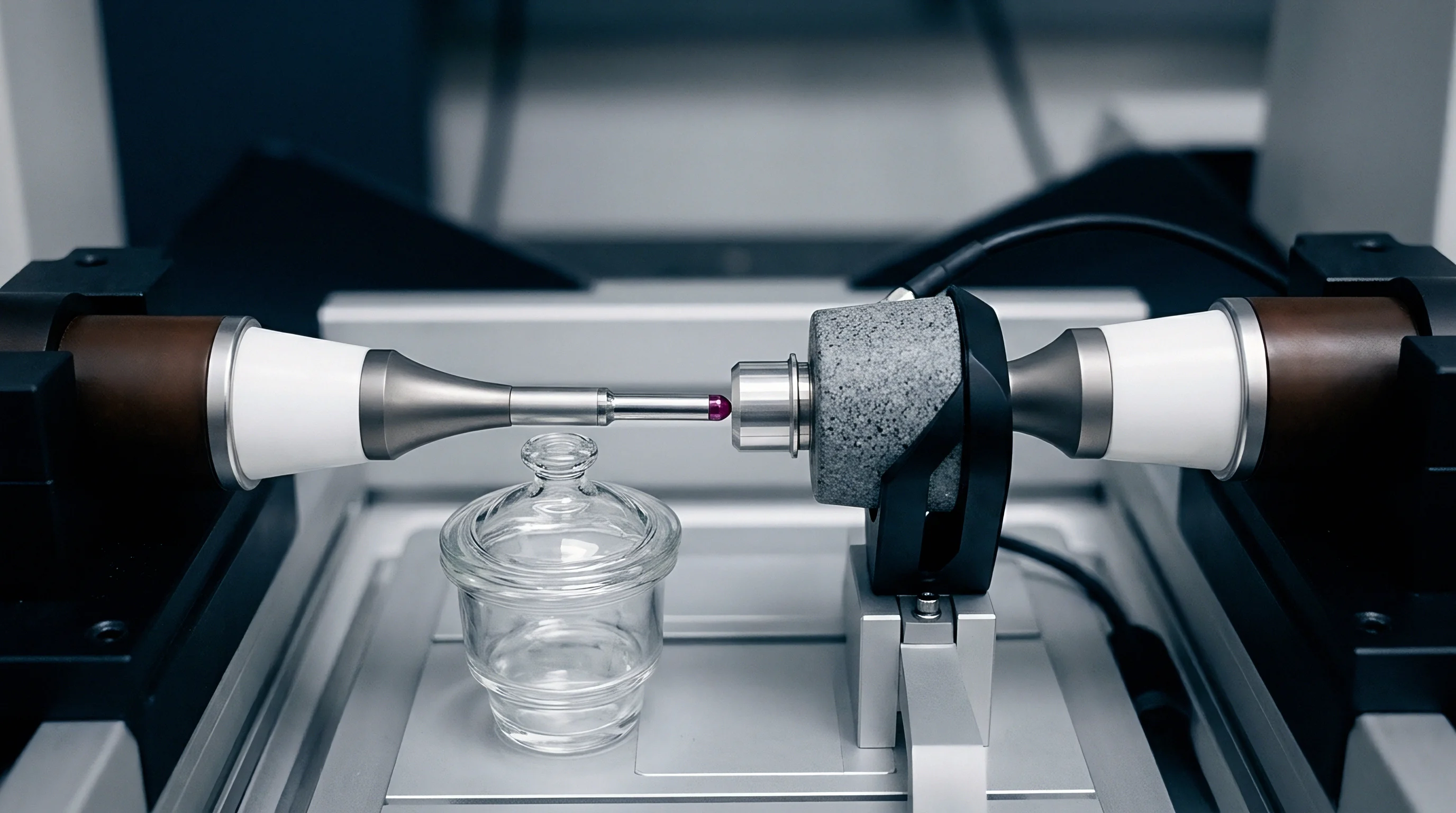
Oscillatory mechanical analyzers record specimen reaction torque and displacement phase angles. High-precision characterization of die attach adhesives demands calibration across thermal and mechanical channels. Errors in furnace temperature control, transducer alignment, or sample geometry distort raw storage and loss curves before master curve construction begins.
Thermal lag distorts isothermal frequency readings. Polyimide film samples and silicon-die sandwiches possess distinct thermal masses compared to the testing chamber environment. Heating a specimen chamber at five degrees Celsius per minute creates a temperature gradient between the control thermocouple and the adhesive core.
Commencing frequency sweeps before thermal stabilization skews raw modulus measurements, assigning wrong temperature tags to isothermal frequency slices.
Clamping torque alters thin specimen geometry. Fixturing rectangular polyimide strips inside tensile or dual-cantilever clamps requires calibrated torque wrenches. Insufficient torque allows specimen slippage at high frequencies, manifesting as artificial loss modulus peaks.
Excessive torque crushes the cured film edges, generating localized stress fields that depress apparent storage modulus across all frequencies.
Apparatus Compliance and Phase Lag Calibration
Instrument frame deflection introduces substantial measurement error during glassy modulus sweeps. At temperatures below the glass transition, cured polyimide films exhibit high rigidity, with storage moduli between three and eight gigapascals. The force generated during deformation flexes the instrument drive shaft, sample clamps, and transducer frame simultaneously.
Transducer compliance absorbs applied displacement amplitudes. If the software assumes infinite instrument stiffness, it attributes frame deflection to specimen deformation, understating the actual storage modulus. Accredited metrology laboratories calibrate system compliance using rigid steel calibration standards, establishing compliance correction curves that subtract instrument frame deflection from measured specimen response.
Table 2 details the expanded uncertainty contributions for oscillatory dynamic mechanical testing on high-temperature polyimide films.
| Uncertainty Contribution Source | Evaluation Type | Probability Distribution | Standard Uncertainty (%) | Sensitivity Coefficient | Combined Uncertainty Impact (%) |
|---|---|---|---|---|---|
| Load Cell Calibration Traceability | Type A | Normal | 0.35 | 1.0 | 0.35 |
| Specimen Caliper Dimensional Measurement | Type B | Rectangular | 0.82 | 2.0 | 1.64 |
| Phase Lag Transducer Noise | Type A | Normal | 0.45 | 1.0 | 0.45 |
| Clamping Thermal Expansion Mismatch | Type B | Rectangular | 0.60 | 1.0 | 0.60 |
| Temperature Gradient Along Specimen Span | Type B | Triangular | 0.75 | 1.5 | 1.12 |
| Combined expanded uncertainty equals 4.38% with coverage factor k=2 at approximately 95% confidence level per JCGM 100 evaluation. | |||||
Isothermal Soak Schedules and Specimen Fixturing
Specimen thermal equilibrium governs the consistency of multi-frequency modulus data. To eliminate spatial temperature gradients, testing procedures enforce minimum soak durations at each temperature step before activating mechanical oscillations. Thin film specimens measuring one hundred microns in thickness demand five-minute dwell intervals, whereas thick bonded die assemblies require twenty minutes to reach steady-state thermal equilibrium.
ASTM D4065 requires isothermal equilibrium within 0.5°C across the gauge length before frequency sweep execution, penalizing rapid thermal ramp profiles with invalid shift factors.
Phase lag measurements reveal damping capacity. Verifying transducer timing calibration ensures that loss factor calculations remain free of instrument phase distortion. Sourcing auditors evaluate incoming qualification dossiers by reviewing calibration records for the following physical check sequence:
- Transducer compliance correction establishes baseline frame deflection across the entire operational temperature envelope using certified calibration blocks.
- Temperature sensor offset trim aligns furnace thermocouples against melting point standards to ensure accurate absolute temperature assignment.
- Strain amplitude verification maps the linear boundary via automated amplitude sweeps at both minimum and maximum test temperatures.
- Isothermal stability dwell confirms specimen equilibrium by monitoring modulus drift rates below 0.1 percent per minute prior to frequency execution.
MIL-STD-883 Method 5011 paragraph 3.8.5 enforces die shear testing after 1,000 hours at 200°C, overriding theoretical master curve projections with empirical pass-fail retention tallies.
Margin
Silicon carbide junctions generate severe heat. Power module packaging engineers utilize master curves to predict stress relaxation over fifteen-year service lifetimes. In automotive traction inverters, die attach layers absorb continuous thermal mismatch between silicon carbide die and direct bonded copper substrates.
Thermal stress relaxes over operational years. When a master curve miscalculates the long-term relaxation modulus, package stress models generate inaccurate fatigue predictions. Underestimating modulus relaxation causes engineers to over-design compliant buffer layers, increasing thermal resistance.
Overestimating relaxation leads to premature adhesive shear fatigue and device lift-off in field service.
Glass transition temperatures exceed three hundred degrees. Formulations engineered for extreme temperatures display steep relaxation slopes within their glass transitions. A slight experimental variance during laboratory shift factor extraction translates into substantial errors when projected across logarithmic time scales.

Compounded Logarithmic Error in Operating Projections
Horizontal translation shifts carry experimental uncertainty that multiplies exponentially across decades. Shifting frequency sweeps across twenty temperature steps introduces cumulative alignment error. If an operator misaligns adjacent curves by 0.15 logarithmic decades, this minor experimental offset compounds into an order-of-magnitude error when projecting modulus out to ten thousand hours.
Crosslink density sets the rubbery plateau. At extended operating durations, adhesive stress retention depends entirely on the relaxed rubbery modulus. Table 3 illustrates how shift factor uncertainty alters long-term modulus predictions and projected shear retention margins for high-temperature power modules.
| Horizontal Shift Error (log aT) | Implied Activation Energy Shift (kJ/mol) | Predicted Modulus Relaxation Time (Hours) | Projected Five Year Storage Modulus Decay (%) | Shear Retention Margin Shift (%) |
|---|---|---|---|---|
| +0.30 | +18.4 | 22,400 | 31.2 | +14.5 |
| +0.15 | +9.2 | 14,100 | 42.8 | +6.8 |
| 0.00 (Nominal Baseline) | 0.0 | 10,000 | 52.5 | 0.0 |
| -0.15 | -9.2 | 7,100 | 63.1 | -8.2 |
| -0.30 | -18.4 | 4,500 | 76.4 | -18.7 |
Procurement Clauses and Acceptance Tolerances
Material specifications require empirical shear testing alongside theoretical viscoelastic master curves. Sourcing contracts that accept unverified supplier master curves expose buyers to catastrophic field failure risks. Procurement teams mitigate this exposure by inserting verification clauses into technical purchase agreements.
Master curve validation requires empirical milestone cross-checks. Sourcing agreements enforce mandatory high-temperature storage verification at 1,000, 2,500, and 5,000 hours. If actual die shear strength falls below the master curve prediction window by more than fifteen percent, the supplier faces lot rejection and qualification suspension.
Master curves constructed without isothermal verification at maximum operating temperatures overstate die shear life under cyclic thermal strain.