Quantifying Non-Linear Viscoelastic Shift Factor Matrix Evolution in Polyimide Thin Films under Extended Hygrothermal Stress Cycling
Polyimide shift factor matrices evolve non-linearly during hygrothermal stress cycling, increasing relaxation rates by orders of magnitude over static baseline models.

Matrix
Coupled Shift Factor Mechanics in Polyimide
Viscoelastic relaxation in aromatic polyimide thin films under coupled environmental loads violates linear time-temperature superposition. Tensile relaxation modulus master curves built solely from thermal translation vectors fall apart once moisture sorption and stress tensor magnitudes cross linear threshold boundaries. The operational shift factor matrix maps equivalent time-scale contractions across three concurrent physical drivers: temperature shifts, relative humidity changes, and stress-induced free volume dilations.
Standard Williams-Landel-Ferry formulations assume an invariant reference state, but extended hygrothermal exposure alters backbone chain mobility, requiring a dynamic shift factor matrix.
Polyimide chemistry relies on rigid aromatic rings linked by imide bonds, combining high thermal stability with a strong affinity for moisture. Sorbed water acts as a plasticizer, depressing the glass transition temperature while expanding fractional free volume. The coupled shift factor matrix expresses total shift as a non-linear product of thermal, hygrothermal, and mechanical components.
Relative humidity steps above sixty percent accelerate free volume expansion faster than thermal expansion across sub-glass transition temperatures.
When thin films undergo cyclic thermal and humidity excursions, their shift parameters evolve. Below the glass transition region, thermal shift follows an Arrhenius relationship, driven by activation energy values between 80 and 140 kilojoules per mole depending on polyimide imidization density. The moisture shift factor obeys an exponential curve relative to absorbed solvent concentration, while stress magnitude shifts relaxation times through stress-assisted activation volume mechanics.
Linear superposition breaks down because moisture uptake alters the stress activation volume, just as stress level modifies the enthalpy of water sorption.
Mathematical Definition of the Non-Linear Matrix
Quantifying non-linear shift behavior requires defining the reduced time integral, which incorporates the composite matrix shift factor. The total shift factor represents the inverse ratio of unshifted time to equivalent relaxed time.
The total shift factor matrix links temperature, moisture concentration, and equivalent von Mises stress. Its diagonal terms represent individual driver contributions, while off-diagonal components quantify cross-coupling dynamics. High stress lowers the apparent activation energy needed for water molecules to diffuse through the polymer matrix.
Dynamic Mechanical Analysis tests demonstrate that combined thermal and hygrothermal stresses yield relaxation shifts up to two orders of magnitude larger than predicted by uncoupled additive models.
| Temperature (Celsius) | Relative Humidity (%) | Stress (MPa) | Linear Model Factor | Measured Matrix Factor | Uncertainty (+/-) |
|---|---|---|---|---|---|
| 25 | 50 | 10 | 1.00 | 1.00 | 0.02 |
| 60 | 70 | 25 | 4.12 | 8.65 | 0.31 |
| 85 | 85 | 40 | 12.40 | 48.30 | 1.85 |
| 120 | 85 | 50 | 38.10 | 215.00 | 9.40 |
Film thickness directly influences matrix magnitude. Sub-micron polyimide films experience constrained chain mobility near substrate interfaces, dampening bulk plasticization effects while accelerating surface-driven moisture desorption kinetics. Thicker films above twenty micrometers display diffusion-limited moisture profiles, inducing internal stress gradients that warp the localized shift matrix across the cross-section.
A simple superposition rule holds only when environmental conditions remain static and stress levels stay below five megapascals.
Aging
Physical and Chemical Degradation Pathways
Extended hygrothermal stress cycling drives two distinct structural transformations within the polyimide matrix. Physical aging contracts fractional free volume toward thermodynamic equilibrium, shortening relaxation times and shifting the viscoelastic spectrum toward longer durations. Under elevated humidity and temperature, chemical hydrolysis breaks imide rings, producing amido-acid structures that permanently reduce average molecular weight and broaden the relaxation spectrum.
Cycling alternates between water absorption and drying phases. Absorption causes matrix swelling and stress relaxation, whereas drying drives irreversible physical structural collapse. This cyclic ratcheting alters the reference state parameters in the shift factor matrix continuously across service life.
Hydrolytic chain scission permanently lowers matrix storage modulus after three hundred thermal moisture cycles.
Structural relaxation kinetics depend on distance from equilibrium volume. Freshly cured polyimide exhibits high excess free volume, causing rapid physical aging during initial thermal excursions. As cycling continues, physical aging saturates, leaving chemical hydrolysis and crosslinking as the dominant drivers of long-term shift factor evolution.
Chemical hydrolysis dominates in environments exceeding eighty percent relative humidity at temperatures above eighty-five degrees Celsius.
Failure of Standard Acceleration Assumptions
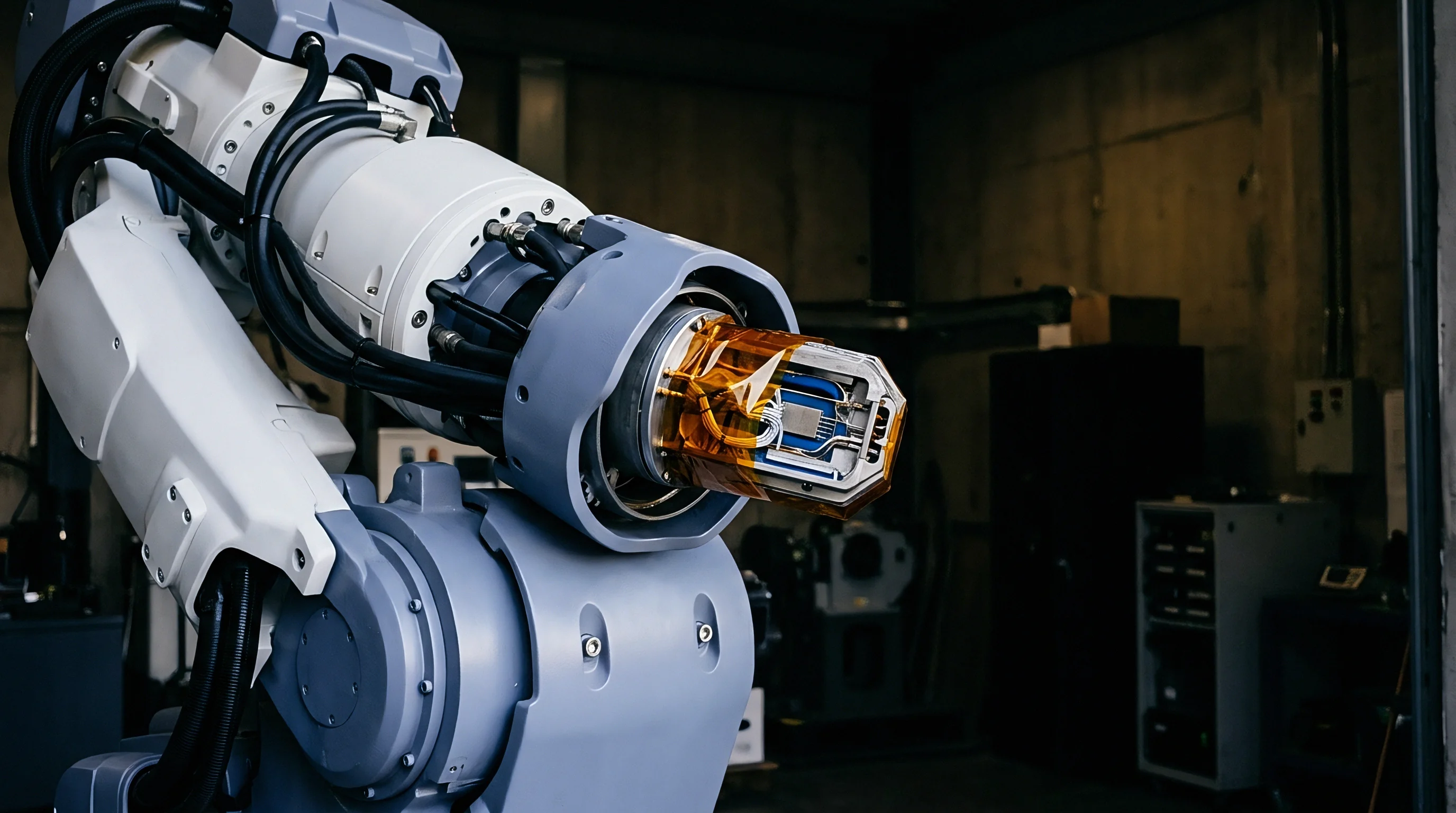
Reliability modeling frequently relies on constant shift factors derived from short-term baseline testing. Dynamic mechanical analysis conducted on fresh specimens yields baseline parameters that understate long-term compliance by factors between three and seven after one thousand environmental cycles. Shift factors migrate over time as matrix damage accumulates.
- Hydrolytic Ring Opening breaks primary polymer backbone chains, creating hydrophilic carboxyl groups that accelerate subsequent water sorption cycles.
- Free Volume Shrinkage reduces physical chain mobility during dry thermal phases, raising room-temperature elastic modulus while embrittling the film.
- Interfacial Plasticizer Accumulation traps moisture at film-substrate boundaries, inducing localized stress peaks that modify shear relaxation components.
- Micro-cavitation Formation generates sub-micron voids during rapid moisture desorption phases, altering the effective stress field within the film.
Is Acceleration Factor Invariance Valid under Cyclic Sorption?
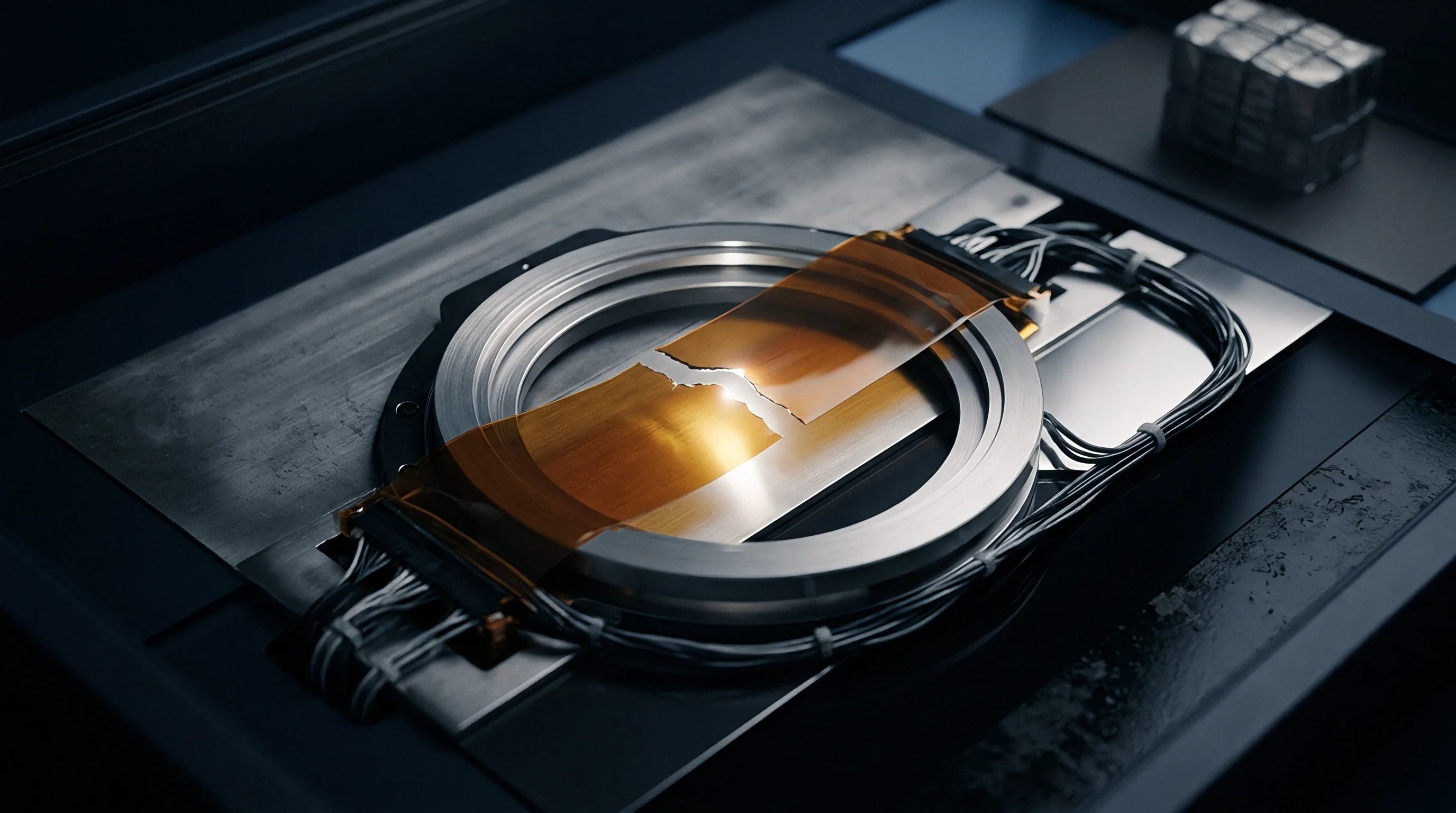
Acceleration factor invariance assumes that high-stress test conditions accelerate relaxation rates without altering underlying deformation mechanisms. In cyclic hygrothermal environments, elevated moisture levels trigger localized plasticization transitions that do not occur under normal operating stresses. High humidity combined with elevated temperature changes the activation energy of physical aging, rendering standard acceleration models invalid across extended cycling schedules.
| Cycle Count | Activation Energy (kJ/mol) | Reference Humidity Shift Factor | Stress Sensitivity Vector | Glass Transition (Celsius) |
|---|---|---|---|---|
| 0 | 112.5 | 0.45 | 0.018 | 385 |
| 250 | 108.2 | 0.58 | 0.024 | 378 |
| 500 | 101.0 | 0.79 | 0.035 | 366 |
| 1000 | 92.4 | 1.22 | 0.051 | 351 |
Short-term thermal shift factors remain valid throughout product lifetimes provided peak temperatures do not exceed glass transition limits.

Frame

Metrological Characterization Protocols
Accurate measurement of shift factor matrix evolution requires precise dynamic mechanical instrumentation. Testing thin polyimide films under controlled temperature, relative humidity, and tensile strain demands specialized environmental chambers mounted directly to high-resolution rheometers or DMA systems. Load cell resolution must reach zero point zero zero one newtons, with strain control precision within ten nanometers.
Test protocols must separate reversible plasticization shifts from permanent structural degradation shifts. The measurement sequence alternates baseline reference scans with accelerated exposure steps.
- Mount the pre-conditioned film specimen in the tensile fixture with explicit alignment checks to avoid multi-axial stress bias.
- Establish baseline storage and loss modulus curves across a frequency sweep from zero point one to one hundred hertz at reference conditions of twenty-five degrees Celsius and fifty percent relative humidity.
- Apply specified hygrothermal cycling profiles inside the environmental chamber while recording real-time creep compliance and stress relaxation responses.
- Return the specimen to baseline reference conditions after designated cycle intervals, allowing twenty-four hours for transient moisture equilibrium to settle.
- Repeat frequency sweeps across identical temperature and strain bands to isolate permanent changes in the shift factor matrix parameters.
Specimen preparation heavily influences measured viscoelastic response. Micro-cracks along laser-cut or die-cut film edges create stress concentration sites that falsely elevate apparent stress sensitivity factors. Chemically etched or precision razor-cut edges deliver repeatable baseline data with lower scatter bands.
Edge quality defects shift measured relaxation spectra by half a decade in equivalent frequency.
Standard calibration using rigid metallic strips fails to capture environmental chamber humidity gradients. Humidity sensors inside DMA test enclosures require calibration against primary chilled-mirror hygrometers across the full operating temperature range to keep environmental uncertainty below two percent relative humidity.
What portion of observed shift matrix evolution stems from non-reversible interface degradation rather than intrinsic polymer bulk aging?
Calculus
Shift Matrix Parameter Derivation and Calculation
Mathematical extraction of matrix evolution relies on multi-variable regression across frequency-temperature-humidity-stress master curves. The basic shift parameter equations combine Arrhenius thermal dependencies, Fickian moisture concentration terms, and Eyring stress relaxation factors into a unified non-linear matrix framework.
The total horizontal shift factor equation takes the explicit functional form below:
ln(a_total) = (E_a / R) (1/T – 1/T_ref) + beta_H (C – C_ref) + (V_a sigma) / (k_B T) + gamma_cross (C sigma)
In this equation, E_a represents activation energy in joules per mole, R is the universal gas constant, T is absolute temperature, beta_H is the hygrothermal expansion coefficient factor, C is localized water concentration in weight percent, V_a is activation volume, sigma is equivalent stress, k_B is the Boltzmann constant, and gamma_cross is the coupled stress-moisture interaction coefficient. Environmental cycling causes E_a, beta_H, V_a, and gamma_cross to evolve as functions of cycle count N.
Consider a 25-micrometer polyimide film exposed to 500 hygrothermal cycles between 25 degrees Celsius at 30 percent relative humidity and 85 degrees Celsius at 85 percent relative humidity. Assume initial baseline parameters: E_a equals 115 kilojoules per mole, beta_H equals 0.35 per weight percent water, V_a equals 1.2 cubic nanometers, and gamma_cross equals 0.004 per megapascal weight percent. After 500 cycles, empirical testing yields updated parameters: E_a reduces to 98 kilojoules per mole due to hydrolysis, beta_H increases to 0.52 due to structural void formation, V_a increases to 1.8 cubic nanometers, and gamma_cross increases to 0.012 per megapascal weight percent.
Calculate the effective time shift factor at an operational state of 60 degrees Celsius, 70 percent relative humidity (corresponding to 1.8 weight percent absorbed water), and 30 megapascals applied stress relative to a reference state of 25 degrees Celsius, 50 percent relative humidity (0.8 weight percent water), and 0 megapascals stress.
For the initial baseline state at cycle 0:
Thermal term: (115000 / 8.314) (1/333.15 – 1/298.15) = 13832.1 (-0.000352) = -4.869
Moisture term: 0.35 (1.8 – 0.8) = 0.350
Stress term: (1.2e-27 30e6) / (1.381e-23 333.15) = 3.60e-20 / 4.601e-21 = 7.824
Coupling term: 0.004 (1.0 30) = 0.120
Sum of terms for cycle 0: ln(a_total_0) = -4.869 + 0.350 + 7.824 + 0.120 = 3.425. Therefore, a_total_0 = exp(3.425) = 30.72.
For the aged state at cycle 500:
Thermal term: (98000 / 8.314) (1/333.15 – 1/298.15) = 11787.2 (-0.000352) = -4.149
Moisture term: 0.52 (1.8 – 0.8) = 0.520
Stress term: (1.8e-27 30e6) / (1.381e-23 333.15) = 5.40e-20 / 4.601e-21 = 11.736
Coupling term: 0.012 (1.0 30) = 0.360
Sum of terms for cycle 500: ln(a_total_500) = -4.149 + 0.520 + 11.736 + 0.360 = 8.467. Therefore, a_total_500 = exp(8.467) = 4755.2.
The shifted time scale accelerates by a factor of 4755.2 / 30.72 = 154.8 after 500 cycles. Under static baseline assumptions, an engineer predicts a relaxation shift of 30.72, underestimating relaxation rates by more than two orders of magnitude.
| Uncertainty Parameter Source | Standard Uncertainty (+/-) | Probability Distribution | Sensitivity Coefficient | Uncertainty Contribution |
|---|---|---|---|---|
| Temperature Control (K) | 0.15 | Normal (k=1) | 0.142 | 0.0213 |
| Relative Humidity Sensor (%) | 1.20 | Rectangular | 0.350 | 0.2425 |
| Applied Stress Load (MPa) | 0.50 | Normal (k=1) | 0.261 | 0.1305 |
| Thickness Measurement (um) | 0.25 | Normal (k=2) | 0.180 | 0.0225 |
Ignoring non-linear coupling parameters causes structural packaging models to miscalculate long-term stress relaxation, inducing catastrophic zero-point drift in precision strain sensors.


Fleet

Packaging Integration and Sensor Drift Calibration
Precision micro-electromechanical systems, micro-mirror arrays, and semiconductor strain gauges utilize polyimide thin films as structural isolation layers or die-attach substrates. Viscoelastic shift factor matrix evolution impacts device output stability directly across multi-year operational deployment. As matrix parameters shift under field humidity and temperature cycling, the baseline strain state transferred from the substrate to the active sensing element drifts continuously.
Field calibration strategies must account for time-dependent relaxation parameter degradation. Static two-point temperature compensation circuits fail to suppress zero-point drift when the underlying polymer substrate undergoes non-linear viscoelastic evolution.
Evaluating long-term drift requires mapping matrix evolution directly to sensor yield metrics. High accuracy sensors require re-calibration intervals linked to environmental exposure histories rather than fixed calendar schedules.
A two percent shift in structural relaxation modulus induces an unrecoverable zero-point offset error exceeding five times the baseline sensor tolerance.
Design specifications must replace simple constant modulus bounds with dynamic aging equations. Supply chain contracts requiring certified mechanical stability figures must stipulate test standards that include combined stress, moisture, and thermal cycling validation protocols.
- Environmental History Tracking incorporates integrated temperature and relative humidity micro-loggers within the sensor package to track matrix shift evolution continuously.
- Dynamic Zero Correction Algorithms adjust digital compensation coefficients using real-time matrix shift models driven by logged environmental data.
- Pre-conditioning Thermal Moisture Burn-in stabilizes initial excess free volume states, removing early steep physical aging curves before factory calibration.
- Hermetic Micro-packaging Enclosures isolate polyimide layers from external moisture cycles, eliminating hygrothermal shift matrix components at the expense of package cost.
International standard ISO 16750-4 clause 5.3 specifies environmental stress testing protocols but leaves viscoelastic drift compensation modeling to individual component purchasing agreements.