Arrhenius Shift Factor Characterization for Polyimide Diaphragms under Automotive Thermal Stress
Arrhenius shift factors map short-term thermal DMA data to multi-year polyimide sensor drift, controlling zero-point offset and span calibration limits.

Kinetics
Under the hood, sustained thermal stress alters molecular chain mobility within aromatic polymers over extended operating hours. Transducers mounted near turbocharger wastegates, exhaust recirculation loops, or automatic transmission valve bodies endure continuous soak temperatures from -40 °C to +180 °C. During these thermal excursions, the micro-machined or die-cut polyimide diaphragm that maintains mechanical displacement under load undergoes microscopic viscoelastic relaxation. Predicting long-term zero-point drift and sensitivity loss requires mapping how temperature, frequency, and material relaxation dynamics interact.
Below the glass transition point, polyimide relaxation rates follow an exponential kinetic model. The Arrhenius shift factor, aT, measures the horizontal shift along a logarithmic time axis needed to align viscoelastic compliance curves from an elevated temperature with a reference baseline. The standard expression relates shift factor to activation energy and the universal gas constant:
ln(aT) = (Ea / R) (1 / T – 1 / Tref)
Here Ea is the apparent activation energy of the main relaxation process in Joules per mole, R equals 8.314 Joules per mole-Kelvin, T is absolute operating temperature in Kelvin, and Tref is the baseline calibration temperature in Kelvin, though thermal aging eventually alters polymer crosslinking over time.
Determining Ea accurately requires dynamic mechanical analysis across discrete isothermal steps. As temperature rises, mechanical loss tangent peaks move toward higher frequencies. Below 150 °C, polyimide diaphragms display secondary gamma and beta relaxations driven by local phenyl ring rotations and moisture desorbing from the imide rings.
Above 160 °C, primary alpha relaxation and subtle thermo-oxidative chain scission dominate, pushing apparent activation energy from 95 kJ/mol to over 190 kJ/mol.
Isothermal storage modulus sweeps conducted between 0.1 Hz and 100 Hz at 150 °C yield an apparent activation energy of 112 kJ/mol with an expanded measurement uncertainty of ± 4.2 kJ/mol at a 95 percent confidence level.
Calculating activation energy requires separating sub-Tg molecular transitions from thermo-oxidative decay. Brief isothermal sweeps isolate physical viscoelastic shifts before chemical degradation sets in. When peak-temperature tests run past 200 hours, chemical crosslinking artificially inflates the measured modulus, distorting horizontal shift factors and yielding non-physical activation energies.
- Temperature Step Allocation Isothermal dwell intervals are programmed at 10 °C steps from -40 °C to +200 °C, allowing a 15-minute thermal equilibration soak at each temperature stage prior to dynamic load application.
- Frequency Spectrum Sweep Sinusoidal strain excitation spans from 0.01 Hz to 100 Hz using logarithmic decade increments, maintaining applied strain within the linear viscoelastic boundary below 0.1 percent total strain.
- Atmospheric Environmental Control Tests execute under dry nitrogen purge at a flow rate of 200 mL/min to prevent ambient moisture absorption from altering internal plasticization during thermal ramps.
- Reference Modulus Alignment Storage modulus and loss modulus curves undergo horizontal displacement relative to a selected Tref of 25 °C, minimizing residual mean square error across overlapping frequency segments.
Material selection sets the thermal limit of linear Arrhenius behavior. Monomer chemistry ~ specifically the ratio of pyromellitic dianhydride to oxydianiline or biphenyl-tetracarboxylic dianhydride to p-phenylenediamine ~ determines both baseline modulus and the slope of the shift factor curve.
| Polyimide Grade Chemistry | Glass Transition Tg (°C) | Sub-Tg Activation Energy Ea (kJ/mol) | Linear Arrhenius Upper Bound (°C) | Nominal Modulus at 25 °C (GPa) |
|---|---|---|---|---|
| PMDA-ODA Standard Film | 385 | 105 ± 6 | 165 | 3.1 |
| BPDA-PDA High Modulus Film | 420 | 135 ± 8 | 185 | 8.5 |
| Fluorinated PMDA-Based Film | 340 | 88 ± 5 | 140 | 2.4 |
| Thermosetting Crosslinked Polyimide | 450 | 160 ± 11 | 200 | 4.2 |
When operating temperatures exceed the linear Arrhenius upper bound, apparent shift factors curve downward, leading empirical creep models to underestimate long-term mechanical deflection. Mapping this boundary prevents lifetime prediction models from understating creep during high-temperature automotive soak cycles. A polymer kept below its secondary relaxation threshold retains baseline stiffness far longer than one undergoing continuous thermo-oxidative scission.
Film
Diaphragm geometry determines how internal material relaxation shows up as output drift. Under pressure, a thin circular membrane clamped around its rim develops isotropic radial and tangential stresses. When thermal stress overlaps with mechanical strain, residual tension from casting, imidization curing, and metallization deposition creates anisotropic stress distributions across the film.
Baseline offset shifts in piezoresistive or capacitive sensors stem from local strain relaxation inside the active deflection zone. Modern automotive sensors use polyimide films ranging from 12.5 µm to 50 µm thick. Thinner membranes give higher initial capacitance or strain response per unit pressure, but suffer faster thermal aging along outer clamp radii where shear stresses concentrate.
Mismatched thermal expansion coefficients between organic membranes and inorganic housings aggravate viscoelastic drift. Standard BPDA-PDA polyimide has an in-plane linear expansion coefficient of roughly 3 ppm/K to 6 ppm/K, closely matching silicon. PMDA-ODA variants run between 18 ppm/K and 30 ppm/K, creating heavy thermal stress when bonded to ceramic or metallic housings over broad temperature ranges.
ISO 16750-4 continuous thermal test protocols specify 3,000 hours of soak at peak operating temperature, forcing raw baseline drift tolerances down to less than 0.15 percent of full-scale span.
Physical aging shifts free volume distribution within the amorphous polymer matrix. Rapid cooling after high-temperature curing traps excess free volume. During hot-soak cycles, polymer chains gradually settle into lower-energy conformations, shrinking the matrix and building local tensile stress without applied media pressure, which gradually reduces sensor sensitivity.
- Thermo-Oxidative Chain Scission Molecular weight reduction occurring above 160 °C under ambient oxygen exposure breaks backbone bonds, reducing tensile strength and permanently lowering storage modulus.
- Humidity-Assisted Hydrolysis Absorbed ambient water molecules cleave residual un-imidized polyamic acid bonds at elevated temperatures, accelerating physical swelling and causing irreversible zero-point calibration shifts.
- Anisotropic Creep Strain Non-uniform planar stress profiles induce localized plastic deformation near clamping boundaries, creating asymmetric diaphragm bowing and non-linear pressure-to-output transfer functions.
- Interfacial Delamination Thermal expansion mismatches between polyimide layers and deposited metal strain gage traces yield localized micro-debonding, shifting electrical resistance baseline values.
Room-temperature mechanical property profiles on datasheets often hide how quickly material degrades at high temperatures. Production lots from different casting runs can vary in imide ring conversion, changing their susceptibility to moisture uptake and thermal drift. For instance, a lot with 96 percent imidization degrades much faster in hot, humid environments than a lot cured to 99.5 percent.
Room-temperature tensile modulus measurements are often treated as sufficient quality assurance for elevated-temperature mechanical stability. That assumption fails to capture subtle kinetic shifts driven by residual solvents, where trace amounts of volatile N-methyl-2-pyrrolidone alter long-term sub-Tg relaxation rates without altering room-temperature stiffness.

Mastercurve
Combining short-term high-temperature tests with horizontal shift calculations yields a single reference mastercurve. Applying the Time-Temperature Superposition Principle translates weeks of bench testing into lifetime performance estimates over vehicle operating lifespans. The resulting curve fits storage compliance data from narrow frequency windows into a continuous relaxation profile at reference temperature Tref.
Horizontal shifts alone are not enough when polymer density changes with temperature. A vertical shift factor, bT, accounts for thermal expansion and density shifts:
bT = (Tref rhoref) / (T rho)
Here rhoref is polymer density at reference temperature, and rho is density at test temperature T. For narrow temperature steps below Tg, bT stays close to unity, but across a 200 °C range, vertical shifting keeps the high-frequency relaxation tail from distorting.
How Do Dual Activation Energy States Induce Nonlinear Mastercurve Deviation?
Wide temperature sweeps often capture distinct physical relaxation regimes within the same polymer. Below 100 °C, localized side-group movement dominates with low activation energies. Above 160 °C, cooperative backbone motion takes over, raising the active activation energy.
Building a mastercurve with a single assumed activation energy introduces substantial errors, understating long-term creep at normal operating temperatures while overestimating relaxation during short high-temperature spikes.
Activation energy dictates shift rates. Take a sensor running continuously at 125 °C over a 15-year service life (12,000 operating hours). Laboratory dynamic mechanical analysis evaluates the polyimide diaphragm using short frequency sweeps from 0.1 Hz to 100 Hz at test temperatures up to 185 °C.
Assuming a single activation energy of 110 kJ/mol, the horizontal shift factor between 185 °C (458.15 K) and 125 °C (398.15 K) evaluates as:
ln(aT) = (110,000 / 8.314) (1 / 458.15 – 1 / 398.15)
ln(aT) = 13,230.7 (0.0021827 – 0.0025116) = -4.351
aT = exp(-4.351) = 0.0129
This calculated shift factor demonstrates that 155 hours of continuous testing at 185 °C corresponds to 12,000 hours of continuous operational stress at 125 °C. However, if thermo-oxidative scission activates at 185 °C, elevating the true local activation energy to 175 kJ/mol, the shift factor recalculates to:
ln(aT) = (175,000 / 8.314) (-0.0003289) = -6.922
aT = exp(-6.922) = 0.000985
Under this higher activation regime, 155 hours at 185 °C corresponds to 157,000 hours at 125 °C. Relying on an uncorrected low-activation model leads engineers to over-design membrane thickness, unnecessarily degrading signal-to-noise ratio.
| Test Temperature T (°C) | Absolute Temp (K) | Shift Factor aT (Ea = 110 kJ/mol) | 100 Hours DMA Equivalent at 25 °C (Hours) | Shift Factor aT (Ea = 175 kJ/mol) |
|---|---|---|---|---|
| 50 | 323.15 | 2.84 10^-2 | 3.52 10^3 | 5.81 10^-3 |
| 85 | 358.15 | 8.12 10^-4 | 1.23 10^5 | 1.94 10^-5 |
| 125 | 398.15 | 1.91 10^-5 | 5.23 10^6 | 7.22 10^-8 |
| 150 | 423.15 | 2.15 10^-6 | 4.65 10^7 | 1.85 10^-9 |
| 185 | 458.15 | 2.46 10^-7 | 4.06 10^8 | 2.12 10^-11 |
Arrhenius mastercurves constructed without sub-Tg secondary relaxation corrections understate ten-year low-temperature compliance changes by up to 28 percent.
Checking mastercurve validity requires examining how overlapping modulus segments meet across temperature steps. Smooth continuity in storage modulus curves alone does not guarantee valid extrapolation if loss tangent transitions show step discontinuities.
Section 6.4 of AEC-Q103-002 requires qualification testing to establish functional stability across temperature tiers through continuous parametric tracking. Meeting this standard requires tier-one suppliers to provide verified shift factor characterization dossiers alongside physical test samples.
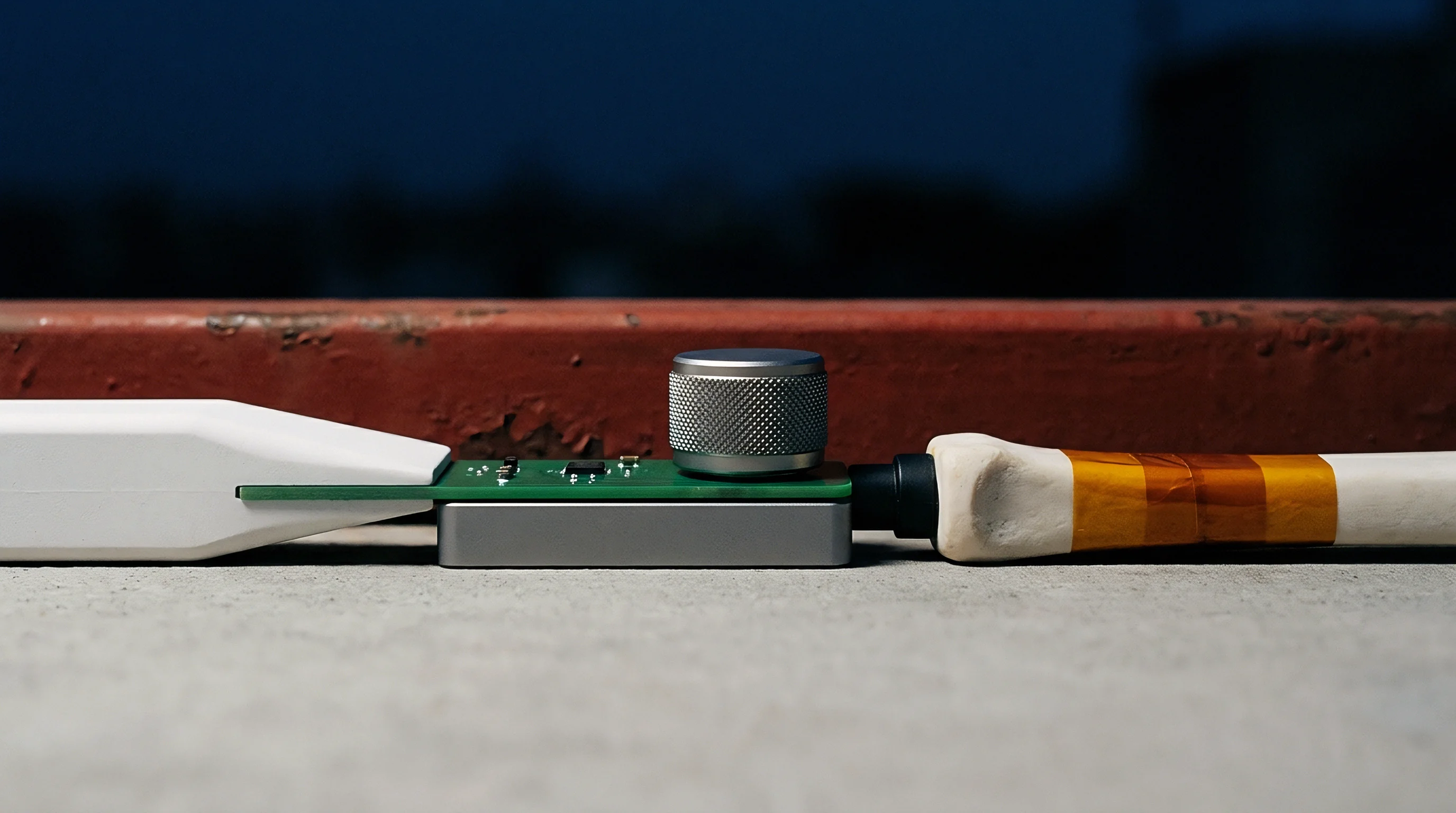
Chamber
Validating theoretical shift factors requires physical testing inside specialized environmental chambers. Standard thermal ovens can develop temperature gradients of up to 5 °C across their internal volume, producing uneven aging rates within sample batches. Proper characterization demands forced-convection chambers that maintain spatial temperature variations within ± 0.5 °C throughout the test area.
Inside the chamber, laser Doppler vibrometry or capacitive displacement sensors measure diaphragm deflection in real time under thermal load. Bridge excitation voltage for piezoresistive units must be held within ± 0.01 percent to separate electrical temperature coefficients from actual mechanical relaxation drift.
Uncorrected thermal gradients throw off mastercurve alignment. Protocols must isolate thermal effects from humidity, since polyimide films absorb up to 3.0 percent atmospheric moisture by weight under ambient conditions. Absorbed water plasticizes the matrix, lowering Tg and shifting Arrhenius curves down in temperature while accelerating structural backbone cleavage.
- Bake all polyimide diaphragm samples at 120 °C under continuous low vacuum below 10 Torr for 24 hours to desorb trapped ambient moisture prior to test chamber insertion.
- Mount test specimens into rigid invar calibration fixtures equipped with four-wire Kelvin resistance sensing lines to eliminate connector thermal electromotive force errors.
- Ramp chamber ambient temperature at a controlled rate of 2 °C/min to the first target soak plateau, holding for 60 minutes to establish complete internal thermal equilibrium.
- Apply stepped differential pressure pulses across the diaphragm using dry ultra-high-purity nitrogen gas, logging continuous deflection profiles at 1 kHz sampling frequency.
- Step chamber temperature sequentially across designated thermal aging tiers while monitoring continuous zero-point offset drift over 1,000 cumulative hours.
Data processing fits deflection decay curves to multi-term Prony series. Converting discrete relaxation times into a continuous activation spectrum shows whether material aging matches Arrhenius predictions or reveals early mechanical failure modes.
A temperature control error of 2 °C during accelerated thermal aging shifts the calculated shift factor by 22 percent, invalidating 1,000 hours of continuous test data.
Failing to verify real-time chamber temperature calibration leads directly to false acceptance of unstable diaphragm lots. If chamber temperatures drift even a few degrees off target, parts can appear stable during accelerated soak tests only to suffer premature zero-point drift once deployed in vehicle fleets.

Yield
Balancing production yield against long-term sensor reliability is a central commercial challenge in automotive manufacturing. Overly tight drift criteria reduce factory yields and push up unit costs, while loose tolerances pass unstable sensors into the field, shifting expenses into warranty claims and recall reserves.
High-reliability applications require post-fabrication thermal burn-in. Exposing assembled diaphragms to elevated thermal soak cycles accelerates initial physical aging, clearing trapped free volume and reducing early operational drift.
Setting optimal burn-in parameters depends on accurate Arrhenius shift factors. A 48-hour burn-in at 170 °C delivers mechanical relaxation equivalent to about 2,200 hours of vehicle operation at 105 °C, stabilizing baseline drift without hogging production line capacity or causing premature thermo-oxidative degradation.
Establishing burn-in profiles from unverified datasheet activation energies creates substantial financial risk. Underestimating activation energy leaves diaphragms incomplete during burn-in, delivering sensors that drift during early vehicle service. Overestimating activation energy over-bakes components, damaging leadframe bonds and weakening wire bond shear strength.
Sourcing strategies must account for total lifecycle costs when selecting diaphragm material grades. Premium BPDA-PDA polyimide carries a raw film price premium of roughly 40 percent over standard PMDA-ODA formulations. However, the higher activation energy threshold and stability of BPDA-PDA structures cut required burn-in times in half while reducing three-year zero-point drift by two-thirds.
How far can multi-regime Arrhenius shift models reduce burn-in duration without inducing latent micro-structural damage along polyimide-to-metal bond interfaces?