Polyimide Thermal Decay
Thermomechanical deformation occurring within a high-temperature polymer film under constant mechanical strain defines polyimide stress relaxation, which gradually reduces the internal restorative force exerted by the material over operational time. Mechanical integrity depends entirely upon maintaining dimensional stability within microelectronic substrates and aerospace insulation barriers. Ambient thermal aging accelerates molecular chain slippage inside the aromatic ring structure, leading to a permanent loss in sealing force once yield thresholds are exceeded.
Continuous exposure to elevated temperatures drives viscoelastic flow, causing the initial clamping pressure of a laminated film to degrade along a logarithmic decay curve.
Measurement Protocol
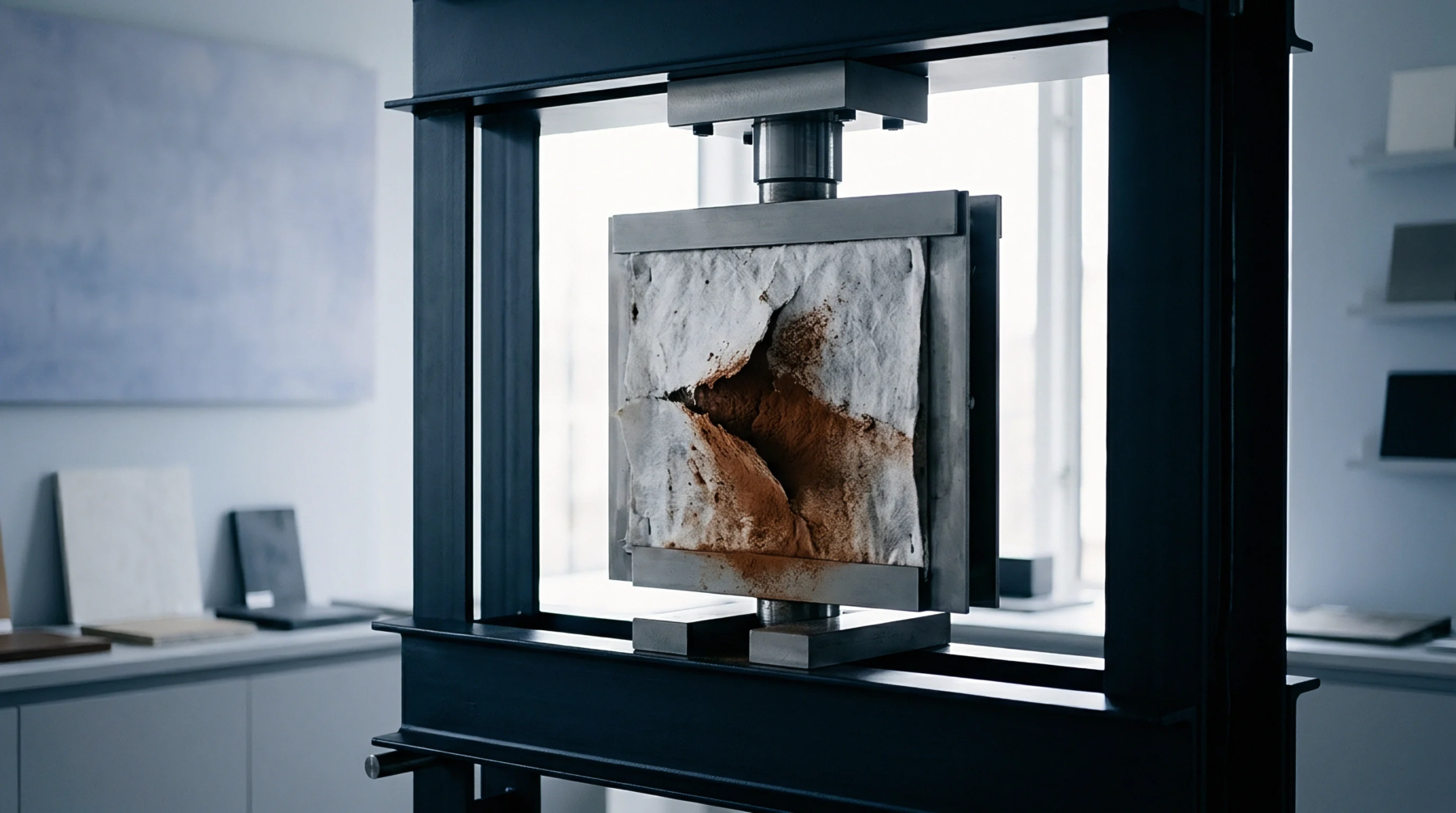
Verification requires mounting a standardized polymer strip within a high-precision load frame enclosed by an environmental chamber capable of maintaining isothermal conditions at maximum rated operating limits. Initial tension is applied instantly to reach a predetermined elongation value, and load cells record the diminishing force output continuously as the polymer accommodates the displacement. Data acquisition systems log voltage changes from strain gauges attached to the test fixture, translating electrical resistance shifts into calibrated force values against time.
Thermal expansion mismatches between the metallic test grips and the polymer specimen introduce parasitic errors, so baseline corrections must be subtracted from the raw sensor output before analysis.
Environmental Interference
Moisture absorption plasticizes the polymer matrix, lowering the activation energy for molecular chain rearrangement and compounding the rate of internal force dissipation during service. Oxidation reactions occurring at elevated temperatures crosslink the polymer chains irregularly, shifting the mechanical response from predictable viscoelastic flow to erratic brittle fracture. Electromagnetic radiation from nearby circuitry induces localized heating within conductive layers adjacent to the film, creating thermal gradients that exacerbate localized stress concentrations.
Calibration drift in the load cell instrumentation due to ambient temperature fluctuations introduces systematic measurement bias, masking true material behavior unless compensating thermistors are integrated into the sensor housing.
Operational Tolerance
Manufacturing specifications established by component standards organizations dictate maximum allowable force degradation percentages over specific thermal endurance cycles. Quality control laboratories verify compliance by subjecting production batches to accelerated thermal testing regimens, comparing the resulting decay curves against empirically derived threshold limits. Sensor assemblies failing to retain the minimum specified holding force at the end of the qualification run are rejected before final integration into high-reliability electronic assemblies.
Corrective adjustments to the curing profile during polymerization alter the initial crosslink density, mitigating excessive force loss under prolonged mechanical loading.