Quantifying Temperature Modulated Cross Sensitivity Matrices in Polycrystalline Sensing Arrays
Dynamic thermal modulation extracts orthogonal kinetic descriptors from polycrystalline sensing arrays, enabling regularized inversion of cross-sensitivity.

Barrier
Conduction Physics across Polycrystalline Metal Oxides
Polycrystalline metal oxide gas sensors depend on inter-granular potential barriers formed by chemisorbed oxygen ions. When ambient oxygen adsorbs onto grain boundaries of n-type materials such as tin dioxide, zinc oxide, or tungsten trioxide, it extracts electrons from the conduction band. This trapping creates an electron depletion layer near the surface, elevating the energy barrier between adjacent crystalline grains.
Target reducing or oxidizing gas molecules react with these surface oxygen species or the metal oxide surface itself, modifying the trapped charge density and changing the boundary barrier height. Electrical resistance through the bulk polycrystalline film scales exponentially with this barrier height according to classic thermionic emission over potential barriers.
Elevating the operating temperature from 150 degrees Celsius to 450 degrees Celsius shifts the dominant chemisorbed oxygen species from molecular ions to atomic and lattice-incorporated states. Molecular ions dominate below 200 degrees Celsius, yielding to singly ionized atomic oxygen species between 200 and 400 degrees Celsius, while doubly ionized oxygen species dominate above 400 degrees Celsius. The reaction rate constants for different gas analytes depend directly on these specific surface oxygen transitions.
This mechanism renders sensor selectivity intrinsically temperature-dependent.
Baseline surface resistance across a polycrystalline tin dioxide film drops by two orders of magnitude between 200 and 400 degrees Celsius under pure synthetic air.
Cross-sensitivity arises because multiple volatile compounds react simultaneously with identical surface oxygen species at overlapping temperatures. A single gas exposure does not generate an exclusive signature. Instead, ethanol, carbon monoxide, methane, and humidity all modulate the same conduction band population, each possessing a distinct, non-linear activation energy curve over temperature.

Temperature Modulated Operational Framework
Thermal modulation converts this chemical cross-sensitivity into a multi-dimensional measurement vector using a single sensing element or an array of varied films. Supplying a dynamic heater profile transforms static surface interactions into transient non-equilibrium kinetic regimes. Common heating waveforms include sinusoidal profiles, triangular sweeps, staircase sequences, and pulsed high-low square waves.
Cycle periods typically range from 2 seconds to 60 seconds.
Dynamic thermal sweeps separate gases whose steady-state responses overlap entirely at fixed temperatures. Fast thermal ramping decouples adsorption rates from desorption and catalytic conversion kinetics. While carbon monoxide oxidizes rapidly at lower temperatures around 250 degrees Celsius, methane demands thermal activation exceeding 400 degrees Celsius to initiate hydrogen abstraction.
Sampling conductance across this sweep generates an analytical fingerprint containing gas-specific reaction constants and diffusion rates.
Kinetics

Chemisorption Rates and Surface Coverage
Surface kinetics govern the instantaneous fractional coverage of ionosorbed oxygen and gaseous targets across every point in the heating cycle. The transient occupation density of oxygen follows kinetic rate equations balancing adsorption, desorption, and consumption via target gas oxidation. When temperature cycles rapidly, surface coverage lags behind the instantaneous thermodynamic equilibrium.
The response becomes path-dependent, exhibiting distinct hysteresis loops between the heating and cooling phases of the waveform.
Exposure to reducing targets depletes the surface coverage of ionized oxygen, shifting the effective activation energies for subsequent steps. At any instantaneous surface temperature, the net reaction velocity reflects the localized concentration of targets, ambient background oxygen partial pressure, and available adsorption sites. Faster thermal slew rates emphasize transient desorption spikes, whereas slower slews map steady-state surface equilibria.
Relative humidity compounds this kinetic complexity. Water vapor dissociates across oxygen vacancies at elevated temperatures, generating hydroxyl groups that consume active adsorption sites and release additional conduction electrons. The interaction of water with surface tin or tungsten atoms introduces an extrinsic donor mechanism operating with its own distinct hydration and dehydration time constants.
These hydration rates differ substantially from the reaction kinetics of hydrocarbons or carbon monoxide, altering the slope and curvature of transient resistance profiles across thermal sweeps.
Uncompensated humidity swings between 30 and 80 percent relative humidity alter kinetic cross-sensitivity coefficients by up to 45 percent at 300 degrees Celsius.

Mathematical Formulation of the Sensitivity Matrix
Quantifying cross-sensitivity in an array operating under temperature modulation demands a formal matrix representation. Consider an array of n sensing elements or virtual sensors derived from n distinct temperature sampling points during a periodic thermal cycle. When exposed to m gas analytes at concentrations collected in vector C, the sensor array generates a response vector R. The cross-sensitivity matrix S relates gas concentrations to observed resistance changes or relative conductance variations.
Linearized around a stable background baseline, the relation takes the form R equals S multiplied by C. Component S_ij represents the partial derivative of sensor metric i with respect to the concentration of analyte j at an evaluation point. Because metal oxide transduction follows power-law relationships governed by the Freundlich adsorption isotherm, the sensitivity coefficients depend heavily on analyte concentrations. Matrix terms assume the form S_ij equals partial derivative of R_i with respect to C_j.
Thermal modulation yields a time-varying sensitivity matrix S(T(t)), where each matrix entry represents an explicit function of instantaneous temperature, thermal slew rate, and operational history. Expanding the matrix into a Taylor series captures non-linear coupling between gases:
The vector components follow the expression where R_i(t) is the sum over j of S_ij(T) multiplied by C_j, plus second-order summation terms over j and k of Gamma_ijk(T) multiplied by C_j and C_k, capturing mutual displacement and competitive surface consumption.
| Film Material | Dopant Chemistry | CO Sensitivity Peak | CH4 Sensitivity Peak | Ethanol Sensitivity Peak | RH Cross-Factor |
|---|---|---|---|---|---|
| SnO2 | Undoped | 260 deg C | 410 deg C | 310 deg C | 0.38 / %RH |
| SnO2 | 0.5% Pd | 180 deg C | 340 deg C | 240 deg C | 0.22 / %RH |
| WO3 | Undoped | 320 deg C | Above 450 deg C | 360 deg C | 0.14 / %RH |
| ZnO | 1.0% Pt | 210 deg C | 380 deg C | 270 deg C | 0.45 / %RH |
The table displays values extracted under dry air with 100 ppm analyte gas steps, using a 30-second triangular thermal ramp. Thermal peak positions clarify why a single operating temperature cannot resolve mixtures containing both light hydrocarbons and combustion products.

Rig

Chamber Architecture and Flow Dynamics
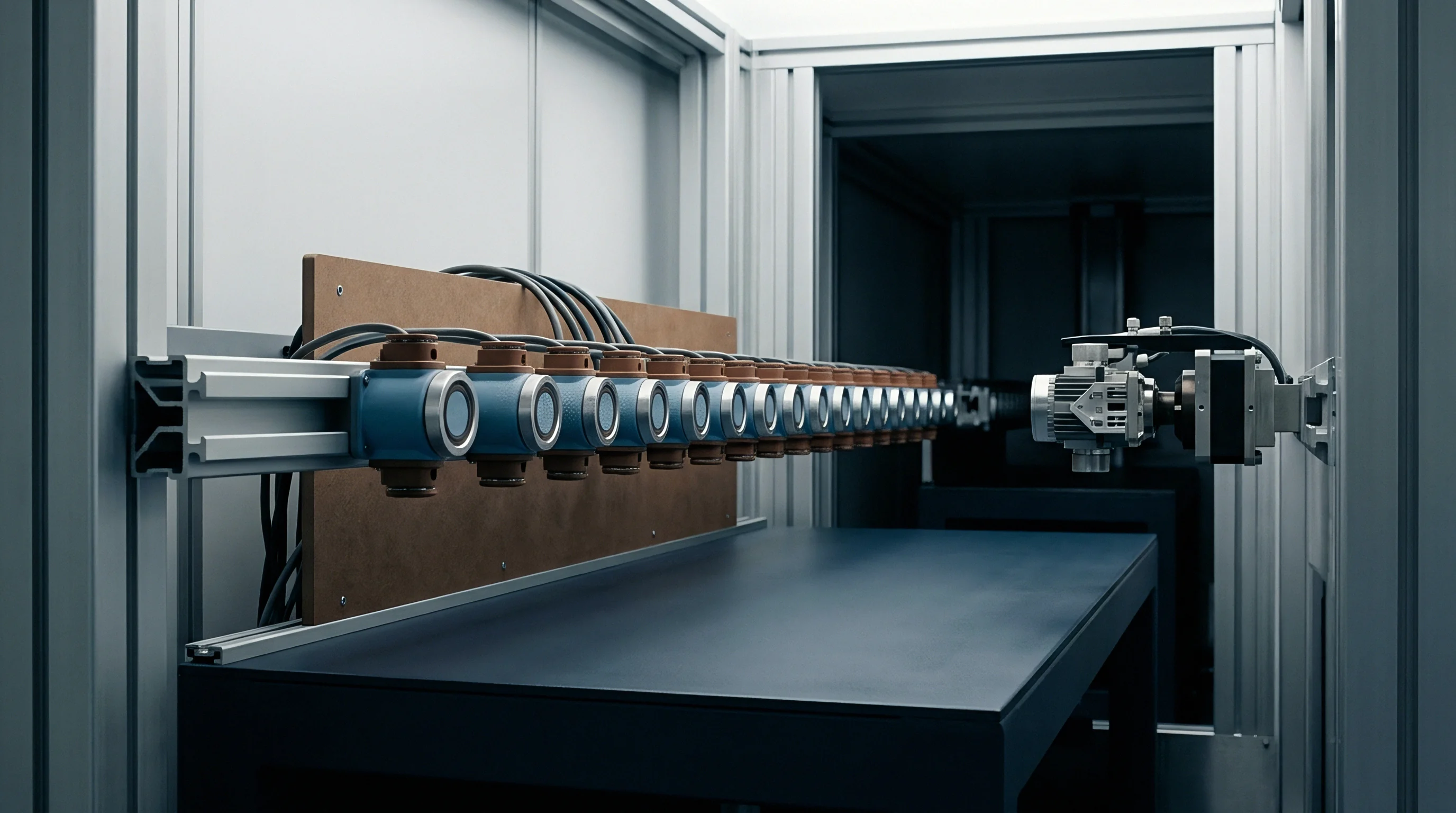
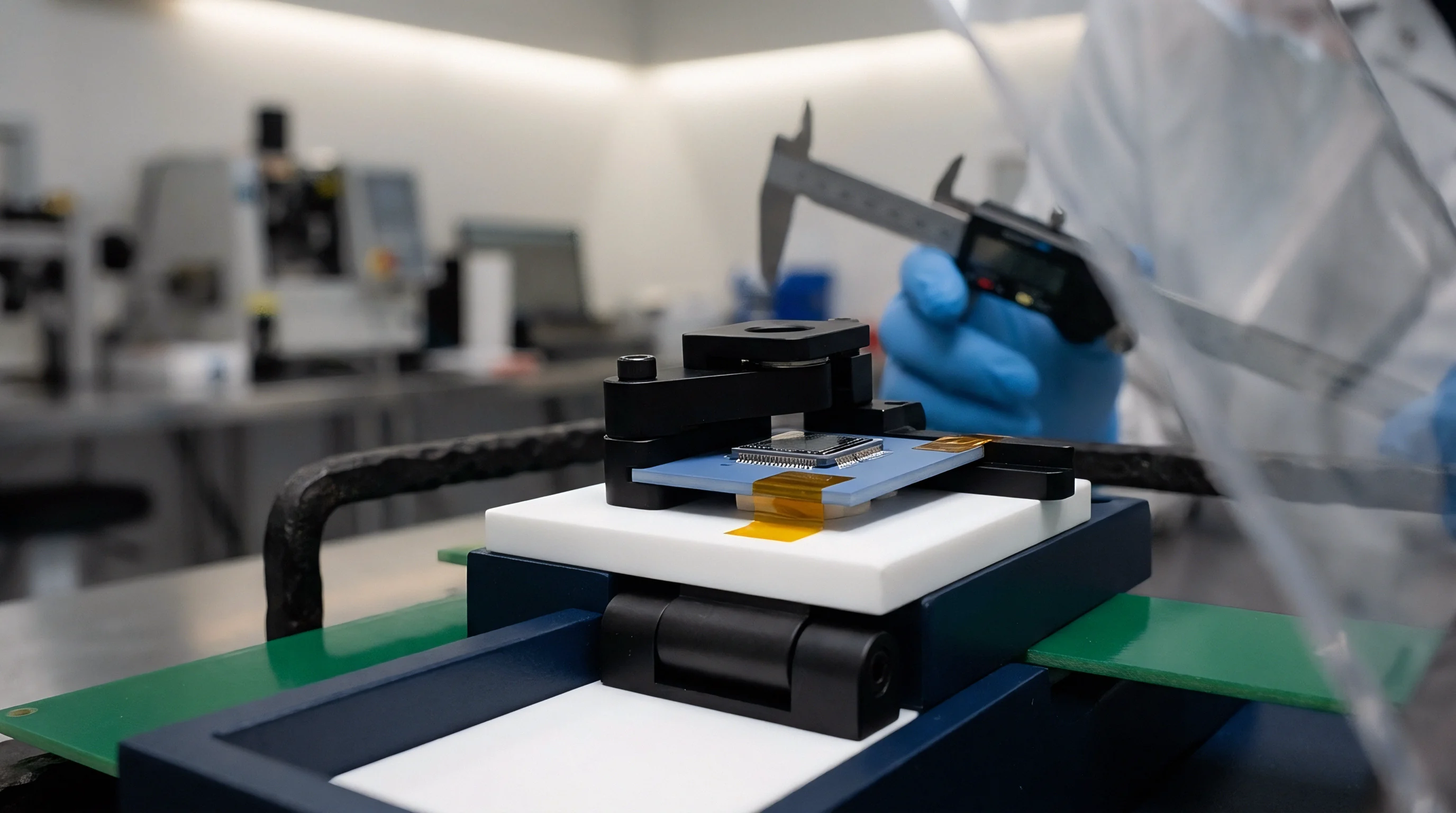
Isolating the cross-sensitivity matrix requires a gas exposure apparatus engineered to prevent mass-transport limitations from distorting surface kinetics. The internal volume of the test chamber must remain minimal, typically under 15 cubic centimeters, while maintaining a laminar flow regime across the sensor array surface. Dead volumes create exponential dilution tails that disguise the true sensor response times, contaminating matrix quantification.
The delivery manifold employs digital mass flow controllers calibrated specifically for the test carrier and analyte gases. Teflon, electropolished 316L stainless steel, or quartz tubing prevents target gas adsorption along chamber walls. Polar gases such as nitrogen dioxide or ethanol readily coat raw elastomeric seals, causing measurement lag.
Sensor chambers incorporate thermal isolation blocks to prevent the cycling micro-heaters from drifting the ambient chamber wall temperature, which would induce baseline shifts.
Electrical Interfacing and Thermal Actuation
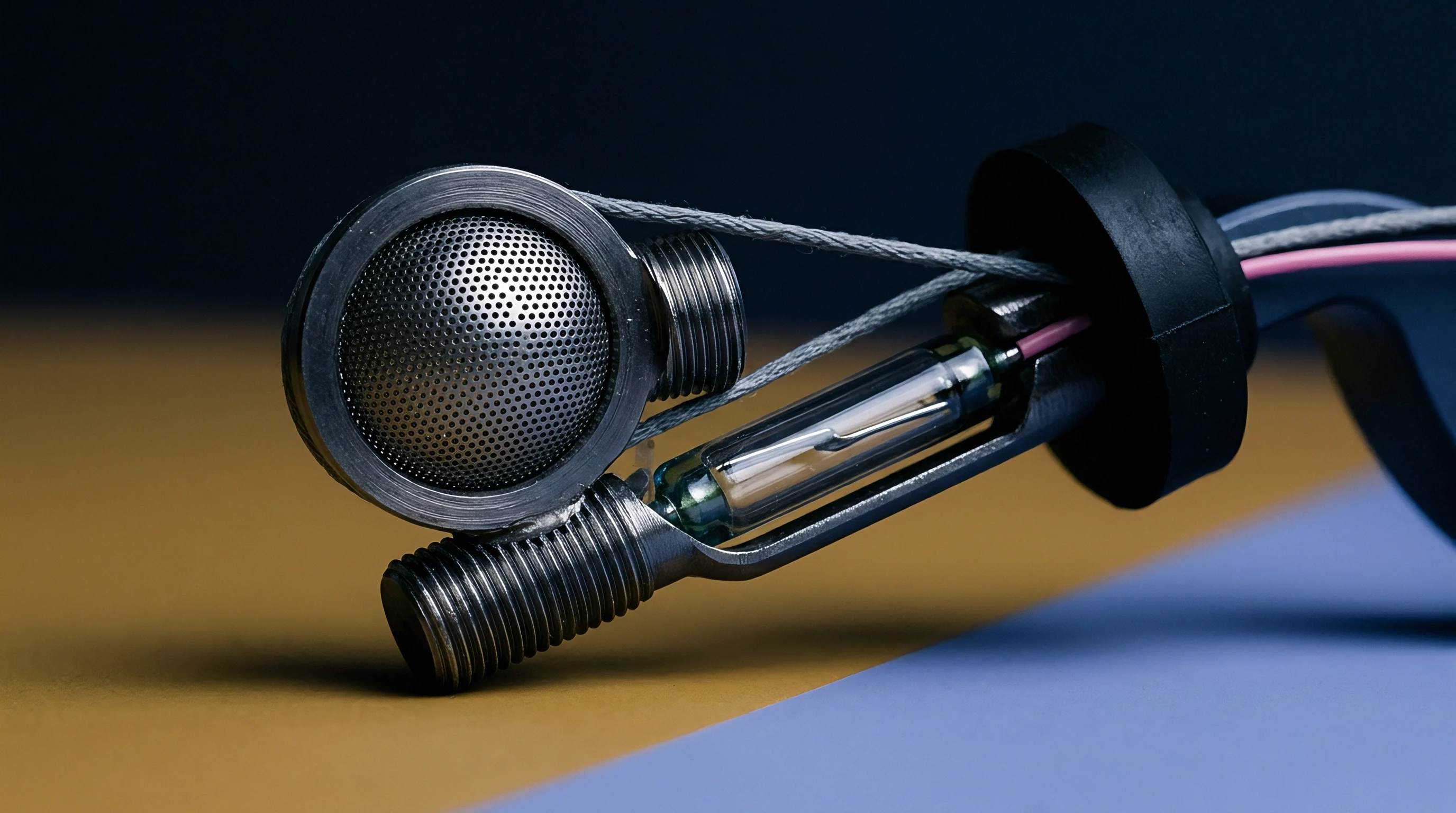
Thermal control of polycrystalline arrays relies on integrated platinum or polysilicon resistive heaters. Achieving precise matrix quantification demands closed-loop temperature control using the heater element itself as a resistance temperature detector. A constant-current or constant-voltage bridge configuration continuously samples the heater resistance, calculating instantaneous temperature via the material’s temperature coefficient of resistance.
Proportional-integral-derivative control loops running at update rates of 1 kHz or higher ensure that the sensor film tracks arbitrary temperature waveforms despite convective cooling variations. A high thermal mass substrate introduces thermal low-pass filtering, limiting the maximum practical slew rate. Modern micro-machined silicon hotplates exhibit thermal time constants below 15 milliseconds, permitting aggressive ramp rates up to 500 degrees Celsius per second.
Thick-film alumina substrates operate with thermal constants near several seconds, restricting profiles to slow sweeps.
Sensor film readout demands wide dynamic range instrumentation. The baseline electrical resistance of a polycrystalline tin dioxide film spans five to six orders of magnitude across a 200 to 400 degrees Celsius sweep. Low-noise transimpedance amplifiers featuring programmable gain stages, or high-speed multi-range electrometer circuits, prevent signal saturation at cold states while retaining bit resolution at high-temperature conductance peaks.


Calibration

Design of Experiments for Binary and Ternary Gas Mixtures
Populating the cross-sensitivity matrix cannot be accomplished by measuring single gases in isolation. Competitive chemisorption produces non-additive resistance responses in mixtures. An experimental design must map the multidimensional concentration space across all anticipated operational boundaries.
A full factorial or central composite design establishes the testing sequences. For an array assessing carbon monoxide, methane, and background relative humidity, test points span three to five discrete concentrations per gas alongside interleaved binary and ternary permutations. The total measurement points expand exponentially with analyte count:
- Gas mixture permutations establish baseline training sets across defined concentration nodes, varying target analytes alongside humidity spans from 10 to 80 percent relative humidity.
- Thermal sweep stabilization periods guarantee repeatable initial coverage states, holding sensors at 400 degrees Celsius for 60 seconds between consecutive gas exposures to clear surface hydroxyls.
- Randomized sequence injection eliminates systematic drift biases caused by grain boundary sintering or micro-heater resistance migration during prolonged testing routines.
- Multi-point reference exposures return the array to a verified baseline gas mixture every five cycles, tracking zero-point decay and span calibration shift.
The sequence ensures adequate statistical degrees of freedom to fit both first-order linear cross-sensitivity entries and second-order interaction terms. Failure to randomize or interleave reference exposures confounds long-term sensor drift with cross-gas sensitivity coefficients.
Skipping ternary verification points leaves high-temperature competitive desorption non-linearities undetected until field deployment.

Extracting Descriptors from Dynamic Waveforms
Continuous thermal modulation generates continuous time-series conductance data for each sensor element. Mapping these profiles directly to a matrix requires extracting distinct mathematical features that summarize the chemical and kinetic behavior across specific thermal bands.
Feature extraction pipelines reduce the high-dimensional conductance vector into discrete numerical metrics. Useful descriptors include integral conductance over defined temperature windows, instantaneous slopes at specific activation thresholds, and Fourier transform harmonic coefficients. Fast Fourier analysis converts periodic conductance output into magnitude and phase components.
Phase shifts reflect chemical relaxation times relative to the driving thermal frequency, decoupling fast catalytic reactions from slow surface equilibration.
Discrete wavelet transforms provide localized time-frequency decomposition, isolating sharp conductance transients associated with rapid catalytic ignition. These extracted feature vectors populate the sensor array response vector R used during matrix inversion.


Inversion

Conditioning and Orthogonality of the Matrix
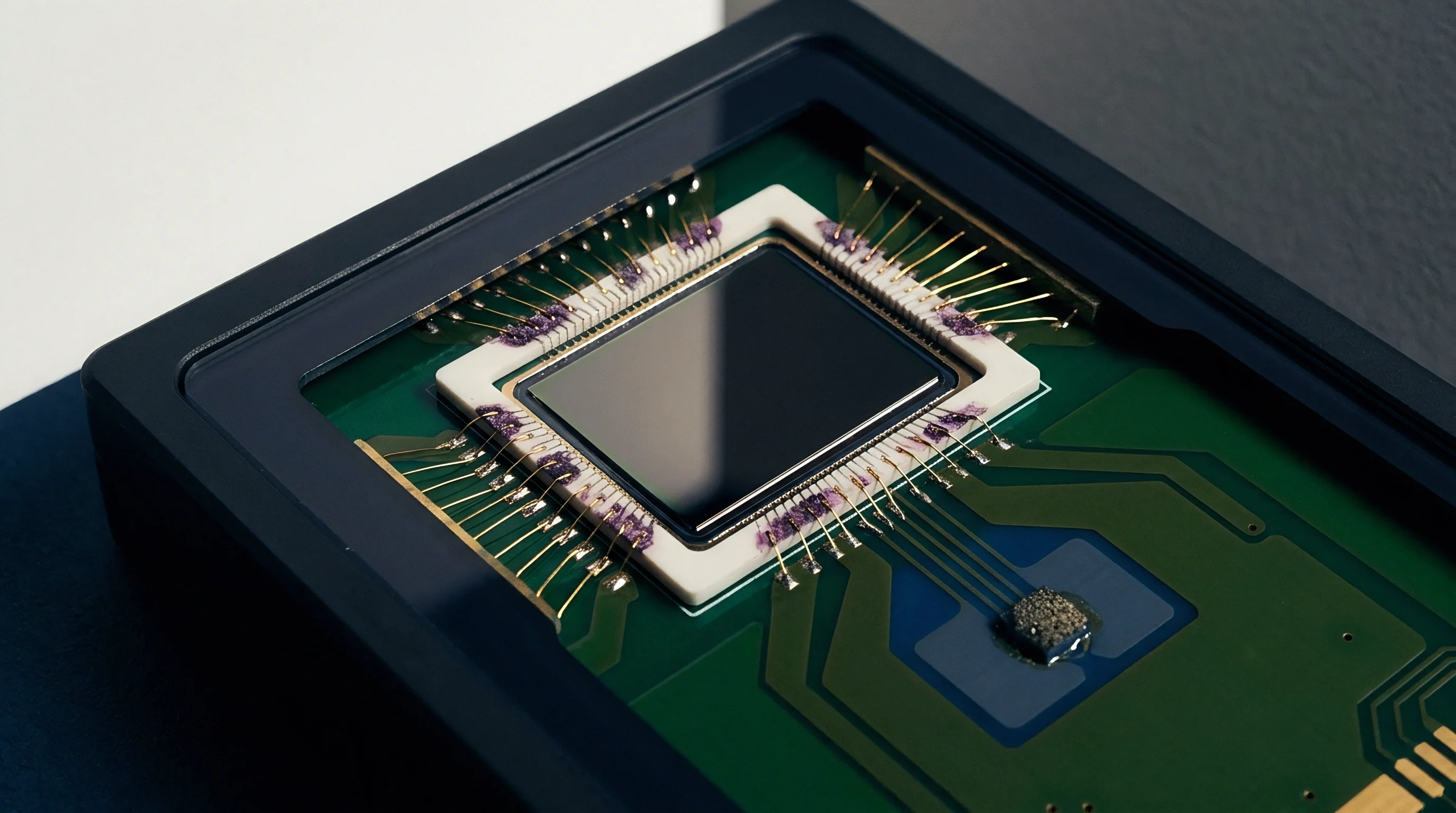
Resolving independent gas concentrations from array signals requires computing the inverse of the cross-sensitivity matrix. The mathematical stability of this inversion depends directly on the orthogonality of sensor responses across the selected features. Highly correlated features or identical temperature responses across array elements generate an ill-conditioned matrix.
The condition number of the sensitivity matrix provides an operational metric of stability. The condition number is defined as the ratio of the maximum singular value to the minimum singular value of the matrix, determined through singular value decomposition. A condition number close to unity indicates mutually orthogonal sensor responses, allowing robust concentration extraction.
A large condition number indicates near-collinearity. In an ill-conditioned system, minute instrumentation noise, quantization errors, or small baseline shifts in the front-end amplifier propagate massive errors into the calculated gas concentrations.
Decomposition Algorithms and Error Propagation
When solving the non-linear relationship R equals S(C) multiplied by C, linear matrix inversion via simple Gaussian elimination or basic pseudo-inverse techniques proves inadequate. Practitioners turn to regularized parameter estimation and multivariate regression frameworks. Partial least squares regression projects both the feature matrices and concentration matrices into latent variables, maximizing covariance while filtering out correlated noise components.
Ridge regression and Tikhonov regularization introduce a penalty term to stabilize the matrix inversion against noise amplification. The optimization minimizes the Euclidean norm of prediction error while penalizing extreme weight coefficients. The regularized inversion takes the operational form:
C_estimated equals the product of the transposed sensitivity matrix and the inverse of the sum of the sensitivity matrix times its transpose plus lambda times the identity matrix, acting on the measured response vector R.
The parameter lambda controls the trade-off between model fit and noise amplification. Setting lambda too high attenuates sensitivity to trace analytes. Setting lambda too low allows thermal noise and baseline drift to generate wild concentration swings, particularly for weakly responding target gases.
| Inversion Formulation | Effective Condition Number | CO Error (50 ppm Step) | CH4 Error (500 ppm Step) | Computational Complexity |
|---|---|---|---|---|
| Direct Moore-Penrose Inverse | 412.8 | Plus or minus 18.4 ppm | Plus or minus 112 ppm | O(n cubed) |
| Tikhonov Regularization (Optimal Lambda) | 24.6 | Plus or minus 3.2 ppm | Plus or minus 28 ppm | O(n cubed) |
| Partial Least Squares (5 Latent Vars) | 8.3 | Plus or minus 1.9 ppm | Plus or minus 14 ppm | O(k times n squared) |
| Kernel Ridge Regression | 4.1 | Plus or minus 1.1 ppm | Plus or minus 9 ppm | O(n cubed) storage heavy |
Data reflects evaluation against a synthetic testing set containing 20 to 100 ppm carbon monoxide, 200 to 1000 ppm methane, and 20 to 80 percent relative humidity under simulated 12-bit ADC noise. The condition numbers demonstrate why raw pseudo-inversion fails in real instrumentation signal chains.
Yield

Grain Growth, Phase Segregation, and Thermal Aging
The long-term validity of any calibrated cross-sensitivity matrix depends on the structural stability of the underlying polycrystalline film. Operating metal oxides under continuous thermal cycling imposes severe thermomechanical and chemical stresses. Repeated expansion and contraction cycles between 150 and 450 degrees Celsius drive microstructural evolution at the nanoscale.
Grain boundary mobility increases at elevated temperatures. Nanocrystalline domains undergo grain growth via Ostwald ripening, reducing the net active surface area and increasing average grain diameter. Because the sensitivity of metal oxide films scales inversely with crystallite size when the grain radius approaches the Debye screening length, grain ripening permanently suppresses raw sensitivity coefficients.
The baseline entries of the sensitivity matrix decay systematically over operating life.
Dopants such as platinum, palladium, or gold nanoparticles undergo surface migration and agglomeration under cyclic thermal operation. Catalytic cluster coalescence decreases surface dispersion, shifting optimal catalytic operating temperatures upward. The physical peaks of the temperature sensitivity curves migrate along the time axis, invalidating the static descriptors extracted during original factory calibration.
Packaging choices dictate matrix reliability under environmental stress. Sensor dies bonded with standard gold wire to ceramic headers suffer from intermetallic phase growth at the contact pads when exposed to prolonged thermal cycling. Micro-machined silicon membranes with dielectric support layers like silicon nitride or silicon dioxide develop mechanical micro-fractures under alternating thermal stress.
Dielectric cracking alters thermal dissipation paths, causing the actual film temperature to diverge from the value predicted by the heater resistance measurement.

Supply Base Realities and Alternate Sourcing
Specifying polycrystalline metal oxide arrays with modulated thermal matrices introduces substantial commercial dependencies. Few merchant suppliers manufacture micro-machined multi-sensor arrays. Most commercial suppliers sell single-substrate sensors optimized for static heating in consumer air quality monitors or automotive cabin air systems.
Procuring custom arrays or integrated micro-hotplate devices limits the supplier pool to a narrow selection of specialized European and Asian semiconductor foundries.
Cross-qualifying an alternate vendor presents severe qualification hurdles. Two polycrystalline tin dioxide films exhibiting identical nominal base resistance at 300 degrees Celsius in synthetic air will display radically divergent cross-sensitivity matrices under thermal cycling. Variations in screen-printing paste binders, chemical vapor deposition parameters, sol-gel annealing temperatures, or trace catalytic impurities alter grain boundary distributions.
Sourcing teams cannot simply replace a metal oxide sensor part number with an alternate manufacturer component without executing a full multi-gas kinetic matrix re-calibration. Qualifying a replacement foundry demands extensive chamber testing cycles spanning several months to reconstruct the behavioral matrix and verify thermal aging constants.
The procurement contract must incorporate precise batch-to-batch repeatability requirements. Suppliers routinely defend baseline sensitivity variations between production lots by citing the broad tolerance bands accepted in static threshold-detection applications.