Deriving Clausius-Mossotti Permittivity Correction Factors for Humid Vacuum Calibration
Clausius-Mossotti permittivity correction factors account for water vapor dipoles, eliminating hidden capacitance calibration errors in humid vacuum systems.


Vapor
Vacuum chambers operating in the low-pressure regime between 0.001 millibar and 10 millibar contain residual gas molecules that alter dielectric properties. Water molecules present in evacuated spaces contribute disproportionately to total dielectric permittivity due to a permanent electric dipole moment. Precision electrical capacitance standards, microwave resonant cavities, and optical interferometers calibrated in evacuated test cells depend directly on absolute dielectric baseline accuracy.
When uncorrected humidity persists in a vacuum chamber, capacitance bridge balances shift away from true physical dimensions. Calibration systems that assume ideal zero-density vacuum conditions without accounting for residual moisture generate hidden system errors.
The distinction matters.
Gas Density and Permittivity Coupling
Gas phase constituents within test chambers alter the electric flux density under applied voltages. The dielectric constant of an evacuated chamber occupied by gas species deviates from unit vacuum permittivity based on molar density and molecular polarizability. While homonuclear diatomic gases like nitrogen and oxygen exhibit pure electronic and atomic polarizability, water molecules display strong orientational polarizability.
This dipole alignment mechanism creates a steep permittivity dependence on partial pressure and ambient temperature.
Water alters the dielectric constant.
Laboratory vacuum systems pump down through the roughing regime while continuously desorbing moisture from metal chamber walls. During this transit, total cell pressure drops faster than water vapor partial pressure, elevating the relative concentration of polar molecules. A capacitance standard evaluated at 0.1 millibar total pressure under humid residual gas exhibits a permittivity offset identical to several millibars of dry nitrogen.
Failing to isolate the partial pressure of water vapor invalidates the assumption of linear vacuum scaling.
At 293.15 Kelvin and 10 millibar partial pressure, water vapor elevates relative permittivity by 0.000132 relative to pure vacuum.
Residual Moisture Mechanisms
Environments transition from viscous flow to molecular flow while retaining multi-layer water coverage on electrode surfaces and chamber walls. Gas molecules continually desorb into the open volume, establishing dynamic partial pressure equilibrium based on pumping speed and wall temperature. Physical mechanisms impacting electrical standard accuracy fall into clear operational categories.
- Gas Phase Compression alters local molar density through real-gas non-ideality and second virial interactions under variable cell temperatures.
- Adsorbed Surface Layers modify effective inter-electrode spacing by forming polarized nanometer-thick water films on metallic capacitor plates.
- Temperature Gradient Instability shifts the local orientation polarizability term by modulating thermal kinetic energy across the sensing cell.
- Partial Pressure Fluctuations introduce low-frequency permittivity drift as chamber outgassing rates decay over extended test runs.
Uncorrected residual moisture in vacuum standards causes systematic calibration shifts that propagate into downstream product tolerances, invalidating factory accuracy guarantees and triggering severe field yield losses.
Polarity
Molecular structure dictates how electric fields interact with gaseous constituents. The classic Clausius-Mossotti relation connects macroscopic relative permittivity to microscopic polarizability for nonpolar isotropic media. When polar molecules with permanent dipoles inhabit the gas volume, the classical relation extends into the Debye equation to account for thermal agitation opposing field alignment.
Molar density dictates the correction.
Mathematical Derivation of the Correction Factor
Deriving the correction factor begins with the fundamental Clausius-Mossotti equation written in terms of molar polarizability. Macroscopic permittivity relates to molecular parameters through the specific molar polarization equality:
(ε_r – 1) / (ε_r + 2) = (N / (3 ε_0)) α
Where ε_r represents relative dielectric permittivity, ε_0 represents absolute vacuum permittivity, N represents molecular number density in molecules per cubic meter, and α represents total molecular polarizability. Expressing number density through molar density ρ_m = P / (Z R T), where P is total pressure, T is thermodynamic temperature, R is the universal gas constant, and Z is the gas compressibility factor, yields:
(ε_r – 1) / (ε_r + 2) = (N_A / (3 ε_0)) ρ_m α = A_m ρ_m
The parameter A_m defines the molar polarizability constant in units of cubic meters per mole. For pure water vapor, total polarizability combines temperature-independent electronic and atomic polarizability α_e with temperature-dependent orientation polarizability α_d:
α = α_e + μ_0^2 / (3 k_B T)
Where μ_0 represents the permanent dipole moment of the water molecule (6.181 x 10^-30 Coulomb-meters) and k_B represents the Boltzmann constant (1.380649 x 10^-23 Joules per Kelvin). Dipole orientation dominates dielectric response.
Substituting molecular parameters into the molar polarizability expression provides the temperature-dependent equation for water vapor:
A_m,w = (N_A / (3 ε_0))
In low-density vacuum environments where relative permittivity differs from unity by parts per million, the denominator term (ε_r + 2) evaluates to approximately 3. Simplifying the left-hand side yields the direct relation for gas permittivity expansion:
ε_r – 1 = 3 A_m,mix ρ_m + 3 B_ε,mix ρ_m^2
Where B_ε,mix represents the second dielectric virial coefficient accounting for two-body molecular interactions. For binary mixtures of residual dry background gas and water vapor, molar polarizability combines linearly by mole fraction:
A_m,mix = x_dry A_m,dry + x_w A_m,w
Converting molar density to partial pressure terms yields the operational correction factor equation for humid vacuum cell calibrations:
ε_r – 1 = (3 / (R T)) (1 / Z_mix) + 3 B_ε,mix (P_total / (R T))^2
To recover the true geometric capacitance C_0 from a measured capacitance C_measured under residual gas, the metrologist applies the multiplicative correction factor k_corr:
C_0 = C_measured k_corr
k_corr = 1 / ε_r ≈ 1 – (3 / (R T))
Precision demands explicit virial corrections.
| Gas Species | Electronic Polarizability (10^-40 F m^2) | Permanent Dipole Moment (10^-30 C m) | Molar Polarizability A_m (cm^3/mol) | Dielectric Shift (ppm per mbar) |
|---|---|---|---|---|
| Dry Nitrogen (N2) | 1.96 | 0.00 | 4.45 | 0.547 |
| Dry Oxygen (O2) | 1.75 | 0.00 | 3.98 | 0.489 |
| Argon (Ar) | 1.83 | 0.00 | 4.16 | 0.511 |
| Water Vapor (H2O) | 1.60 | 6.18 | 22.67 | 2.788 |
Temperature Sensitivity in Orientational Alignment
Orientational alignment introduces an inverse temperature dependence into the polarizability equation. As cell temperature increases, thermal kinetic energy disrupts the directional alignment of water dipoles in the electric field, reducing macroscopic permittivity. Lower temperatures intensify dipole alignment, increasing dielectric permittivity per unit partial pressure.
Evaluating calibration uncertainty without continuous, high-resolution chamber temperature tracking introduces unquantified baseline drift.
Whether quantum rotational mechanical coupling introduces non-linear permittivity deviations at sub-millibar pressures remains an open question in low-density gas metrology.

Outgassing
Internal chamber surfaces continuously release adsorbed moisture into the evacuated space. Stainless steel walls, ceramic insulators, and elastomer seals act as persistent reservoirs of water molecules. Pumping down a chamber reduces total total pressure quickly while moisture outgassing maintains a higher partial pressure ratio of water vapor over time.
Chamber conditioning determines the stability of the dielectric baseline during long calibration procedures.
Outgassing rates decay exponentially.
Desorption Dynamics in Evacuated Cells
Surface desorption rates depend heavily on thermal history, wall surface finishes, and vacuum baking parameters. Water molecules bind to oxide layers via physical adsorption and hydrogen bonding. In unbaked vacuum systems, outgassing rates remain dominated by moisture for hundreds of hours of continuous evacuation.
This continuous gas release creates partial pressure gradients between the chamber measurement cell and vacuum pump inlets.
Pressure gauges drift over time.
Determining true gas density inside the capacitance inter-electrode volume requires localized pressure and temperature telemetry. Standard cold-cathode or Pirani gauges read total pressure based on thermal conductivity or ionization probability calibrated for nitrogen. These uncorrected gauge indicators miscalculate partial pressure when moisture concentration rises, corrupting the density input fed into Clausius-Mossotti correction algorithms.
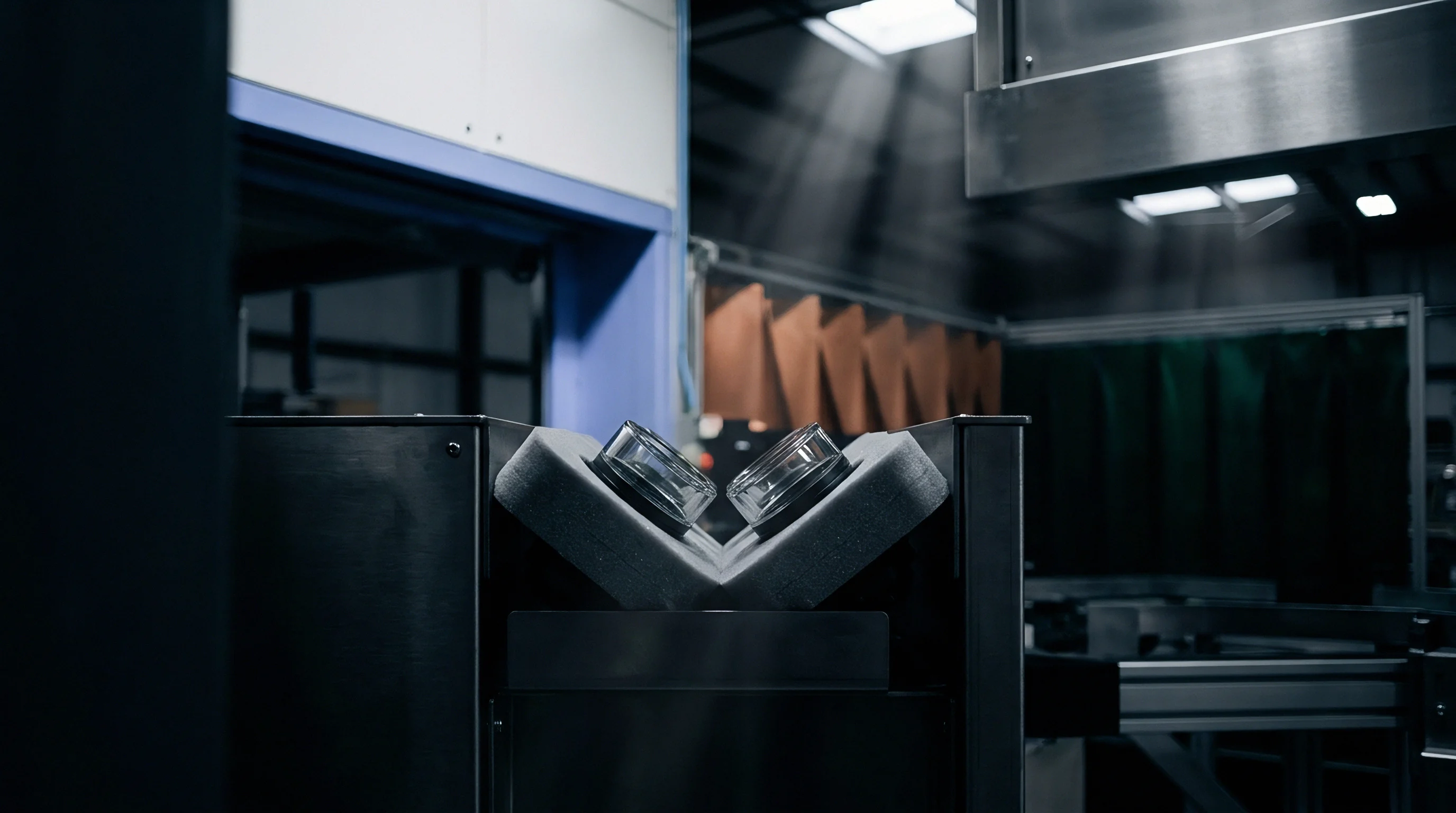
Standardized Vacuum Bakeout Procedure
Establishing an accurate dielectric baseline demands a structured bakeout protocol that removes adsorbed water layers prior to taking standard measurements.
- Evacuate the chamber to a base pressure below 0.00001 millibar for twenty-four hours to desorb loose surface moisture.
- Activate external heating jackets to elevate chamber wall temperature to 150 degrees Celsius while maintaining continuous pumping.
- Hold thermal soak for twelve hours while monitoring residual gas species with an inline residual gas analyzer.
- Cool the chamber down to 23.00 degrees Celsius at a maximum rate of 1 degree Celsius per minute to avoid thermal stress.
Desorption duration scales inversely with chamber wall temperature during the primary vacuum bakeout phase.
Chamber manufacturers frequently state that residual outgassing below 0.001 millibar contributes negligible dielectric distortion, ignoring the high permanent dipole moment of water molecules that causes fractional parts per million shift even at trace pressures.
Resonance
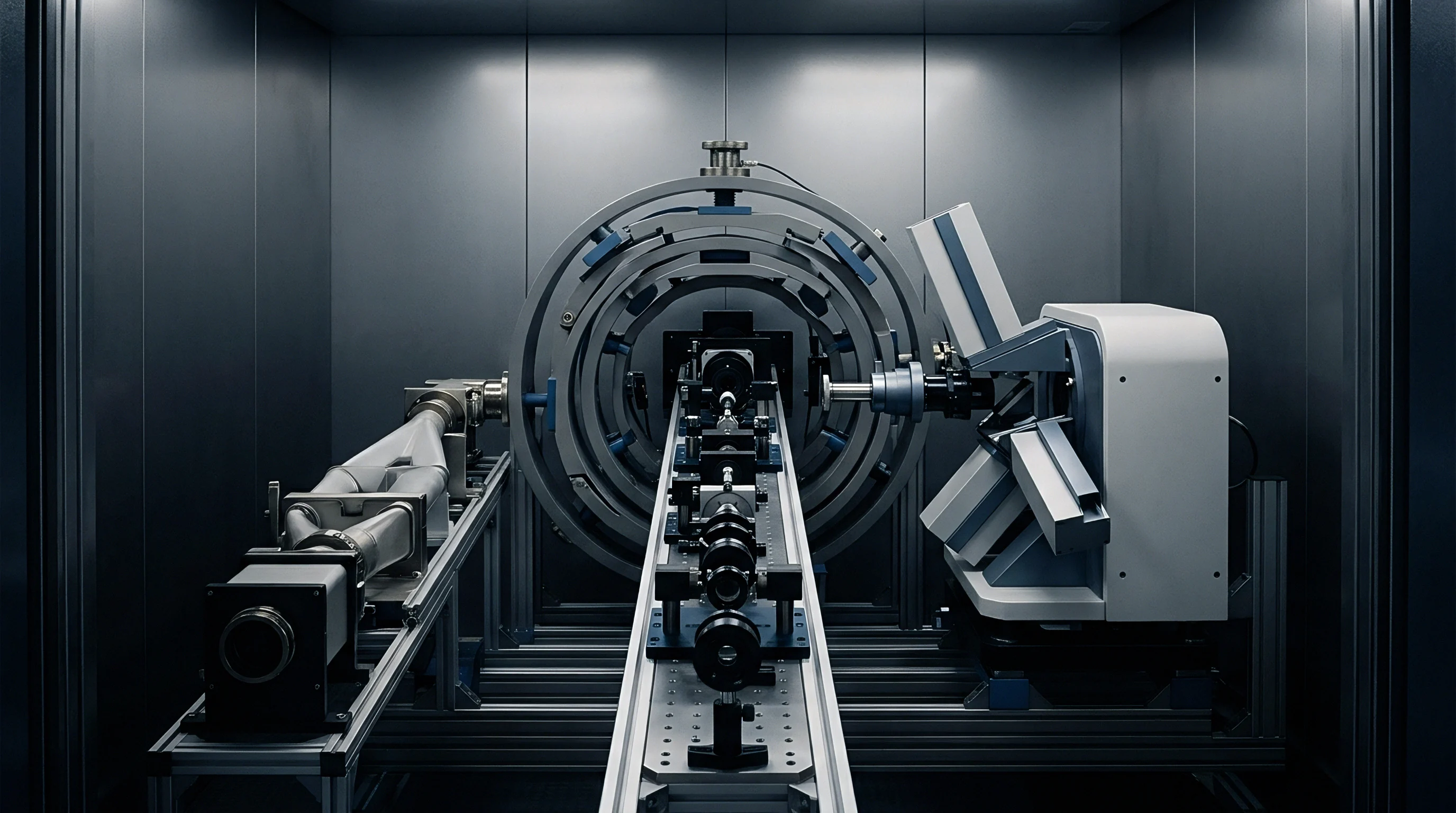
High-frequency dielectric cavities measure physical displacement through frequency shifts in an electromagnetic standing wave. Modern microwave resonator standards and precision air-gap capacitors operate as primary displacement transducers or permittivity sensors. Residual polar molecules inside the resonant cavity shift the resonance frequency and lower the cavity quality factor due to dielectric loss tangents.
How Does Residual Water Vapor Shift Standard Capacitance?
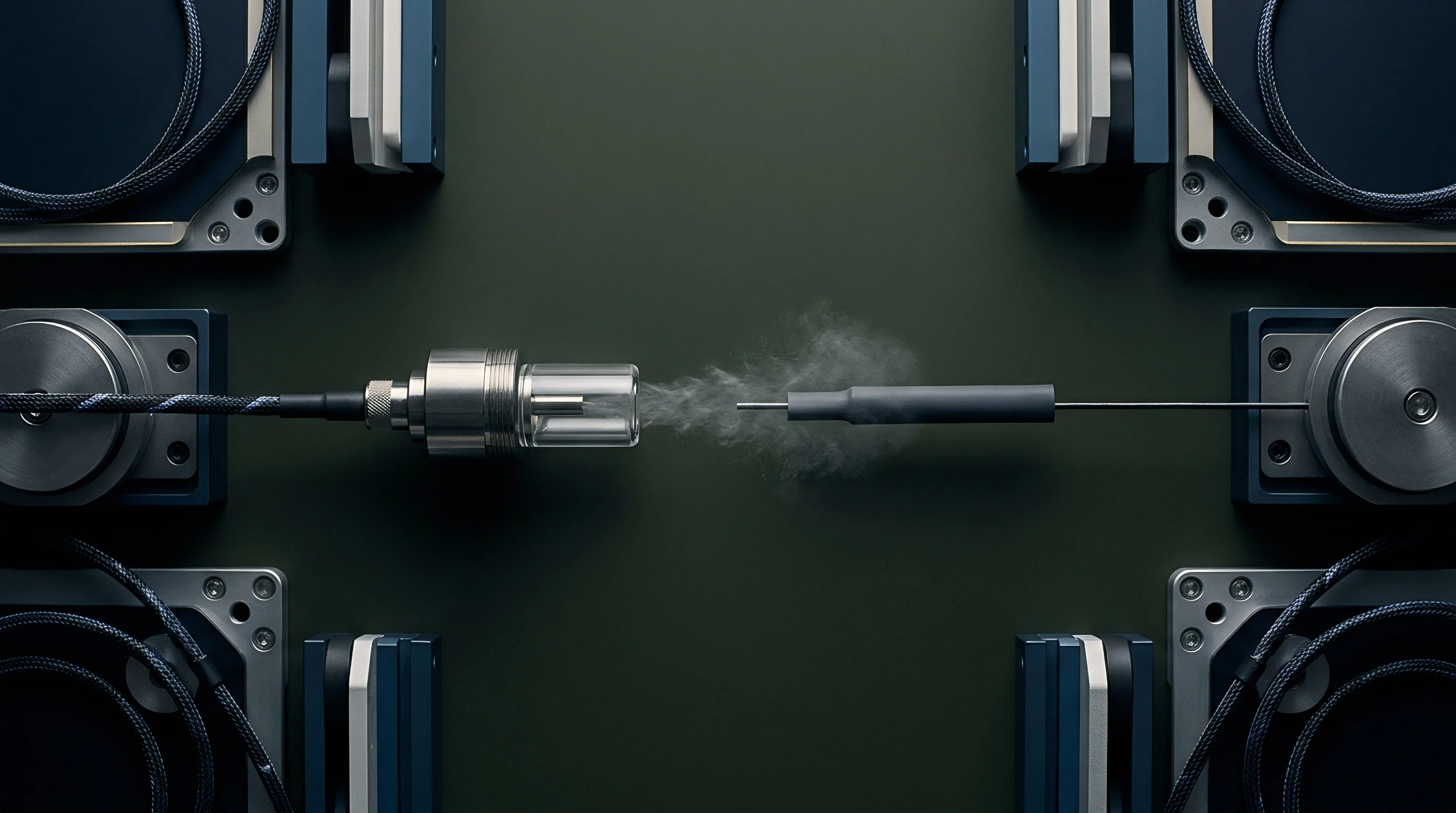
Dielectric loading alters electrical length across an air gap electrode assembly. When water molecules inhabit the inter-electrode space, relative permittivity rises above unity, increasing capacitance according to C = ε_r C_0. In microwave cavities, resonant frequency scales inversely with the square root of permittivity: f = f_0 / sqrt(ε_r).
Uncorrected moisture causes measured resonance frequencies to sit below true geometric vacuum frequencies.
Residual humidity distorts vacuum measurements.
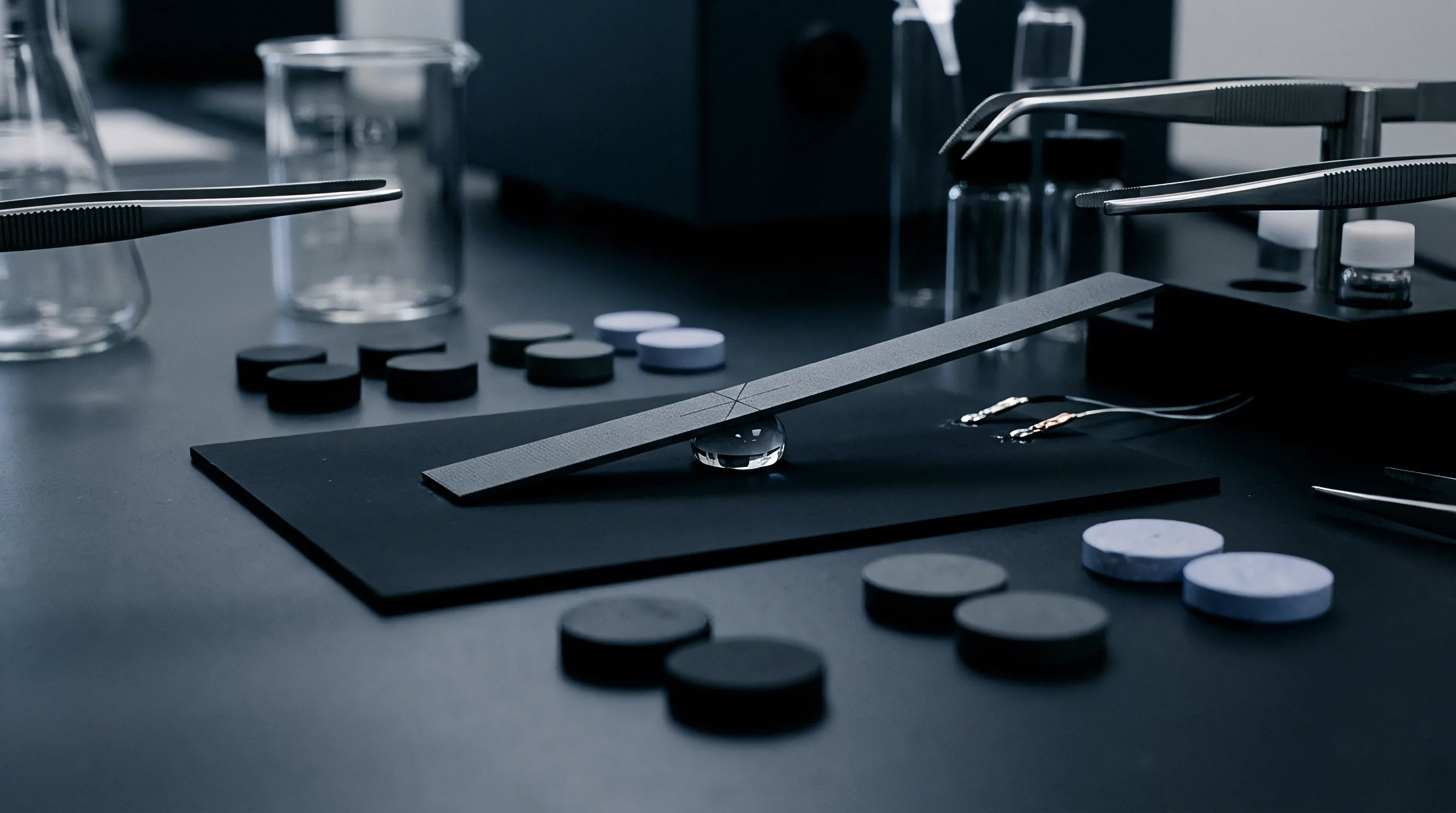
Precision bridge circuits comparing an air-gap standard against a sealed reference capacitor detect small permittivity changes as balance voltage offsets. A water vapor partial pressure of merely 1 millibar raises cell permittivity by approximately 2.79 parts per million. In high-accuracy calibration procedures aiming for 0.1 part per million uncertainty, this moisture effect represents twenty-eight times the total allowable error budget.
| Partial Pressure (mbar) | Molar Density (mol/m^3) | Relative Permittivity Offset (ε_r – 1) | Capacitance Shift (ppm) | Correction Factor k_corr |
|---|---|---|---|---|
| 0.01 | 0.00041 | 0.000000028 | 0.028 | 0.999999972 |
| 0.10 | 0.00410 | 0.000000279 | 0.279 | 0.999999721 |
| 1.00 | 0.04103 | 0.000002788 | 2.788 | 0.999997212 |
| 5.00 | 0.20516 | 0.000013941 | 13.941 | 0.999986059 |
| 10.00 | 0.41031 | 0.000027883 | 27.883 | 0.999972117 |
Capacitance shifts with partial pressure.
Calculating the exact shift requires accurate knowledge of both gas density and molar polarizability. Integrating residual gas analyzer mass spectra with total pressure gauge readings enables continuous calculation of species mole fractions. Applying the full Debye-Clausius-Mossotti derivation converts these mass spectra inputs into live permittivity correction multipliers across variable vacuum conditions.
Permanent electric dipole alignment in water molecules creates a dielectric response far exceeding nonpolar electronic polarization.
A useful operational guideline dictates that whenever residual humidity partial pressure exceeds one-thousandth of total cell pressure, water vapor corrections override all background gas permittivity corrections combined.
Uncertainty
Traceable calibration certificates quantify error sources down to fractional parts per million. Constructing a complete measurement uncertainty budget for Clausius-Mossotti permittivity correction requires identifying and propagating every underlying parameter variation. Temperature errors, pressure transducer calibration drift, mass spectrometer sensitivity variations, and molar polarizability uncertainty contribute directly to the combined expanded uncertainty.
Uncertainty budgets expand with moisture.
Uncertainty Budget Structure
Evaluating standard uncertainty follows the Guide to the Expression of Uncertainty in Measurement framework. The functional relationship for permittivity correction combines partial pressure, cell temperature, and molar polarizability constants into a unified sensitivity equation. Differentiating the correction function with respect to each input parameter produces partial derivative sensitivity coefficients.
Errors accumulate rapidly in vacuum.
Temperature measurement accuracy represents a major contributor to combined variance. Because orientational polarizability contains an inverse temperature term, temperature error impacts both molar polarizability calculation and molar density determination. A cell temperature uncertainty of 0.05 Kelvin generates a corresponding permittivity correction uncertainty of 0.17 parts per million at 5 millibar partial pressure.
- Molar Refractivity Deviation contributes systematic error through uncertainty in published fundamental molecular dipole moments and polarizability constants.
- Thermal Expansion Variance shifts electrode geometry simultaneously, requiring mechanical separation from gas dielectric permittivity corrections.
- Capacitance Bridge Drift introduces bridge ratio errors during multi-hour gas pressure stepped calibration runs.
- Pressure Transducer Non Linearity corrupts low-end partial pressure calculations if calibrated solely at atmospheric scale.
Temperature stability controls gas density.
ISO/IEC 17025 Section 7.8.4 mandates explicit reporting of environmental parameters and combined calibration uncertainties, forcing laboratories to document water vapor partial pressure corrections whenever vacuum standard accuracy claims exceed cell gas density tolerances.

Tolerance
Specification bounds written into sensor procurement contracts define accepted deviation limits. When purchasing or operating high-precision primary capacitance standards or capacitive vacuum transducers, tolerance definitions must specify whether baseline figures apply to dry pure vacuum or ambient vacuum cell conditions. Equivocal specification terms allow suppliers to claim tight tolerances measured under extreme dry vacuum bakeout that cannot be replicated in practical test cells.
Field verifications confirm sensor alignment.
Grade Classification and Pricing Metrics
Primary standards laboratories categorize standard capacitors into accuracy tiers that reflect verification depth and environmental compensation capabilities. Highest-tier primary standards incorporate integrated vacuum jackets, internal platinum resistance thermometers, and dedicated residual gas monitoring ports. Secondary transfer standards omit integrated telemetry, relying on external chamber environmental controls.
| Standard Grade | Base Capacitance Uncertainty (ppm) | Humidity Correction Method | Re-Calibration Interval (Months) | Service Cost Delta (%) |
|---|---|---|---|---|
| Primary National Standard | 0.05 | Live RGA Clausius-Mossotti Derivation | 12 | 100 |
| Secondary Reference Standard | 0.50 | Fixed Dewpoint Sensor Polynomial | 24 | 45 |
| Industrial Transfer Standard | 5.00 | Uncompensated Dry Vacuum Assumption | 36 | 15 |
Selecting standard equipment without accounting for environmental correction infrastructure leads to unexpected total cost of ownership inflation. A primary standard rated to 0.1 part per million baseline accuracy demands an auxiliary vacuum telemetry package costing as much as the standard itself. Omitting live residual gas analysis degrades true operational accuracy down to secondary standard levels, making the original capital expenditure ineffective.
Procurement documents must specify exact calibration test conditions, including maximum allowable moisture partial pressure limits, chamber bakeout protocols, and specific Clausius-Mossotti derivation models required for certificate endorsement. Specifying standard performance without explicit humidity correction protocols leaves open technical disputes over return claims when field bench verification tests fail to reproduce factory calibration certificates.