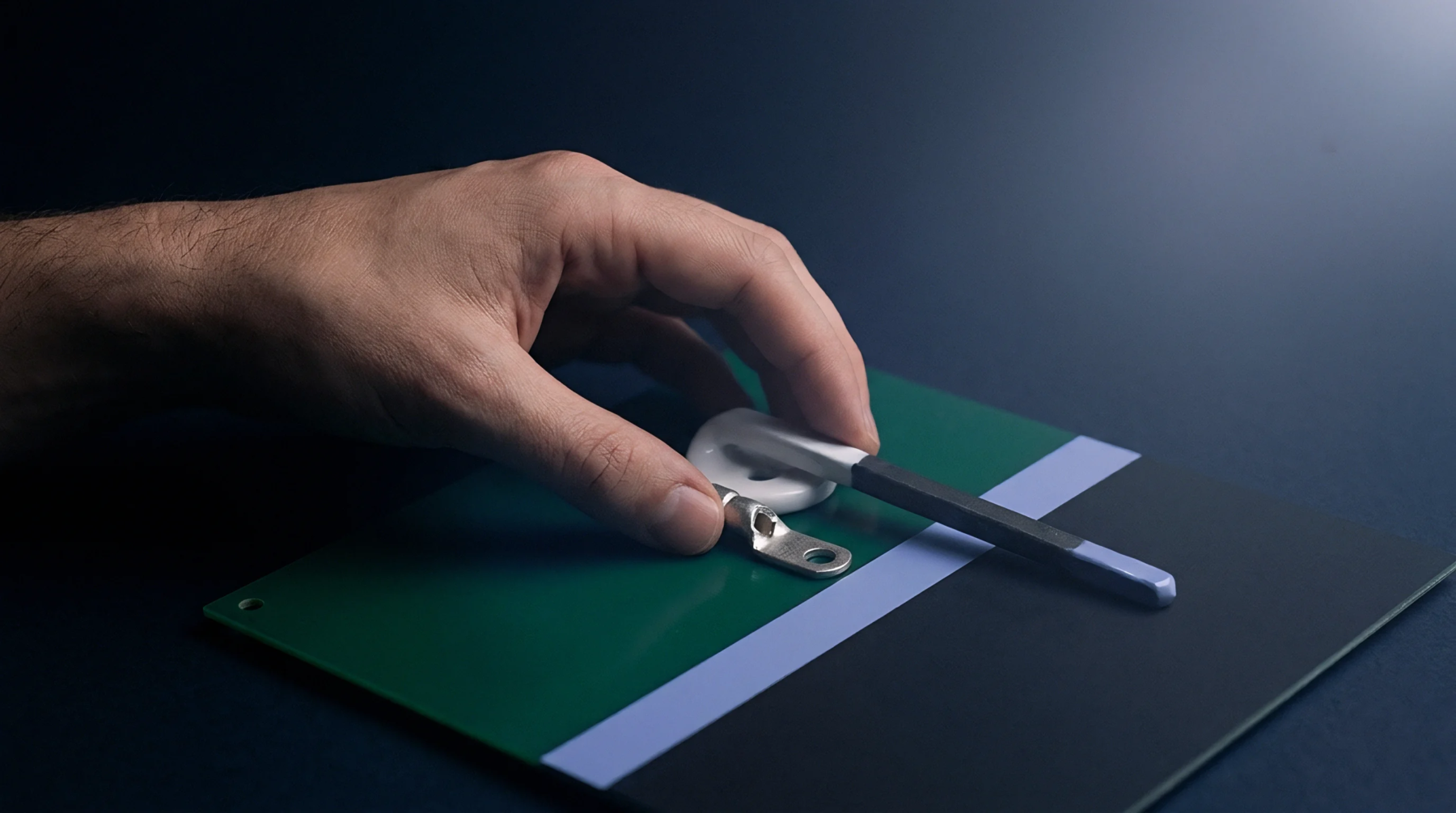
Singulation Pressure
Process of separating individual circuit boards along a pre-cut groove by applying a bending force. The v score breakout method is common for panels where components are not placed close to the edges of the board. It relies on the reduced thickness of the laminate at the score line to control the fracture path.
Stress Profile
Force required to snap the board generates a large amount of mechanical energy that travels through the substrate. During the v score breakout, the strain levels peak at the moment the glass fibres in the laminate rupture. If the score depth is inconsistent, the required force increases and risks damaging nearby ceramic capacitors or other brittle components.
Automated singulation machines often use controlled wedge-shaped rollers to apply this pressure evenly across the length of the score line.
Tooling Alignment
Blades used to create the initial groove must be perfectly centered on both sides of the panel. Misalignment leads to an uneven v score breakout where the fracture wanders away from the intended line. This wandering can result in dimensional errors or exposed copper traces that degrade the reliability of the finished product.
Measurement Verification
Monitoring of the singulation process involves placing strain gauges adjacent to the score line to qualify the process for a new production run. Data collected during the v score breakout confirms that the peak microstrain remains within the limits set by the component manufacturers. Regular inspection of the scoring equipment ensures the depth and angle of the cut stay within the specified tolerance.