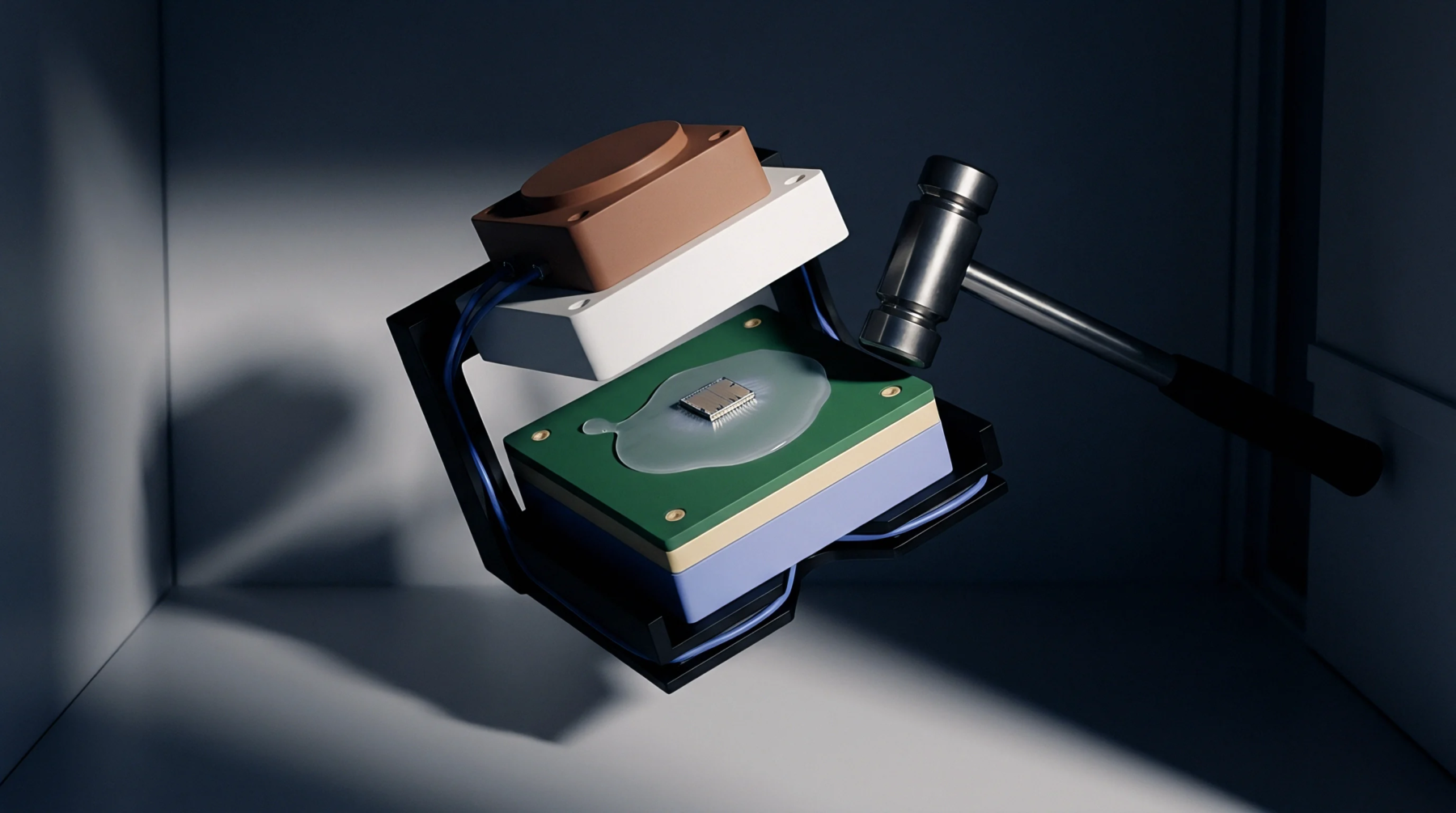
Deformation Coupling
Combined physical deformation arises when thermal expansion mismatches and external mechanical forces act concurrently on structural assemblies. Material layers expand at different rates under thermal loads, creating internal stress distributions. Quantifying thermo-mechanical strain isolates mechanical load responses from purely thermal dimensional changes.
Temperature-induced expansion must be subtracted from total observed deformation to determine true structural loads.
Expansion Mismatch
Heterogeneous material stacks experience internal shear stress when subjected to uniform temperature changes. Differences in thermal expansion coefficients cause adjacent material layers to expand at unequal rates during thermal cycling. Microscopic cracking and interfacial delamination occur when thermal stresses exceed bond strength limits.
High-accuracy strain gauges require active temperature compensation circuits to decouple thermal expansion from applied mechanical forces. Uncompensated temperature effects bias structural health measurements and compromise load calculations. Laboratory testing establishes specific expansion curves for each material combination across expected operating temperatures.
Cyclic Fatigue
Repeated thermal cycling combined with dynamic mechanical loads accelerates structural fatigue in electronic packaging. Micro-yielding within solder joints alters baseline strain values over extended operating lifetimes. Tracking thermo-mechanical strain progression identifies impending material failure prior to structural separation.
Qualification Standard
Industry standards specify maximum allowable total deformation across defined thermal ramp rates. Environmental stress screening confirms structural reliability under concurrent mechanical and thermal loads.