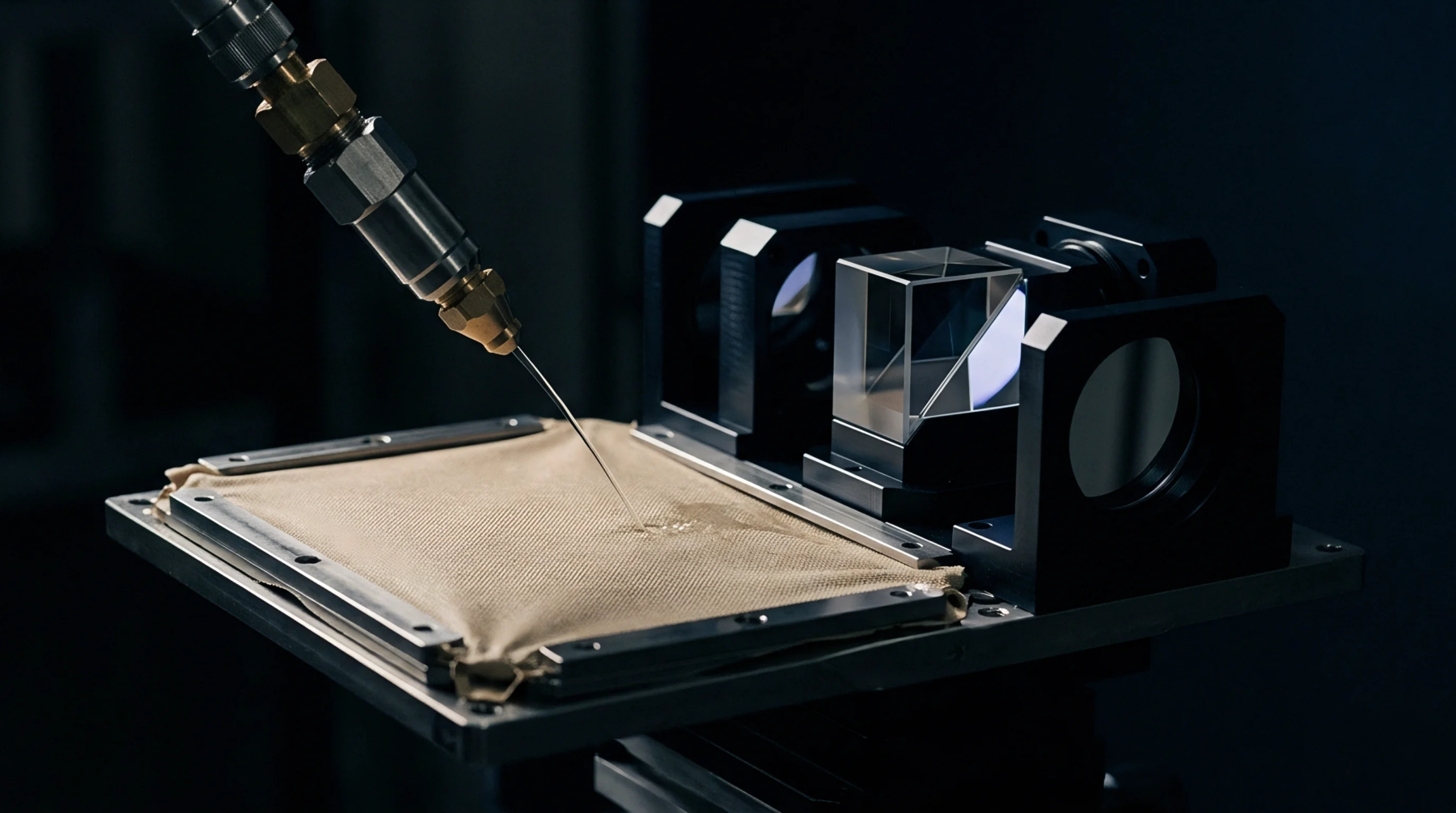
Structural Contraction
Thermodynamic relaxation in amorphous polymers describes the slow structural contraction toward equilibrium at a constant temperature below the glass transition point. Material qualification protocols quantify isothermal volume recovery to predict dimensional drift in precision optical mounts and encapsulated sensor housings. The process begins immediately following rapid cooling from processing temperatures to fixed storage conditions.
Excess free volume trapped within the polymer matrix undergoes non-exponential decay as molecular segments rearrange. Measurement requires high-resolution dilatometry capable of resolving sub-micron dimensional changes over extended timeframes.
Qualification Threshold
Verification of dimensional stability relies on long-term dilatometric testing inside temperature-controlled liquid baths maintained within five hundredths of a kelvin. Metrology standards require continuous monitoring of sample length or density across hundreds of hours. Testing laboratories document the non-linear volume contraction rate to establish structural relaxation limits for optical substrates.
The evaluation stops when the relaxation rate falls below the noise threshold of laser displacement sensors. Materials failing to meet rate limits undergo additional thermal annealing cycles before assembly.
Temperature Sensitivity
Proximity to the glass transition temperature governs the speed and magnitude of structural rearrangement. Operating an encapsulated sensor near this thermal threshold accelerates volume loss, shifting internal strain distributions against delicate silicon diaphragms. Differential scanning calorimetry verifies the glass transition temperature prior to testing, setting the safe thermal margin for operation.
Lower storage temperatures reduce molecular mobility, extending the time required to reach structural equilibrium.
Drift Consequence
Uncorrected volume relaxation alters mechanical preload on internal sensing elements, causing zero-point offset shifts over time. Encapsulation resins that undergo unmonitored shrinkage introduce asymmetrical stress that degrades transducer linearity. Uncontrolled temperature fluctuations during testing obscure intrinsic structural recovery by introducing thermal expansion noise.