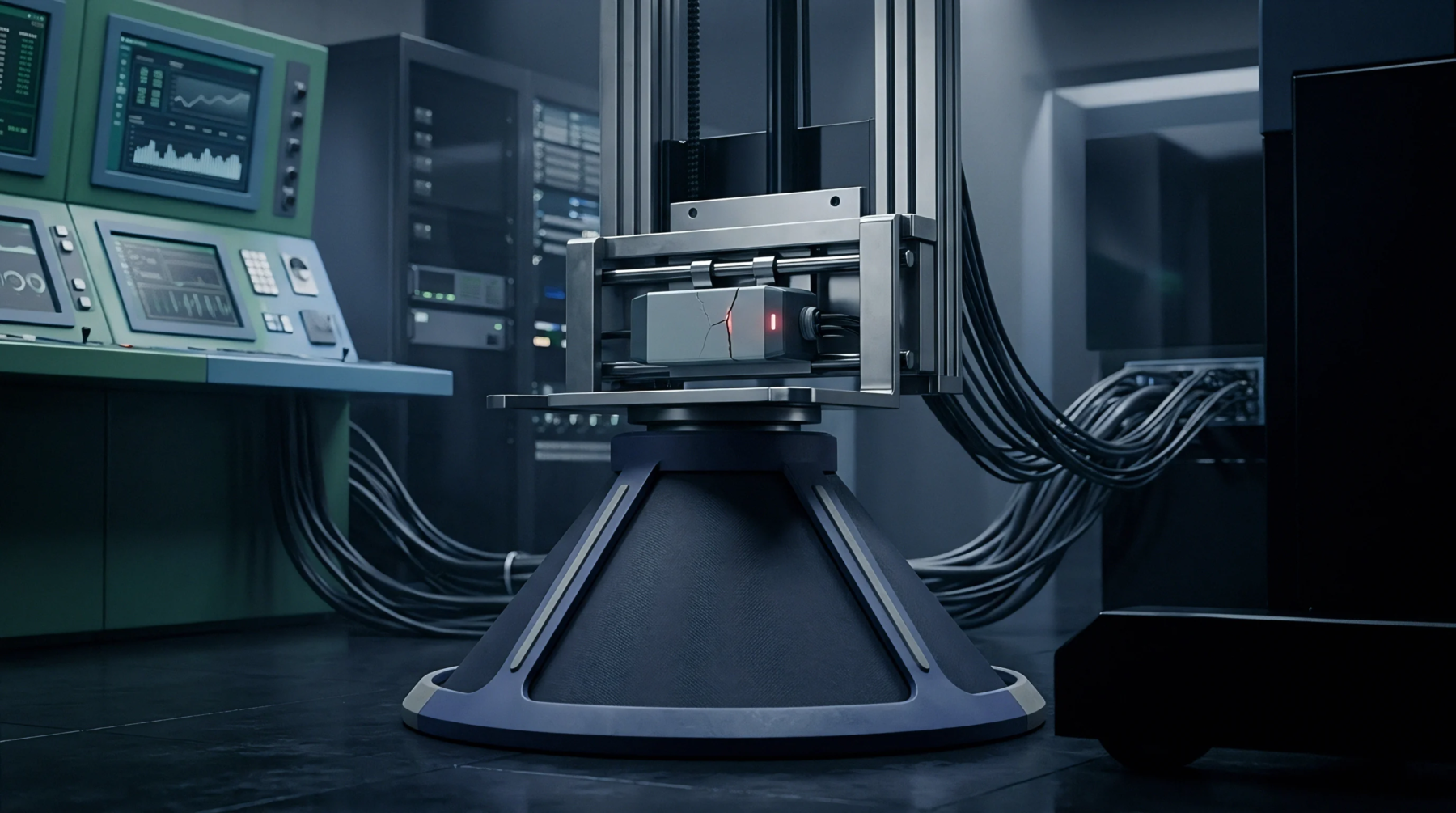
Polymer Die Attach Stress Coupling in MEMS Accelerometers
Polymer die attach stress directly alters MEMS zero-g bias; specifying low-modulus adhesives and central island anchors mitigates thermal strain coupling.
Dynamic mechanical analysis measures the real component of complex modulus to quantify an adhesive polymer network’s capacity to store elastic energy under cyclic mechanical strain. Measuring epoxy storage modulus evaluates the load-bearing capacity and structural stiffness of crosslinked structural adhesives used to anchor semiconductor dies and optical subassemblies. Structural integrity requires high elastic stiffness to prevent micro-deflection under mechanical shock, thermal cycling, and high-g acceleration.
Temperature elevation induces a transition from a glassy, highly rigid state to a compliant rubbery plateau characterized by substantial drops in load support. Dynamic mechanical analyzers apply sinusoidal stress across calibrated specimen bars, monitoring strain response to compute this elastic property. Thermal qualification tracks the inflection trajectory through the glass transition zone where mechanical properties degrade rapidly.
Modulus metrics lose analytical validity once material decomposition or destructive yielding ruptures crosslinked polymer bonds.
Polymer chains experience sudden increases in segmental mobility when ambient thermal energy surmounts secondary intermolecular bonding forces. Epoxy formulations exhibit a precipitous decline in elastic stiffness across this glass transition range, dropping several orders of magnitude over narrow temperature increments. Sourcing engineers specify glass transition boundaries well above targeted device operating ceilings to avoid localized assembly flexure.
Below this threshold, highly crosslinked networks resist structural creep, maintaining precision alignment across delicate wire bonds and silicon dies. Thermal analysis protocols establish transition onset temperatures by identifying the initial drop in the elastic response curve under controlled heating rates. Incomplete cure profiles depress this critical thermal boundary, exposing assemblies to premature mechanical compliance.
Thermal expansion mismatches between silicon dies, leadframes, and ceramic substrates generate high interfacial shear stresses during thermal transitions. High epoxy storage modulus below the glass transition temperature concentrates mechanical strain across the bonded interfaces, raising the risk of die cracking or substrate delamination. Formulations engineered for packaging applications incorporate micro-fillers or toughening agents to tailor elastic stiffness, balancing rigidity with compliant strain relief.
Inelastic energy dissipation characteristics govern shear resistance across repetitive operational thermal cycles. Failure analysis protocols utilize acoustic microscopy to detect internal bond-line delamination induced by excessive elastic stress concentration. Mechanical qualification establishes permissible modulus windows that preserve assembly co-planarity without inducing destructive interfacial failure.
Sourcing documentation defines minimum and maximum limits verified through dynamic mechanical testing.
Adhesive crosslinking density governs the ultimate magnitude of the elastic plateau achieved by the cured polymer matrix. Inadequate thermal soak profiles or incorrect mixing ratios yield incomplete polymerization networks characterized by depressed room-temperature stiffness. Dynamic mechanical testing of incoming material lots verifies curing kinetics by measuring modulus development as a function of cure schedule and exposure time.
Moisture absorption within the cured matrix acts as a plasticizer, lowering the storage modulus and shifting the glass transition point toward lower temperatures. Reliability qualification requires environmental baking and dynamic mechanical profiling of pre-conditioned test coupons to ensure long-term retention of structural modulus. Procurement specifications define test specimen preparation, frequency of cyclic testing, and acceptable elastic stiffness thresholds.
Periodic analytical audits confirm compliance against engineering drawing tolerances.
Polymer die attach stress directly alters MEMS zero-g bias; specifying low-modulus adhesives and central island anchors mitigates thermal strain coupling.
Expertise is a utility, not a secret. sentiention™ publishes its working knowledge as open reference: intelligence layer covering the materials it sources, the markets it enters, and the reference that serves both.