Viscoelastic Relaxation Models in Hermetic Sensor Packaging Bondlines
Viscoelastic stress relaxation in polymer die-attach bondlines causes continuous zero-point offset drift in hermetic MEMS and piezoresistive sensors.

Bond
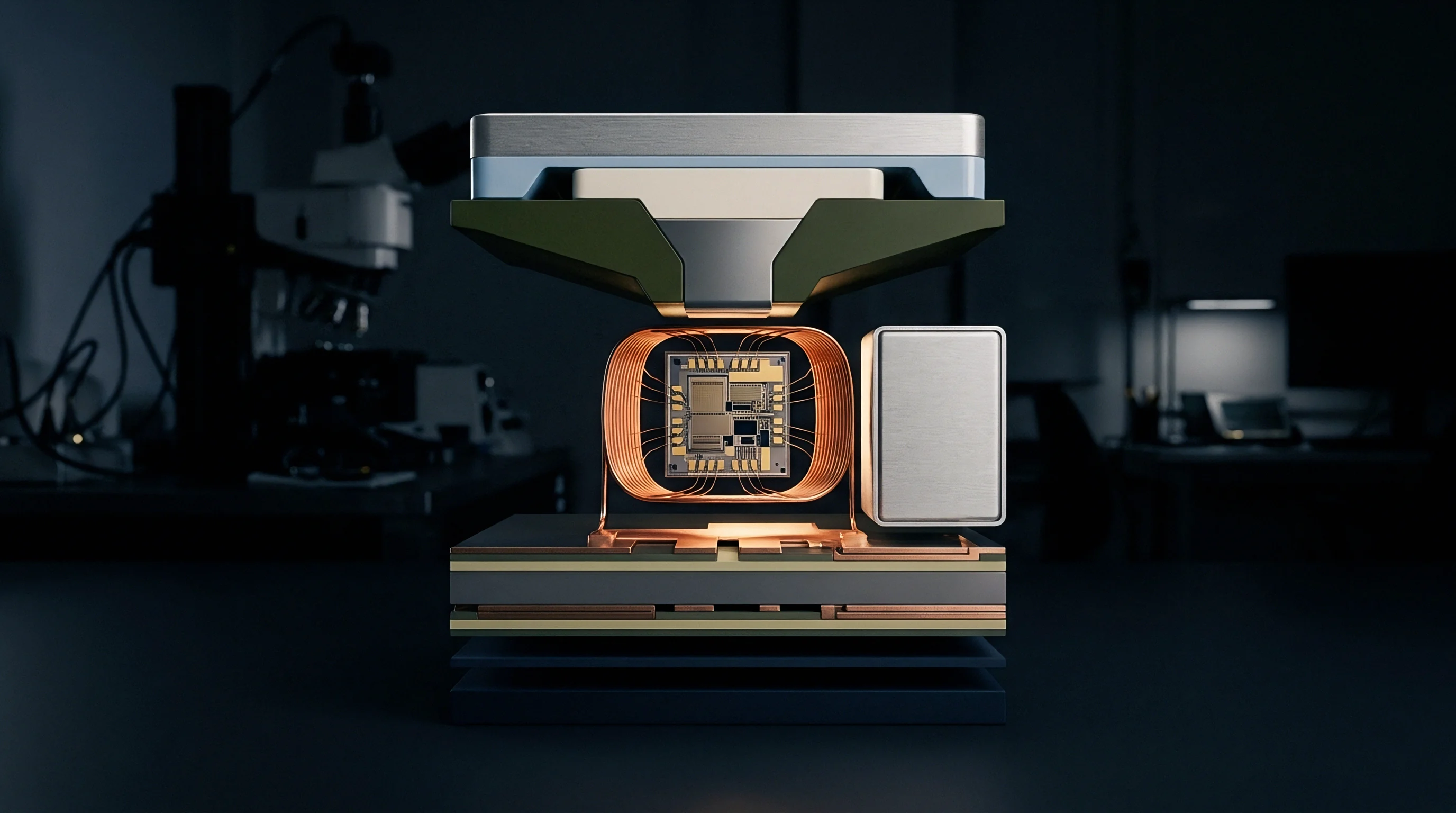
Mechanical stress in sensor packaging originates during high-temperature die-attach cure cycles and remains trapped within the structural package upon cooling down to ambient operating conditions. Coefficient of thermal expansion mismatches between a monocrystalline silicon sensing element, the die-attach adhesive, and a ceramic or metallic substrate generate high initial strain fields across the sensor die. Over extended operational lifespans, organic polymer adhesives undergo molecular restructuring to relieve this internal strain, converting elastic potential energy into permanent viscous deformation.
Polymer chains slide under constant strain. Shear forces decay exponentially. Silicon dies resist planar deformation.
This continuous stress relaxation alters the baseline physical boundary conditions supporting the transducer element. In piezoresistive pressure sensors or MEMS accelerometers, the localized strain field directly dictates the zero-measurand output signal. When the adhesive layer yields, the mechanical force transmitted into the sensor die shifts, causing continuous zero-point calibration offset drift that masquerades as an environmental input change.
Harder polymers shorten transient creep duration but transmit higher peak assembly stresses directly into piezoresistive sensing elements.
Modelling this mechanical relaxation accurately requires capturing both instantaneous elastic response and multi-scale viscous flow. Standard linear elastic assumptions fail over multi-year sensor deployment cycles because polymer shear modulus exhibits strong time-dependent degradation. Engineers apply viscoelastic constitutive equations to represent the time-varying stress tensor under sustained strain profiles.
The Generalized Maxwell Model, implemented computationally as a Prony series expansion, models the continuous relaxation spectrum by combining a parallel array of spring-dashpot elements with distinct characteristic relaxation times.
The time-dependent relaxation shear modulus is expressed analytically through a sum of decaying exponential functions:
G(t) = G_infinity + sum( G_i exp(-t / tau_i) )
where G_infinity represents the long-term equilibrium shear modulus after all viscous dissipation concludes, G_i denotes the modulus weight of the i-th Maxwell arm, and tau_i defines the characteristic relaxation time constant for that specific molecular mode. Accurate calibration of these Prony series coefficients requires baseline stress relaxation testing across multiple decade time scales.
Sensors deployed in aerospace, automotive powertrain, and deep-hole drilling applications encounter complex stress state shifts governed by distinct physical mechanisms inside the structural seal:
- Differential Thermal Contraction initiates immediately during cool-down from adhesive cure temperatures, locking residual shear stress into the die edge where geometric stress concentrations reach maximum intensity.
- Polymeric Chain Realignment drives long-term room-temperature stress decay, allowing localized strain gradients beneath the active piezoresistors to relax asynchronously over thousands of operating hours.
- Moisture Induced Plasticization lowers the effective glass transition temperature of epoxy matrices, accelerating viscous flow mechanisms under ambient relative humidity exposure.
- Cyclic Thermal Fatigue superimposes dynamic strain oscillations onto the static relaxation background, accelerating micro-void propagation within non-hermetic polymeric package interfaces.
Quantifying these failure vectors requires evaluating whether the time-dependent mechanical strain boundary of a specific package construction can stabilize within the calibration lifetime of the finished instrument.
Transition
Polymer behavior changes fundamentally across the thermal boundary where glassy solids turn into rubbery networks. Operating ambient sensor packages near or through the glass transition region introduces massive non-linearities into the mechanical stress relaxation kinetics. Below this temperature limit, polymer backbone mobility remains locked in low-energy conformational wells, producing high elastic moduli and extended relaxation time constants measured in years.
Above this thermal boundary, thermal energy overcomes secondary intermolecular bonds, reducing shear modulus by up to three orders of magnitude and compressing relaxation timelines down to minutes.
Temperature accelerates this physical decay. Zero shift corrupts signal calibration. Standard engineering practice uses the Williams-Landel-Ferry equation to map viscoelastic material response across varying thermal environments onto a unified master curve.
This time-temperature superposition principle asserts that raising ambient temperature compresses the mechanical time scale by a deterministic shift factor:
log10(a_T) = -C1 (T – T_g) / (C2 + T – T_g)
where a_T is the empirical shift factor relative to reference temperature T_g, while C1 and C2 represent universal material constants specific to the chosen formulation. Applying this calculation allows accelerated high-temperature thermal dwell testing to predict decades of ambient strain relaxation.
| Material Class | Elastic Modulus (GPa) | Glass Transition (C) | CTE (ppm/K) | Hermeticity (mbar L/s) |
|---|---|---|---|---|
| 68.0 | N/A (Melts 280) | 16.0 | 1.0e-10 | |
| 40.0 | 320 | 7.5 | 1.0e-9 | |
| 8.5 | 135 | 35.0 | 1.0e-4 | |
| 0.005 | -115 | 300.0 | 1.0e-2 |
Inorganic die-attach materials present an entirely different relaxation profile than organic chemistry. Gold-tin eutectic solders and glass frit seals do not exhibit glass transition behavior within normal sensor operational envelopes. Gold tin eutectics eliminate polymeric creep.
Glass frits yield minimal thermal drift.
Minimizing residual assembly strain in high-reliability sensor packages demands precise control over thermal processing schedules during package sealing. Assembly teams enforce strict curing procedures to maximize polymer network crosslink density:
- Ramp the thermal chamber from ambient to the primary solvent evaporation temperature at 2 degrees Celsius per minute to prevent void formation.
- Maintain isothermal dwell for 45 minutes to evacuate volatile carrier solvents completely prior to crosslinking initiation.
- Elevate temperature to the full curing plateau at 175 degrees Celsius using a controlled linear ramp to limit transient thermal gradients.
- Hold at maximum cure temperature for 120 minutes to achieve greater than 98 percent polymer network conversion.
- Cool the assembly down to ambient room temperature at a maximum rate of 1 degree Celsius per minute to minimize frozen-in thermal stresses.
Cure schedules set crosslink density. Departing from established cure parameters alters the crosslink topology of the adhesive, reducing the glass transition temperature and initiating premature viscoelastic relaxation during field operation.
Offset
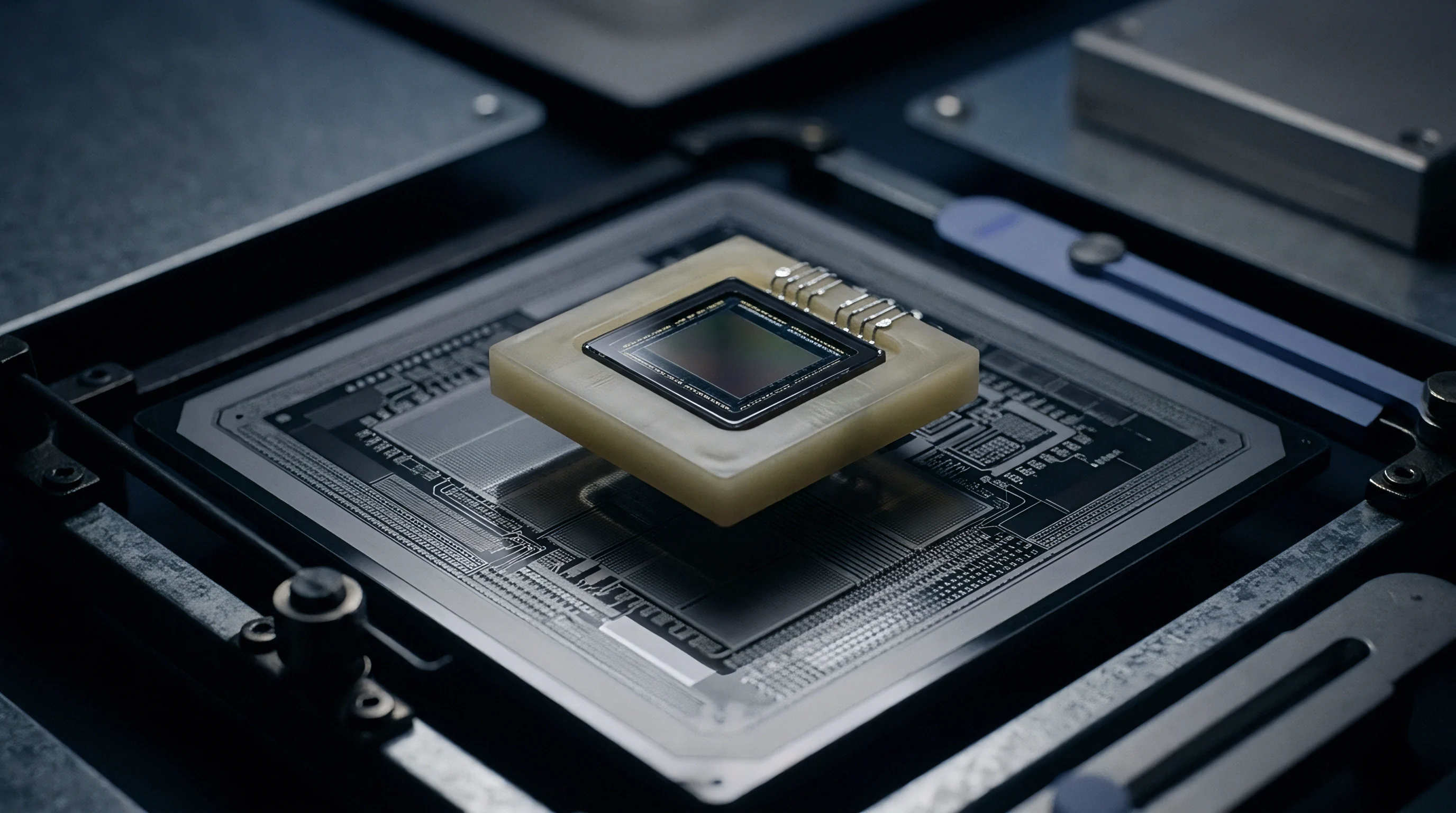
Analog signal chains magnify microvolt-level sensor bridge imbalances caused by mechanical relaxation at the die interface. In a full-bridge piezoresistive pressure transducer, four active resistors integrated into a silicon diaphragm convert localized strain into a differential voltage signal. When viscoelastic stress relaxation alters the static stress tensor across the die, the unbalance produces a steady drift in the zero-pressure offset voltage.
This mechanical offset shift bypasses optical, electrical, and firmware calibration steps executed prior to shipment.
A 10 MPa initial shear stress in epoxy die-attach relaxes by 35 percent over 1,000 hours at 125 degrees Celsius.

How Viscoelastic Shear Induces Dynamic Drift in Piezoresistive Elements?
Piezoresistive coefficients link mechanical strain fields directly to localized electrical resistivity shifts within p-type silicon channels. When an epoxy bondline undergoes stress relaxation under constant environmental conditions, the magnitude of horizontal shear stress acting on the bottom surface of the silicon die decays over time. The reduction in interface shear strain propagates upward through the silicon thickness, altering the baseline strain state of the top surface diaphragm resistors.
Consider a practical worked case involving a 3 mm by 3 mm piezoresistive pressure sensor die mounted inside a ceramic package using a high-temperature silver-filled epoxy bondline. The assembly experiences a post-cure temperature drop of 130 degrees Celsius, inducing an initial maximum shear stress of 45 MPa at the die corners. Assuming a three-term Prony series representation for the epoxy modulus at an operating temperature of 85 degrees Celsius:
G_1 = 1.2 GPa, tau_1 = 50 hours
G_2 = 0.8 GPa, tau_2 = 500 hours
G_3 = 0.5 GPa, tau_3 = 5000 hours
G_infinity = 0.4 GPa
Over the first 1,000 hours of continuous operational dwell at 85 degrees Celsius, the total shear stress at the interface decays from 45 MPa down to approximately 18.5 MPa. This 26.5 MPa shear stress drop alters the differential strain across the active sensing diaphragm by 42 microstrain. Given a longitudinal piezoresistive coefficient pi_11 of 6.6e-5 MPa^-1, this strain shift translates to a permanent zero-point offset shift of 1.75 mV/V. For a sensor operating with a 3.3 V excitation supply and a 50 mV full-scale output span, this viscoelastic relaxation consumes 11.5 percent of the total systemic error budget.
Analog front ends amplify microvolt shifts. Modern high-resolution signal chains incorporating 24-bit delta-sigma analog-to-digital converters readily resolve microvolt signals, rendering mechanical package drift the dominant source of long-term measurement instability. Standard digital offset compensation schemes fail to correct for this movement because viscoelastic relaxation velocity varies non-linearly with operating temperature history.
- Static Offset Calibration captures only the initial post-assembly stress state, leaving the system completely uncompensated against time-dependent stress decay.
- Multipoint Thermal Calibration corrects for deterministic temperature coefficients of resistance but fails to account for path-dependent viscoelastic hysteresis.
- Firmware Drift Filtering risks attenuating genuine slow physical measurand changes alongside mechanical package relaxation signals.
- Dual-Die Differential Topologies reduce common-mode package stress drift only if both die-attach layers share identical cure history and void-free bondline geometry.
Failure to model these physical signal chain degradation dynamics leads directly to field recalibration calls, field instrument recalls, and severe warranty claim exposure when installed devices drift out of declared accuracy specifications.
Chamber
Verification of viscoelastic package models demands empirical stress and deformation testing inside environmental test enclosures. Optical techniques, including laser scanning profilometry and digital image correlation, measure surface warpage of the silicon sensing element through glass viewport windows during controlled thermal cycles. Correlating measured surface curvature directly with finite element simulations validates the Prony series parameters extracted from isolated material test specimens.
Dynamic Mechanical Analysis provides the primary baseline physical inputs required to construct accurate stress relaxation equations. DMA instruments apply minute sinusoidal strain amplitudes to cured adhesive specimens across swept frequency ranges and stepped thermal plateaus. The instrument measures the phase lag between applied strain and resulting stress, decomposing material response into storage modulus G’ and loss modulus G”.
| Test Parameter | Experimental Setup | Extracted Output | Model Functionality |
|---|---|---|---|
| Temperature Sweep | -65 C to +200 C at 2 C/min | Glass Transition (Tg) | Defines shift equation boundary limits |
| Frequency Sweep | 0.01 Hz to 100 Hz isothermal | Storage / Loss Moduli | Calibrates short-term Prony series terms |
| Isothermal Stress Relaxation | Constant 0.5% strain for 24 hours | Transient Modulus Decay E(t) | Determines long-term equilibrium modulus |
| Creep Compliance Sweep | Constant 5 MPa stress load | Time-dependent compliance J(t) | Validates linear viscoelastic range |
Thermal dwell alters polymer modulus. Laser profilometry tracks substrate warpage. Combining DMA dynamic data with long-term isothermal creep measurements allows mathematical curve-fitting software to solve for individual Maxwell arm time constants.
MIL-STD-883 Method 1014 condition C demands seal integrity checks after thermal aging to catch stress-induced micro-cracks.
Environmental verification testing exposes package designs to extreme stress states to uncover latent adhesion failure modes before volume manufacturing release:
- Interfacial Delamination occurs when shear stress relaxation exceeds the local adhesive bond strength, creating micro-voids that alter the mechanical support of the sensor.
- Hygrothermal Degradation combines moisture saturation with high thermal exposure, breaking polymer crosslinks and permanently altering the baseline glass transition temperature.
- Outgassing Moisture Condensation traps volatile organic species inside sealed hermetic cavities, causing internal surface corrosion and secondary bridge leakage currents.
- Substrate Cracking emerges when rigid glass frit or solder layers transmit unmitigated thermal expansion stresses directly into brittle ceramic header walls.
Material suppliers frequently claim their automotive-grade adhesive formulations show zero drift under standard environmental stress testing protocols. Application engineering teams routinely observe that these claims rest entirely on short-duration test windows that terminate long before slow-acting viscoelastic relaxation mechanisms reach structural equilibrium.

Contract
Procuring die-attach formulations for high-stability hermetic sensor packaging requires controlling chemical lot consistency and storage history. Raw resin shelf life dictates performance. Batch variation shifts glass transition temperatures.
Cold storage preserves active chemistry. Polymer formulations deteriorate if exposed to ambient temperatures during transit, initiating premature crosslinking that permanently alters the viscoelastic spectrum of the cured material.
Sourcing agreements for precision sensor assembly materials must enforce strict receiving controls, including mandatory differential scanning calorimetry testing on incoming lot samples. The buyer specifies maximum allowable deviation limits for glass transition temperature, cure peak onset, and total reaction enthalpy. Any material batch failing to land within a plus or minus 3 degrees Celsius Tg window gets rejected before entering the automated dispensing production lines.
Contractual terms governing material specifications must mandate that suppliers provide fully calibrated Prony series coefficients and WLF shift constants derived from verified third-party laboratory DMA testing. A standard procurement clause enforces this requirement:
The material supplier shall provide certified Dynamic Mechanical Analysis test data across a temperature range of negative 55 degrees Celsius to positive 175 degrees Celsius for every resin lot, guaranteeing that the calculated five-term Prony series relaxation moduli do not deviate by more than five percent from the baseline qualification dossier specifications.
Incorporating explicit mechanical performance tolerances into supply contracts shifts the financial burden of material-induced calibration drift back onto the chemistry supplier. Establishing rigorous incoming material qualification safeguards sensor manufacturing operations against field failures caused by unaccounted viscoelastic stress relaxation.