Resolving Non-Linear Permeability Curvature in High-Temperature Ferromagnetic Alloy Eddy Current Displacement Compensation
Dual-frequency vector impedance inversion decouples target magnetic permeability curvature from physical displacement in high-temperature ferromagnetic applications.

Phase
Non-contact displacement sensing on high-temperature ferromagnetic components presents a coupled electromagnetic and thermodynamic problem. Inductive eddy current transducers detect target position by evaluating coil complex impedance, which changes as the magnetic field produced by the sensor driver interacts with the conductive target material. For non-magnetic targets such as titanium or austenitic stainless steels, impedance trajectories respond primarily to changes in electrical conductivity driven by temperature.
Ferromagnetic alloys introduce magnetic permeability, a parameter that exhibits severe temperature dependence, non-linear hysteresis, and field-intensity sensitivity.
Electrical conductivity in metallic conductors drops predictably as lattice vibrations scatter charge carriers at elevated thermal states. Relative magnetic permeability follows a far more erratic trajectory. Below the Curie point, domain wall mobility and saturation magnetization vary across thermal gradients, causing the real component of permeability to exhibit local maxima before dropping precipitously toward unity.
The target skin depth dictates the spatial penetration of the excitation field. This parameter varies inversely with the square root of both conductivity and magnetic permeability.
Thermal gradients alter target skin depth during operation. As the target heats from room temperature to six hundred degrees Celsius, local magnetic permeability fluctuations dominate impedance changes, completely masking physical displacement changes if uncompensated.
The total probe complex impedance maps directly into two orthogonal vectors inside the demodulation circuit. The real vector corresponds to resistive losses within the eddy current loop, while the imaginary vector reflects coil inductance modified by target magnetic coupling. When target permeability shifts non-linearly, the impedance vector moves along an locus curve that overlaps the physical clearance trajectory.
| Alloy Designation | Curie Temperature (Celsius) | Conductivity at 20 Celsius (MS per m) | Conductivity at 500 Celsius (MS per m) | Initial Permeability at 20 Celsius | Peak Permeability Drift Ratio (20 to 500 C) |
|---|---|---|---|---|---|
| AISI 4140 Alloy Steel | 770 | 4.52 | 1.82 | 120 | 3.45 |
| 17-4 PH Stainless Steel | 630 | 1.30 | 0.74 | 95 | 4.12 |
| Inconel 718 (Aged) | -112 | 0.80 | 0.61 | 1.002 | 1.001 |
| Inconel 722 | 380 | 0.91 | 0.68 | 28 | 2.88 |
Engineers specifying displacement transducers for heat-treated structural steels must account for the coupling between electrical and magnetic transport properties. A shift in target surface temperature alters both the amplitude and the phase angle of the reflected magnetic field. Processing units evaluating single-frequency excitation voltage signals interpret this phase shift as a mechanical gap expansion.
- Skin depth compression occurs when local target permeability increases prior to reaching the Curie transition, forcing eddy currents into a thinner surface layer and inflating effective target resistance.
- Domain wall pinning release at elevated temperatures alters the low-field magnetic susceptibility, causing zero-displacement baseline drift in the signal conditioning electronics.
- Phase trajectory rotation pulls the imaginary impedance component into the real axis, collapsing the signal-to-noise ratio of conventional phase-discriminating demodulators.
- Thermal conductivity decay reduces the total power dissipated in the target eddy current path, altering coil loading characteristics independently of physical clearance changes.
Failure to isolate the magnetic permeability coefficient from physical displacement during high-temperature operation yields gross measurement errors, frequently exceeding thirty percent of full-scale measurement range during rapid thermal transients.


Curvature
Drive field intensity establishes the operating point on the magnetic magnetization curve of a ferromagnetic target. Standard eddy current displacement systems employ constant-current or constant-voltage bridge excitation signals ranging from one hundred kilohertz to two megahertz. These excitation levels generate a spatially varying magnetic field intensity H inside the target material.
Because field intensity decays rapidly with distance from the sensor face, different depths within the target material experience vastly different magnetic field strengths.

Magnetic Field Intensity Decay across Air Gap
Air gap length directly modulates the peak magnetic field intensity reaching the target surface. When the sensor sits close to the target, high field intensity drives the surface material near magnetic saturation, lowering the incremental relative permeability. As the sensor retracts, the field intensity at the target surface drops, shifting the material response back into the steep, highly non-linear region of the magnetic hysteresis loop.
Thermal energy exacerbates field-dependent non-linearity. The slope of the magnetization curve decreases as thermal energy disrupts magnetic domain alignment. Consequently, the differential magnetic permeability becomes a simultaneous function of instantaneous target gap, sensor drive current, and local surface temperature.
The non-linear permeability function requires mathematical linearization schemes capable of handling coupled multi-variable fields.
Baseline calibration matrices built at room temperature generate displacement errors up to two hundred micrometers when applied to ferromagnetic targets operating at four hundred degrees Celsius.
Breakdown of Conventional Linearization Models
Polynomial calibration functions fitted at room temperature fail entirely under elevated thermal conditions. Single-variable look-up tables assume a fixed, monotonic relationship between bridge output voltage and physical distance. In ferromagnetic targets, the non-monotonic behavior of relative magnetic permeability across temperature invalidates this assumption.
At specific threshold temperatures below the Curie point, relative permeability peaks sharply due to the Hopkinson effect. At this junction, a probe moving away from a target can produce a constant output voltage because the reduction in magnetic coupling caused by increased distance is exactly counteracted by the rise in target permeability. Sensor conditioning electronics report zero displacement change despite physical motion occurring on the test bench.
Suppliers of standard industrial eddy current probes routinely assert that high-temperature target drift can be eliminated by using invar target inserts or by applying static offset corrections in firmware. This assertion ignores target structural requirements and fails to address non-linear permeability curvature occurring under dynamic thermal cycles.

Heat
Metallurgical state shifts in precipitation-hardened and alloy steels alter magnetic properties during extended high-temperature exposure. Alloys such as 17-4 PH stainless steel undergo secondary tempering, carbide precipitation, and localized phase transformations when held at temperatures above four hundred degrees Celsius. These microstructural modifications alter the fundamental magnetization curve of the target alloy permanently.

Microstructural Evolution in Structural Alloys
Phase stability dictates the long-term repeatability of non-contact displacement systems. In a precipitation-hardened alloy, aging shifts the ratio of magnetic martensite to non-magnetic retained austenite. This structural evolution occurs independently of probe temperature and target position, creating a baseline drift that cannot be cleared by standard temperature sensors placed behind the probe coil.
Thermal cycling produces magnetic hysteresis loops that do not close. The permeability trajectory recorded during heating differs from the trajectory recorded during cooling. This path dependence creates dual displacement values for a single electrical impedance state, depending entirely on the thermal history of the target component.
Standard procurement specifications for high-temperature displacement monitoring must mandate target thermal stabilization annealing prior to sensor calibration.
Sustaining measurement integrity across extended deployments demands target alloy selection optimized for magnetic phase stability rather than mechanical yield strength alone.
Permeability Stabilization Strategies
Mitigating metallurgical drift requires thermal conditioning of the target region. Subjecting the target alloy to heat treatment cycles above the peak operating temperature stabilizes domain structure and precipitates metastable phases prior to commissioning. Where target material substitution remains permissible, switching from precipitation-hardened martensitic steels to stable nickel-chromium alloys eliminates magnetic non-linearity entirely by operating the target material strictly in its paramagnetic regime.
Stable magnetic performance requires target materials operating at least one hundred degrees Celsius clear of structural phase boundary temperatures.

Topology
Signal chain architectures designed to compensate for non-linear permeability curvature must measure target electrical conductivity and magnetic permeability independently. Single-frequency bridge circuits lack sufficient degrees of freedom to decouple gap variations from material property shifts. Multi-frequency excitation topologies and differential coil configurations supply the requisite independent electrical equations.

Why Does Thermal Permeability Hysteresis Ruin Linear Lookup Tables?
Linear lookup tables assume a continuous, one-to-one mapping between measured coil impedance and target distance. Thermal permeability hysteresis breaks this assumption by creating a double-valued impedance response across thermal cycles. At a fixed target position of one millimeter, heating the target to five hundred degrees Celsius and cooling it back to two hundred degrees Celsius produces two distinct complex impedance points.
A static lookup table maps these two points to two different physical distances, introducing non-recoverable position measurement errors.
Dual-frequency excitation resolves property ambiguity by exploiting the frequency dependence of skin depth. A low-frequency signal penetrates deep into the target bulk material, sensing fundamental permeability and bulk temperature states. Simultaneously, a high-frequency excitation signal remains constrained to the immediate surface layer, responding primarily to physical displacement and surface conductivity.
Signal processing electronics process both return signals through a real-time matrix transformation matrix to extract distance independently of permeability variations.
| Topology Architecture | Excitation Modes | Bandwidth Limit (kHz) | Permeability Decoupling Method | Relative Electronics Complexity |
|---|---|---|---|---|
| Single-Frequency Bridge | Single Sine (500 kHz) | 50 | None (Requires constant temp) | Low |
| Dual-Frequency Vector Demodulation | Dual Sine (100 kHz + 2 MHz) | 10 | Real-time 2×2 Matrix Inversion | High |
| Pulsed Eddy Current (PEC) | Square Wave Pulse (100 Hz repetition) | 1 | Time-Domain Transient Analysis | Very High |
| Differential Target Bridge | Single Sine (1 MHz) | 25 | Symmetrical Reference Target Coil | Moderate |
Selecting an appropriate signal conditioning topology requires balancing real-time measurement bandwidth against target material complexity. High-speed turbomachinery applications demand dual-frequency vector demodulation to sustain twenty-kilohertz measurement bandwidth, whereas static structural monitoring permits pulsed eddy current processing with extended transient evaluation algorithms.
- Target Material Screening defines whether the target material exhibits paramagnetic or ferromagnetic behavior across the entire operational temperature envelope.
- Excitation Frequency Selection establishes skin depth ratios, placing the lower frequency deep within the magnetic material bulk and the higher frequency at the surface.
- Matrix Calibration Coefficient Extraction measures complex impedance vectors across a full matrix of known distances and temperatures inside an environmental chamber.
- Firmware Inversion Implementation executes real-time polynomial matrix inversion on digital signal processing hardware to resolve displacement output.
Dual-frequency vector demodulation sustains one-micrometer resolution across a six-hundred-degree thermal transient when coupled with real-time matrix inversion firmware.
Contracts for high-temperature sensing systems specified under ISO 26262 or IEC 61326 must specify total allowable displacement drift across defined temperature slew rates rather than static steady-state thermal accuracy values alone.
Furnace
Verification of displacement sensor performance under extreme thermal conditions demands specialized bench equipment designed to isolate sensor performance from fixture expansion. Thermal expansion of mechanical mounting structures frequently introduces parasitic displacements that exceed the physical target drift being measured. A valid test environment requires reference measurement instrumentation operating entirely outside the thermal test chamber.

Bench Testing Apparatus Configuration
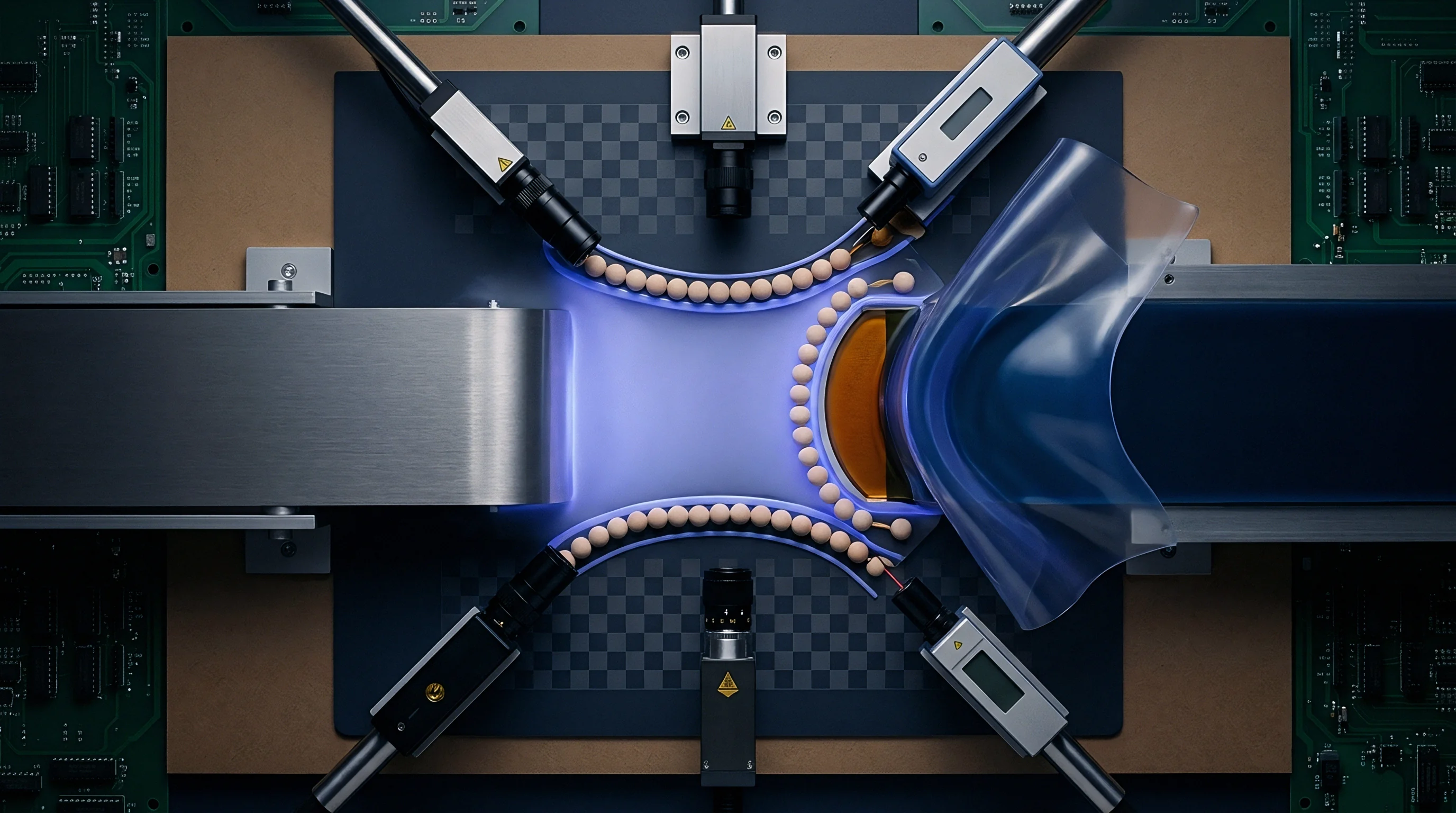
Precision calibration rigs utilize water-cooled ceramic extension rods to transmit target motion to optical laser interferometers positioned externally. The test fixture target mounts inside a multi-zone quartz tube furnace capable of sustaining uniform thermal zones up to one thousand degrees Celsius. Closed-loop temperature controllers regulate local zone gradients to within half a degree Celsius.
Position adjustments inside the hot zone rely on piezoceramic micro-positioning stages located outside the heat zone, connected via rigid fused-silica pushrods. This mechanical isolation ensures that target positioning resolution remains locked to nanometer scales regardless of internal furnace temperature.
| Error Source | Uncompensated Magnitude (micrometers) | Compensated Magnitude (micrometers) | Primary Mitigation Method |
|---|---|---|---|
| Target Thermal Expansion | 45.0 | 0.5 | Material Expansion Coefficient Matrix Correction |
| Probe Head Thermal Growth | 18.0 | 0.2 | Water-Cooled Probe Body Mounts |
| Target Permeability Curvature | 120.0 | 1.5 | Dual-Frequency Vector Inversion |
| Cable Resistance Drift | 8.5 | 0.1 | Triaxial Mineral-Insulated Differential Cabling |
| Fixture Gradient Warp | 32.0 | 0.8 | Fused-Silica External Interferometer Mounting |

Execution Procedure for Thermal Calibration
Execution of a full calibration sweep involves systematic stepping through displacement and temperature matrices.
- Mount the target alloy sample and high-temperature probe head inside the cold furnace chamber, connecting the external laser interferometer to the fused-silica reference rod.
- Establish vacuum or inert argon atmosphere inside the quartz tube to prevent surface oxidation of the ferromagnetic target alloy during heating cycles.
- Zero the laser interferometer reference system at room temperature with the target held at zero physical gap clearance.
- Ramp furnace temperature at five degrees Celsius per minute to the first calibration plateau, holding temperature static for thirty minutes to achieve complete thermal equilibrium.
- Command the external piezoceramic stage to step through target gap increments of fifty micrometers across the full two-millimeter range, recording complex impedance values at each step.
- Repeat gap displacement sweeps at one-hundred-degree thermal increments up to the maximum operational temperature limit.
- Process the collected multi-dimensional impedance matrix through numerical surface-fitting algorithms to extract compensation polynomial coefficients.
Inert gas purged test chambers prevent target surface oxidation layers from altering high-frequency surface conductivity during calibration sweeps.
How do real-time variations in target alloy surface oxidation kinetics alter the long-term stability of dual-frequency impedance inversion algorithms during multi-thousand-hour deployments?

Supply
Commercial sourcing of high-temperature eddy current displacement sensors requires rigorous qualification of probe construction materials and signal processing module availability. Standard industrial displacement probes utilizing epoxy-encapsulated coils, copper windings, and PEEK housing structures collapse when exposed to operating environments exceeding two hundred degrees Celsius. High-temperature applications demand specialized probe architectures built around inorganic materials.
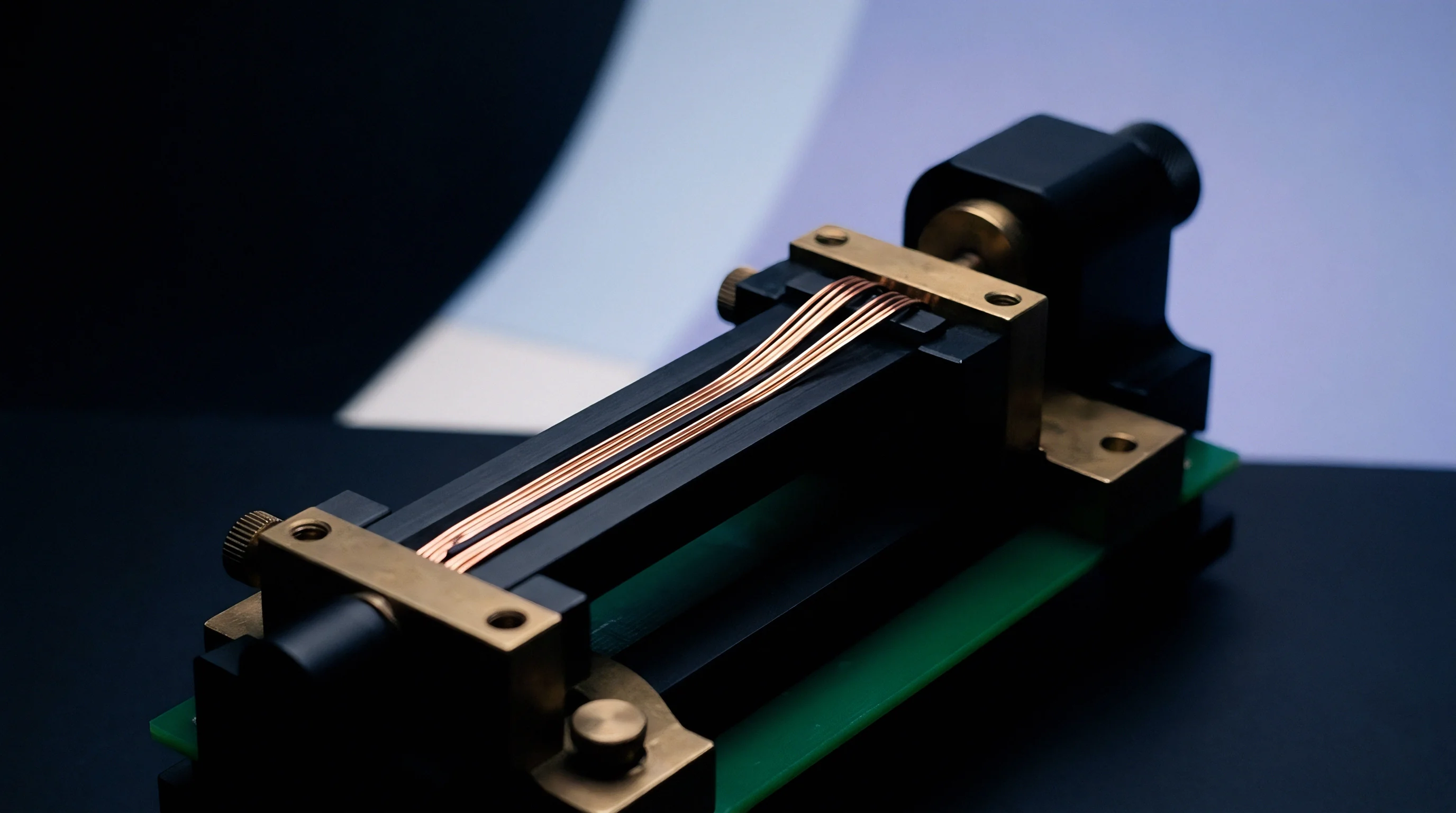
Custom probe construction relies on platinum or palladium-clad copper wire wound onto purity-grade alumina ceramic formers. Electrical connections must transition to mineral-insulated, stainless-steel-sheathed coaxial cables sealed with glass-ceramic hermetic headers. These construction requirements restrict the qualified supplier base to a narrow tier of specialized instrumentation vendors globally.
Lead times for mineral-insulated ceramic probe assemblies routinely extend from sixteen to twenty-four weeks due to custom ceramic sintering and vacuum brazing operations. Signal conditioning modules capable of multi-frequency vector demodulation represent sole-source proprietary IP risks if specified without open matrix interface protocols. Procurement teams specifying these sensor systems must lock down secondary source qualifications for signal processing hardware or secure firmware IP licensing agreements to guarantee long-term system sustainment.
Alternative non-contact sensing modalities present severe commercial and physical trade-offs in extreme temperature applications. Piezoresistive pressure-based proximity sensors fail at elevated temperatures due to junction leakage currents in silicon substrate layers. High-temperature optical displacement sensors using fiber-optic bundles eliminate electromagnetic interference and target permeability dependencies entirely, but suffer from optical transmission degradation caused by window fouling and thermal radiation background noise above six hundred degrees Celsius.
High-temperature eddy current sensors remain the primary physical modality capable of operating reliably in oil-contaminated, high-pressure environments, provided the signal chain incorporates real-time permeability curvature compensation.