Quadrupolar Coil Potting Modulus Impact on Tactical Bias Stability
Potting elastomers with storage modulus below five megapascals across operating temperatures prevent asymmetric stress from degrading tactical gyro bias stability.

Strain
A tactical fiber optic gyroscope sensing coil wound with 200 meters of 80-micrometer polarization-maintaining fiber drifts 0.42 degrees per hour when a 1.0 Kelvin per minute thermal ramp penetrates the coil housing. The optical path consists of clockwise and counter-clockwise propagation paths that must maintain spatial and temporal symmetry down to nanometer-scale core perturbations. Thermal gradients generate non-reciprocal phase shifts between the counter-propagating waves via the Shupe effect.
Symmetrical quadrupolar winding places fiber turns equidistant from the coil center in pairs, alternating between the inner and outer diameters of the spool. This winding geometry cancels pure, linear, axially symmetric conduction gradients when the mechanical pack remains uniform, but asymmetric stress undermines that cancellation.
The elastic modulus of the potting adhesive governs how much mechanical stress transfers into the silica cladding during ambient temperature transitions. Fused silica has a thermal expansion coefficient of 0.55 multiplied by 10 to the power of negative six per Kelvin, whereas polymer potting compounds expand at 50 to 220 multiplied by 10 to the power of negative six per Kelvin. This two-order-of-magnitude mismatch forces the curing adhesive to grip the optical fiber under severe compressive and shear loads.
When the potting compound possesses a high Young’s modulus, its thermal expansion produces localized transverse pressure spikes across the fiber cross-section. That transverse pressure alters the propagation constant beta unevenly across adjacent turns through the photoelastic tensor.
A thermal ramp of 1.0 Kelvin per minute produces 0.42 degrees per hour of bias error when potting shear modulus exceeds 50 megapascals at minus 40 degrees Celsius.
Coil survivability depends on maintaining thermal symmetry. When heat enters from one face of the coil, the quadrupolar pattern pairs turns to balance the rate of temperature change across equal fiber lengths. The photoelastic effect couples this mechanical strain field directly into optical path length variation:
Delta beta equals negative one-half times the optical wavenumber times the refractive index cubed, multiplied by the sum of the photoelastic coefficients and the strain tensor components. High potting stiffness amplifies the mechanical strain tensor components epsilon-x and epsilon-y. Any resulting asymmetry generates a non-reciprocal phase shift that mimics an actual angular rate vector acting on the sensor axis.
Mechanical Load Transmission Paths inside the Fiber Pack
Heat transfer through a quadrupolar coil proceeds along three structural paths: through the aluminum or titanium spool hub, across the potted turn-to-turn adhesive matrices, and along the silica fiber cores. Silica carries a thermal conductivity near 1.38 Watts per meter-Kelvin, whereas typical potting silicones deliver only 0.15 to 0.25 Watts per meter-Kelvin. Filled epoxy systems achieve 0.8 to 1.2 Watts per meter-Kelvin by loading aluminum oxide or boron nitride particulates into the liquid prepolymer.
That heavy filler loading raises the dry storage modulus from 10 megapascals to over 3000 megapascals, directly converting internal stress into optical phase error through the photoelastic effect.
Adhesive modulus establishes the mechanical boundary conditions for each turn. A low-modulus potting compound allows the silica fiber to dictate its own axial expansion while accommodating matrix expansion through elastic deformation. A high-modulus compound clamps the fiber, converting thermal expansion into axial tension and localized transverse microbending that causes polarization loss.
Tactical bias stability targets, ranging between 0.05 and 0.5 degrees per hour, demand that residual Shupe bias drift remain below 0.02 degrees per hour across the operating envelope.
- Coil spool interface bonding transfers flange expansion loads directly into the initial winding layer when the potting modulus exceeds 100 megapascals, producing baseline tactical drift offsets.
- Intra-layer adhesive bridging creates localized stress concentration nodes at the tangent points of adjacent fiber claddings, driving h-parameter polarization cross-coupling.
- Outer layer encapsulation thickness induces asymmetric radial clamping during thermal contraction, destabilizing gyro scale-factor linearity across rapid cooling profiles.
- End-turn adhesive meniscus geometry imposes localized axial bending moments on the turn reversal loops outside the winding groove, shifting the zero-rate bias output.
Uneven modulus distributions left by the curing process twist the fiber axis and prevent the quadrupolar winding pattern from balancing thermal phase delay. Under transient thermal flight profiles, the instrument can quickly breach its tactical error budget.
Matrix
Polymer matrices in tactical sensing coils must provide mechanical cushioning, electrical isolation, and structural integrity without concentrating pressure on the optical waveguide. Potting design historically split into two camps: freestanding wet-wound coils using soft elastomeric silicones, and spool-mounted coils using rigid epoxies. Soft silicones feature a room-temperature Young’s modulus below 5 megapascals, preserving low fiber microbending attenuation.
Rigid epoxies provide Young’s modulus ratings between 1000 and 4500 megapascals to prevent structural shifts under high mechanical shock and pyrotechnic separation events, though phase errors accumulate along the circuit.
The choice between these chemical systems determines the glass transition temperature, designated Tg, where the polymer shifts from a flexible rubbery state to a rigid glassy solid. During this transition, which corrupts sensor calibration, the storage modulus climbs by two to three orders of magnitude within an interval of 15 Kelvin. A tactical missile or aerospace guidance unit operates from minus 40 degrees Celsius to plus 85 degrees Celsius.
If the adhesive glass transition falls anywhere within that window, the coil pack undergoes radical mechanical transformations during normal flight maneuvers.

Can Silicone Maintain Shear Rigidity under Rapid Chilling?
Silicone potting formulations, particularly two-component polydimethylsiloxane materials, maintain a low storage modulus across broad operating ranges. Dimethyl-type silicones exhibit a glass transition below minus 100 degrees Celsius and a crystallization transition between minus 40 and minus 50 degrees Celsius. Phenyl-substituted silicones disrupt this low-temperature crystallization, maintaining a stable storage modulus between 1.5 and 4.0 megapascals from minus 55 degrees Celsius to plus 125 degrees Celsius while helping dampen external acoustic excitation.
This modulus stability preserves the Shupe cancellation balance of quadrupolar winding across thermal cycling.
Silicone elastomers possess low tensile strength, typically between 0.8 and 2.5 megapascals, alongside high coefficients of thermal expansion near 300 parts per million per Kelvin. Under centrifugal acceleration or sustained high-g vibration, the low shear modulus allows internal winding layers to migrate relative to the spool flange. This centrifugal displacement alters the effective optical enclosing area and shifts the scale factor, introducing velocity-dependent navigation errors.
Coils potted with unverified elastomeric matrices risk uncompensated zero-rate bias shifts exceeding one degree per hour under rapid thermal shock.
Polyurethane resins offer a middle ground between silicones and epoxies, delivering tensile modulus values between 15 and 80 megapascals at room temperature with moderate elongation at break. Their properties vary with humidity, but adjusting the polyol and isocyanate reaction chemistry can push the glass transition temperature below minus 45 degrees Celsius, maintaining a controlled modulus trajectory across tactical operating profiles.
| Polymer Chemistry | Modulus at -40°C (MPa) | Modulus at +25°C (MPa) | Modulus at +85°C (MPa) | Glass Transition Tg (°C) | CTE Below Tg (ppm/K) | Induced Bias Drift (°/h) |
|---|---|---|---|---|---|---|
| Phenyl Silicone Elastomer | 8.5 | 2.8 | 2.1 | -115 | 280 | 0.04 |
| Dimethyl Silicone Gel | 1.2 | 0.4 | 0.3 | -125 | 310 | 0.02 |
| Flexible Polyurethane | 450.0 | 28.0 | 6.5 | -42 | 160 | 0.35 |
| Filled Optical Epoxy | 4200.0 | 2400.0 | 450.0 | +65 | 45 | 1.85 |
| UV-Curable Acrylate | 1800.0 | 120.0 | 12.0 | +15 | 110 | 0.78 |
Epoxy resins exert high cure shrinkage, contracting between 1.5 and 4.0 percent by volume during room-temperature cross-linking and imposing permanent radial pre-stress on the encapsulated fiber. Ultraviolet-curable optical acrylates eliminate batch pot-life constraints but cure unevenly through multi-layer coil packs. Shaded winding regions retain unreacted liquid monomer, creating spatial gradients in both modulus and cure shrinkage throughout the sensing volume.
- Interfacial void formation occurs when volatile components outgas during vacuum degassing cycles, inducing asymmetrical localized heat transfer barriers across adjacent windings.
- Polymer crystallization kinetics cause sudden modulus spikes in poorly formulated silicones near minus 45 degrees Celsius, producing step changes in instrument bias.
- Moisture plastification mechanisms depress the matrix glass transition temperature over storage intervals, transforming previously stable room-temperature polymers into viscoelastic dampening elements.
- Radial filler separation during winding centrifugal filtration shifts the mechanical modulus along the coil height, dismantling the mathematical symmetry of the quadrupolar winding.
Secondary post-curing can stabilize mechanical properties across thermal bands, though the added thermal cycle risks shifting the core fiber geometry.

Creep
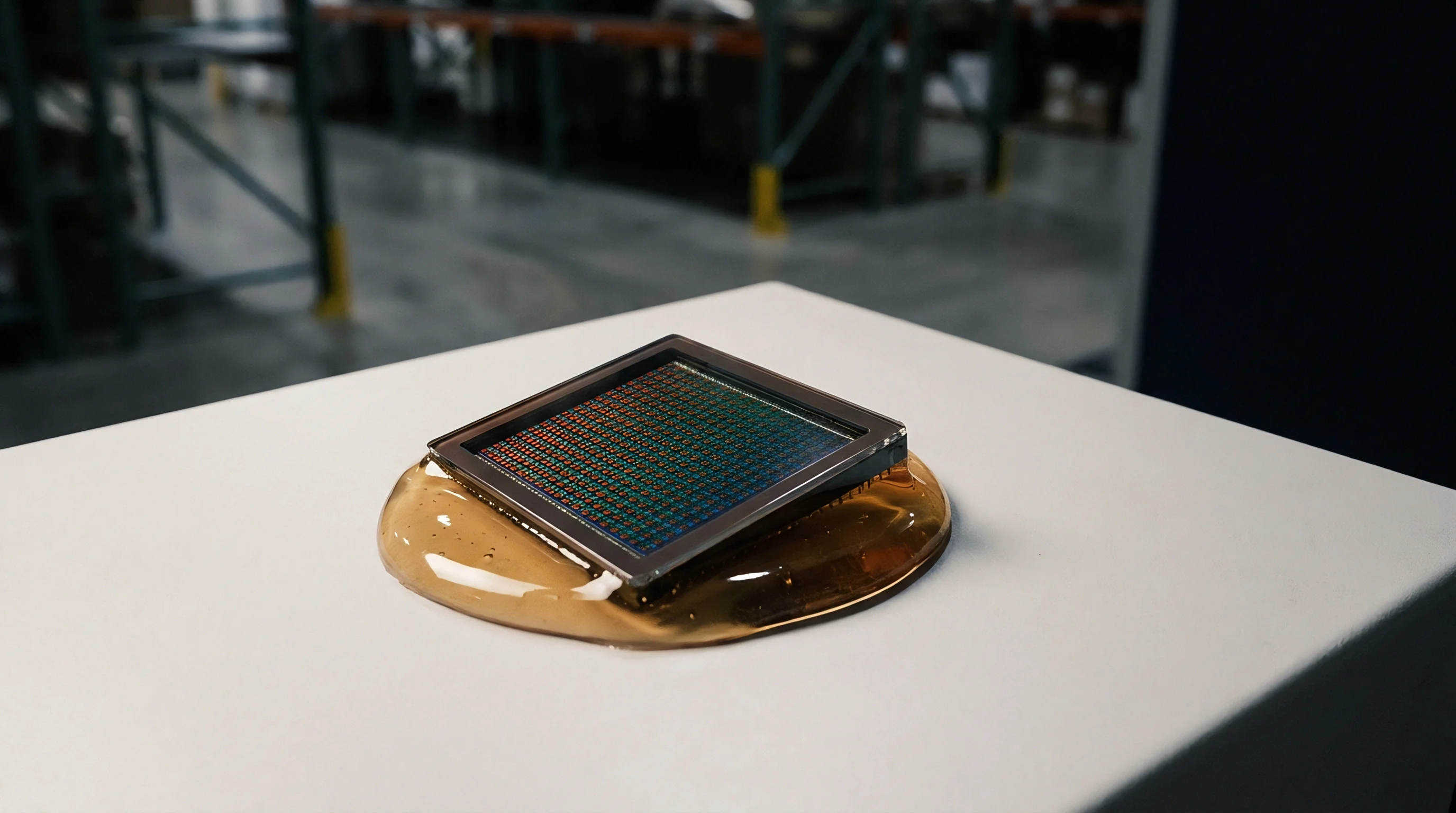
Polymeric potting materials exhibit time-dependent viscoelastic responses under sustained mechanical load and thermal excursion. The complex shear modulus comprises the real storage modulus G-prime, characterizing elastic energy storage, and the imaginary loss modulus G-double-prime, characterizing viscous energy dissipation. When a gyroscope coil experiences rapid environmental heating, the thermal expansion mismatch between the aluminum spool, the polymeric matrix, and the silica fiber induces high internal shear stress.
In an ideal elastic matrix, this stress tracks the instantaneous temperature profile, whereas a viscoelastic matrix relaxes through molecular chain disentanglement and localized viscous creep.
Stress relaxation disrupts the thermal compensation models running inside tactical inertial measurement unit firmware. Firmware algorithms sample temperature sensors placed around the coil periphery, predicting Shupe bias through calibrated differential equations based on temperature rate of change dT over dt. These compensation models assume that the thermal strain field relates directly to the thermal gradient.
Viscoelastic creep introduces a time-lagged residual strain that persists long after spatial temperature gradients reach zero, leaving the gyro with a lingering zero-rate bias drift during thermal soak conditions.
Is Glass Transition Temperature Predictable across Production Batches?
Variations in stoichiometric mixing ratios, prepolymer moisture contamination, and ambient cure humidity destabilize the final cross-link density in polyurethane and epoxy systems. An off-ratio variation of 2 percent shifts the glass transition temperature by as much as 8 Kelvin. If the nominal glass transition sits at minus 45 degrees Celsius, batch-to-batch variation moves this transition into the lower operating limit of tactical hardware, converting an elastic assembly into a highly dissipative mechanical system.
Dynamic mechanical analysis tracking the loss tangent peak identifies these deviations prior to coil winding operations.
During winding campaigns executing hundreds of layer transitions, axial tension must be tightly controlled ~ typically between 15 and 35 grams of force for 80-micrometer fiber ~ to keep loads balanced. If tension varies between the inward-progressing layers and outward-progressing layers of a quadrupolar wind, the stored elastic strain relaxes unevenly through the potting matrix over months of field deployment. This relaxation alters the birefringence axes of the polarization-maintaining fiber, eroding the polarization extinction ratio below 20 decibels.
A loss tangent exceeding 0.15 within the operating thermal band indicates severe viscoelastic phase lag between external temperature gradients and internal core stress.
As thermal gradients penetrate inward from the spool edges, the non-reciprocal phase shift phi-error follows the integral of the time derivative of temperature weighted by position along the fiber:
Phi-error equals the integral from zero to total length L of the thermal sensitivity coefficient multiplied by the quantity L minus two times the fiber coordinate s, multiplied by the time derivative of temperature at coordinate s, integrated over ds. In the presence of potting stress, the thermal sensitivity coefficient combines the pure thermal coefficient with the modulus-driven photoelastic coefficient:
S-effective equals the quantity dn over dT plus the term n cubed divided by two, multiplied by the photoelastic matrix and the temperature derivative of internal stress. When the potting compound stiffens, internal stress increases proportionally with Young’s modulus E, multiplying the magnitude of S-effective across the coil structure.
| Potting Compound Class | Storage Modulus G’ (MPa) | Viscous Loss Modulus G” (MPa) | Effective Core Stress (MPa) | Peak Shupe Bias Drift (°/h) | Post-Ramp Residual Drift (°/h) |
|---|---|---|---|---|---|
| Soft Silicone Gel | 0.8 | 0.05 | 0.12 | 0.015 | 0.002 |
| Toughened Silicone Elastomer | 3.5 | 0.25 | 0.55 | 0.038 | 0.006 |
| Modified Polyurethane | 45.0 | 8.50 | 6.80 | 0.320 | 0.085 |
| Structural Optical Epoxy | 1200.0 | 95.00 | 85.00 | 2.150 | 0.620 |
In high-modulus structural epoxy, peak Shupe drift climbs to 2.150 degrees per hour, breaching tactical limits by an order of magnitude. Residual drift after the external ramp terminates remains elevated at 0.620 degrees per hour because the stored viscoelastic stress requires several hours to achieve mechanical equilibrium.
The exact time required for an aged polymer to resolve its internal shear stresses under sustained tactical vibrations remains an unresolved question when testing protocols span only brief laboratory thermal cycles.
Inspection
Quality verification for sensing coil potting requires testing both raw chemical precursors and fully cured fiber-matrix composites. Incoming raw resins arrive in moisture-barrier packaging, but moisture absorbed during transfer steps alters curing stoichiometry. Dynamic shear rheometers verify that prepolymer viscosity stays within process tolerances between 1200 and 2500 centipoise at 25 degrees Celsius; above 3000 centipoise, resin fails to penetrate the narrow gaps between adjacent fiber turns, leaving microscopic voids that ruin thermal conductivity.
Cured potting samples undergo Dynamic Mechanical Analysis, known as DMA, across a temperature sweep from minus 60 degrees Celsius to plus 120 degrees Celsius at a frequency of 1.0 Hertz. DMA measurement records storage modulus, loss modulus, and the tan delta ratio under a controlled strain of 0.05 percent to ensure linear viscoelastic behavior. Any batch where the tan delta peak shifts above minus 40 degrees Celsius is quarantined to keep it out of tactical production pipelines.
Military standard qualification programs reject sensing coil lots if differential scanning calorimetry reveals residual unreacted curing enthalpy exceeding four Joules per gram.
Finished sensing coils pass through thermal-rate environmental chambers instrumented with precision optical reflectometry. Optical low-coherence reflectometry measures localized polarization cross-coupling along the wound fiber length with spatial resolution below 10 centimeters. Pressure points induced by adhesive shrinkage appear as sharp increases in cross-coupling amplitude, flagging localized groupings of turns compressed by adhesive pooling or improper layer stepping during the quadrupolar wind.
- Raw material rheological analysis mandates incoming dynamic viscosity verification alongside Karl Fischer titration measuring moisture content below 50 parts per million.
- Cured matrix thermal verification tracks the glass transition temperature through differential scanning calorimetry with heating rates fixed at 10 Kelvin per minute.
- Optical polarization preservation mapping records the distributed h-parameter profile across the total fiber length under a thermal ramp from minus 40 to plus 85 degrees Celsius.
- Acoustic micro-imaging inspection identifies internal delamination planes between the coil spool flange and the primary encapsulation layer.
Coil acceptance documents specify absolute limits on zero-rate bias drift and scale factor error under standardized environmental stress profiles. Standard environmental screening clauses in defense supply contracts dictate that optical sensing coils undergo 24 continuous thermal cycles between minus 40 degrees Celsius and plus 85 degrees Celsius with bias stability monitored dynamically, and any sudden step function in bias output invalidates the qualification lot.
Mount
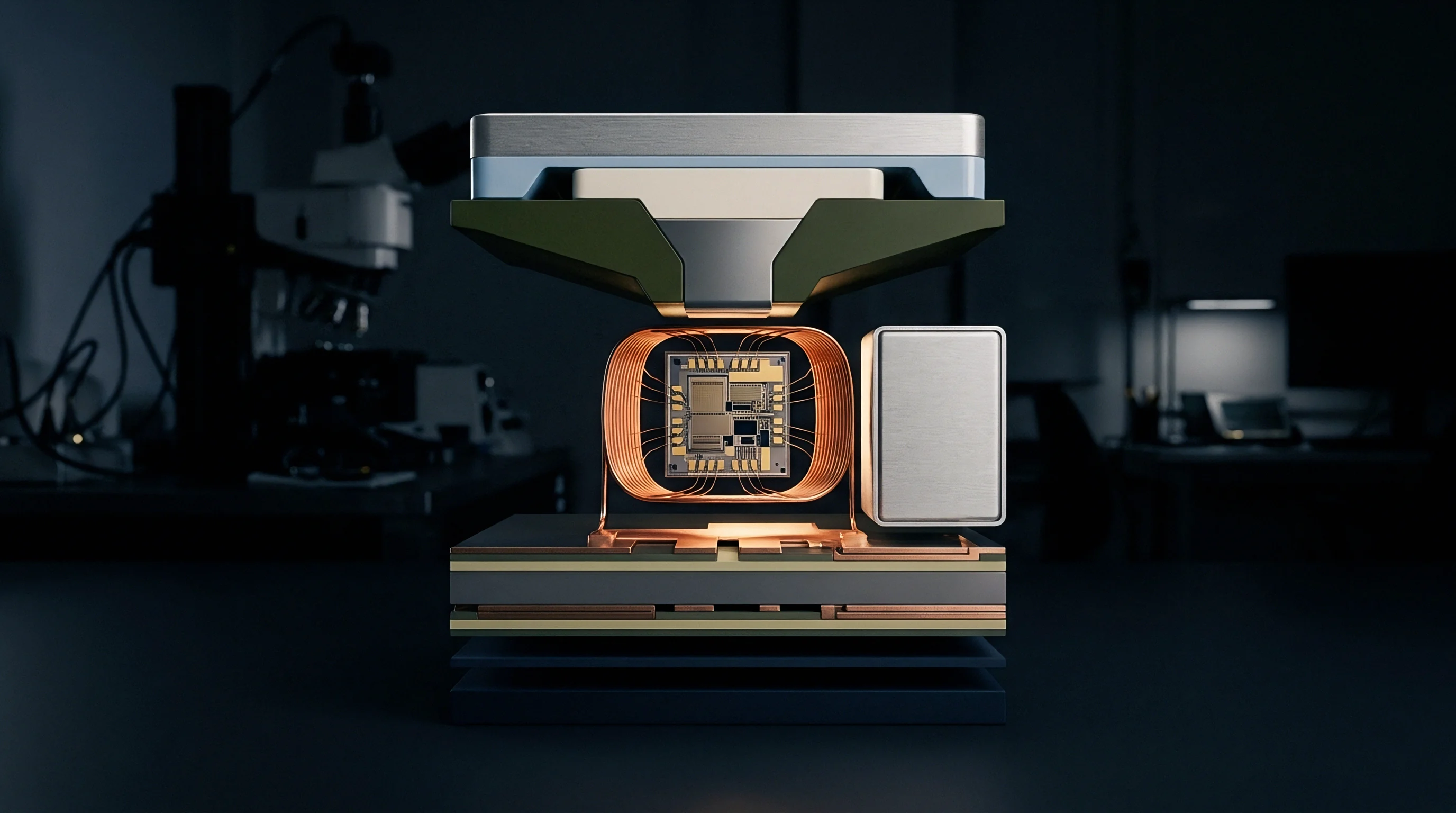
Integrating a potted quadrupolar sensing coil into an inertial measurement unit housing introduces secondary mechanical constraints that amplify internal potting stress. Spool selection balances thermal expansion against the mounting flange. Aluminum alloys deliver high thermal conductivity around 167 Watts per meter-Kelvin but exhibit thermal expansion rates near 23 parts per million per Kelvin.
Titanium alloy Ti-6Al-4V drops the expansion coefficient to 8.6 parts per million per Kelvin, matching the effective transverse expansion rate of a silicone-potted fiber pack, but its lower thermal conductivity ~ near 6.7 Watts per meter-Kelvin ~ intensifies internal spatial temperature gradients.
Fasteners securing the spool hub to the gyroscope chassis generate asymmetric compressive stress patterns across the coil volume. Three-point kinematic mounts isolate the optical assembly from baseplate warping during chassis thermal expansion. Flange mounting screws tightened to nominal torque induce localized micro-strains in the base turns of the quadrupolar coil if the potting compound lacks sufficient mechanical compliance to isolate the fiber.
Adhesives possessing an elastic modulus below 10 megapascals absorb these localized mechanical mounting strains, insulating the core from mounting-induced birefringence changes.
Potting modulus also governs how the sensing coil responds to external acoustic fields and mechanical vibration. Tactical missile applications involve high acoustic energy fields exceeding 140 decibels sound pressure level during launch boost phases. Acoustic energy penetrates sensor enclosures and excites structural resonances within the coil pack.
A rigid potting matrix transmits these pressure waves directly to the silica core, causing acoustic-optic phase modulation that manifests as white noise on the angular rate channel. An elastomeric matrix dampens high-frequency acoustic waves, converting vibrational energy into viscous heat via the loss modulus.
Freestanding coils eliminate the mechanical spool completely, bonding the fiber turns solely with a self-supporting potting adhesive. The coil assembly cures inside a precision winding fixture, after which technicians extract the wound toroid and mount it onto an elastomeric central pedestal. Freestanding coils decouple the fiber pack from metallic spool expansion, reducing Shupe drift by a factor of three relative to hard-anodized aluminum spools.
Freestanding coils remain sensitive to radial shock profiles, requiring elastomeric boots that match the potting matrix chemistry to preserve symmetric dampening.
A soft potting elastomer shields the optical core from external chassis strain, whereas a hard potting resin transfers structural flight vibrations directly into the optical phase signal.