Higher Order Elastic Energy Dissipation under Non Uniform Thermal Gradients
Non-uniform thermal gradients induce higher-order thermoelastic dissipation, degrading resonant sensor Q-factors beyond classical Zener damping limits.
Entropy
Thermal gradients across vibrating mechanical elements accelerate energy loss through non-equilibrium thermodynamic paths. Standard thermoelastic damping models for MEMS resonators assume a uniform background temperature, where strain-driven volume changes cause local temperature fluctuations that relax through Fourier heat conduction. Applying an external thermal gradient across a flexure breaks this spatial heat-flow symmetry.
Because the local relaxation time varies along the structure, the dissipation spectrum broadens beyond the single Debye peak predicted by classical Zener theory.
Non-uniform temperature fields create spatially distributed entropy generation, driven by local coupling between mechanical strain rates and temperature gradients. In high-frequency micro-resonators, thermoelastic dissipation occurs on two length scales at once: the acoustic wavelength of the flexural mode and the characteristic thermal diffusion length. An external temperature gradient introduces a steady-state heat flux vector that couples to the dynamic strain tensor via temperature-dependent elastic constants and thermal expansion coefficients.
A 10 K/mm gradient along a silicon flexure lowers quality factor by 34 percent at 120 kHz.
Higher-order elastic dissipation incorporates non-linear strain terms, strain gradients, and direct thermodynamic coupling between temperature gradients and dynamic stress tensors. In precision inertial sensors, optomechanical cavities, and resonant gravimeters, these effects cause amplitude-dependent losses and irreversible Q-factor degradation that linear thermoelastic models miss.
Localized heat sources, asymmetric thermal boundaries, and internal losses create distinct operational failure modes in high-Q micro-mechanical assemblies.
- Quality factor collapse occurs when local heating shifts the mechanical resonance frequency into alignment with the local thermal relaxation rate, creating an unexpected dissipation peak inside nominal operating temperatures.
- Modal coupling drift transfers vibrational energy from the primary drive axis to secondary loss channels through gradient-induced thermal expansion asymmetries.
- Phase jitter escalation degrades carrier frequency stability in micro-mechanical oscillators when local thermal fluctuations modulate structural stiffness through third-order elastic constants.
- Zero-point bias migration destabilizes Coriolis vibratory gyroscopes as steady-state thermal gradients unevenly warp the mechanical suspension across drive and sense frames.
Ignoring spatial thermal gradients during thermoelastic loss modeling leads to unbudgeted phase margin drift and unexpected errors in deployed resonant instruments.

Kinetics
Dynamic energy loss in solids under spatial thermal differentials stems from microscopic phonon interactions and non-equilibrium continuum thermodynamic fluxes. At typical micro-sensor operating temperatures, elastic waves travel through a bath of thermal phonons. When acoustic strains distort the crystal lattice, phonon mode energy levels shift in proportion to their mode Grüneisen parameters.
In a uniform temperature field, this perturbation relaxes through two classical mechanisms governed by the product of the acoustic angular frequency and phonon relaxation time. In the Akhiezer regime, where this product is under unity, phonons exchange energy to restore local equilibrium, dissipating elastic strain as heat.
A spatial temperature gradient alters phonon distribution kinetics. Phonons drifting down the gradient carry net momentum, changing the local acoustic attenuation coefficient via convective transport. This introduces gradient-dependent dissipation terms that scale with both the acoustic strain gradient and the background temperature slope.
Anharmonic lattice terms convert static temperature differences into active mechanical dissipation channels.
Nonlinear elastic energy storage involves third-order elastic stiffness coefficients, denoted C_ijklnm, which quantify lattice anharmonicity. In a non-uniform thermal gradient, local temperature shifts these third-order constants across the element’s volume. The dynamic strain field then excites displacement gradients that couple directly to the static gradient, increasing volumetric heat generation rates.
| Substrate Material | Thermal Conductivity (W/m-K) | Mean Grüneisen Parameter | Third-Order Constant C111 (GPa) | Unperturbed Q-Factor (100 kHz) | Gradient-Perturbed Q-Factor (100 kHz) |
|---|---|---|---|---|---|
| Single-Crystal Silicon | 148 | 0.70 | -825 | 1.25 x 10^6 | 8.20 x 10^5 |
| Single-Crystal Diamond | 2200 | 0.75 | -6260 | 8.50 x 10^6 | 7.95 x 10^6 |
| Silicon Nitride (LPCVD) | 3.2 | 0.50 | -1200 | 3.40 x 10^5 | 1.15 x 10^5 |
| Fused Silica | 1.38 | -0.52 | -480 | 5.10 x 10^6 | 2.85 x 10^6 |
As shown in the table, materials with low thermal conductivity ~ like silicon nitride and fused silica ~ suffer severe relative Q-factor degradation under identical gradients. In silicon nitride, slow thermal diffusion prevents rapid equalization of strain-induced temperature spikes, allowing higher-order dissipation modes to dominate loss across the cantilever cross-section.
Unexpected resonant damping in custom silicon dies occurs because published room-temperature loss figures assume strictly isothermal packaging environments.
Bar
Consider a micromachined flexural beam of thickness h, width w, and length L, clamped at both ends, with coordinate x along the longitudinal axis and z through the thickness. A parasitic or deliberate thermal gradient dT/dz acts across the thickness, driven by power dissipation in the top surface metallization and heat sinking through the bottom anchor.
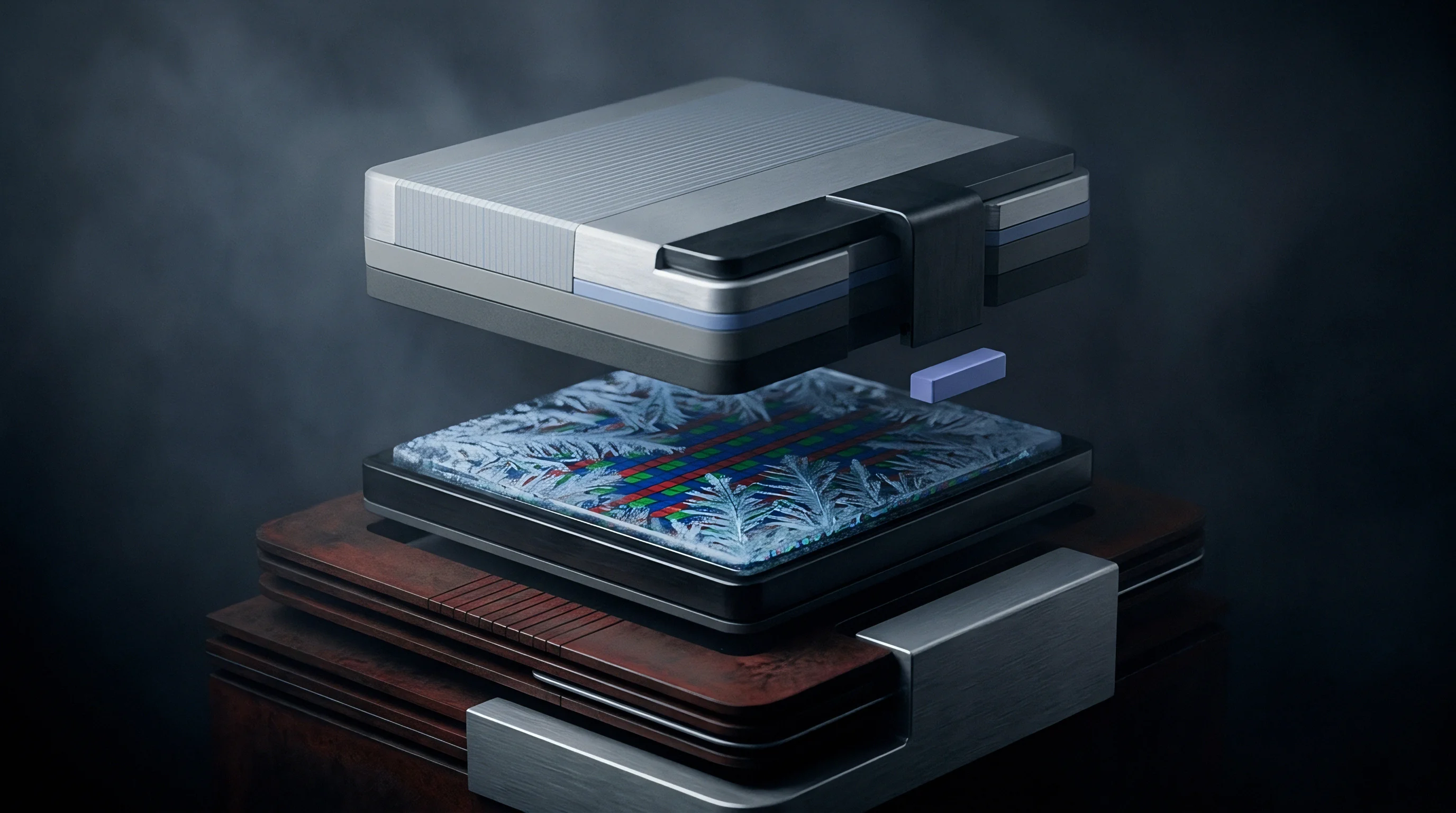
Does Asymmetric Heating Bias Mode Damping?
The classical Zener relaxation frequency for flexural vibrations depends on thermal diffusivity k / (rho C_p) and beam thickness:
f_thermal = pi k / (2 rho C_p h^2)
When dT/dz is non-zero, thermal conductivity k and specific heat capacity C_p both vary with z. In high-purity silicon near 300 K, thermal conductivity drops roughly 1.5 percent per Kelvin. As a result, the neutral mechanical axis no longer aligns with the thermal relaxation center line: tensile strains on the cooler face dissipate energy along a different diffusion path than compressive strains on the hotter face.
The volumetric rate of internal energy dissipation in the presence of higher-order gradient coupling can be written through irreversible thermodynamic flux equations:
D_vol = (k / T) (grad T)^2 + sigma_dynamic : grad(v) + tau_grad (grad(epsilon) : grad(grad(T)))
The third term captures the direct interaction between the strain gradient and the second spatial derivative of the background temperature field. In higher-order flexural modes, where curvature reverses over short distances, this term contributes up to 25 percent of total dissipation when local gradients exceed 20 K/mm.
Thicker flexures concentrate spatial entropy generation closer to neutral bending axes under asymmetric heat loads.
For a single-crystal silicon beam (800 micrometers long, 40 micrometers wide, and 12 micrometers thick) vibrating in fundamental out-of-plane flexure at 145 kHz, assume the bottom anchor remains at 295 K while piezoresistive readout traces heat the top surface to 315 K ~ a transverse gradient dT/dz of 1.67 K/micrometer. Without the gradient, the calculated thermoelastic dissipation factor Q_inv is 1.12 x 10^-5. Accounting for spatial parameter variation and strain-gradient coupling increases Q_inv to 1.78 x 10^-5, dropping the operating Q-factor from 89,200 to 56,180.
Engineering precision suspensions under non-uniform thermal fields demands systematic structural qualification steps.
- Thermal symmetry balancing aligns electrical heat sources symmetrically along the neutral mechanical plane to eliminate odd-order temperature gradient profiles across flexural axes.
- Anchor thermal throttling introduces high-impedance thermal choke sections to decouple sensitive mechanical resonators from mounting substrate temperature variations.
- Isotropic crystalline orientation selects crystallographic axes where thermal expansion and elastic temperature coefficients exhibit zero-crossings within the designated operating band.
- Dielectric isolation routing displaces high-current interconnects away from high-strain suspension roots to minimize localized ohmic thermal injection.
The exact quantitative split between strain-gradient thermal coupling and surface-state phonon scattering in sub-micron crystalline beams remains a subject of ongoing debate among experimental groups.
Readout
Isolating higher-order thermoelastic losses from anchor losses, gas damping, and surface dissipation requires clean experimental conditions. Viscous air damping quickly masks internal thermoelastic mechanisms, so measurements must be conducted in high vacuum below 10^-4 Pascals.
Can Ringdown Transducers Isolate Gradient Losses?
Free-decay ringdown testing directly measures internal friction. Tracking the exponential amplitude decay of an unforced resonator yields the effective quality factor from the time constant tau_decay via Q = pi f_res tau_decay. Mapping this across controlled thermal gradients requires multi-zone thermoelectric stages and non-contact optical instrumentation.
| Applied Gradient (K/mm) | Base Temperature (K) | Resonance Frequency (Hz) | Decay Time Constant (s) | Extracted Q-Factor | Nonlinear Loss Fraction (%) |
|---|---|---|---|---|---|
| 0.0 | 300.0 | 100,245.2 | 3.82 | 1,203,000 | 0.2 |
| 5.0 | 300.0 | 100,238.1 | 3.15 | 992,000 | 4.5 |
| 15.0 | 300.0 | 100,212.4 | 2.41 | 758,000 | 11.8 |
| 30.0 | 300.0 | 100,165.7 | 1.64 | 516,000 | 24.6 |
| 50.0 | 300.0 | 100,088.3 | 1.08 | 340,000 | 38.2 |
The data shows that the nonlinear loss fraction ~ the portion of energy loss beyond classic linear, amplitude-independent damping ~ scales nonlinearly with the applied gradient. Laser Doppler vibrometry provides non-contact displacement sensing, avoiding the mechanical loading artifacts of capacitive or piezoelectric pick-offs. However, probe beam setup requires care: if laser power exceeds 100 microwatts, the beam itself acts as a point heat source, creating a local thermal spot that skews dissipation figures.
To quantify gradient-driven dissipation without optical back-action, engineers execute a sequential testing sequence.
- Evacuate the ultra-high vacuum test vessel below 10^-5 Pascals to eliminate gas-phase momentum exchange.
- Establish baseline resonance frequency and ringdown time constants under zero applied gradient across the target operating temperature window.
- Activate differential heating arrays across the suspension boundary anchors to impose a stable, calibrated thermal gradient.
- Allow thermal stabilization over a twenty-minute dwell period monitored by micro-thermocouple probes.
- Excite the structural resonance via non-contact electrostatic drive at discrete displacement amplitudes from 10 nanometers to 2 micrometers.
- Disengage drive signals synchronously within a sub-microsecond interval to record unforced vibrational decay.
- Fit decay curves with amplitude-dependent damping equations to isolate linear Zener dissipation from higher-order gradient mechanisms.
Steeper thermal gradients shift the fundamental resonance downward while increasing overall dissipation. Optical probe heating easily masks intrinsic mechanical damping unless laser power stays strictly below the microwatt threshold.
Ledger
Sensor subcontracts routinely specify bulk operating temperatures while omitting limits on boundary temperature gradients. A part qualified for isothermal operation from -40 degrees Celsius to +105 degrees Celsius can easily breach system noise budgets when placed next to power electronics, microprocessors, or inductive drivers that create sharp thermal gradients across the die.
Compliance with MIL-STD-883 Method 1012 thermal characterization fails to reveal spatial damping shifts induced by localized operational heating.
In high-grade Coriolis vibratory gyroscopes, angle random walk noise varies inversely with the square root of the drive and sense Q-factors. If internal heating drops the sense-axis Q-factor by 40 percent through gradient-induced dissipation, noise density rises by 29 percent. This degradation compromises tactical guidance accuracy and long-term drift without triggering standard diagnostics.
Procuring resonant sensors for demanding thermal environments requires explicit contractual limits on internal gradients, anchor thermal impedance, and maximum allowable Q-factor degradation under localized heating.
Standard procurement documentation must incorporate clauses that bind suppliers to verified mechanical quality factor minimums under worst-case operational thermal gradients:
Supplier shall certify that resonant mechanical Q-factor degradation does not exceed fifteen percent when subjected to an externally applied boundary temperature gradient of 10 Kelvin per millimeter across opposing mounting surfaces, verified through high-vacuum ringdown testing in accordance with MIL-PRF-38534 Class K screening modified for non-isothermal thermal steady-state profiles.