Basic Fluxgate Differential Sensing Principles and Core Hysteresis
Differential fluxgate sensing cancels symmetric drive feedthrough to isolate second-harmonic signals, while core coercivity limits baseline offset and noise.


Permeability
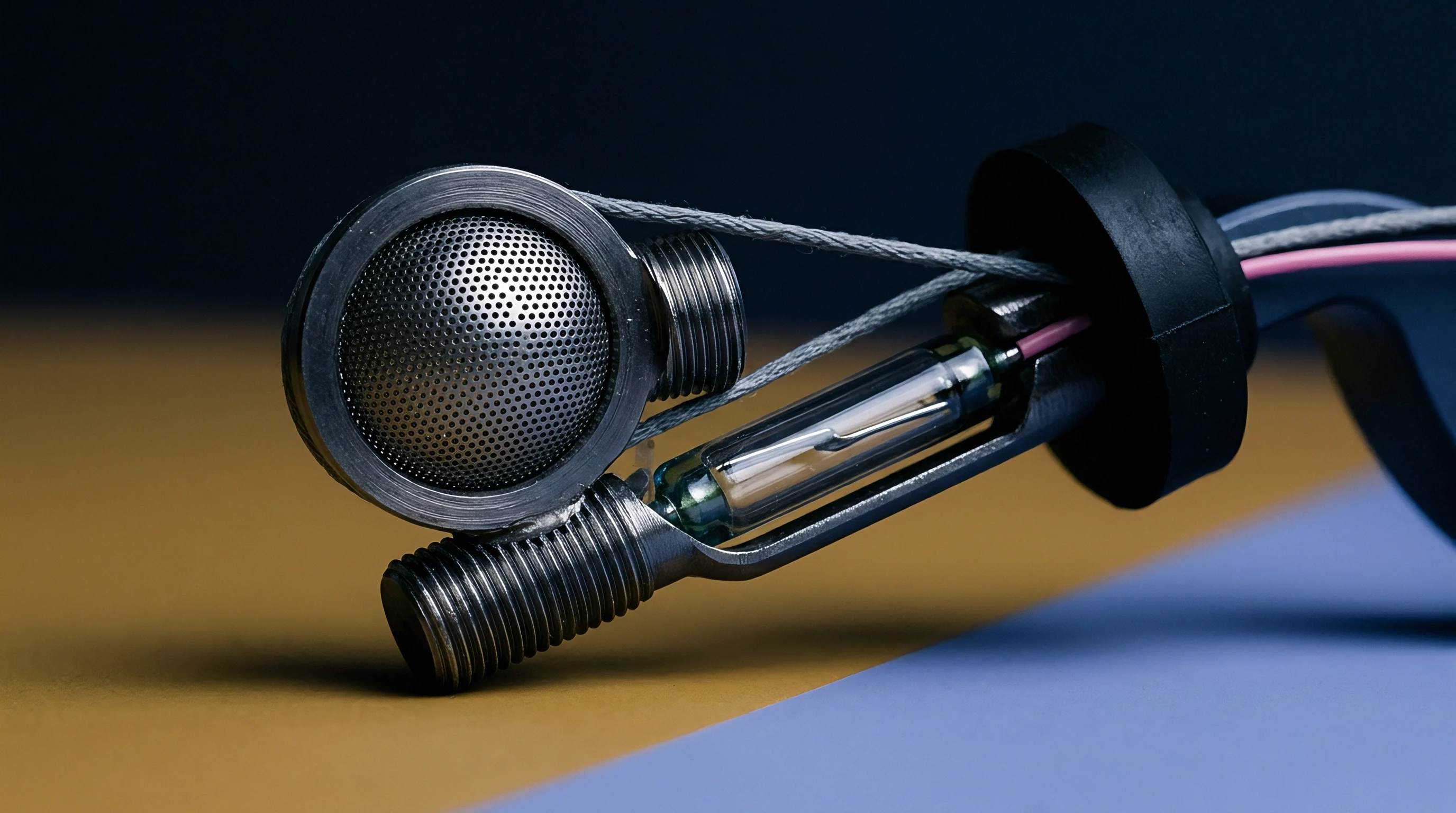
Nonlinear Magnetization in Soft Magnetic Alloys
Toroidal fluxgate sensing elements exploit the nonlinear magnetization curve of high-permeability ferromagnetic alloys driven cyclically past saturation. An external magnetic flux density biases this symmetric alternating cycle, shifting the temporal incidence of core saturation between forward and reverse drive half-periods. This temporal asymmetry produces even-order harmonics within the pick-up winding voltage, with the second harmonic amplitude exhibiting direct proportionality to the measured external direct-current or low-frequency magnetic field.
Cobalt-based amorphous ribbons such as Co68Fe4Mo1Si16B11 and ultra-thin nickel-iron permalloy foils achieve saturation induction levels between 0.5 T and 0.8 T while maintaining coercive field values below 1.0 A/m. Relative permeability peaks sharply above 100,000 within the Rayleigh region before collapsing toward vacuum permeability when the material saturates. Driving the magnetic path into deep saturation twice per excitation cycle eliminates remnant magnetic domains, suppressing long-term baseline wander.
Commercial differential architectures evaluate balanced configurations where two identical cores, or two halves of a single closed toroid, receive opposing excitation fields. External ambient fields enter both cores in parallel. The differential winding configuration cancels the massive odd-harmonic feedthrough induced by the excitation drive, isolating the microvolt-level second-harmonic signal generated by the target field.
Relative magnetic permeability collapses from 120,000 to unity within 80 nanoseconds when the excitation field exceeds 120 A/m.
Residual geometric mismatch between opposing cores limits the suppression of fundamental drive feedthrough. A physical mismatch of 0.1 percent in core cross-sectional area or winding turn density generates fundamental feedthrough voltages exceeding the full-scale differential second-harmonic output by 40 dB. Demodulation electronics require steep synchronous filtering to strip this fundamental feedthrough before preamplification stages clip.
Thermal variations govern permeability dynamics across industrial operating ranges. As ambient temperature climbs toward 85 degrees Celsius, the saturation magnetization of cobalt-base amorphous cores drops according to Bloch spin-wave power laws, lowering the drive current required to reach the saturation boundary. Failing to track this threshold via closed-loop excitation circuitry results in under-saturated core states and runaway offset errors.


Saturation
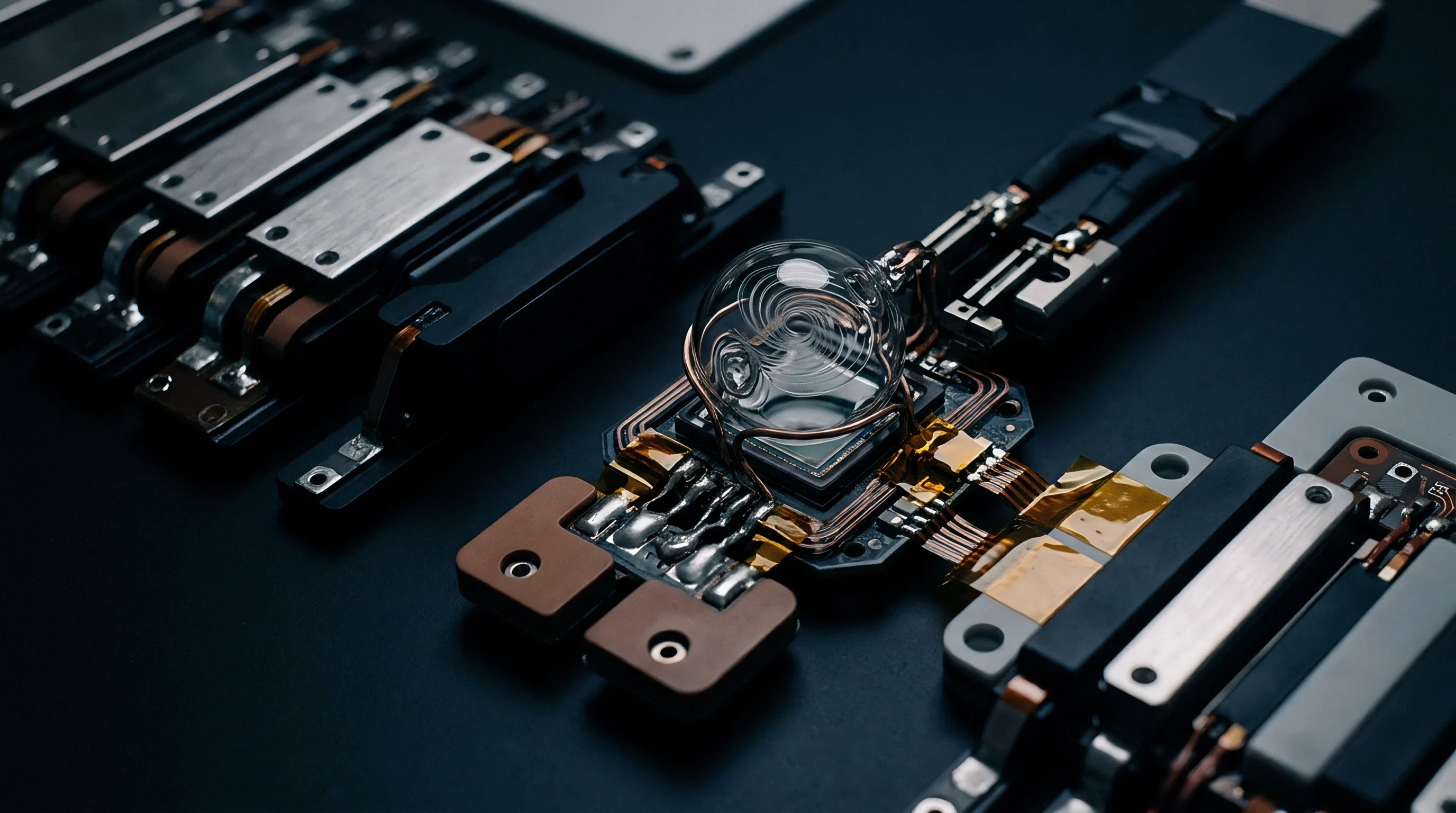
Differential Cancellation of Drive Feedthrough
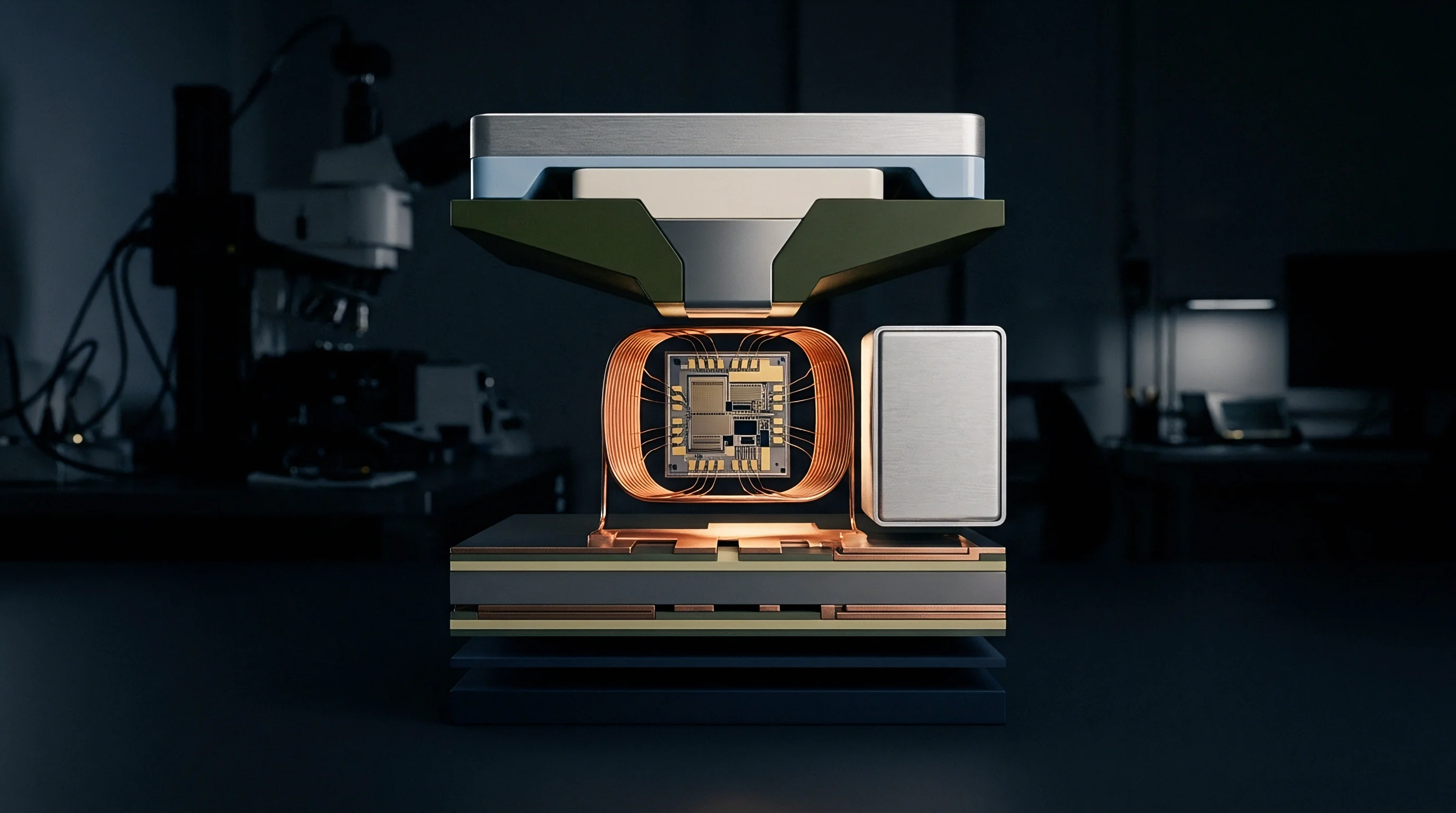
Symmetric core geometries suppress odd-harmonic cross-talk by arranging drive windings in series-opposition around twin magnetic elements. The alternating drive current forces both cores into saturation simultaneously with inverted magnetic polarities. External direct-current fields assist saturation in one core during the positive half-cycle while delaying saturation in the opposing core, creating differential flux pulses picked up by an encompassing sense winding.
Sense coil output contains second-harmonic spectral content whose phase indicates field direction and whose amplitude tracks field strength. Closed-loop fluxgate systems feed this demodulated error signal back through a compensation winding, generating an equal and opposite magnetic field that locks the net internal core flux at zero. Operating the core as a null detector removes transfer-function nonlinearities introduced by temperature-dependent saturation curves.
| Alloy Composition | Saturation Flux Density (T) | Coercivity (A/m) | Initial Permeability | Curie Point (C) |
|---|---|---|---|---|
| Cobalt Amorphous Co68Fe4Mo1Si16B11 | 0.57 | 0.45 | 110,000 | 225 |
| Nanocrystalline Fe73.5Cu1Nb3Si13.5B9 | 1.24 | 0.80 | 80,000 | 570 |
| Supermalloy Ni79Fe16Mo5 | 0.78 | 0.60 | 100,000 | 400 |
| High-Silicon Steel Fe93.5Si6.5 | 1.80 | 8.50 | 18,000 | 700 |
Drive waveform architecture sets the power consumption and thermal profile of the transduction head. Sinusoidal excitation generates minimal high-frequency radiated noise but requires continuous circulating current, generating resistive losses across copper windings. Square-wave voltage drive, mediated by H-bridge drivers with fast slew rates, creates peaked current spikes when core inductance collapses at saturation, maximizing the derivative of flux with respect to time.
Short voltage pulses reduce overall excitation power while delivering the drive field strength required to sweep pinning sites clear of magnetic domains. Gate drive timing must account for winding capacitance to avoid ringing transients that mirror second-harmonic signatures. Phase margins degrade rapidly if drive circuit switching nodes oscillate against inductive winding tails.
Differential core layouts isolate the sense winding from primary current lines. In residual current sensing applications, twin-core ring designs allow primary conductors to pass through the central aperture without physical contact, measuring differential fault currents below 5 mA against common-mode load currents exceeding 32 A.
Field nulling eliminates gain drift tied to core thermal expansion. Temperature-induced changes in core cross-sectional area alter the open-loop voltage output by 120 ppm per Kelvin. A closed-loop feedback coil wound directly over the magnetic element keeps the core working at zero field, shifting the system transfer function stability entirely onto the physical winding geometry and feedback resistor precision.


Loop
Coercivity, Barkhausen Jumps, and Hysteresis Loss
Ferromagnetic hysteresis loops define the fundamental noise floor and offset stability of fluxgate heads. Coercive force represents the reverse magnetic field intensity needed to restore magnetic induction to zero after saturation. Non-zero coercivity introduces phase lag into the saturation transition, converting magnetic energy into thermal dissipation each half-cycle.
Microscopic domain wall movements do not proceed continuously across the magnetization curve. Internal dislocations, grain boundaries, and chemical inhomogeneities create localized energy wells that pin domain walls. When the external driving field overcomes these barriers, walls jump abruptly between pinning sites, generating discrete Barkhausen noise pulses across the secondary winding.
- Barkhausen noise voltage originates from discontinuous domain wall displacements and dictates the wideband noise ceiling between 0.1 Hz and 10 Hz.
- Magnetostrictive coupling translates environmental mechanical stress into magnetic domain shifts, generating baseline offsets under structural torque.
- Thermal relaxation drift shifts the hysteresis loop centers over time when pinning site potentials fluctuate under prolonged thermal cycles.
- Excitation amplitude insufficiency leaves unpinned domain remnants near core edges, inducing long-term zero-offset memory after primary current surges.
Annealing protocols adjust domain wall mobility in cobalt-based alloys. Annealing under transverse magnetic fields at temperatures near 380 degrees Celsius induces an easy axis perpendicular to the driven flux path, yielding flat, sheared hysteresis loops with minimal coercivity. Sheared loops reduce Barkhausen noise by promoting magnetization rotation rather than abrupt domain wall nucleation.
Hysteresis loop area correlates directly with core power loss per cycle. The integral of magnetic field intensity across magnetic flux density over a complete excitation cycle defines the dissipated volumetric energy density. Driving at excitation frequencies from 20 kHz to 100 kHz multiplies this cycle loss, heating tiny core structures and changing their magnetic properties during operation.
DIN EN 60404-6 sets coercive field determination criteria under alternating-field excitation up to 100 kHz.
Residual magnetic memory appears after high-amplitude external magnetic field pulses saturate the core along an uncompensated axis. When an external surge field drops back to ambient levels, pinned domains remain trapped within local potential wells, shifting the zero-field sensor output by several microteslas. Deep over-excitation clears these trapped domain walls, cycling the core five to ten times beyond nominal saturation levels to erase remanence.


Demodulation

Phase-Sensitive Extraction of Second Harmonics
Secondary sense winding signals pass through preamplifiers into phase-sensitive demodulators configured to extract the 2f harmonic component. Analog multipliers or synchronous sampling switches reference their switching events to a digital clock derived directly from the primary excitation source, preserving strict phase coherence. Phase alignment between the reference clock and the incoming second-harmonic peaks fixes the conversion gain and rejection ratio.
Phase alignment errors degrade demodulation efficiency. When the reference drive clock slips from the true second-harmonic phase by an angle theta, the recovered DC voltage drops by a factor of cosine theta, while quadrature components inject residual fundamental feedthrough directly into the DC measurement path. Analog phase-locked loops or microcontrollers executing synchronous undersampling track this phase relationship across changing temperatures.
| Processing Architecture | Dynamic Range (dB) | Offset Drift (uV/C) | Conversion Bandwidth (kHz) | Supply Current (mA) |
|---|---|---|---|---|
| Analog Dual-Gate Switch with Active Filter | 96 | 0.45 | 2.5 | 12.0 |
| Balanced Four-Quadrant Analog Multiplier | 84 | 1.20 | 10.0 | 18.5 |
| Direct 16-Bit Synchronous Digital Sampling | 115 | 0.08 | 4.0 | 32.0 |
| Switched-Capacitor Phase-Sensitive Integrator | 90 | 0.60 | 1.0 | 4.5 |
Synchronous rectifiers convert 2f voltage signals into raw DC error currents. Low-pass filters clean the demodulated output, removing 2f ripple components, high-order harmonics, and excitation clock bleed. Active multi-pole Bessel or Butterworth filter topologies preserve group delay linearity across the signal passband, avoiding phase distortion when monitoring transient differential leakage events.
High-speed current drivers route this filtered output back through the closed-loop nulling winding. Dynamic loop stability demands phase margins above 45 degrees at the system crossover frequency. The high inductance of multi-turn sense and compensation coils interacts with parasitic winding capacitances, generating complex impedance poles that require active phase-lead compensation networks in the feedback amplifier loop.
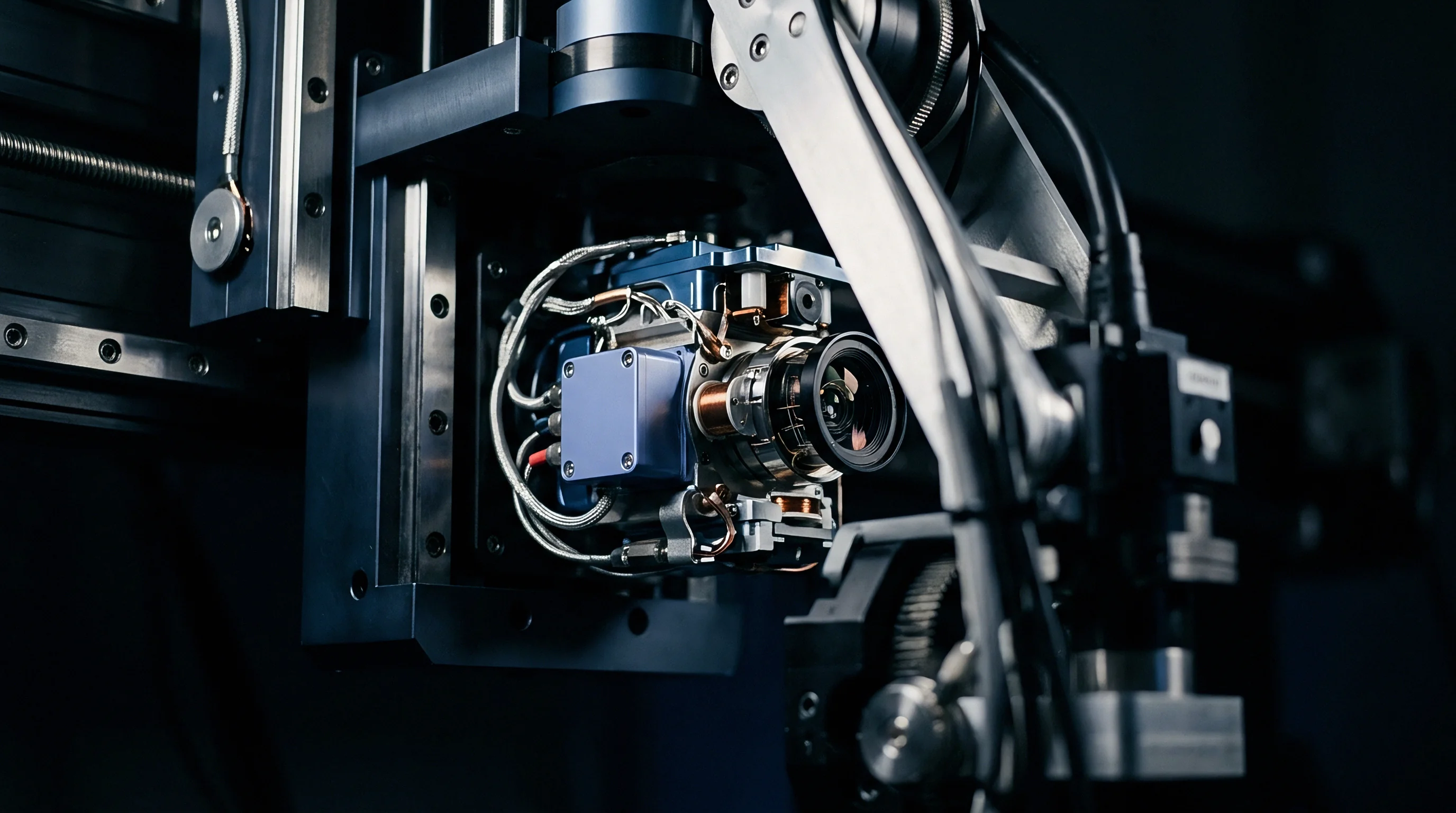
Drift
Thermal, Mechanical, and Remanent Instability
Operational stability depends on isolating the soft magnetic alloy from environmental stresses. Amorphous and nanocrystalline ribbons display magnetostriction constants ranging from 0.1 to 30 parts per million. Mechanical pressure applied by rigid epoxy encapsulation transfers stress into the alloy matrix, creating magnetic anisotropy barriers via the inverse magnetostrictive effect and inflating both coercivity and baseline offset.
Core potting procedures utilize flexible silicone gels or grease suspensions rather than solid resins. Encapsulating the magnetic ribbon within a rigid plastic shell filled with damping fluid decouples external chassis torsion from the core material. Thermal expansion differentials between copper wire, bobbin thermoplastics, and metallic ribbons otherwise generate offset shifts exceeding 200 nT per Kelvin.
Residual direct-current offsets drift over operating life due to material aging. Structural relaxation in amorphous glasses allows atom pairs to reorient along preferred magnetization vectors, slowly altering the local coercive field. Operating devices at elevated temperatures accelerates this directional ordering, producing gradual offset wander that auto-zero routines must calibrate out periodically.
A five-kelvin gradient across balanced sensing cores generates eight nanoteslas of uncorrectable baseline offset.
Thermal gradients across differential pairs break mathematical symmetry. If core A operates 0.5 degrees hotter than core B, their saturation flux densities diverge, preventing complete cancellation of fundamental drive feedthrough. Layout rules demand compact, concentric core placements or interlocked toroidal structures to maintain thermal equilibrium between paired magnetic components.
Demagnetization routines address offset errors caused by severe electrical over-current conditions. When lightning strikes or short circuits pass thousands of amperes through monitored conductors, magnetic fields drive fluxgate cores into extreme saturation, pinning magnetic domains. Auto-degaussing circuits inject decaying alternating-current waveforms into the excitation or feedback windings, cycling core magnetization from full saturation down to zero over 50 to 100 milliseconds to restore baseline accuracy.

Procurement

Alloy Sourcing and Manufacturing Verification
Specifying magnetic materials for fluxgate production involves balancing magnetic performance with raw material costs. Vacuum-melted, thin-strip cobalt amorphous ribbons deliver excellent magnetic properties and low Barkhausen noise, yet raw material pricing runs three to five times higher than crystalline permalloys or nanocrystalline iron alloys. Sourcing teams verify supplier ribbon thickness tolerances, because variations above 2 micrometers along a strip create uneven saturation timing.
Winding precision dictates production yields. Ring cores wound with unequal tension develop localized stress concentrations that alter ribbon permeability, producing unbalanced differential assemblies. Automated winding equipment with active wire tension monitoring below 0.2 N protects soft magnetic strips from work-hardening during assembly.
Testing protocols at incoming inspection require automated coercive field characterization under dynamic excitation. Standard single-sheet testers or closed-yoke permeameters evaluate ribbon samples at operational drive frequencies, confirming that coercivity remains below agreed thresholds before ribbons enter slitting and core-winding operations.
Multi-source production strategies navigate distinct processing chemistries between suppliers. Japanese and European ribbon manufacturers utilize proprietary trace element additions such as molybdenum, niobium, and silicon to tailor crystallization kinetics, yielding ribbons that behave differently during customer stress-relief annealing cycles. Switching ribbon vendors requires re-qualifying core heat-treatment profiles to preserve target coercivity and temperature coefficients.
Finished sensor qualification demands rigorous temperature shock and vibration testing per IEC 60068 standards. Thermal cycling between minus 40 and plus 125 degrees Celsius evaluates core degradation, package stress isolation, and winding continuity. Incoming inspection protocols must incorporate baseline noise density checks, rejecting finished sensor heads displaying excess low-frequency noise signatures linked to micro-cracked magnetic ribbons.
Suppliers frequently defend offset drift deviations by asserting that test fixtures introduced ambient magnetic distortion during component screening.