Evaluating Surface Tension and Pore Radius in Hydrostatic Ingress Calculations
Hydrostatic ingress occurs when external head plus internal thermal vacuum exceeds Young-Laplace capillary breakthrough pressure governed by throat radius.

Head
Capillary Pressure in Enclosure Sealing
Hydrostatic immersion calculations depend fundamentally on the Young-Laplace relation, which balances the liquid head pressure against the capillary entry pressure developed across small aperture geometries. Ingress testing under standards such as IEC 60529 (IPX7 and IPX8) or ISO 20653 subjects sealed electronic enclosures to water columns ranging from 0.15 meters to tens of meters. When an enclosure contains microscopic leak paths, including microporous vents, casting voids, joint imperfections, or interfacial gaps between elastomeric gaskets and machined surfaces, entry occurs only when the hydrostatic driving head exceeds the breakthrough capillary resistance.
The fundamental physical equilibrium governs this interface. A cylindrical pore geometry defines the entry pressure delta P through the direct force balance:
delta P = (2 gamma cos theta) / r
The parameter gamma represents the liquid-vapor surface tension of the immersion medium in Newtons per meter. The contact angle theta denotes the wettability between the liquid front and the pore wall material, measured in degrees. The internal pore radius r represents the critical hydraulic dimension in meters.
When the hydrostatic head P_h = rho g h surpasses delta P, fluid enters the pore and penetrates the housing cavity. Density rho and local gravitational acceleration g scale the fluid column height h.
A pure water surface tension of 0.0728 N/m at 20 degrees Celsius drops to 0.0280 N/m with 0.1 percent surfactant contamination, reducing ingress breakthrough pressure by 61 percent across an identical 5-micrometer pore.
Engineers evaluating water ingress frequently treat surface tension and pore radius as static single-point inputs pulled from textbook tables. Real working conditions contradict this baseline assumption. Ambient wash solutions contain cleaning detergents, glycols, suspended road grime, or dissolved salts that alter surface tension across half an order of magnitude.
Manufacturing variations produce pore geometries that diverge significantly from uniform cylinders, exhibiting non-circular cross sections, necking, and tortuous paths. Surface roughness, localized contamination, and chemical composition shift the contact angle dynamically as the meniscus advances. Calculating hydrostatic resistance requires rigorous evaluation of these variables under actual operating conditions.
Fluid

Surface Tension Dynamics in Aqueous Immersion Media
Pure water exhibits a high surface tension of 0.0728 N/m at 20 degrees Celsius. In industrial and field deployments, pure water rarely serves as the wetting agent. Runoff water on public roadways contains traces of engine oils, fuel residues, and ionic salts.
Industrial environments expose housings to machine tool coolants, cutting fluids, and surfactant-rich washdown agents. A clean automotive connector housing resisting water ingress during a pure distilled water immersion check fails rapidly when exposed to a standard 5 percent automotive detergent solution possessing an interfacial tension below 0.030 N/m.
Temperature variation introduces another deterministic reduction in fluid cohesion. As temperature increases, intermolecular hydrogen bonding within the liquid phase weakens. The empirical relationship established by the Eotvos equation or the Jasper correlation tracks this decay:
gamma(T) = gamma_0 (1 – T / T_c)^n
For clean water, gamma falls from 0.0756 N/m at 0 degrees Celsius to 0.0728 N/m at 20 degrees Celsius, 0.0662 N/m at 50 degrees Celsius, and 0.0589 N/m at 100 degrees Celsius. Calculating sealing margins based on ambient laboratory conditions underestimates the risk for systems operating under high internal thermal dissipation or warm fluid washdowns.
| Immersion Fluid Formulation | Surface Tension (N/m) | Equilibrium Contact Angle (deg) | Entry Pressure (kPa) | Equivalent Head (m H2O) |
|---|---|---|---|---|
| High-Purity Deionized Water | 0.0728 | 105.0 | 37.68 | 3.84 |
| Standard Tap Water (Municipal) | 0.0715 | 101.5 | 28.51 | 2.91 |
| 3.5 wt% Synthetic Seawater (ASTM D1141) | 0.0734 | 104.0 | 35.51 | 3.62 |
| 50/50 Water-Ethylene Glycol Coolant | 0.0482 | 84.0 | -10.08 | Ingress (Spontaneous) |
| 0.1 wt% Nonionic Surfactant (Triton X-100) | 0.0310 | 58.0 | -32.85 | Ingress (Spontaneous) |
| 2.0 wt% Alkaline Washdown Solution | 0.0285 | 62.0 | -26.76 | Ingress (Spontaneous) |
Surfactant accumulation alters ingress kinetics through time-dependent dynamic surface tension. When an enclosure enters a liquid bath, dynamic surface tension governs early contact rather than the static equilibrium value. Surfactant molecules require finite diffusion intervals to migrate from the bulk liquid to the newly formed air-water meniscus at the pore entrance.
Maximum bubble pressure tensiometry demonstrates that at surface ages under 10 milliseconds, a surfactant solution behaves nearly identically to pure water. As contact time extends past 10 seconds, surfactant molecules align at the interface, collapsing gamma down to its equilibrium plateau. A momentary splash test permits survival where continuous static immersion yields rapid flooding.
Contact angle hysteresis compounds this sensitivity. Advancing contact angles theta_A exceed receding contact angles theta_R by 10 to 40 degrees depending on substrate chemical heterogeneity and micro-roughness. The advancing contact angle dictates initial penetration resistance across a dry pore.
Once liquid establishes entry and coats the channel walls, the receding or equilibrium angle governs subsequent meniscus stabilization. If internal housing pressure cycles negatively during thermal contraction, the lower contact angle drastically reduces the pressure necessary to draw fluid deeper into the enclosure cavity.
Contamination of test tanks presents an acute procedural hazard. Laboratory immersion tanks accumulating trace plasticizers, silicones, or biological films display lowered surface tension that invalidates IP verification dossiers. The European standard EN 60529 specifies water parameters only vaguely, omitting strict tensiometric validation criteria.
Calibration laboratories maintaining accredited testing protocols measure the static surface tension of immersion reservoirs daily using a Wilhelmy plate or Du Nouy ring method. A recorded value dropping below 0.070 N/m mandates bath replacement to prevent false fail results on water-repellent porous elements.

Aperture
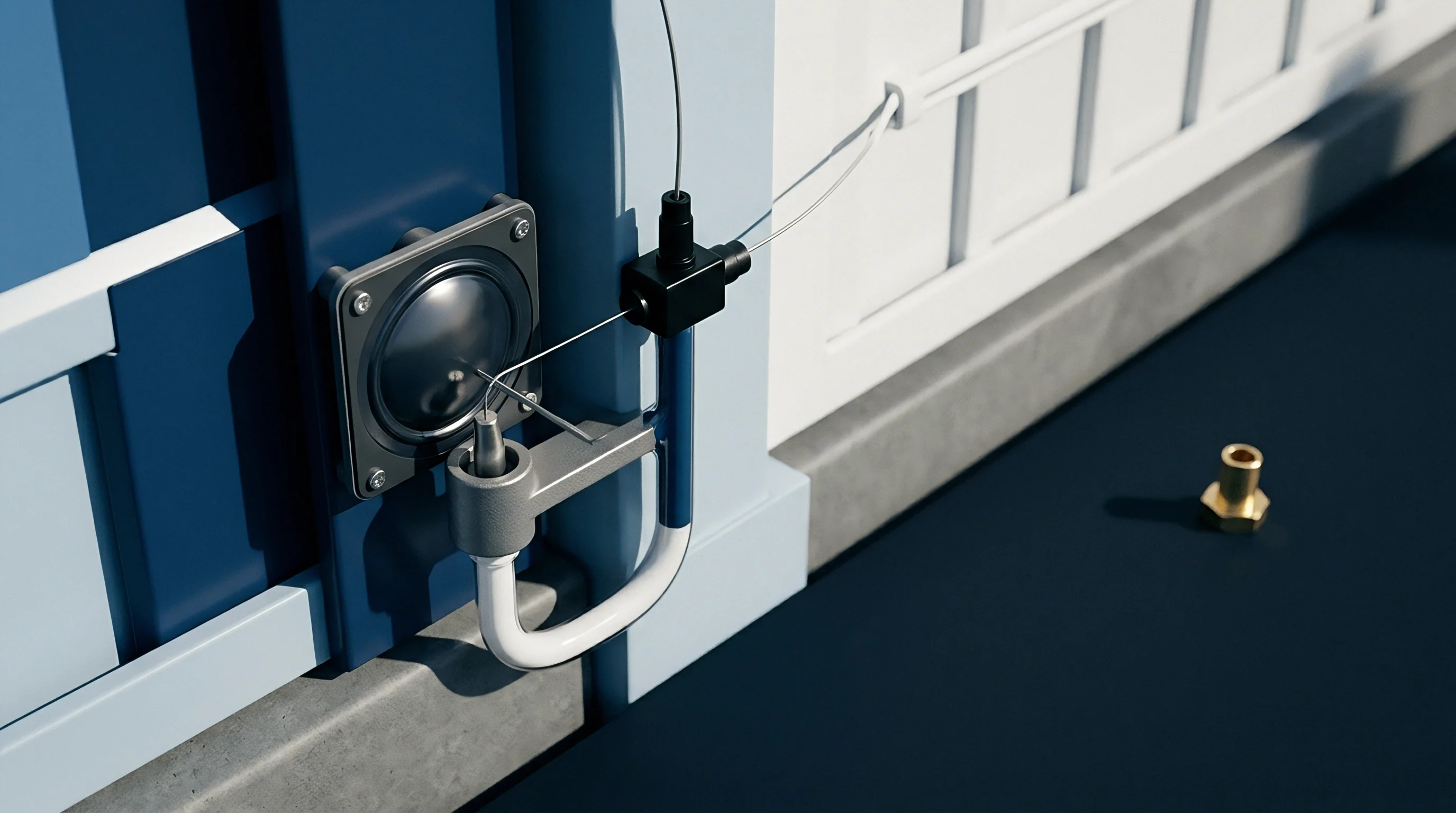
Pore Microstructure and Effective Hydraulic Radius
Ideal cylindrical tubes rarely exist in actual sealing failures. Real apertures consist of tortuous channels through expanded polytetrafluoroethylene (ePTFE) vents, voids in sintered metals, fibrous gasket intersections, or surface micro-asperity gaps along clamped rubber o-rings. Converting irregular void spaces into an effective pore radius r requires careful application of capillary flow theory.
Hydraulic radius r_h serves as the foundational parameter, defined as the ratio of cross-sectional flow area A to the wetted perimeter P:
r_h = A / P
For an ideal circular tube of diameter D, r_h equals D/4, meaning the equivalent circular radius r equals 2 r_h. For non-circular cross sections, applying the circular radius equation directly overestimates breakthrough pressure.
Capillary breakthrough across an irregular slit of width w and depth d (where w is much greater than d) demonstrates this divergence. The hydraulic radius approaches d/2. The capillary entry pressure across a parallel plate slit follows:
delta P_slit = (2 gamma cos theta) / d
Setting slit opening d equal to the diameter of a circular pore yields identical analytical forms. The physical perimeter difference alters wetting lines, contact angle pinning, and meniscal curvature across two orthogonal radii of curvature. The classical Young-Laplace relation accounts for two principal radii R_1 and R_2:
delta P = gamma (1 / R_1 + 1 / R_2)
In a long, narrow gasket leakage track, R_1 corresponds to half the gap height, while R_2 along the slit width approaches infinity. Consequently, the capillary resistance drops to exactly half of that generated by an axisymmetric circular pore whose diameter equals the gap height.
Tortuosity tau and constriction effects further modulate fluid passage. Real porous matrices consist of serial expansions and constrictions. The breakthrough pressure of a pore depends entirely on its maximum constriction point, known as the pore throat radius r_t.
Conversely, permeability and flow volume once breakthrough occurs depend on the broad pore body radius r_b and the path tortuosity:
tau = L_actual / L_straight
Mercury intrusion porosimetry (MIP) and capillary flow porometry (CFP) provide the primary empirical means for characterizing these dimensions in membrane media and cast housings.
Mercury porosimetry determines the throat dimension of the largest interconnected path, which sets the lower boundary for hydrostatic pressure resistance.
Capillary flow porometry tracks gas displacement of a wetting liquid from the porous structure according to the ASTM F316 standard. CFP generates three discrete structural metrics critical for ingress assessment:
- Bubble point diameter corresponds to the largest accessible pore throat present within the entire active area, defining the precise hydrostatic threshold where fluid first penetrates the assembly.
- Mean flow pore diameter designates the dimension at which fifty percent of the total gas volume passes through the membrane, dictating the post-breakthrough ingress rate under sustained pressure.
- Smallest pore diameter tracks the final clearance threshold where the porometer reaches gas flow saturation, indicating the baseline resistance of the densest microstructure regions.
Castings and injection moldings present random fissure defects governed by extreme value statistics. The largest pore throat controls sealing integrity. A membrane having a nominal pore size of 0.2 micrometers may carry a statistical outlier defect of 2.5 micrometers.
Under 20 kPa of hydrostatic pressure, the bulk membrane rejects water entry, but the 2.5-micrometer defect permits local breakthrough. Inspection dossiers must state maximum detected defect radii rather than averaged volumetric values.
Calculus
Worked Mathematical Derivations and Uncertainty Budgets
To demonstrate the interaction between surface tension, contact angle, and throat dimensions, consider an outdoor field sensor housing sealed with an oleophobic ePTFE venting membrane. The sensor must survive an IPX7 immersion challenge consisting of 1.0 meter of water depth for 30 minutes, followed by exposure to warm industrial washdown conditions.
Assume an ambient test temperature of 20 degrees Celsius. Pure water provides gamma = 0.0728 N/m. The housing membrane exhibits an advancing water contact angle theta = 115 degrees.
The membrane pore throat distribution has a certified maximum bubble-point radius r = 1.25 micrometers (1.25 10^-6 m). Gravitational acceleration g is 9.80665 m/s^2, and water density rho is 998.2 kg/m^3 at 20 degrees Celsius.
First, calculate the hydrostatic pressure applied at the bottom of the 1.0-meter column:
P_h = rho g h = 998.2 kg/m^3 9.80665 m/s^2 1.0 m = 9,789 Pa = 9.789 kPa
Next, determine the theoretical capillary breakthrough pressure resisting ingress:
delta P = (2 gamma cos theta) / r
cos(115 deg) = -0.4226
delta P = (2 0.0728 N/m (-0.4226)) / (1.25 10^-6 m) = -61.530 / 1.25 10^3 Pa = -49,224 Pa = -49.22 kPa
The negative sign confirms that the capillary force opposes inward water intrusion, requiring positive external pressure to force entry. The breakthrough resistance magnitude is 49.22 kPa, equivalent to 5.02 meters of clean water head. The baseline safety margin under IPX7 requirements equals 49.22 kPa / 9.79 kPa = 5.03.
Now evaluate the operational shift. The sensor is subjected to a cleaning solution containing an industrial surfactant at 45 degrees Celsius. Chemical analysis reveals gamma drops to 0.0315 N/m.
The presence of surfactant lowers the advancing contact angle on the fluoropolymer membrane to theta = 96 degrees. Thermal expansion and micro-yielding open the maximum effective defect radius to 1.60 micrometers.
Recalculate the capillary resistance:
cos(96 deg) = -0.1045
delta P = (2 0.0315 N/m (-0.1045)) / (1.60 10^-6 m) = -6.585 10^-3 / 1.60 10^-6 Pa = -4,115 Pa = -4.12 kPa
The critical ingress pressure collapses from 49.22 kPa to 4.12 kPa. Converting this to hydraulic head reveals the physical consequence:
h_critical = delta P / (rho g) = 4,115 Pa / (990.2 kg/m^3 9.80665 m/s^2) = 0.424 m = 42.4 cm
The modified assembly fails the 1.0-meter IPX7 immersion challenge. Ingress initiates spontaneously once the water column exceeds 42.4 centimeters.
| Uncertainty Parameter | Nominal Value | Standard Uncertainty u(x) | Probability Distribution | Sensitivity Coefficient c_i | Uncertainty Contribution u_i(P) |
|---|---|---|---|---|---|
| Surface Tension (gamma) | 0.0728 N/m | 0.0012 N/m | Normal | -676.16 kPa/(N/m) | 0.811 kPa |
| Contact Angle (theta) | 115.0 deg (2.007 rad) | 2.50 deg (0.0436 rad) | Rectangular | -24.58 kPa/rad | 1.072 kPa |
| Pore Radius (r) | 1.25 10^-6 m | 0.08 10^-6 m | Normal | 39.38 10^9 Pa/m | 3.150 kPa |
| Water Temperature (T) | 20.0 deg C | 1.50 deg C | Rectangular | -0.095 kPa/deg C | 0.143 kPa |
| Combined Expanded Uncertainty (U, k=2) | 6.89 kPa (Relative Expanded Uncertainty = 14.0 Percent) | ||||
The uncertainty budget reveals that pore radius tolerances dominate total measurement variance, accounting for over 70 percent of the combined uncertainty index. Surface tension and contact angle fluctuations contribute the remainder. Quality inspection protocols prioritizing nominal chemical metrics while permitting loose pore throat sorting accept massive unexplained variations in real enclosure yield.
Seam
Which Aperture Dimensions Cause Real Enclosure Failures?
Ingress failures divide sharply into three geometric regimes based on leak channel morphology. Each regime demands distinct measurement methodologies and analytical assumptions.
- Sub-micrometer membrane vents range from 0.05 to 1.0 micrometers in effective radius. These structures follow classical capillary theory precisely, displaying sharp breakthrough boundaries governed strictly by contact angle and surface tension. Viscous resistance dominates fluid entry, meaning that even when breakthrough pressure is exceeded by a slight margin, volumetric flow remains constrained to micro-liter levels over hours.
- Elastomeric joint imperfections encompass gap geometries between 1.0 and 25 micrometers. These gaps originate from mold parting lines, compression set drift, and housing wall flexure between bolt points. In this regime, slit geometry principles apply, cutting capillary resistance in half relative to circular pore assumptions. Dynamic distortion under external hydrostatic load continuously narrows or widens the gap, causing sudden snap-through fluid ingress.
- Macroscopic casting porosity and weld fissures exceed 25 micrometers in hydraulic radius. At these dimensions, capillary pressure drops below 5 kPa for clean water and below 1 kPa for washdown solutions. Surface tension becomes negligible as a sealing barrier. Flow behavior shifts immediately into gravity-driven and viscous-dominated Poiseuille channel flow, flooding the internal volume within seconds of immersion.
Dynamic gasket deflection under external hydrostatic pressure alters the critical slit dimension during testing, invalidating pre-test static leak calculations.
Contact line pinning at structural edges alters breakthrough physics in regimes one and two. Gibbs established that when a liquid meniscus reaches an abrupt geometric edge, such as the exit lip of a gasket channel or a drilled pore, the effective contact angle must advance past the intrinsic contact angle by the sharp edge exterior angle before the liquid front can physically advance. For a 90-degree internal ledge, the apparent breakthrough resistance increases substantially:
theta_apparent = theta_intrinsic + (180 deg – alpha)
The variable alpha represents the interior corner angle of the solid wall. This pinning phenomenon provides an artificial buffer in machined housings. Under vibration, thermal expansion, or pressure pulsation, pinned menisci destabilize instantly, dropping resistance back to the bulk contact angle value and permitting rapid ingress.
Internal atmospheric dynamics within sealed enclosures frequently override external capillary calculations. Enclosures are sealed at ambient assembly temperatures, typically 22 degrees Celsius, at atmospheric pressure (101.3 kPa). Operating electronics inside the housing generate waste heat, driving internal temperatures to 60 degrees Celsius.
Air escapes across semi-permeable gaskets until internal pressure equilibrates. When the unit is suddenly submerged in cold water at 10 degrees Celsius, rapid internal air cooling creates an internal vacuum:
delta P_thermal = P_initial (1 – T_cold / T_warm)
delta P_thermal = 101.3 kPa (1 – 283.15 K / 333.15 K) = 15.22 kPa
This 15.22 kPa internal vacuum adds directly to the external hydrostatic water column. A 1.0-meter immersion IPX7 test (9.8 kPa head) transforms into an effective hydrostatic challenge of 25.02 kPa. If the leak path relies on an aperture radius designed strictly against 10 kPa of hydrostatic pressure, thermal contraction pulls liquid across the interface regardless of membrane oleophobicity.
When sealing specifications overlook this thermal depression mechanism, field returns escalate during seasonal rain transitions as warm engine components plunge into road spray pools.
Qualification
Inspection Verification and Procurement Acceptance Standards
Purchasing components for high-reliability enclosures requires moving beyond unverified supplier claims regarding IP ratings. Suppliers frequently state compliance based on single prototype tests conducted in fresh, static water. Procurement engineers must demand rigorous traceable verification of the underlying physical parameters.
Incoming inspection procedures require three baseline physical audits on porous vents and prefabricated gasket assemblies:
- Capillary flow porometry verification must follow ASTM F316 procedures across three distinct manufacturing lots, establishing statistical control limits for maximum pore throat radius (bubble point) rather than mean flow porosity.
- Advancing contact angle goniometry using the sessile drop method under ISO 19403-2 must be executed across both deionized water and low-surface-tension reference test fluids (such as 30 mN/m ethanol-water mixtures) to confirm oleophobic treatment durability.
- Hydrostatic water breakthrough pressure testing per ISO 811 must be conducted using a dynamic pressure ramp rate not exceeding 10 kPa per minute, capturing the precise threshold of initial liquid weeping.
Contractual agreements must lock the test fluid chemistry explicitly. Standard clauses should define bath liquid electrical conductivity, maximum allowable dissolved surfactant concentration, and fluid surface tension limits. Stating compliance with IEC 60529 alone permits suppliers to conduct tests in unmonitored municipal water containing mineral scale that artificially bridges micro-pores and obscures underlying seal leaks.
A supplier attempting to explain field ingress in an oleophobic vent assembly typically reports that the membrane complied with bubble point specifications at shipment, suggesting that customer washdown solvents contained unapproved aggressive chemicals that degraded the contact angle post-installation.