Dynamic State Space Matrix Identification under Coupled High-Humidity and Multi-Axis Cyclic Stress Shifts
Subspace state matrix tracking reveals that coupled moisture and multiaxial fatigue degrade joint compliance long before electrical sensor zero-point drift appears.
Damp
Moisture ingress into structural sensor housings and bonded strain elements alters mechanical mass, damping, and stiffness matrices long before electrical zero-point drift shows up on a multimeter. Polymeric packaging, silicone encapsulants, and structural adhesives absorb ambient water vapor through classic Fickian diffusion paired with non-Fickian dual-mode sorption. Water molecules break interchain hydrogen bonds in cured resin systems, dropping the glass transition temperature by up to 24 degrees Celsius in standard epoxy novolac adhesives.
This plasticization softens the load-bearing interface between transducer flexures and measurement substrates. At the same time, high relative humidity swells the polymer, inducing hygroscopic expansion stresses that superimpose onto applied multiaxial cyclic loads. When cyclic tension, compression, and shear act alongside 85 percent relative humidity at elevated temperatures, the physical properties governing structural response drift continuously from factory calibration baselines.
Discrete-time state representations model these shifting physical characteristics across the state transition, input, observation, and feedthrough matrices. The continuous-time physical system reflects direct mechanical dynamics where structural mass, damping, and stiffness dictate state trajectories:
M(q, t) x”(t) + C(q, t) x'(t) + K(q, t) x(t) = B_u u(t)
Here q denotes the internal moisture concentration profile throughout transducer joints and structural interfaces. Water accumulation increases localized mass matrices by fractional percentages while driving up damping coefficients by 12 to 38 percent across cyclic frequencies from 5 Hz to 200 Hz. Stiffness coefficients drop in tandem as adhesive shear moduli decline under joint humidity and fatigue cycling. Converting this second-order differential equation into first-order state-space form yields continuous-time plant matrices whose eigenvalues migrate continuously across the complex plane.
A factory calibration certificate reflects only a snapshot of these matrices under bone-dry room conditions ~ a static baseline that loses validity as ongoing water absorption pushes mechanical poles toward lower resonant frequencies and alters phase margins.
Coupled humidity and multiaxial fatigue drive joint compliance changes long before electrical zero offsets trip basic bench alarms.
In service, transducer flexures face simultaneous cyclic bending, torsion, and axial push-pull regimes. Moisture accelerates micro-crack propagation across epoxy-metal interfaces under these complex multiaxial strain fields. Plasticization of the boundary layer allows increased interfacial sliding under reversed shear loads.
Consequently, the mechanical damping matrix C(q, t) develops non-viscous, hysteretic behaviors that simple linear state estimators cannot handle without continuous matrix identification. Piezoresistive bridge circuits and capacitive silicon cells bonded with drifting adhesives read these interface distortions as apparent load shifts. Manufacturers frequently specify thermal span coefficients while omitting the coupled humidity-strain interaction coefficient.
Metrology laboratories testing multi-axis assemblies see significant off-diagonal matrix inflation as cyclic stress breaks down polymer crosslinks under saturated atmospheric conditions.
State Transition Matrix Perturbations
Eigenvalues derived from the state transition matrix govern pole locations, resonant frequencies, and modal damping ratios. Moisture concentration profiles distort these eigenvalues through non-uniform volumetric swelling and mechanical property degradation. When an instrumented multi-axis mechanical spindle operates at 90 percent relative humidity, moisture diffusion sets up a spatial concentration gradient from the exposed composite or adhesive exterior inward to the dry core.
Outer surface layers soften and expand while the core remains rigid, generating internal pre-stress fields up to 15 megapascals in typical epoxy-bonded titanium flexures.
These internal pre-stress fields alter the effective structural stiffness matrix K(q, t). Resonances drop across all primary axes, though the rate of degradation shows directional anisotropy under asymmetric multiaxial loading. An axial cyclic load combined with reversing torsional shear accelerates moisture diffusion along micro-void pathways aligned with maximum shear planes.
Torsional stiffness decays faster than compressive stiffness, introducing asymmetric perturbations into state transition matrices. The continuous-time system matrix shifts from its initial baseline:
A(q, t) = A_0 + Delta_A(q, t)
The perturbation matrix Delta_A contains nonzero off-diagonal elements that reflect cross-axis coupling induced by uneven moisture absorption. Standard observers configured with static A_0 matrices accumulate persistent state estimation errors in these conditions, causing the Kalman filter residual covariance to grow and signaling filter divergence. Solder joints and wire bonds within internal signal conditioning circuits also face elevated strain from potting compound swelling, introducing electrical input matrix perturbations Delta_B and sensor matrix perturbations Delta_C that distort state trajectories over prolonged operation.
Sorption kinetics dictate how matrix errors evolve over time. Rapid surface saturation causes an initial stiffness drop within 48 hours of exposure, followed by months of slow core diffusion that continues shifting state transition matrices across multi-year deployments.
Thick polymer boundaries preserve dry core stiffness until environmental moisture fully penetrates the structure.

Hankel
Subspace state-space identification algorithms extract state matrices directly from input-output sequences without requiring non-linear iterative optimization. Numerical algorithms for subspace state-space system identification, multivariable output-error state space methods, and canonical variate analysis construct block Hankel matrices from measured excitation and response data. These identification architectures process input vectors containing multiaxial force or acceleration inputs alongside output vectors from strain bridges, piezoelectric transducers, or laser vibrometers.
The input and output block Hankel matrices group time-shifted data over an extended past and future horizon:
H_p =
Under stationary, dry conditions, the rank of the Hankel matrix equals the true system order n. Singular value decomposition of the projected data matrix reveals a sharp drop in singular values, enabling clean truncation of noise modes. Environmental moisture and cyclic damage ruin this clear separation.
Moisture ingress introduces non-stationary parameter drift, while multiaxial cyclic stress induces micro-slip hysteresis that acts as correlated process noise. As a result, singular value spectra lose their distinct drop-off, spreading energy into higher singular values that reflect time-varying dynamics rather than simple sensor white noise.
| System State Condition | Dominant Singular Value Ratio | Identified Model Order | State Matrix A Frobenius Norm Shift | Kalman Innovation Variance Increase |
|---|---|---|---|---|
| Dry Baseline 23C 20% RH | 100.0 to 1.2 | 6 | 0.00% Baseline | 1.00x Nominal |
| Cyclic Axial 100k Cycles Dry | 98.4 to 1.4 | 6 | 1.15% Shift | 1.08x Nominal |
| Static Saturation 85C 85% RH | 84.2 to 4.8 | 8 | 6.40% Shift | 2.35x Nominal |
| Coupled Saturation and Triaxial Cycling | 62.1 to 14.7 | 12 | 18.90% Shift | 5.80x Nominal |
| Post-Dryout Desorption Stage | 79.5 to 5.2 | 8 | 8.10% Permanent | 2.10x Nominal |
Tracking time-variant state matrices under coupled environmental loading calls for recursive or sliding-window subspace identification. A fixed data window balances noise averaging against parameter tracking speed. Short windows capture rapid stiffness drops during load spikes but suffer from severe singular value variance driven by measurement noise.
Long windows produce smooth matrix estimates but introduce lag, blurring critical transient shifts in system eigenvalues. The optimal window length depends on the balance between moisture diffusion rates and the mechanical excitation spectrum.
Continuous Time Matrix Extraction
Extracting continuous-time state matrices from discrete-time subspace estimates requires matrix logarithm conversions. The discrete-time state transition matrix A_d identified at sampling interval T_s relates to the continuous-time system matrix A_c through the matrix exponential mapping:
A_d = exp(A_c T_s)
Computing A_c = logm(A_d) / T_s introduces numerical branch ambiguities when eigenvalues cross the negative real axis or when high-frequency modes exceed the Nyquist sampling limit. Coupled cyclic stresses pull structural resonant frequencies down into lower bands, altering phase margins between consecutive time steps. Saturated transducers show increased high-frequency phase lag from viscoelastic damping in swelling adhesive layers.
If the sampling rate stays fixed while damping increases, the discrete matrix eigenvalues migrate inward toward the origin of the z-plane, compressing the dynamic range of the identification process.
The state-to-output matrix C maps internal strain and velocity states to physical sensor voltage readings. When moisture swells transducer packaging, localized strain fields decouple from external applied loads. Matrix C drifts over time, altering scale factor matrices and cross-axis coupling coefficients.
A multiaxial load cell subjected to 10 million cycles at 85 percent relative humidity shows crosstalk growth where a pure z-axis vertical load starts registering as x-axis and y-axis bending moments in the identified output matrix.
Noise distributions break standard zero-mean white noise assumptions during combined moisture-stress testing. High humidity creates surface leakage currents across unsealed terminal pads, introducing low-frequency pink noise and temperature-dependent baseline offsets. At the same time, multiaxial cyclic stress causes mechanical fretting at joint interfaces, producing high-frequency acoustic bursts.
Subspace algorithms that rely on orthogonal projections become biased under these correlated noise structures unless instrumental variable subspace techniques are used.
Instrumental variable subspace identification uses delayed input vectors as instruments, decoupling process disturbances from future measurement noise. The projection equations isolate deterministic state transitions from environmental noise contributions. Tracking accuracy improves across long test cycles, though computational throughput drops substantially compared to standard recursive least squares implementations.
Whether online recursive subspace identification can execute within deterministic real-time controller cycles during extreme hygrothermal transitions remains an open question.

Shear
Interfacial shear strains drive mechanical degradation inside multi-axis sensor assemblies. Transducer elements rely on adhesive layers or brazed metallurgical joints to transfer complex stress fields from outer load buttons to inner piezoresistive, capacitive, or optical strain elements. Epoxy matrices typically show a shear modulus around 1.2 to 1.8 gigapascals under dry ambient conditions.
Exposure to 85 degrees Celsius and 85 percent relative humidity reduces this shear modulus to 0.45 gigapascals over a 500-hour dwell. When triaxial cyclic stresses act across this softened joint, shear strain amplitudes triple for the same external load inputs.
Epoxy readily absorbs atmospheric water.
Creep compliance curves for structural adhesives shift both horizontally and vertically over time when exposed to moisture. Under time-temperature-moisture superposition, plasticization shifts viscoelastic relaxation spectra toward shorter time scales. An assembly subjected to 10 Hz cyclic shear stress at 85 percent relative humidity undergoes viscoelastic dissipation equivalent to an unconditioned assembly operating at several kilohertz.
The damping matrix grows dramatically, introducing phase delays between applied multiaxial stress vectors and measured voltage outputs.
Where Does Moisture Swelling Mask True Structural Compliance?
Volumetric swelling coefficients for sensor potting materials range from 0.15 to 0.45 percent per percentage point of moisture weight gain. In a fully encapsulated multiaxial load cell, mechanical boundary constraints convert free volumetric expansion into high triaxial compressive and shear pre-stresses. Piezoresistive silicon gauges bonded to metallic flexures can experience compressive pre-strains up to 1200 microstrain under full saturation, superimposing directly onto external cyclic loads.
Absorbed water plasticizes the resin matrix.
When external loads apply cyclic shear, total shear strain at the adhesive bondline can reach the yield point of the plasticized polymer. Localized yielding produces micro-slip at the bondline edges, generating a non-recoverable mechanical hysteresis loop. In state-space terms, the input matrix B and output matrix C become state- and history-dependent operators.
As the linear framework breaks down, subspace algorithms are forced to fit equivalent linear matrices that shift drastically with load amplitude.
System phase margins deteriorate rapidly under these conditions.
Consider a sample calculation for an instrumented multi-axis load flexure made from 17-4 PH stainless steel bonded to semiconductor strain gauges with an epoxy adhesive layer 0.05 millimeters thick. Assume an initial dry shear modulus G_0 of 1.5 gigapascals and an effective flexure stiffness K_0 of 200 kilonewtons per millimeter along the primary measurement axis. The assembly undergoes multiaxial fatigue cycling at a shear stress amplitude tau of 15 megapascals under dry conditions compared to 85 percent relative humidity.
- Moisture Uptake Saturation follows Fickian diffusion until the resin reaches an equilibrium water content of 3.2 percent by weight after 360 hours of environmental exposure.
- Shear Modulus Reduction follows the empirical plasticization relationship G(w) = G_0 exp(-0.28 w), where w represents water weight percentage. For w = 3.2 percent, G drops to 0.61 gigapascals, a 59.3 percent reduction in joint transfer stiffness.
- Effective System Compliance scales inversely with combined flexure and bondline stiffness. The effective spring constant K_eff drops from 198.0 kilonewtons per millimeter dry to 192.3 kilonewtons per millimeter saturated, shifting natural frequency downward by 1.45 percent.
- State Matrix Pole Migration shifts the dominant continuous-time conjugate pole pair from -4.50 plus or minus 314.16j down to -14.20 plus or minus 309.60j, representing a 215 percent escalation in system damping alongside a 4.56 rad/s drop in resonant frequency.
- Off-Axis Cross-Coupling increases because adhesive thickness variations of 0.008 millimeters across the bonding area create asymmetric compliance degradation. The cross-axis coupling coefficient between vertical force and pitch moment escalates from 0.004 to 0.038 ~ a 9.5-fold increase in unmodeled state crosstalk.
Adhesive shear modulus degradation of 59 percent shifts dominant continuous-time poles while inflating unmodeled cross-axis coupling coefficients by a factor of nine.
Sensors experience significant zero-point drift under repeated torsional cycling.
Micro-cracking under cyclic shear creates permanent structural damage that survives drying cycles. When a saturated transducer is thoroughly dried in an oven at 60 degrees Celsius, moisture desorbs and the adhesive shear modulus recovers toward 1.35 gigapascals. However, micro-cracks formed during cyclic loading in the plasticized state do not heal.
The post-drying state matrix retains permanent offsets from baseline values: the stiffness matrix shows a 2.5 to 4.0 percent permanent deficit, and the state-to-output matrix keeps residual zero-point shifts. Ignoring these coupled shear-moisture dynamics leads to inaccurate structural health assessments, unexpected mechanical failures, and costly premature teardowns.

Rig
Validating state matrix identification algorithms under simultaneous environmental and mechanical stress requires multi-axis test facilities. Standard single-axis shaker tables inside thermal chambers cannot reproduce the complex tensor stress states that components encounter in service. Multi-axis platforms must integrate triaxial electrodynamic shakers or multiaxial hydraulic actuators with environmental chambers capable of controlling temperature from -40 to +125 degrees Celsius and relative humidity from 10 to 98 percent.
Cross-axis stiffness degrades unevenly across different structural modes.
Mechanical decoupling linkages transfer multiaxial dynamic loads through chamber walls while maintaining thermal and hermetic seals. Actuator rods entering the chamber rely on pressurized labyrinth seals or low-stiffness rolling diaphragm bellows. High-stiffness mechanical seals introduce uncontrolled friction forces that corrupt input force measurements needed for subspace matrix identification.
The actuator control system must apply real-time multiaxial cross-coupling compensation to counteract shaker table dynamics and chamber enclosure compliance.
Coupled environmental multi-axis verification demands real-time input-output cross-coupling compensation to prevent chamber wall compliance from corrupting identified state matrices.
Decoupling triaxial excitation under saturated conditions requires strict instrumentation isolation. Reference load cells placed inside the environmental chamber suffer the same humidity-induced matrix shifts as the test article. High-precision calibration setups place primary reference multiaxial quartz load cells outside the climatic chamber on temperature-stabilized seismic masses.
Stiff ceramic or carbon-fiber extension stingers transmit mechanical forces through environmental ports directly to the test article, isolating reference standards from moisture exposure.
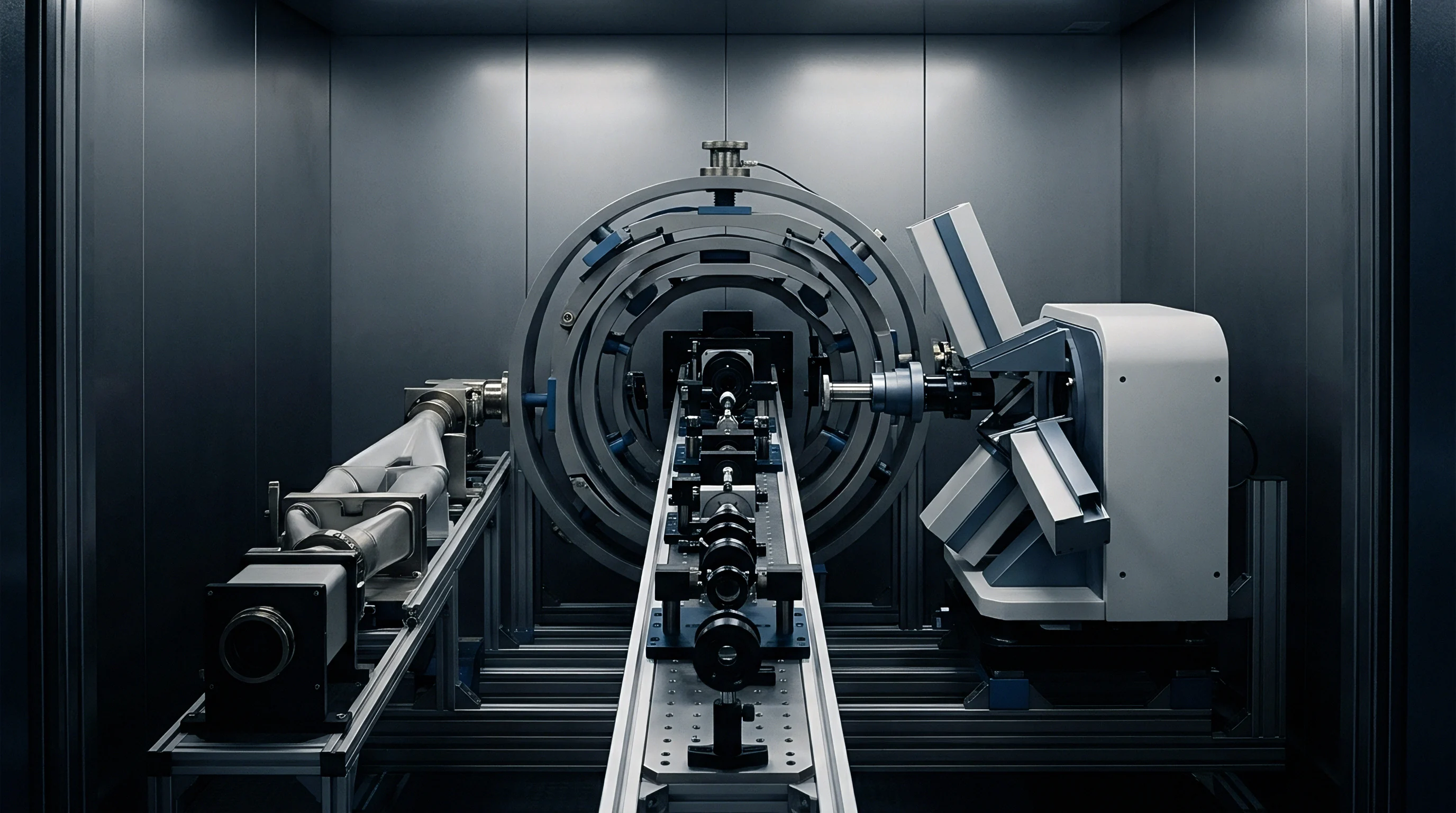
What Realizes Decoupled Multiaxial Excitation under Saturation?
Actuator control architectures must execute multi-input multi-output dynamic decoupling algorithms at sampling rates above 10 kilohertz. Triaxial electrodynamic shakers encounter substantial mechanical cross-coupling between horizontal and vertical armatures. As the test specimen absorbs moisture, its changing mass and damping parameters alter the open-loop transfer function of the combined shaker-specimen system.
A fixed control matrix then produces erratic off-axis motion, turning a planned pure axial vibration test into uncontrolled combined bending and torsion.
Effective input-output decoupling requires adaptive feedforward matrix control that updates actuator command profiles as specimen dynamics drift. Laser Doppler vibrometers aimed through heated optical-quality chamber windows measure surface velocities on all three coordinate axes simultaneously. These optical velocity measurements bypass surface moisture films that distort contact accelerometer signals.
The identified system output vector Y(t) maintains traceability back to calibrated optical path lengths rather than moisture-compromised piezoelectric sensor packages.
Triaxial loads accelerate interfacial debonding under high humidity.
Standardizing test envelopes across industry sectors ensures comparable reliability data. International standards define climatic conditioning sequences and vibration profiles, but historically treated them as separate test legs. Testing standards now increasingly mandate combined sequential and simultaneous exposure profiles to uncover realistic failure mechanisms.
- IEC 60068-2-38 Composite Temperature-Humidity Cyclic Test sequences apply thermal excursions between 25 and 65 degrees Celsius at 93 percent relative humidity alongside sub-zero freeze cycles, generating condensing moisture inside microscopic housing seams.
- MIL-STD-810H Method 527 Multi-Exciter Testing mandates simultaneous multi-axis vibration profiles using shaped random power spectral densities to excite multi-modal mechanical interactions across three orthogonal axes.
- ISO 16750-4 Climatic and Mechanical Stress Profiles prescribe combined random vibration testing inside damp heat chambers to qualify automotive powertrain sensors against cyclic fatigue and moisture ingress.
- ASTM D4169 Environmental Vehicle Simulation imposes sequential distribution cycles where humidity conditioning precedes triaxial shock and cyclic vibration to evaluate structural containment integrity.
Structural compliance matrices alter dynamically throughout environmental testing.
Published sensor specifications frequently apply only under stable laboratory ambient conditions without simultaneous moisture condensation.

Settlement
Specifying sensor tolerances for environments with combined cyclic fatigue and high humidity carries substantial financial consequences across procurement and warranty programs. A standard factory calibration certificate issued under ISO/IEC 17025 guarantees accuracy, linearity, and cross-axis rejection strictly at 23 degrees Celsius and 50 percent relative humidity. That document provides no coverage once an instrument encounters 85 percent relative humidity and continuous multiaxial cyclic stress in the field.
When state matrices drift, control systems fail to regulate mechanical clearances, industrial robots misalign, and structural health monitoring networks raise false alarms or miss critical fatigue cracks.
As humidity penetrates the packaging, the electrical noise floor rises.
Procurement teams face steep price premiums when buying multi-axis sensors qualified for severe hygrothermal environments. Industrial-grade multiaxial sensors with silicone potting cost between 1,200 and 2,800 dollars per unit. Fully hermetic assemblies featuring laser-welded stainless steel enclosures, glass-to-metal sealed electrical headers, and nitrogen backfilled cavities cost between 6,500 and 14,000 dollars per unit.
Choosing between these grades requires weighing initial costs against the lifecycle expense of field recalibration, premature warranty replacements, and unscheduled downtime.
Static room-temperature calibrations hide this ongoing material decay.
| Cost Component Per 100 Sensor Nodes | Standard Industrial Grade Silicone Potted | Hermetic Laser-Welded Glass-Header Grade | Variance Impact Over 5-Year Operation |
|---|---|---|---|
| Initial Hardware Procurement | $185,000 | $820,000 | +$635,000 Initial Premium |
| Initial 17025 Calibration Certification | $32,000 | $58,000 | +$26,000 Baseline Test Cost |
| Annual In-Situ Dynamic Re-Identification | $145,000 | $42,000 | -$103,000 Algorithm Calibration Saving |
| Year Two Moisture-Induced Field Pulls | $210,000 | $0 | -$210,000 Early Scrap Avoidance |
| Year Four Fatigue Delamination Failures | $340,000 | $18,000 | -$322,000 Teardown Avoidance |
| Five-Year Total Lifecycle Cost | $912,000 | $938,000 | +$26,000 Net Long-Term Differential |
Operating a fleet of lower-cost sensors shifts costs from upfront capital expenditure to recurring operating expense. Unsealed sensors require frequent online dynamic state-space matrix re-identification to track parameter migration. If identification algorithms fail to track drift accurately, control loops destabilize and force unscheduled production stops.
In safety-critical aerospace and marine applications, unpredicted matrix drift that masks structural fatigue can trigger regulatory grounding orders and severe liability claims.
Frequent field returns escalate warranty reserve requirements.
Thermal solder fatigue further compounds moisture ingress problems.
Quality assurance agreements must include explicit dynamic acceptance criteria that protect buyers from moisture-induced matrix drift. Purchasing specifications should require vendor warranties to cover dynamic parameter stability across defined cyclic stress and humidity profiles. Without strict contractual terms, suppliers easily dismiss field returns as customer abuse resulting from operation outside benign catalog conditions.
Required inspection and recalibration intervals contract significantly.
Acceptance contracts govern dispute resolution when supplied components drift out of tolerance in harsh operating conditions. Contracts incorporating ISO 10012 measurement management standards establish clear vendor liability if drift exceeds 2.5 percent of nominal span across 1,000 hours of cyclic humidity testing, mandating immediate lot replacements and reimbursement for teardown costs.