Dynamic Hydrostatic Pressure Decoupling Algorithms for Subsea Fiber Bragg Strain Arrays
Dynamic hydrostatic pressure decoupling isolates structural strain from fluid compression in subsea fiber Bragg arrays via multi-parameter matrix algorithms.
Matrix
Optical fiber strain sensing in subsea environments relies on separating mechanical elongation from isotropic fluid compression. When a Fiber Bragg Grating (FBG) operates in a deepwater environment, external hydrostatic pressure acts directly on the silica glass cladding, inducing volumetric compression. This compression alters both the physical grating period and the effective refractive index of the fiber core through the photoelastic effect.
The resulting wavelength shift combines axial strain, isotropic pressure, and ambient temperature shifts into a single optical value. Standard interrogation systems reading a single wavelength peak cannot differentiate between a structural load change of 50 microstrain and a hydrostatic pressure change of 3 megapascal without explicit decoupled mathematical modeling.
Coupled Optomechanical Strain Tensor Coefficients
Silica glass subjected to deepwater pressure experiences volumetric compression that modifies both physical grating pitch and core refractive index. The total fractional Bragg wavelength shift under combined mechanical strain, isotropic fluid pressure, and thermal excursion follows a coupled tensor relationship. Silica expands under tensile loads.
Hydrostatic compression alters optical refractivity. The Governing optomechanical equation expresses wavelength shift as:
delta lambda_B / lambda_B = (1 – p_e) epsilon + ( (1 – 2 nu) / E ) (1 – p_e) P + (alpha_A + zeta) delta T
In this relationship, lambda_B represents the baseline center wavelength, p_e is the effective photoelastic coefficient of the optical fiber core, epsilon is the axial structural strain, nu is the Poisson ratio of fused silica, E is the Young modulus of silica, P is the external hydrostatic pressure, alpha_A is the coefficient of thermal expansion, and zeta is the thermo-optic coefficient. For standard single-mode silica fiber (SMF-28), p_e equals 0.216, Poisson ratio nu equals 0.17, and Young modulus E equals 72 gigapascals. Under pure hydrostatic loading with zero axial strain and isothermal conditions, the pressure sensitivity coefficient yields approximately -3.0 picometers per megapascal at 1550 nanometers wavelength.
Ignoring this negative optical shift leads to massive underreporting of structural tension in submerged pipelines.
| Parameter | Physical Constant Value | Strain Sensitivity | Pressure Sensitivity | Measurement Condition |
|---|---|---|---|---|
| Effective Photoelastic Coefficient (p_e) | 0.216 dimensionless | 1.20 pm/microstrain | -0.65 pm/MPa | 23 °C, Silica Core |
| Young Modulus (E) | 72.0 GPa | N/A | -3.00 pm/MPa | Bare Fiber Immersion |
| Poisson Ratio (nu) | 0.170 dimensionless | N/A | +0.42 pm/MPa | Radial Compression Only |
| Thermo-Optic Coefficient (zeta) | 6.45 x 10^-6 K^-1 | N/A | N/A | 1550 nm Baseline Wavelength |
| Coefficient of Thermal Expansion (alpha_A) | 0.55 x 10^-6 K^-1 | N/A | N/A | Unbonded Fused Silica |

Mathematical Isolation of Hydrostatic Photoelastic Response
Decoupling algorithms resolve overlapping spectral shifts by structuring simultaneous equations across multi-grating arrays or multi-wavelength sensor nodes. By arranging sensitivity coefficients into a transfer matrix, the algorithm computes mechanical strain vector values directly from raw wavelength data. Baseline Bragg shifts obscure true deformation.
The inversion equation matrix takes the matrix structure:
=
Inverting this 3×3 transfer matrix yields the explicit structural strain component, isolating external fluid pressure effects. Accuracy hinges on matrix conditioning. High condition numbers in the sensitivity matrix amplify wavelength measurement noise, causing strain reconstruction errors to skyrocket.
If the thermal cross-sensitivity terms match strain sensitivity ratios across sensors, the determinant approaches zero, rendering the decoupling algorithm unstable under subsea temperature transients.
Encapsulating baseline optical fiber in hyperbaric capillary tubing transfers external hydrostatic load into pure radial compression.
Suppliers routinely claim that single-grating wavelength shifts under deepwater immersion reflect structural axial elongation, omitting the hydrostatic strain component from their baseline optical sensitivity reports.

Grid
Subsea sensing topologies deploy multiple fiber gratings across structural components to capture spatial deformation gradients. In deepwater risers, subsea manifolds, and flowlines, sensor arrays experience complex pressure gradients along their length. Designing a sensor node layout capable of supporting dynamic mathematical decoupling demands strategic physical orientation and isolation mechanisms.
Hardware decoupling through differential sensor construction reduces the numerical conditioning burden placed on processing algorithms.
Differential Dual-Grating Array Architecture
Pairing a bonded optical element with an unbonded reference element establishes a baseline zero-pressure reference at each sensor node. The bonded grating measures total structural strain, hydrostatic pressure compression, and temperature. The adjacent unbonded grating, housed within a miniature pressure-permeable sleeve, experiences identical hydrostatic pressure and fluid temperature without carrying mechanical structural load.
Subtracting the unbonded grating wavelength shift from the bonded grating shift removes both pressure and thermal components in real time.
The secondary grating configuration exhibits distinct operational boundaries:
- Bonded Strain Element records structural axial tension, radial Poisson contraction, fluid pressure compression, and core thermo-optic expansion.
- Unbonded Reference Element experiences isotropic hydrostatic compression and ambient temperature shifts while completely isolated from structural bending and tension.
- Capillary Enclosed Element sits within an oil-filled stainless steel housing, shielding the fiber from external hydrostatic pressure while maintaining thermal equilibrium.
- Piezoresistive Hybrid Reference combines an optical Bragg sensor with a micro-machined silicon pressure transducer to provide independent pressure inputs for real-time algorithmic correction.
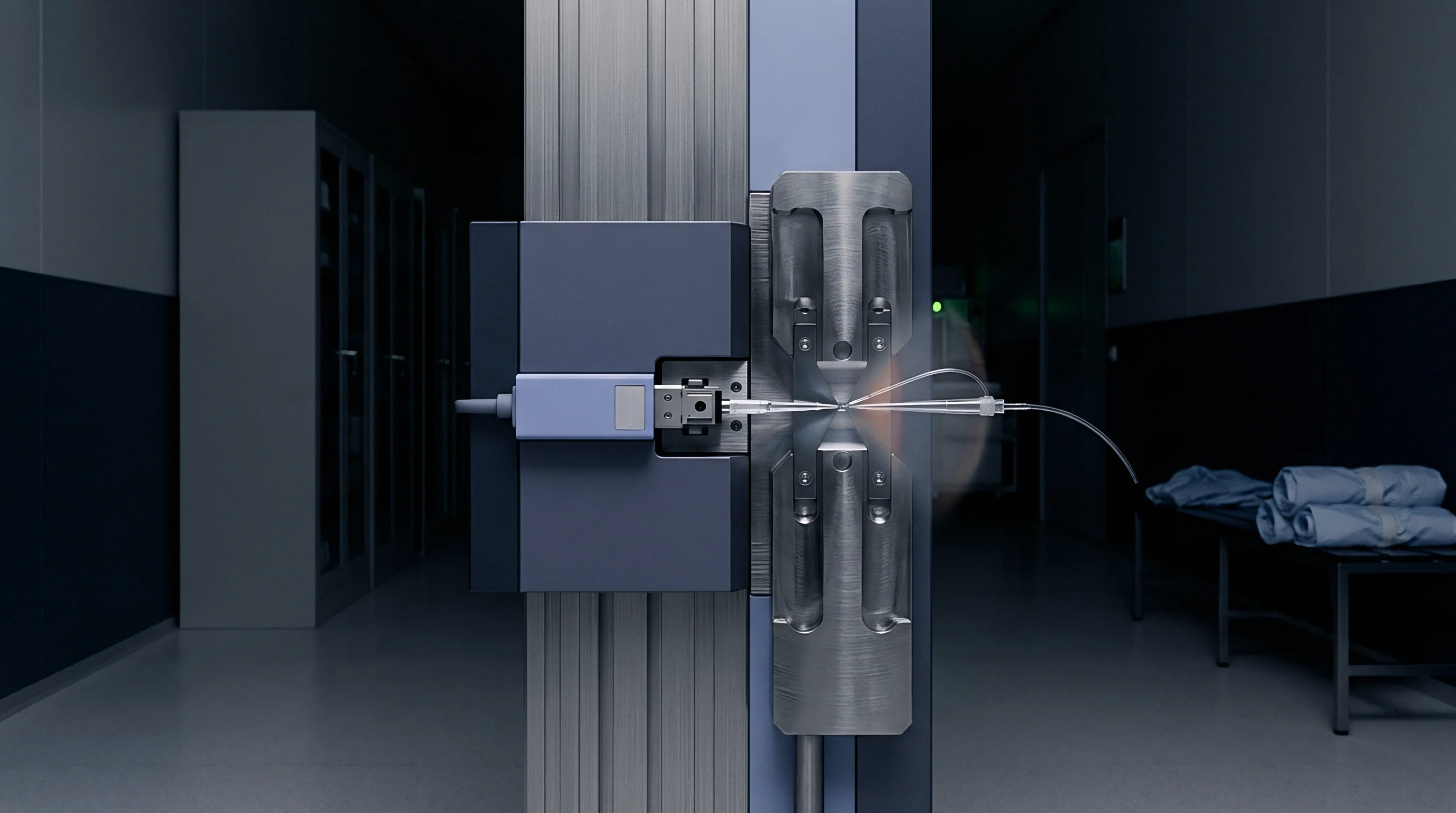
Capillary Isolation Glands and Mechanical Decoupling
Enclosing reference fibers inside fluid-filled stainless steel tubes isolates the optical glass from external fluid loads. When subsea pipe walls expand under internal pressure while simultaneously compressing under external hydrostatic head, the strain profile across the pipe wall becomes non-linear. Differential pressure sensors eliminate static offset.
Mechanical glands must seal against seawater ingress while maintaining zero friction along the sliding fiber entry port. Failure of internal grease seals allows high-pressure fluid into the capillary tube, corrupting the pressure-free optical baseline reference.
| Decoupling Topology | Strain Accuracy | Pressure Crosstalk | Response Time | Mechanical Complexity |
|---|---|---|---|---|
| Single FBG with Software Matrix Decoupling | +/- 8.5 microstrain | 0.25 microstrain/bar | < 1 ms | Low (Bare or Armored Cable) |
| Dual FBG (Bonded + Hydrostatic Reference) | +/- 2.1 microstrain | 0.04 microstrain/bar | < 1 ms | Moderate (Slotted Encapsulation) |
| Dual FBG (Bonded + Capillary Isolated) | +/- 1.2 microstrain | 0.01 microstrain/bar | 12 ms (Thermal Delay) | High (Oil-Filled Tubing) |
| Hybrid Optical FBG + Piezoresistive Transducer | +/- 1.5 microstrain | 0.02 microstrain/bar | < 5 ms | High (Subsea Electronics Pod) |
A 30 megapascal pressure shift creates a 0.15 picometer wavelength deviation in an uncompensated single-mode fiber grating at 4 degrees Celsius.
Selecting bare fiber Bragg arrays without secondary capillary sheaths forces signal processing software to resolve hydrostatic zero-drift rather than structural load changes.
Wave
Subsea risers and flowlines experience transient environmental loads from surface swell and hydrodynamic shedding. Hydrodynamic waves cause rapid hydrostatic pressure oscillations along submerged vertical risers as surface swells pass above. These dynamic pressure waves create high-frequency optical wavelength fluctuations that mimic structural vibration strains.
High-frequency algorithms process these optical signals continuously to decouple pressure transients from structural dynamic bending strains.
Can Hydrodynamic Transients Masquerade as Structural Strain?
Passage of high-amplitude ocean swells creates localized hydrostatic pressure oscillations along the water column. In 500 meters water depth, surface waves introduce dynamic hydrostatic pressure swings up to +/- 20 kilopascals at frequencies between 0.05 Hz and 0.25 Hz. Dynamic pressures disrupt structural telemetry. These pressure variations produce false strain signals of +/- 15 microstrain on uncompensated fiber Bragg sensors attached to riser walls.
If the sensor array monitors vortex-induced vibration (VIV), dynamic pressure frequencies overlap directly with lock-in structural vibration frequencies, obscuring fatigue calculations.
Adaptive Real-Time Spectral Decoupling Filters
Algorithmic extraction of mechanical signals relies on digital filtering techniques executing inside optoelectronic interrogators. Modern interrogators sample FBG arrays at rates between 1 kHz and 5 kHz. Dynamic pressure decoupling algorithms deploy Kalman state-space filtering combined with finite impulse response (FIR) bandpass arrays to isolate phase-shifted pressure transients.
Phase lag in mechanical capillary tubes degrades high-frequency dynamic correction accuracy.
- Sample optical spectrum data across all multiplexed FBG channels simultaneously at 2000 Hz.
- Extract instantaneous center peak wavelengths using Gaussian peak-tracking algorithms.
- Compute localized hydrostatic pressure estimates using designated unbonded reference optical channels.
- Apply phase-compensated transfer functions to eliminate propagation delay differences between strain and pressure channels.
- Subtract pressure-induced wavelength shifts from total strain sensor channels to output true mechanical structural strain.
ISO 13628-5 mandates that subsea structural monitoring sensors maintain calibration accuracy across transient pressure spikes up to 1.2 times maximum operating depth rating.
Whether adaptive Kalman state estimators can isolate low-frequency tidal pressure oscillations from subsea riser bending strains without requiring secondary piezoresistive reference transducers remains unresolved for deepwater deployments exceeding 2000 meters depth.


Verification
Laboratory validation of subsea strain sensor accuracy relies on controlled hyperbaric test chambers capable of simulating ocean depths down to 3000 meters. Calibrating dynamic hydrostatic decoupling algorithms requires decoupling temperature fluctuations from pressure changes during chamber pressurization. Adiabatic heating during rapid fluid pressurization raises water temperatures inside test vessels, creating combined thermal and pressure wavelength shifts that ruin static calibration coefficients if left unmeasured.

Hyperbaric Calibration Protocols and Reference Standards
Traceability demands primary piston gauges calibrated to national metrology institute standards. Hyperbaric testing protocols apply step-change pressurization profiles from 0 to 35 megapascals while holding chamber temperature within +/- 0.05 degrees Celsius using recirculating jackets. Pressure step increments of 5 megapascal reveal non-linear optomechanical hysteresis in fiber coatings.
Glass exhibits anisotropic strain response. Polyimide-coated fibers demonstrate minimal pressure hysteresis compared to soft acrylate coatings, which absorb fluid micro-compression and introduce time-dependent zero drift.
Uncertainty Budget for Decoupled Subsea Strain
Calculating combined standard uncertainty requires combining individual variance contributions according to the Guide to the Expression of Uncertainty in Measurement. Calibration drift alters subsea strain data. Main uncertainty components include interrogator wavelength repeatability, reference pressure transducer calibration uncertainty, photoelastic matrix coefficient fit errors, and thermal sensor cross-talk.
Cable tension alters Bragg center wavelengths. Thermal shifts mimic mechanical strain.
| Source of Uncertainty | Standard Uncertainty Value | Probability Distribution | Sensitivity Coefficient | Uncertainty Contribution |
|---|---|---|---|---|
| Optical Interrogator Peak Resolution | 0.10 pm | Normal (k=1) | 0.833 microstrain/pm | 0.083 microstrain |
| Reference Pressure Transducer Calibration | 0.05 bar (0.005 MPa) | Normal (k=2) | 0.250 microstrain/bar | 0.012 microstrain |
| Photoelastic Coefficient (p_e) Fit Error | 0.004 dimensionless | Rectangular | 12.5 microstrain/unit | 0.029 microstrain |
| Temperature Compensation Residual Error | 0.02 °C | Normal (k=1) | 6.80 microstrain/°C | 0.136 microstrain |
| Pressure-Induced Fiber Hysteresis | 0.15 pm equivalent | Rectangular | 0.833 microstrain/pm | 0.072 microstrain |
| Combined Expanded Uncertainty (k=2, 95% Confidence Level): +/- 0.36 microstrain at constant temperature. | ||||
Auditing array performance prior to subsea deployment requires validating four primary operational criteria:
- Hydrostatic Step Response verifies that reference channels recover zero strain baseline within 5 seconds of a 2 megapascal pressure step.
- Thermal Compensation Isolation confirms that temperature steps at constant pressure produce zero output on decoupled mechanical strain channels.
- Coating Creep Resistance measures zero-point stability under sustained 30 megapascal hyperbaric exposure over a continuous 72-hour test period.
- Interrogator Spectral Stability establishes that optical interrogator source drift remains under 0.5 picometers across the full operating ambient temperature range.
Thermal variations inside hyperbaric pressure vessels alter silica thermo-optic coefficients faster than ocean floor currents change ambient water temperatures.
Failing to account for temperature-dependent elasticity shifts during dynamic hyperbaric calibration results in structural strain errors that trigger false pipeline integrity shutdowns under normal operational wave loading.

Provision
Procurement decisions for subsea structural health monitoring systems balance hardware fabrication costs against algorithm validation expense. Installing physical mechanical decoupling glands increases sensor node manufacturing costs and cable thickness. Relying strictly on software decoupling using bare fiber arrays reduces initial procurement expenditure but increases subsea qualification liability and software validation costs.
Contract terms dictate acceptable drift margins.
Commercial Trade-Offs in Optical Subsea Array Procurement
Selecting between physical mechanical decoupling hardware and software-based signal correction defines the long-term capital expenditure profile. Field calibration carries severe vessel costs. Bare optical arrays with algorithm decoupling cost approximately $45 per meter delivered.
Capillary-enclosed dual-grating arrays cost approximately $135 per meter delivered due to micro-tubing assembly and oil-filling labor. Seal integrity governs signal clarity. For a 2000-meter subsea riser installation, physical isolation hardware adds $180,000 in direct material expense but reduces software qualification documentation by 60 percent.
Warranty Exposure and Life-Cycle Re-Calibration Costs
Contractual guarantees for subsea sensor accuracy extend across multi-year operational cycles without intermediate bench recalibration. Subsea intervention vessel day rates range from $150,000 to $350,000 per day, making field retrieval of drifting sensors commercially impossible. Decoupling algorithm failure exposes system integrators to severe warranty liabilities if false fatigue accumulation data forces premature riser decommissioning.
Procurement specifications mandate explicit performance verification clauses tied to long-term hyperbaric aging tests.
Inserting DNV-ST-F101 compliance requirements into array supply contracts forces vendors to deliver traceable hyperbaric drift test certificates covering 500 thermal pressure cycles before project delivery.