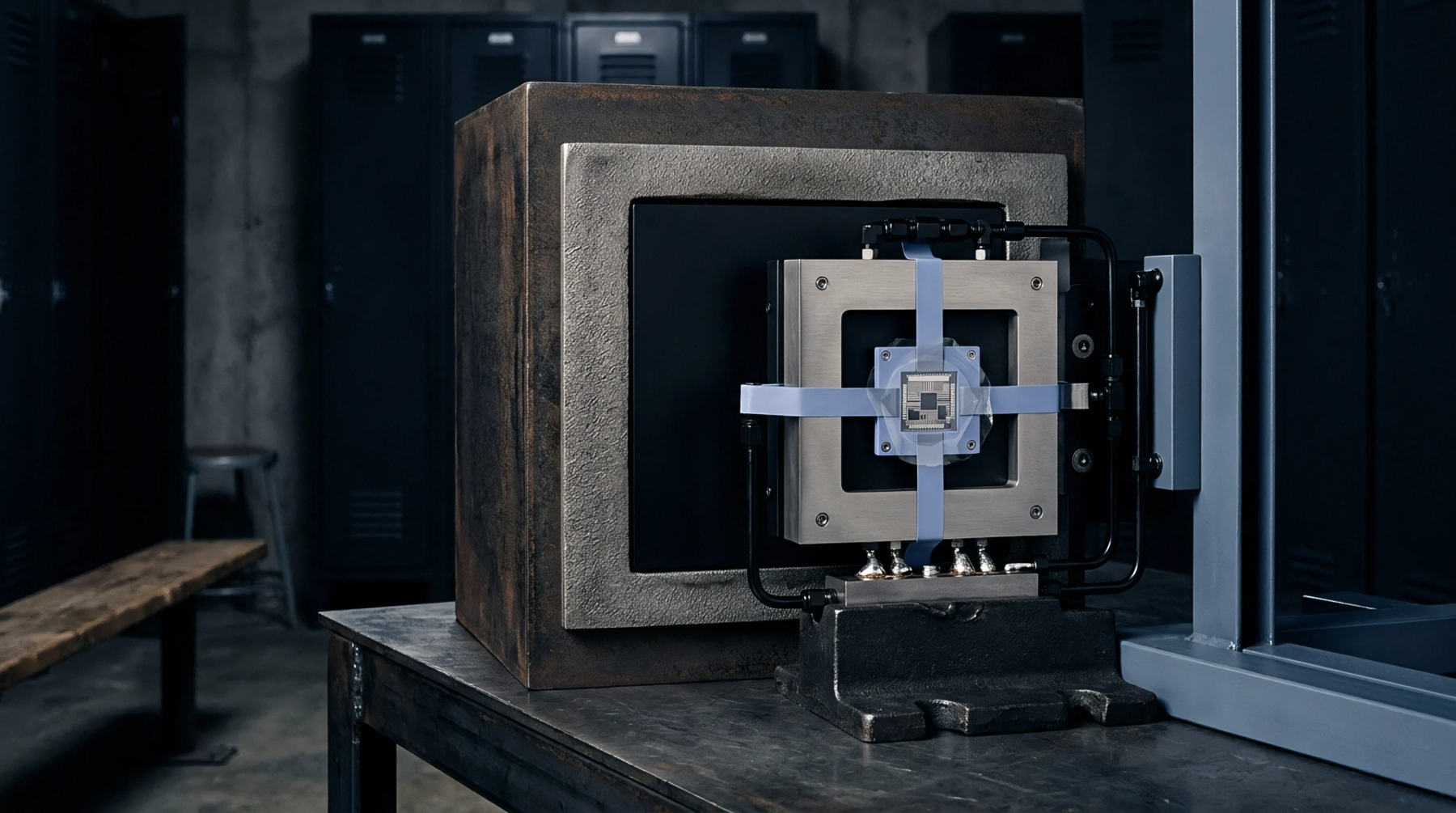
Bulk Metal Foil Resistor Drift in Precision Voltage References
Bulk metal foil divider drift in precision voltage references is driven by viscoelastic adhesive creep, demanding monolithic hermetic packaging and pre-aging.
Proportional relationships between two coupled electrical or physical parameters maintain consistency despite ambient environmental changes or component aging. In multi-element sensor bridges and precision voltage divider networks, ratio stability defines the capacity of two circuit elements to drift by identical proportional amounts, preserving their relative mathematical quotient. The measurement metric is expressed as parts per million drift over operational lifetimes or thermal ranges, distinct from absolute parameter stability.
While the individual values of the paired elements may drift substantially under mechanical or thermal strain, the ratio between them remains static if both elements track each other symmetrically. The functional boundary of the concept requires matched physical environments, failing when localized thermal gradients or asymmetric mechanical strains isolate one element from the other.
Operational accuracy in instrumentation topologies frequently depends on tracking symmetry rather than absolute value retention. When two thin-film resistors in a bridge circuit undergo identical surface oxidation, both baseline resistances increase by the exact same percentage. Because an analogue-to-digital converter measures the voltage split between them, this uniform upward drift yields zero net change in the divided output signal.
Common-mode cancellation neutralizes matched environmental variables, including ambient temperature swings, atmospheric moisture absorption, and ionizing radiation. Monolithic integration provides the physical mechanism for this performance, as adjacent resistive elements fabricated from the same metal deposition run share near-identical metallurgical structures and lattice geometries.
Characterization protocols verify performance by measuring bridge balance across environmental transition envelopes. Automated test fixtures cycle paired networks through thermal limits inside environmental chambers, recording differential voltages using high-precision ratio-metric voltmeters. The system records individual component drift along with the continuous ratio between them, deriving the tracking delta across time and temperature steps.
Sourcing engineers audit qualification matrices to ensure that testing includes mechanical board-level stress, where substrate warp threatens to induce asymmetric piezoresistive shifts between adjacent traces. Long-term life tests confirm that ratio stability exceeds individual component stability by at least an order of magnitude, proving the efficacy of internal drift cancellation mechanisms.
Asymmetric spatial effects break tracking relationships, causing the relative ratio to degrade even when using high-grade matched parts. A nearby heat source such as a power switching regulator or processor creates a directional heat path across the circuit assembly, forcing one component to operate warmer than its matched partner. Uneven trace geometry, asymmetric solder volumes, and unbalanced package pinouts induce localized mechanical stresses that selectively alter thin-film properties.
Packaging engineers enforce symmetrical circuit board layouts, placing matched sensor elements on identical thermal isotherms and routing connections with balanced copper planes. Sourcing criteria prioritize monolithic arrays over discrete component pairs whenever extreme tracking performance is required over extended operating periods. The cancellation effect ceases entirely when ambient thermal slew rates exceed the heat transfer speed between the matched elements.
Bulk metal foil divider drift in precision voltage references is driven by viscoelastic adhesive creep, demanding monolithic hermetic packaging and pre-aging.
Expertise is a utility, not a secret. sentiention™ publishes its working knowledge as open reference: intelligence layer covering the materials it sources, the markets it enters, and the reference that serves both.