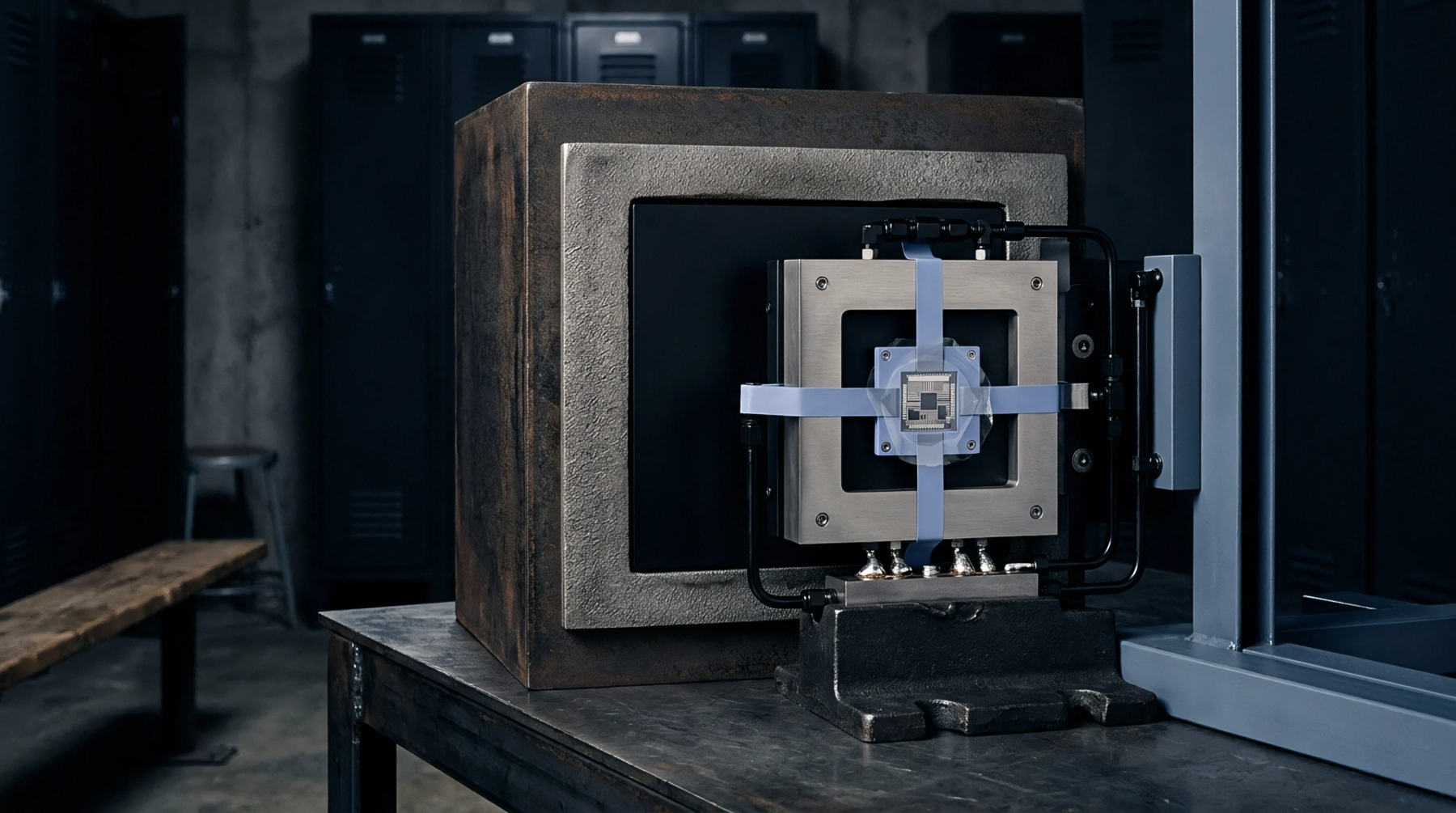
Voltage Standard
Solid-state electronic devices produce an exceptionally stable direct-current output potential regardless of ambient thermal fluctuations, supply voltage ripple, or system age. A precision voltage reference serves as the primary electrical benchmark within data acquisition hardware, digital multimeters, and analogue-to-digital converter architectures. The generated potential establishes the full-scale baseline against which all incoming analogue transducer signals are digitized and measured.
Device performance centers on minimal initial tolerance, low noise spectral density, and negligible output drift over thermal cycles. The operating boundary of the component covers low-current reference generation, requiring dedicated operational amplifier buffers whenever downstream circuits demand active drive current.
Operational Physics
Integrated circuits generate these reference potentials using subsurface Zener junctions or bandgap core topologies. Buried Zener structures operate beneath the silicon surface to minimize mechanical surface stress and contamination effects, producing exceptional long-term stability and ultralow low-frequency noise. Bandgap references leverage the predictable difference in base-emitter voltages between two bipolar transistors operated at mismatched current densities, producing a voltage with a positive temperature coefficient.
This rising voltage is summed with a standard diode junction’s negative temperature coefficient, canceling thermal sensitivity to produce a stable nominal output near one point two volts. Advanced CMOS devices replace simple junctions with curved curvature-compensation circuits to flatten residual parabolic temperature drift over broad operating ranges.
Metrological Verification
Qualification protocols subject reference devices to prolonged environmental stress testing to define operational boundaries. Technicians house test batches in thermally isolated, magnetically shielded oil baths or environmental chambers, measuring outputs with eight-and-a-half-digit digital voltmeters tied back to national metrology standards. Engineers quantify thermal stability by measuring the output over the entire operational span and calculating the temperature coefficient in parts per million per degree Celsius using the box method.
Long-term aging evaluation tracks device performance continuously across a thousand-hour interval, recording baseline output shift under settled thermal conditions. Verification testing records flicker noise within the zero point one to ten Hertz spectral bandwidth, identifying low-frequency anomalies that degrade converter resolution.
Environmental Rejection
External physical stressors distort the solid-state output unless proper layout and mechanical protections isolate the integrated circuit. Mechanical strain transferred from printed circuit board flexure alters the bandgap lattice spacing through piezoresistive effects, shifting the baseline potential. Thermal gradients across the package leads generate parasitic thermoelectric Seebeck voltages that degrade microvolt-level accuracy.
Circuit layouts mitigate these effects by placing stress-relief slots in the substrate and orienting the reference package along axes with low mechanical strain. Sourcing teams review historical drift metrics because unconditioned parts exhibit rapid initial drift that settles out only after several hundred operational hours. Output voltage stability collapses completely if supply voltages drop below the rated dropout threshold.