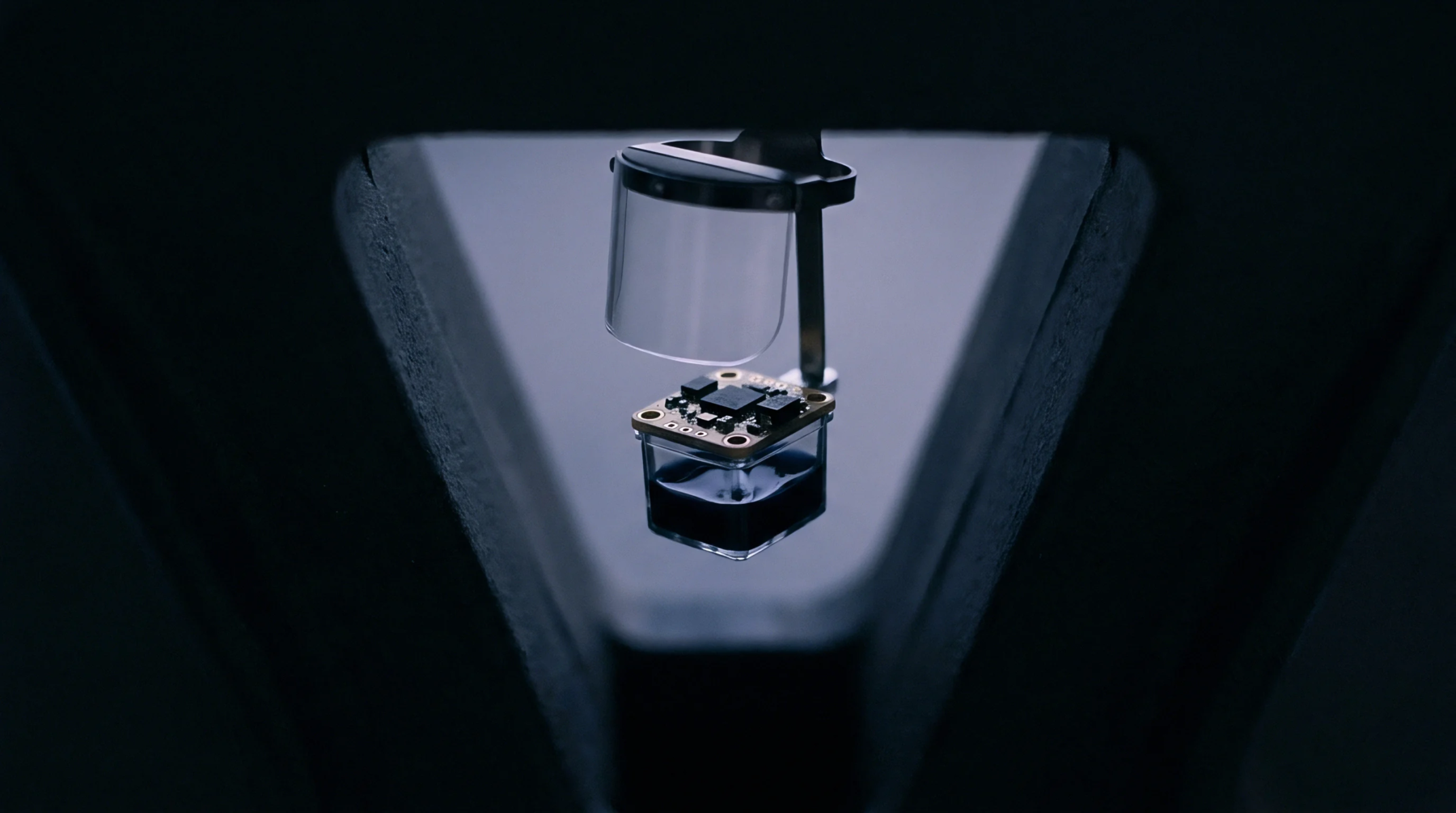
Material Deformation
Permanent strain within a solidified gold-tin or silver-tin alloy layer occurs when thermal cycling forces the die to shift against the substrate. This eutectic die attach creep represents the slow, time-dependent plastic flow of the bonding medium under elevated temperatures and sustained mechanical stress. Calibration of the shear modulus at the operational temperature limit provides the baseline for predicting how much displacement develops before the joint fails.
Thermal Load
Internal stress gradients originate from the mismatch in coefficients of thermal expansion between the silicon die and the ceramic or lead-frame base. Once the temperature cycles cross the homologous temperature of the solder, the interface experiences viscous sliding that alters the geometry of the connection. Measurements taken with high-resolution acoustic microscopy identify the voids and elongated grains that correlate with the rate of bond degradation.
Interface Physics
Grain boundary sliding dominates the movement in eutectic systems where the lead-free or tin-based metallurgy lacks the pinning phases required to lock the crystal structure. Gravity and localized vibration accelerate this gradual movement, causing the die to drift from its original alignment during long service life. Precise control over the cooling rate during the initial reflow process limits the initial defect density, which reduces the potential for propagation during the operational life of the module.
Measurement Standard
Quantifiable data regarding this movement relies on periodic cross-sectional analysis of test coupons exposed to accelerated aging protocols defined by electronic standards bodies. Monitoring the width of the bond line provides a stable verification metric for production consistency. Any deviation beyond the established mean predicts a loss of thermal conductivity or electrical integrity, marking the functional expiration of the assembly.