Real Time Kinematic Trajectory Matrix Compensation for Thermal Deformation
Dynamic trajectory matrix compensation corrects multi-axis thermal expansion in real time by coupling sensor arrays with forward kinematic transformation algorithms.

Warp
Mechanical structures in precision motion equipment expand and distort whenever internal friction or ambient surroundings alter the system thermal field. Spindle bearings, linear motor drives, and structural support casting continuously transfer heat into structural linkages during multi-axis machining operations. Linear expansion occurs at predictable rates based on material composition, such as structural steel expanding at 11.7 micrometers per meter for every degree Celsius rise in temperature.
As symmetric structural members experience localized, uneven heating, thermal gradients induce mechanical skew across critical kinematic joint interfaces. Axis displacement degrades tool positioning. These physical shifts distort the spatial geometry of the motion system, turning nominal orthogonal motion vectors into skewed position paths.
Volumetric positional error vectors combine straightness variations, pitch, roll, yaw, and translational growth into a coupled position offset. In three-dimensional motion systems, local heating near a single linear axis carriage induces angular tilt that propagates across the entire structural assembly. The positional error measured at the tool tip or sensor payload increases relative to the distance from the heat source.
Static calibration tables fail when dynamic duty cycles alter thermal distribution across structural frames.
An uncompensated structural steel frame experiences 23 micrometers of axis deviation per meter when temperature rises 2 degrees Celsius over 15 minutes.
Structural stiffness resists microstrain forces, yet material expansion forces dominate structural joints, displacing precision linear encoder scales from their zero-reference frames. Scale expansion modifies the pitch of optical ruler lines, presenting artificial position changes to the control loop. Real-time feedback loops using uncompensated position readings process spatial commands based on assumed static kinematics.
The actual mechanical tool tip follows a modified spatial curve while the encoder electronics report nominal positional compliance.
| Material Type | Expansion Coefficient (µm/m·°C) | Thermal Conductivity (W/m·K) | Volumetric Drift at 5°C Delta (µm/m) | Dominant Skew Mode |
|---|---|---|---|---|
| Structural Cast Iron (FC300) | 10.5 | 45.0 | 52.5 | Angular Pitch and Yaw Tilt |
| Structural Steel (AISI 1045) | 11.7 | 50.7 | 58.5 | Linear Axis Translation |
| Aluminum Alloy (6061-T6) | 23.0 | 167.0 | 115.0 | Rapid Asymmetric Expansion |
| Granite Base Material | 6.5 | 3.0 | 32.5 | Slow Hysteresis Thermal Gradient |
When positioning controllers ignore real-time structural growth, machining tolerances degrade beyond tight drawing limits, producing scrapped workpieces during extended high-speed production runs.

Grid
Real-time kinematic calculations rely on homogeneous transformation matrices to calculate exact position and orientation across multi-axis dynamic assemblies. Each mechanical joint contributes a local coordinate transformation step within a forward kinematics chain. When thermal fields change, elements inside these matrix structures require spatial correction factors to represent physical position variations.
Homogeneous transformation matrices concatenate translation vector offsets alongside rotational transformation matrices, mapping commanded actuator coordinates into absolute spatial end-effector positions.

Homogeneous Transformation Matrix Structuring
Kinematic matrices model physical link lengths as temperature-dependent variables. Structural temperature variations update individual vector entries within coordinate transformation calculations. Local expansion modifies spatial transformation terms in real time.
Dynamic matrix solvers apply expansion vectors directly to baseline kinematic link parameters before multiplying joint transformation chains.

Real Time Strain to Position Kinematics
Physical strain sensors and thermistor arrays map local structural distortion directly into structural correction algorithms. Real-time dynamic solvers recalculate structural matrix transformation parameters at sub-millisecond rates to ensure continuous trajectory alignment. Processing hardware transforms discrete sensor thermal inputs into spatial deviation coordinates using matrix polynomial routines.
Thermal expansion models linked to physical sensor nodes yield tighter error bounds than pure mathematical extrapolation.
- Spindle Axis Coupling offsets translation entries in the spatial transformation matrix to counteract axial growth during high-speed shaft rotation.
- Cross-Slide Angular Skew modifies rotational matrix components when asymmetric heating tilts secondary motion carriages relative to the base rail.
- Volumetric Grid Warping calculates three-dimensional position distortion factors by interpolating values across dense spatial temperature maps.
- Scale Thermal Expansion alters linear encoder scale feedback parameters within the position feedback loop to reflect changed optical grating pitch.
High-frequency spindle rotation generates asymmetric heat fields across the structural bridge. Dynamic position compensation requires updating coordinate transformation arrays faster than the mechanical structure can physically respond to heat transfer variations. If transformation calculations lag mechanical expansion dynamics, motion controllers inject artificial position steps into drive amplifiers, generating visible surface ripple on machined parts.
Drift
Sensors used to track structural thermal changes introduce temporal phase delays into matrix compensation systems. Resistance temperature detectors and optical fiber Bragg grating sensors require finite time for heat to conduct through protective sheath materials into the active sensing element. PT100 elements enclosed in stainless steel probes exhibit thermal response time constants ranging from 1.5 to 8.0 seconds depending on fluid contact and mounting compound density.
Signal acquisition chains introduce additional filtering delays, analog-to-digital conversion latency, and algorithmic smoothing lag.

How Does Conditioning Delay Corrupt Compensation Matrices?
Analog front-end electronics pass sensor signals through low-pass active filters to reject electromagnetic noise generated by pulse-width modulated motor drives. These electronic filters alter signal phase response, shifting reported temperature values backwards in time relative to actual structural events. High-resolution 24-bit delta-sigma converters running digital decimation filters trade bandwidth for resolution, introducing conversion latencies up to tens of milliseconds.
When temperature readings experience signal chain delays, matrix calculation routines compute position corrections using obsolete thermal states.

Phase Matching between Thermal and Mechanical Dynamics
Mechanical expansion proceeds continuously as heat diffuses through cast metal frames. Sampling rate limits dynamic response. If the signal acquisition chain lags thermal propagation within structural walls, calculated matrix vectors undershoot physical position shifts during heating cycles and overshoot during cooling periods.
Dynamic compensation models mandate matched bandwidth across temperature acquisition electronics, structural heat transfer models, and position loop execution units.
| Modality Type | Thermal Time Constant (t90) | ADC Latency | Signal Noise Floor | Cross-Sensitivity Factor |
|---|---|---|---|---|
| Thin-Film PT100 RTD | 2.2 s | 12.0 ms | 0.01 °C RMS | Mechanical Lead Strain |
| NTC Thermistor Die | 0.4 s | 2.5 ms | 0.005 °C RMS | Non-Linear Resistance Drift |
| Fiber Bragg Grating (FBG) | 0.05 s | 0.8 ms | 0.02 °C RMS | Transverse Fiber Strain |
| Infrared Pyrometer Module | 0.01 s | 1.1 ms | 0.10 °C RMS | Surface Emissivity Variations |
Unfiltered noise corrupts matrix determinants. Processing low-level sensor signals near high-current switching amplifiers requires isolated differential instrumentation amplifiers to preserve temperature signal integrity.
- Configure analog front-end amplifiers with matched anti-aliasing filter cutoff frequencies across all structural thermal sensing channels.
- Synchronize temperature telemetry acquisition clocks directly to motion control trajectory loop update ticks.
- Apply phase-lead compensation digital filters inside matrix preprocessing routines to compensate for physical probe conduction delays.
- Validate sensor thermal step response inside environmental chambers before embedding probes into structural castings.
Equipment vendors often claim embedded algorithms correct structural growth automatically, while concealing that temperature sampling occurs at slow multi-second intervals insufficient for rapid spindle speed changes.

Gage
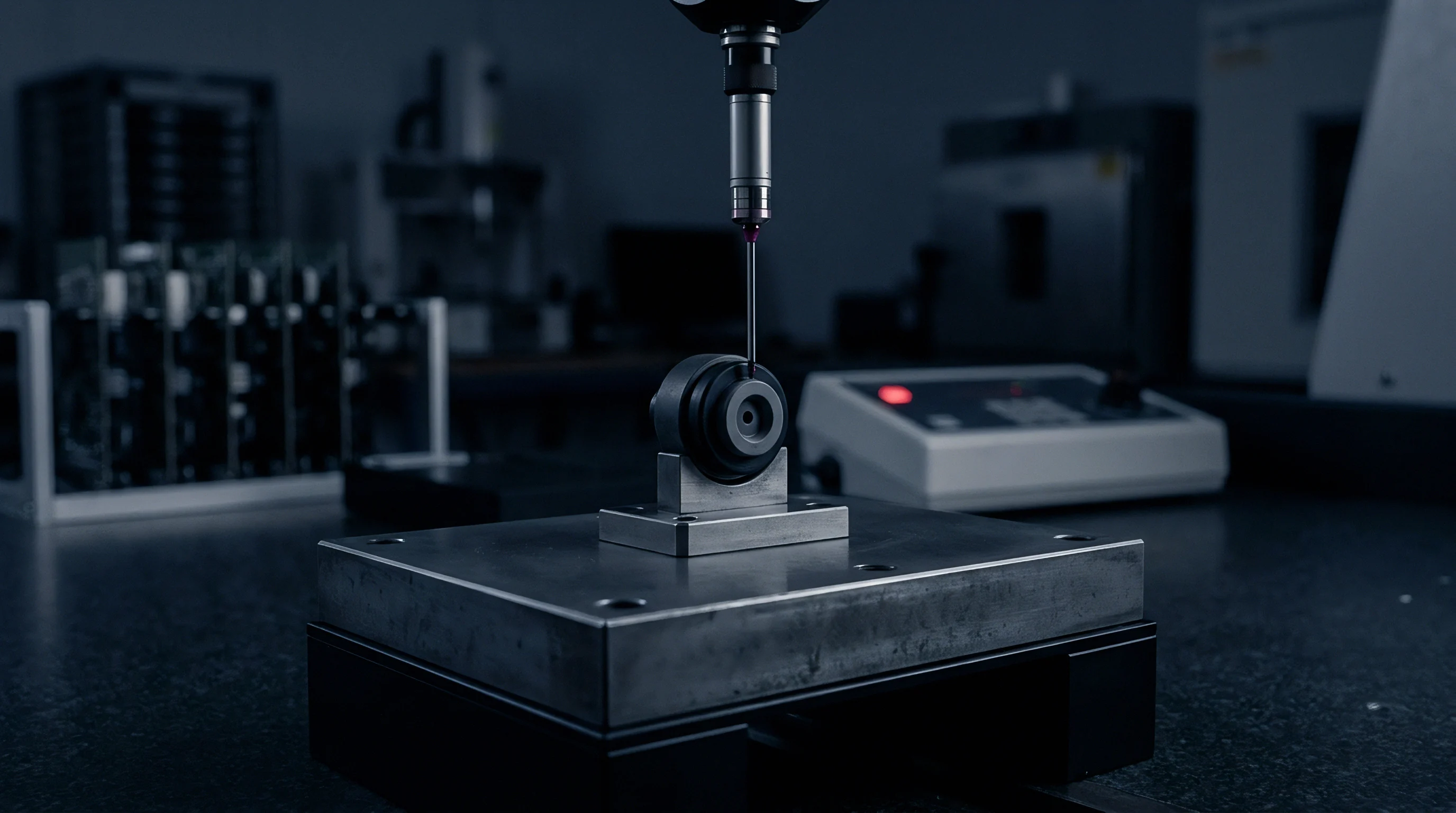
Verifying matrix compensation accuracy requires high-precision optical displacement reference equipment operated inside climate-controlled test cells. Multi-axis laser interferometers and automated tracking units establish baseline volumetric position accuracy maps across machine working envelopes. Test runs execute defined motion trajectories while external optical beams track structural retroreflectors mounted at the tool holder.
Baseline spatial data captured under cold machine conditions establishes the reference kinematic matrix against which thermal deviation paths are evaluated.
Laser Interferometer Trajectory Verification
Thermal verification runs cycle machine motion axes through high-load operating profiles to generate internal structural heating. Optical interferometers track tool-tip spatial positions while internal matrix algorithms compute real-time positional compensation corrections. Comparing optical laser position values against compensated controller position readings exposes residual matrix calculation errors.
Standard verification procedures follow ISO 230-3 guidelines, isolating environmental temperature variation effects from internal motor-driven thermal expansion.
Compliance with ISO 230-3 Clause 5.2 forces vendors to publish environmental temperature variation error figures under active motion loads.

Residual Error Budgeting and Acceptance Testing
Residual errors persist due to simplified matrix modeling assumptions, sensor placement constraints, and unmodeled localized thermal pockets. Spatial interpolation algorithms smooth out discrete temperature data, creating slight deviations from actual structural expansion profiles. Acceptance criteria define maximum allowable volumetric positioning limits across specified thermal working ranges.
- Interferometric Spatial Traceability confirms optical measurement accuracy using helium-neon laser sources calibrated against international wavelength standards.
- Environmental Isolation Logging records ambient room temperature, barometric pressure, and humidity to offset optical refractive index variations during testing.
- Thermal Chamber Profile Maps prove compensation system stability across ambient temperature variations ranging from 15 to 35 degrees Celsius.
- Volumetric Residual Certificates record maximum three-dimensional point positioning errors after matrix compensation processing.
Purchasing specifications that include standard ISO 230-3 thermal test acceptance clauses prevent delivery of motion platforms that lose precision under operational thermal loads.
Margin
Selecting components for real-time trajectory matrix compensation systems involves trade-offs between hardware cost, integration effort, and long-term component availability. Fiber Bragg Grating optical interrogators offer rapid sampling rates and immunity to electromagnetic interference, yet interrogator optoelectronic modules carry high unit prices and rely on specialized optical component suppliers. Resistance temperature detectors and thermistors utilize mature, low-cost silicon processing paths, but require multi-channel analog signal conditioning hardware that increases circuit board layout complexity.

Sensor Component Availability and Supply Architecture
Component sourcing for multi-channel temperature acquisition sub-assemblies faces supply continuity risks when relying on single-source ASIC converter ICs. Standard off-the-shelf instrumentation amplifiers and high-resolution delta-sigma ADCs from major semiconductor foundries provide alternative supply options across secondary distributors. Optical fiber sensing cables demand precise mechanical cleaving and specialty strain-decoupled mounting hardware, raising landed installation costs relative to surface-mounted electrical thermistors.
| Modality / Subsystem | Relative Unit Cost | Primary Sourcing Exposure | Lead Time Range | Second-Source Feasibility |
|---|---|---|---|---|
| Multi-Channel FBG Interrogator | High | Sole-Source Optoelectronic ICs | 16 to 24 Weeks | Difficult (Proprietary Protocols) |
| Precision RTD Acquisition Board | Medium | Standard Industrial ADCs | 6 to 10 Weeks | High (Drop-in Equivalents) |
| NTC Thermistor Harness Array | Low | Multiple Wafer Foundries | 2 to 4 Weeks | Immediate (Standard Specifications) |
| Matrix Processing DSP Module | Medium | Commercial FPGA / ARM Vendors | 8 to 12 Weeks | Moderate (Firmware Recompile) |
Landed Cost and Firmware Integration Requirements
Integrating real-time kinematic matrix algorithms into standard industrial motion controllers requires accessible DSP memory bandwidth and flexible real-time communication bus architecture. Custom firmware development costs expand when closed proprietary motion controllers force signal processing onto external co-processor hardware. EtherCAT temperature module integration simplifies wiring across structural frames, shifting signal digitizing close to sensor probes and reducing noise pick-up across long cable runs.
Optical interrogation reduces cable mass. Open real-time matrix solver libraries reduce software licensing fees while preventing supplier lock-in across production lifecycles. Engineering teams evaluate landed component costs alongside firmware maintenance demands when defining production hardware baselines.