Long Term Baseline Drift Mechanics in Uncalibrated NDIR Gas Measurement Arrays under Variable Environmental Humidity
Uncalibrated NDIR arrays drift under humidity due to line broadening, water vapor dilution, and differential interference filter degradation across channels.

Vapour
Infrared gas analysis relies on the Beer-Lambert relation, measuring radiant power attenuation across a defined optical path. Atmospheric humidity destabilizes this measurement through distinct spectroscopic and physical interactions before light reaches the photodetector. Ambient moisture content alters the transmission profile of the optical cavity across three decades of sensor operational life.
Water molecules exhibit dense rotational-vibrational absorption bands in the near-infrared and mid-infrared spectra, particularly around 2.70 micrometers and 6.27 micrometers. The wings of these absorption bands extend directly into adjacent detection windows, including the 4.26 micrometer absorption band of carbon dioxide and the 3.40 micrometer absorption band of light hydrocarbons.
Collisional line broadening governs the primary spectroscopic baseline shift in uncalibrated sensor assemblies. When polar water molecules collide with target gas molecules, dipole-dipole interactions broaden the target absorption lines significantly more than non-polar nitrogen or oxygen collisions. The self-broadening and foreign-gas broadening coefficients for water vapor exceed the nitrogen broadening coefficient by a factor of 1.35 to 1.62 across the 210 to 310 Kelvin operating range.
An uncalibrated sensor operating at 35 degrees Celsius and 85 percent relative humidity experiences an apparent increase in carbon dioxide absorbance without any physical addition of target gas. The optical bandpass filter, typically having a full-width at half-maximum of 180 nanometers, integrates these broadened spectral lines. The detected signal drops.
The conversion mathematics registers this attenuation as target gas presence.
Volumetric dilution acts concurrently with line broadening. At 40 degrees Celsius and 95 percent relative humidity, water vapor exerts a partial pressure of approximately 73.8 hectopascals in a standard 1013.25 hectopascals atmosphere. This moisture content displaces 7.28 percent of the dry atmospheric volume.
Dry mole fractions of carbon dioxide or methane drop proportionately inside the sample chamber. An ambient background of 420 parts per million drops to 389 parts per million purely through volumetric displacement by steam. Gas monitors lacking integrated barometric and absolute moisture correction report this dilution as a severe negative drift in baseline concentration.
Uncalibrated micro-arrays misinterpret these seasonal atmospheric transitions as systemic transducer decay.
Moisture broadens infrared absorption lines.
Gas density shifts alter acoustic velocities and thermal diffusion around open-path optical geometries. The convective replenishment rate of the optical cell varies with ambient humidity. Moisture changes the molar mass of the gas mixture, lowering the mixture density from 1.204 kilograms per cubic meter in dry air at 20 degrees Celsius to 1.194 kilograms per cubic meter at 90 percent saturation.
Diffusion membranes protecting the optical cell exhibit humidity-dependent permeation kinetics. Hydrophobic porous polymers slow gas exchange rates when capillary condensation forms along their sub-micron pores, inducing prolonged measurement phase lag during rapid weather fronts.
Thermal gradients between the sensor envelope and incoming air provoke micro-condensation cycles. When an unheated optical cell encounters warm, humid air following a cold night cycle, interior gas temperature drops below the dew point. Microscopic water droplets nucleate on reflective light guides.
Optical scattering replaces pure molecular absorption. Whether multi-gas arrays can distinguish between broad foreign-gas line broadening and optical channel dimming without periodic factory recalibration remains an open question across high-humidity field deployments.

Mirror
Internal gold-coated surfaces direct infrared radiation through folded optical paths to achieve functional path lengths within compact footprints. Continuous exposure to ambient humidity initiates physical and chemical degradation on these reflective layers. Industrial electroplated or sputtered gold films require an underlying adhesion layer, typically nickel, chromium, or titanium, deposited upon aluminum or copper substrates.
Water vapor molecules permeate porous boundaries in the gold matrix. Electrolytic cells form at pinholes when condensed moisture bridges the dissimilar metals. Galvanic corrosion forces the nickel or copper substrate to oxidize, pushing metallic oxides through the gold lattice to the reflective optical surface.
Reflectance values degrade rapidly under cyclic wet environments. A pristine vacuum-deposited gold surface provides 98.4 percent specular reflectance at 4.26 micrometers. Oxidation creep and microscopic surface pitting scatter incoming radiation, turning specular reflections into diffuse scattering patterns.
The absolute radiant power arriving at the active detector window declines systematically over months of operation. Signal conditioning electronics interpret this diminishing radiant flux as increased absorption, generating an unrecoverable positive baseline drift.
| Substrate and Plating Chemistry | Initial Reflectance at 4.26 µm | Reflectance at 1,000 Hours | Reflectance at 5,000 Hours | Baseline Equivalent Shift (ppm CO2) |
|---|---|---|---|---|
| Dielectric-coated Aluminum | 95.2% | 91.8% | 84.6% | +182 ppm |
| Electroless Ni Flash with Hard Au | 97.6% | 93.4% | 87.1% | +144 ppm |
| Direct Sputtered Au on Polished Cu | 98.1% | 88.2% | 76.5% | +310 ppm |
| Dual-passivated Pure Au on Glass | 98.8% | 97.9% | 96.8% | +28 ppm |
Capillary condensation inside optical cavities accelerates at low contact angles. Hydrophilic dust particles accumulating on mirror faces lower the nucleation energy for liquid water droplets. At 80 percent relative humidity, microscopic water films develop in structural scratches and plating grain boundaries.
These capillary liquid layers absorb mid-infrared radiation directly through the fundamental liquid water band centered at 3.05 micrometers, whose wide tail attenuates energy through the 4.00 micrometer reference and 4.26 micrometer active channels simultaneously.
Surface tension traps liquid beads.
Mechanical assemblies experience distinct dimensional distortions when structural plastics absorb ambient humidity. Polycarbonate, polybutylene terephthalate, and polyoxymethylene housings expand non-isotropically when saturated with moisture. Polycarbonate absorbs up to 0.35 percent water by weight, producing linear dimensional expansion exceeding 0.08 percent.
This expansion misaligns the optical axis, shifting the focused focal point of the parabolic mirror away from the active photodiode area. A lateral optical shift of twenty micrometers reduces photodiode irradiance by four to seven percent.
- Galvanic substrate pitting dissolves base copper beneath gold plating pins, producing diffuse reflectance scatter.
- Capillary meniscus absorption creates localized liquid water films that absorb infrared energy across active filter windows.
- Hydroscopic plastic creep distorts mirror focal alignments and changes physical cavity path length over operational life.
- Adhesive delamination breaks hermetic bonds around internal optical baffles, introducing corrosive ambient gases directly into dry cavities.
Moisture alters physical cavity alignment permanently. When hygroscopic creep displaces optical focus, baseline error escalates into unrecoverable systematic bias across the array, causing premature equipment replacement cycles.

Filament
Thermal infrared emitters generate radiation by heating resistive elements to operational temperatures between 400 and 800 degrees Celsius. In low-cost NDIR arrays, miniature incandescent bulbs with tungsten filaments or micromachined silicon hotplates serve as infrared sources. Surrounding gas composition governs thermal conduction from the emitter to the cavity body.
Dry air possesses a thermal conductivity of 0.0262 Watts per meter-Kelvin at 300 Kelvin, while water vapor exhibits a thermal conductivity of 0.0196 Watts per meter-Kelvin at equivalent temperature, rising non-linearly to 0.0380 Watts per meter-Kelvin at 600 Kelvin.

How Does Ambient Moisture Alter Thermal Conductivity?
Water vapor molecules entering an unsealed lamp housing or interacting with an open MEMS emitter alter conductive heat loss. At high operating temperatures, the higher specific heat capacity of triatomic water molecules enhances the convective thermal transfer coefficient away from the hot surface. The filament temperature drops when moisture levels rise under constant-voltage or constant-current drive schemes.
A filament temperature decline of only five Kelvin shifts Planck spectral radiation distribution, reducing spectral radiance at 4.26 micrometers by 1.8 percent according to Planck radiation law.
Under ambient transitions from 20 percent to 85 percent relative humidity at 25 degrees Celsius, uncalibrated tungsten filament sources register a 1.4 percent reduction in total mid-infrared emission without physical component ageing.
Pulsed thermal emitters experience altered transient heating profiles in damp environments. MEMS hotplates depend on fragile silicon nitride or silicon oxide membranes with low thermal mass to achieve pulsing frequencies of two to ten Hertz. Water vapor adsorbs onto the rear cavity walls of the micromachined membrane during inactive cooling cycles.
When re-energized, the latent heat of vaporization of adsorbed moisture delays the temperature rise time. The emitter fails to reach its equilibrium steady-state peak temperature within the preset pulsed drive window. Peak radiant emission falls short of dry baseline values.
Drive circuitry instability compounds thermal emitter decay under changing humidity. Atmospheric moisture condenses on circuit board traces, promoting surface leakage currents across high-impedance feedback resistors in constant-current drive topologies. Surface leakage paths of ten megaohms parallel to precision resistors distort driver output.
The drive stage delivers diminished current to the thermal source. Signal-to-noise ratios deteriorate as radiant output falls, forcing downstream operational amplifiers to boost baseline noise alongside optical drift.
Heated channels consume battery budget.
Glass envelopes in miniature incandescent lamps act as selective infrared absorbers. Commercial sub-miniature lamps use soda-lime or borosilicate glass envelopes that cut off transmission sharply beyond 2.7 micrometers. Uncalibrated gas arrays operate these lamps with windowless reflectors or with specialized sapphire or silicon windows glued to metal cans.
Moisture degrades the bonding polymer interfaces sealing these window plates. Ambient water vapor penetrates the lamp enclosure, accelerating tungsten wire evaporation through water-cycle oxidation. Tungsten atoms oxidize at the white-hot wire, deposit onto the colder envelope surface, release oxygen back into the envelope volume, and leave an opaque metallic film that attenuates future emission.
Component vendors dismiss the resulting baseline collapse as ordinary operating life depletion.
Dispersion
Multi-channel sensor arrays employ optical bandpass filters to isolate active analytical wavelengths from non-absorbing reference wavelengths. The reference channel, commonly centered between 3.90 and 4.00 micrometers, monitors source aging, dust accumulation, and path degradation. The active analytical channel isolates target gas bands, such as 4.26 micrometers for carbon dioxide.
Dual-channel differential processing computes the concentration ratio by comparing active transmission to reference transmission. This approach assumes both optical filters and channels degrade identically under environmental stress. This assumption fails under sustained variable humidity.
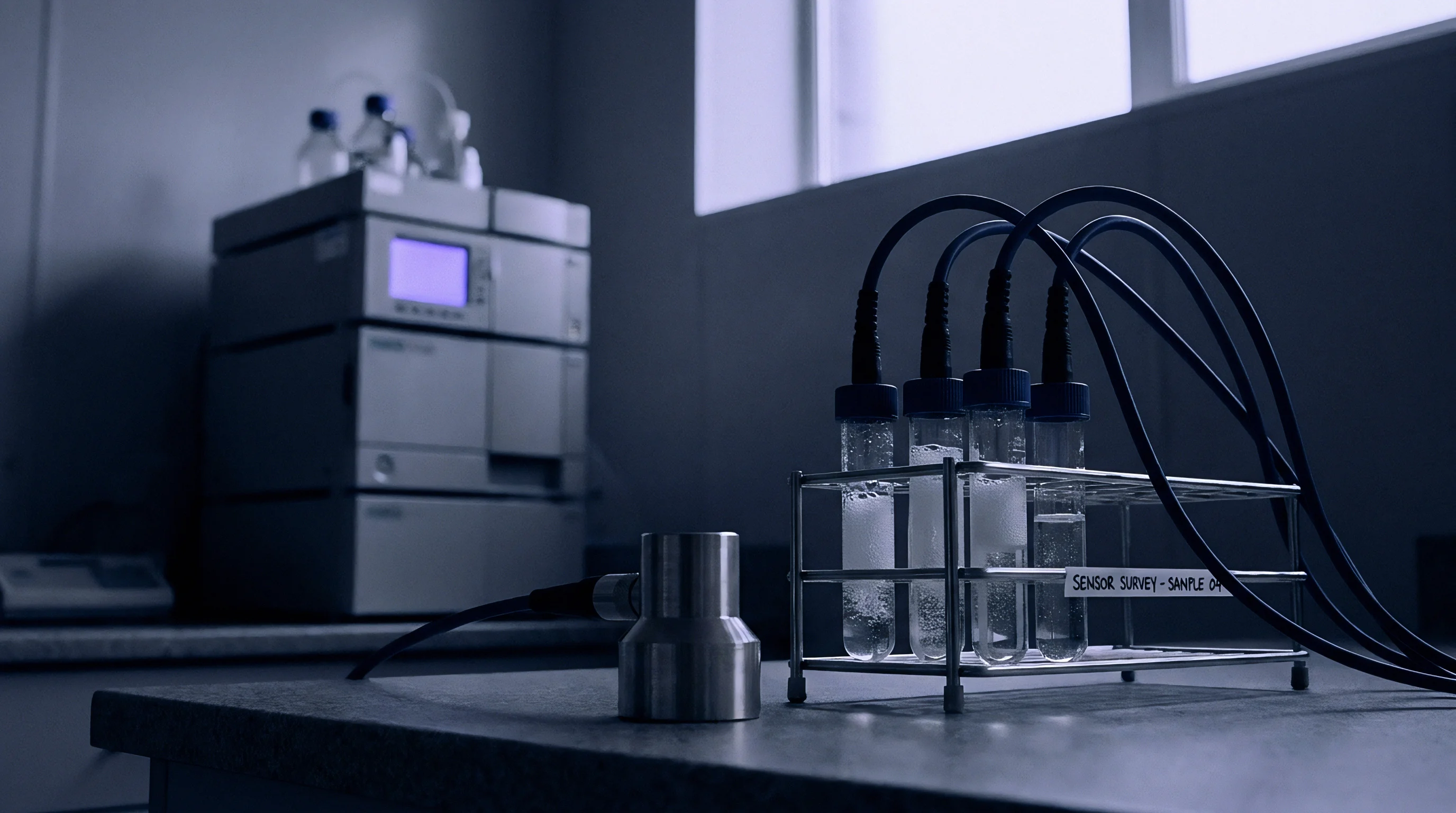
Do Matched Array Channels Prevent Baseline Divergence?
Thin-film dielectric interference filters consist of alternating quarter-wave layers of high and low refractive index materials, such as germanium and silicon dioxide or zinc sulfide. Microscopic columnar voids characterize physical vapor-deposited dielectric stacks. When ambient relative humidity swings, water molecules penetrate these porous column boundaries through capillary condensation.
Liquid water possesses a refractive index of approximately 1.33 in the near-infrared, replacing air voids having an index of 1.00. The effective optical thickness of the interference layers expands, driving the central wavelength of the transmission band toward longer wavelengths.
| Filter Channel | Nominal Center Wavelength | Center Wavelength Shift | Peak Transmission Change | Full Width Half Max Shift |
|---|---|---|---|---|
| Target (CO2 Band) | 4260 nm | +14 nm | -3.8% | +2.1 nm |
| Target (CH4 Band) | 3400 nm | +18 nm | -5.2% | +3.4 nm |
| Reference Channel | 3910 nm | +8 nm | -1.9% | +1.2 nm |
| Hydrocarbon Band | 4670 nm | +22 nm | -6.1% | +4.0 nm |
Differential central wavelength shifting shatters multi-channel baseline symmetry. Because the active and reference optical filters have different dielectric layer stacks and film thicknesses, their moisture absorption rates and refractive index shifts never match. The 4.26 micrometer active filter experiences greater center wavelength shift and transmission loss than the 3.91 micrometer reference filter.
The ratio of active-to-reference intensity drifts independently of gas concentration. Differential processing math translates this internal optical divergence into a sustained baseline error.
A contract clause mandating compliance with IEC 60068-2-78 damp heat steady-state conditioning penalizes arrays lacking hermetically brazed optical filters by disqualifying designs that drift beyond five percent full-scale.
Firmware-level baseline compensation routines exacerbate these physical divergence errors. Uncalibrated field arrays deploy Automatic Baseline Correction logic. These algorithms assume that the lowest sensor reading logged over an evaluation period of seven to fourteen days represents outdoor background air, roughly 400 to 420 parts per million for carbon dioxide.
The algorithm resets this lowest point as the baseline zero point. When persistent seasonal humidity elevates the signal baseline through optical scattering and line broadening, the minimum registered value remains artificially elevated. The algorithm recalibrates against an erroneous floor, corrupting span calibration permanently.
- Capillary moisture ingestion within optical interference layers alters local refractive indices and shifts central filter passbands.
- Channel transmission disparity breaks common-mode rejection ratios across dual-wavelength photodiode pairs.
- Firmware baseline routines lock seasonal humidity shifts into permanent non-volatile flash memory offsets.
- Signal ratio distortion triggers false alarms or suppresses genuine hazard detection thresholds across industrial networks.
Baseline errors propagate through serial output streams silently. Standard qualification protocols under DIN EN 50545-1 for toxic and combustible gases penalize uncompensated baseline drift by enforcing rejection on sensor batches exhibiting divergence across fluctuating damp heat cycles.
Desiccant
Mitigating environmental moisture mechanics demands mechanical and thermal countermeasures integrated into the sensor architecture. Passive physical separation of optical cavities from ambient water vapor prolongs operational life. Sintered polytetrafluoroethylene membranes provide hydrophobic barriers preventing liquid water ingress, meeting IP67 standards.
These porous barriers allow gaseous water vapor to equilibrate across the optical cavity over hours, leaving line broadening and volumetric dilution unaddressed. Physical exclusion of water vapor molecules requires dynamic heating or regenerative absorption barriers.
Heated optical cavities eliminate dew-point excursions entirely. Maintaining cavity walls and mirror surfaces at five to ten degrees Celsius above maximum expected ambient temperature prevents moisture condensation and surface film formation. The thermal gradient keeps internal relative humidity below forty percent even in saturated outdoor atmospheres.
Heated operation increases power consumption, demanding 150 to 500 milliwatts of continuous heater power. Battery-operated wireless gas arrays cannot support this thermal burden.
Optical cleanliness demands continuous surface temperatures remaining strictly above the local ambient dew point.
Integrated environmental co-sensing provides algorithmic compensation where thermal control is impossible. Pairing the NDIR optical array with precision capacitive relative humidity and piezoresistive barometric sensors enables real-time mathematical correction. The host processor samples temperature, relative humidity, and barometric pressure at the optical sample instant.
Polynomial correction matrices calculate instantaneous water vapor partial pressure, adjusting the active channel absorption reading for both volumetric dilution and collisional line broadening.
- Vapor partial pressure calculation translates ambient relative humidity and dry-bulb temperature into absolute moisture concentration.
- Broadening coefficient multipliers rescale apparent absorption cross-sections using empirical collision factors calibrated across temperature.
- Dilution correction scaling restores true dry gas mole fractions by normalizing against instantaneous dry atmospheric pressure.
- Hydrophobic vent integration prevents liquid droplet ingress while maintaining unimpeded gas diffusion across target paths.
Chemical desiccant cartridges absorb moisture within sealed closed-loop sampling systems. Molecular sieves with three-angstrom or four-angstrom pore diameters capture water molecules while passing smaller non-polar gas species. Desiccant beds saturate over time, demanding scheduled physical replacement.
When a chemical drying tube nears exhaustion, moisture breakthrough creates an abrupt step-change in line broadening and cavity refraction, confusing baseline tracking algorithms.
Optical cavity design dictates the fundamental susceptibility to moisture-induced baseline drift across multi-year field installations.