Characterizing Thin Film Adhesive Modulus across Broad Cryogenic Temperatures
Characterizing thin film adhesive modulus at cryogenic temperatures requires substrate compliance subtraction, temperature lag corrections, and non-contact acoustic metrology.

Transition
Cooling polymeric adhesives from ambient temperatures down to 4.2 K alters their mechanical behavior completely. At room temperature, standard structural formulations retain amorphous flexibility through micro-Brownian motion of their polymer backbones. Passing through the glass transition suppresses that long-range segmental mobility, driving the storage modulus up by as much as an order of magnitude.
Far below that primary glassy threshold, secondary beta and gamma relaxations continue to freeze or unfreeze specific side-chain motions.
Tracking storage modulus and loss tangent across this broad span marks out several distinct mechanical plateaus. Structural epoxies at 293 K typically show an elastic storage modulus between 1.5 GPa and 3.5 GPa. By 77 K, broad-scale segment movement has frozen, raising the modulus into the 6.5 GPa to 9.5 GPa range.
Cooling further to 4.2 K eliminates localized sub-glass motions, locking the polymer into a deeply vitrified state where storage modulus stabilizes between 8.0 GPa and 12.5 GPa, depending on filler loading and crosslink density.
Dynamic storage modulus of neat aromatic polyimide film reaches 8.4 GPa at 4.2 K under 1 Hz oscillatory strain.
Dynamic Modulus Evolution across Thermal Regimes
Viscoelastic response shifts non-linearly across these wide thermal declines. Mechanical energy dissipation, measured as loss tangent, produces characteristic resonance peaks during cooling sweeps as kinetic energy drops and chain relaxation times exceed the mechanical loading period. The polymer transitions from a rubbery state through a wide viscoelastic glass zone into a rigid solid.
Dynamic Mechanical Analysis monitors this phase progression by applying sinusoidal displacement and recording the resulting reaction force and phase lag.
Sub-glass relaxations govern low-temperature toughness. While the primary glass transition involves coordinated movement across forty to one hundred chain atoms, beta relaxations involve localized motions like phenyl ring flips or movements of polar pendant groups. Gamma relaxations stem from simple aliphatic segment rotations active below 150 K. Adhesives that maintain active beta pathways down to 77 K retain higher micro-yield thresholds and lower thermal shock sensitivity than networks whose secondary transitions freeze out near room temperature.
Cryogenic Hardening and Secondary Relaxation Peaks
Crosslink topology dictates how steeply modulus climbs during cooling. Highly crosslinked novolac epoxies yield sharp, narrow glass transition peaks followed by flat modulus plateaus once fully frozen. Linear polyimides and toughened siloxane blends show broader transition spans with extended loss tails.
A high crosslink density suppresses local chain motion, strengthening the elastic response while limiting plastic yield. Low-temperature embrittlement sets in as storage modulus nears its thermodynamic limit and loss modulus falls below 0.01 GPa.
| Adhesive Polymer Base | Storage Modulus at 293 K (GPa) | Storage Modulus at 77 K (GPa) | Storage Modulus at 4.2 K (GPa) | Glass Transition Range (K) | Linear CTE below 77 K (ppm/K) |
|---|---|---|---|---|---|
| Aromatic Polyimide | 3.1 ± 0.2 | 7.2 ± 0.3 | 8.8 ± 0.4 | 560 ~ 610 | 12.5 ± 1.0 |
| Toughened Bisphenol-A Epoxy | 2.4 ± 0.1 | 8.1 ± 0.4 | 10.5 ± 0.5 | 390 ~ 420 | 18.0 ± 1.5 |
| Novolac Epoxy (Unfilled) | 3.6 ± 0.2 | 9.4 ± 0.5 | 11.8 ± 0.6 | 430 ~ 460 | 22.0 ± 2.0 |
| Fluorinated Siloxane Hybrid | 0.8 ± 0.05 | 4.5 ± 0.3 | 6.1 ± 0.3 | 210 ~ 240 | 35.0 ± 3.0 |
Under vacuum, matrix shrinkage accelerates this rise in modulus. Trapped moisture or residual solvent outgasses before the cryostat reaches low operating temperatures, bringing crosslinks into closer proximity. Tensile capacity climbs alongside modulus, but critical fracture toughness falls off because chilled chains can no longer dissipate strain through shear yielding.
Cryogenic tensile testing confirms that yield strength converges directly toward ultimate tensile strength, leaving minimal plastic margin before catastrophic fracture.
Modulus growth slows below liquid nitrogen temperatures as chain configurations settle into rigid potential wells. Thermal expansion coefficients drop toward zero, stabilizing physical dimensions, so instruments require higher sensitivity to resolve fractional modulus changes between 77 K and 4.2 K. Thermal contraction in the adhesive layer during cooling also induces internal stress fields that alter baseline stiffness before external mechanical loading begins.
Loss modulus reaches its baseline minimum near liquid helium temperatures. Because high storage stiffness is paired with minimal damping, mechanical vibrations travel through bonded interfaces without attenuation. Cryogenic joint design therefore hinges on whether the adhesive keeps enough secondary relaxation modes active to relieve localized stress concentrations once thermal energy falls below the activation thresholds of internal molecular rotators.
Adhesive layers thinner than fifty micrometers cool faster and register slightly higher effective stiffness than bulk specimens. Geometric restraint by rigid metallic or ceramic substrates forces a triaxial stress state inside the film, preventing transverse Poisson contraction and artificially inflating measured axial modulus. Testing thin films without correcting for this confinement leads to mischaracterization of baseline polymer properties.
Measuring sub-glass transitions demands stable temperature steps, letting the sample reach thermal equilibrium before logging dynamic data. Fast cooling cycles induce thermal gradients across the film thickness that produce artificial modulus spikes; sweeping gradually at rates below 0.5 K per minute prevents these non-equilibrium density fluctuations.
Backbone flexibility ultimately determines whether a bond survives cryogenic thermal shock. In practice, adhesives maintaining broad secondary loss peaks below 150 K resist interfacial debonding far longer than formulations with flat sub-glass dissipation curves.
Frost
Large differences in thermal contraction between thin adhesive films and rigid substrates produce severe strain fields during deep thermal sweeps. Aluminum and copper contract linearly by 0.3 to 0.4 percent when cooled from ambient down to 4 K, whereas polymeric adhesives shrink by 1.2 to 2.5 percent over the same interval. Because the substrate prevents isotropic volume reduction, high shear and tensile stresses concentrate directly along the interface.
Interfacial shear stress tracks both film storage modulus and accumulated mismatch strain. The adhesive stiffens into its glassy state precisely as differential contraction reaches its peak, integrating temperature-dependent modulus against differential thermal expansion coefficients. That high cryogenic modulus compounds residual stress, driving interfacial cracks without any applied external load.
Strain Mismatch and Interfacial Shear Gradients
Stress in bounded thin films clusters near the free edges, where peak shear produces localized peel forces. Moving inward, shear falls off quickly, leaving a region of uniform biaxial tension across the center. Micro-cracking begins once edge shear exceeds the matrix shear yield strength at that temperature.
In thin films, this geometry converts what would be bulk cleavage fractures into interfacial delamination.
Film thickness governs the strain energy release rate. Because stored elastic strain energy scales directly with bondline thickness for a given mismatch, thinner layers store less driving force for crack growth. Films under ten micrometers withstand thermal shocks that rupture fifty-micrometer joints under identical material pairings, making strict bondline thickness control essential.
- Edge Peel Fracture concentrates shear stress along bonded boundaries where thermal expansion differentials generate perpendicular tension forces.
- Interfacial Micro-Void Micro-Cracking originates at void flaws trapped inside the adhesive film, propagating along stress contours during cooling.
- Substrate Cohesive Shearing occurs when localized joint stress exceeds the yield threshold of fragile substrate materials like silicon or fused silica.
- Cohesive Matrix Shattering occurs in un-toughened thermoset matrices when thermal strain energy exceeds the critical strain energy release rate.
Substrate compliance modifies boundary constraint intensity. Mounting an adhesive on copper imposes high differential strain due to copper’s thermal expansion profile. Bonding to fused silica or silicon produces inverted-mismatch conditions, where the polymer attempts to shrink around a near-stationary substrate.
Inverted contraction subjects the film to elevated biaxial tension, accelerating transverse void formation within matrix microstructures.
Standard ISO 22803 mandates structural adhesive bondline thickness variations remain below ten percent to prevent uncalculated stress concentrations during liquid hydrogen exposure.

Micro-Fracture Energetics and Bondline Rupture
Below glass transition thresholds, brittle fracture mechanics dictate bond integrity. Mode I fracture toughness falls as thermal energy dissipates, shrinking the plastic zone ahead of the crack tip from micrometers to nanometer scales. Strain energy release rates drop to a fraction of their room-temperature baselines, leaving the film vulnerable to nanometer-scale surface flaws and filler agglomerations.
Thermal cycling causes cumulative fatigue damage inside the vitrified matrix. Repeated excursions between room temperature and 77 K drive expansion-contraction cycles that propagate micro-cracks through internal void networks. This damage accumulation lowers overall stiffness, skewing non-destructive acoustic characterization with artificially depressed modulus readings.
Surface preparation determines how well the interface withstands this strain. Mechanical interlock features often become stress risers at sub-zero temperatures. Chemical conversion coatings or plasma treatments that form covalent bonds across the boundary resist strain-induced delamination far better than purely mechanical profiling, provided interfacial toughness exceeds stored strain energy.
Modulus measurements must account for this micro-damage accumulation. Because cracking within thin films reduces the load-bearing cross section, it lowers apparent bulk stiffness. Separating intrinsic modulus evolution from structural micro-cracking relies on combining dynamic mechanical testing with acoustic wave velocity inspections; ignoring structural micro-cracking leads to underestimating real material stiffness.
Neglecting substrate contraction gradients during dynamic testing skews calculated modulus figures, risking joint separation and catastrophic loss of mechanical isolation in cryogenic liquid containment systems.

Transduction
Measuring elastic and shear modulus profiles of thin film adhesives across wide cryogenic bands requires specialized physical transduction. Mechanical test methods developed for bulk polymers fail on films thinner than fifty micrometers. Bound to thick substrates, these thin layers require non-destructive or dynamic perturbation techniques that decouple film properties from the underlying support, all while operating inside vacuum cryostats without introducing significant parasitic heat loads.
Dynamic Mechanical Analysis, acoustic micro-resonators, laser ultrasonics, and quartz crystal microbalances represent the primary measurement options. DMA applies localized oscillatory shear or tensile forces directly to the laminate. Ultrasonic methods infer modulus parameters from the phase velocity and attenuation of acoustic waves traversing the bondline, while optical paths eliminate physical contact entirely, avoiding heat transfer into ultra-low-temperature test cells.
Where Does Dynamic Mechanical Testing Fail for Sub-Micron Adhesive Layers?
Direct mechanical loading hits fundamental limits below one micrometer. In conventional load frames, machine compliance dominates the displacement signal: fixture flex, load-cell deflection, and pushrod contraction obscure the sub-nanometer displacement amplitudes generated by ultra-thin polymer films under stress. Mechanical drive systems simply lack the force resolution needed to separate film compliance from thick substrate compliance.
Quartz Crystal Microbalance with Dissipation (QCM-D) resolves this for sub-micron adhesive coatings, providing high sensitivity in transverse shear. Piezoelectric quartz wafers resonate between 5 MHz and 35 MHz, where depositing thin adhesive films onto the electrode induces shifts in both resonance frequency and energy dissipation. Cryogenic QCM-D tracks these shifts to calculate complex shear modulus (G = G’ + i G”) without mechanical contact fixtures.
| Transduction Principle | Operational Frequency Range | Film Thickness Limits | Cryogenic Range (K) | Primary Modulus Output | Parasitic Heat Load |
|---|---|---|---|---|---|
| Dynamic Mechanical Analysis (DMA) | 0.01 Hz ~ 150 Hz | > 10 μm | 4.2 ~ 300 | Storage (E’) & Loss (E”) | High (Direct Rods) |
| Quartz Crystal Microbalance (QCM-D) | 1 MHz ~ 50 MHz | 10 nm ~ 2 μm | 10 ~ 300 | Shear Storage (G’) & Loss (G”) | Low (Coaxial Cabling) |
| Surface Acoustic Wave (SAW) | 10 MHz ~ 1 GHz | 100 nm ~ 10 μm | 1.5 ~ 300 | Rayleigh/Shear Modulus (G) | Negligible (Laser Probe) |
| Picosecond Laser Acoustics (PLA) | 1 GHz ~ 100 GHz | 5 nm ~ 1 μm | 2.0 ~ 300 | Longitudinal Modulus (C11) | Negligible (Optical Windows) |
High-Frequency Acoustic and Resonant Sensing Modalities
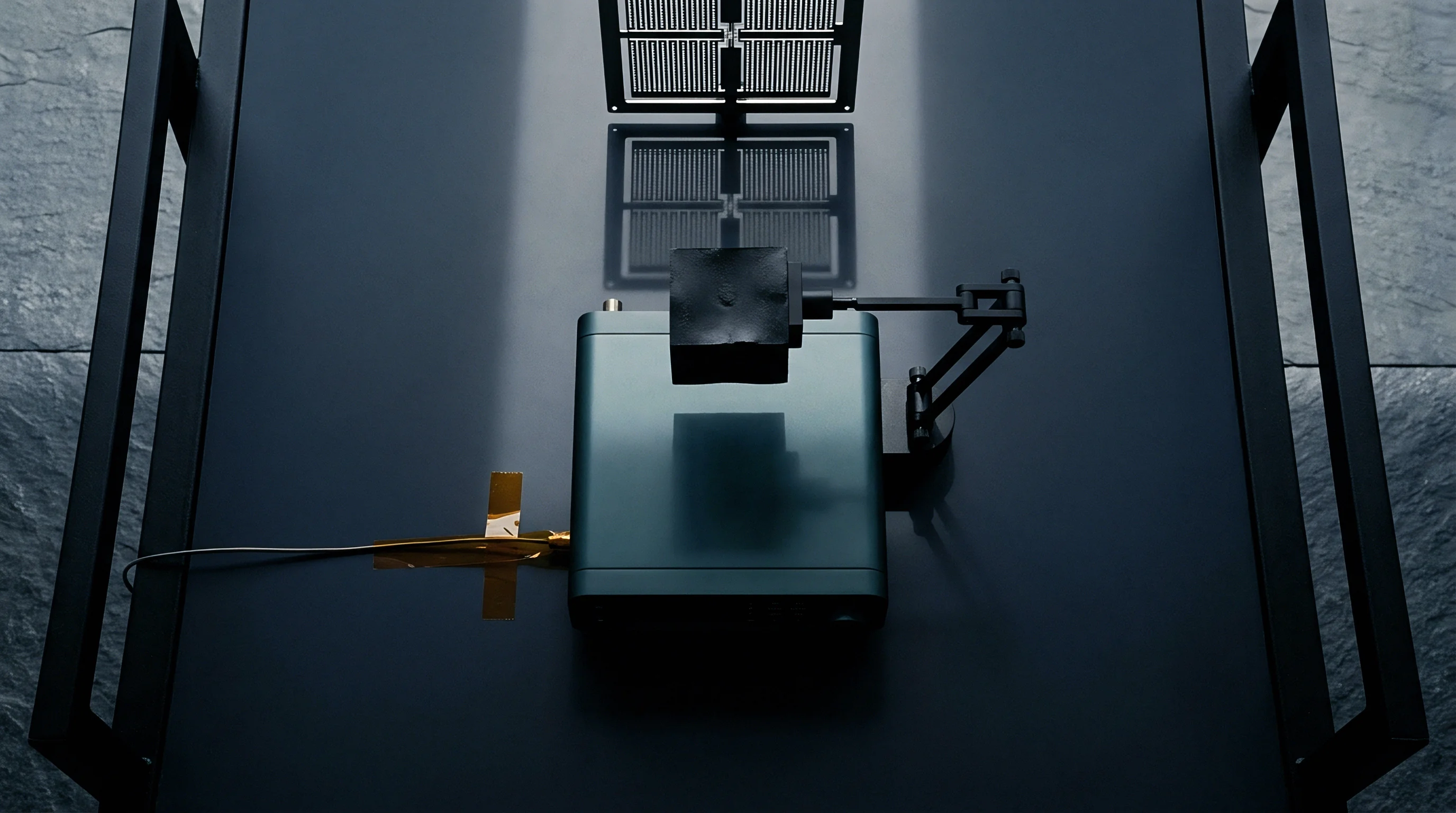
Surface Acoustic Wave sensors use interdigital transducers patterned on piezoelectric substrates to launch Rayleigh waves across thin adhesive surface layers. Acoustic wave energy remains concentrated within one wavelength of the surface. Because the acoustic penetration depth matches film thickness, phase velocity depends directly on film density and shear modulus.
Measuring wave velocity shifts during cryogenic sweeps allows continuous extraction of storage modulus evolution.
Picosecond laser ultrasonics extends non-contact acoustic testing into high frequencies. A femtosecond pump laser pulse hits an absorbing metallic transducer layer on the adhesive film, triggering transient thermoelastic expansion that launches gigahertz longitudinal acoustic waves through the layer. A probe laser detects acoustic echoes reflecting off internal interfaces by recording transit times.
Longitudinal modulus (C11) calculates directly from acoustic transit speed and material mass density.
- Sample Preparation involves depositing uniform adhesive film onto high-purity single-crystal silicon substrates using spin-coating techniques to maintain thickness variances under two percent.
- Cryostat Chamber Evacuation reduces vacuum pressure below 10-4 Pa to prevent frost condensation on optical window surfaces during liquid helium fill sequences.
- Baseline Acoustic Calibration measures signal transit times across the bare substrate at ambient temperature and liquid helium temperature to establish substrate phase reference metrics.
- Transient Optical Interferometry measures thermoelastic acoustic pulse reflections across the film thickness, logging acoustic phase velocity with picosecond temporal resolution.
- Inverse Wave Propagation Inversion extracts complex longitudinal dynamic modulus values by fitting recorded acoustic reflection profiles against viscoelastic wave equations.
Refractive index shifts under cryogenic conditions impact optical displacement sensing accuracy. Window thermal distortion in cryostats modifies laser focus alignment, introducing phase measurement errors during optical interferometry. Dual-path differential interferometers cancel window deflection artifacts by referencing probe signals against adjacent bare substrate positions, preserving resolution through deep thermal steps.
Sensors incorporating embedded piezo-polymeric elements must account for intrinsic transducer property drift. Polyvinylidene fluoride sensor films lose piezoelectric gain when cooled below 100 K, degrading signal-to-noise ratios. Single-crystal lithium niobate transducers retain stable electromechanical coupling metrics down to 2 K, making them far better suited as acoustic sources for ultra-low temperature measurement cells.
Extracting viscoelastic damping requires accurate wave attenuation recording, as signal amplitude decay maps directly to loss modulus (E”). At cryogenic temperatures, impedance mismatches often lower signal-to-noise ratios, making attenuation difficult to measure. Digital phase-locked lock-in amplifiers filter out background electrical noise, preserving microvolt transducer outputs for dissipation loss extraction.
Observed shifts in acoustic wave velocity at liquid helium temperatures do not stem primarily from substrate contraction; free-standing membrane resonators confirm that polymer modulus climbs by up to three hundred percent while substrate dimensions remain essentially unchanged.

Metrology
Extracting intrinsic thin film modulus values from raw sensor readings requires rigorous mathematical corrections for substrate compliance and geometric boundary restraints. Measured displacement in a film-substrate laminate represents the combined deflection of both layers under load. Substrates possess finite elasticity; even high-stiffness materials like silicon or aluminum deform under concentrated shear or normal loads.
Failing to decouple substrate deformation yields apparent adhesive modulus figures far lower than true intrinsic properties.
White’s thin film approximation provides an analytical compliance subtraction framework. Total measured compliance equals adhesive layer compliance plus substrate elastic compliance, which depends on contact radius, substrate Young’s modulus, and Poisson’s ratio. Calculating true adhesive film compliance requires subtracting calculated substrate compliance from gross instrument readings ~ a correction that grows larger as adhesive film thickness contracts relative to the substrate.
Substrate Compliance and Boundary Shear Corrections
Triaxial stress states complicate plane-stress elastic inversions. Thin films bonded between rigid plates cannot undergo free lateral expansion during axial compression. Constrained lateral strain generates hydrostatic stress within the adhesive matrix, inflating apparent compressive modulus toward the bulk modulus limit.
Modulus extraction routines must apply Poisson ratio corrections to isolate true uniaxial storage modulus (E’) from constrained modulus (Keff).
Temperature measurement accuracy governs material property extraction integrity inside cryostats. Cryogenic temperature sensors mounted on cold-stage copper blocks often read lower temperatures than thin film specimens mounted on insulating sub-mounts. Thermal lag between sensor and adhesive sample introduces temperature assignment errors up to 15 K during dynamic sweeps.
Calibrated platinum resistance thermometers or silicon diodes must attach directly adjacent to adhesive bondlines.
Holding periods must exceed twenty minutes per Kelvin step to keep internal specimen temperature gradients below 0.05 K during cryogenic modulus extraction.
For example, evaluating a 20-micrometer bisphenol-A epoxy adhesive film bonded between two 2-millimeter aluminum substrates in dynamic shear at 77 K recorded a gross stiffness of 0.45 kN/micrometer. Calculating from raw displacement without compliance compensation yielded an apparent film shear modulus (Gapp) of 3.2 GPa. Accounting for the substrate deformation compliance factor (Csub = 0.22 × 10⁻⁶ m/N) revealed that aluminum deflection accounted for nearly thirty percent of total system displacement.
Correcting for substrate shear compliance and lateral boundary constraint elevated the true intrinsic shear modulus (Gfilm) to 4.5 GPa ± 0.2 GPa.
Signal processing chains must maintain high dynamic range across broad impedance variations. Cryogenic cooling increases transducer electrical impedance, altering matching network tuning. High-impedance signal paths collect electromagnetic noise generated by cryostat vacuum pumps and temperature control heaters.
Preamplification stages situated inside cryostats at intermediate temperature nodes shorten high-impedance cabling lengths, lowering noise floors to preserve acoustic amplitude resolution.
Thermal Lag and Temperature Sensing Signal Chains
Thermal radiation through cryostat sight glass ports introduces localized heating on thin film sample surfaces. Unfiltered infrared radiation from ambient room environments elevates sample surface temperature above nominal chamber cold-stage readings. Installing cold optical sapphire filters maintained at 77 K blocks ambient thermal radiation while transmitting optical probe beams needed for laser ultrasonics.
Radiation shield integration ensures precise sample temperature control.
Phase alignment errors inside lock-in amplifiers corrupt dynamic loss modulus measurements. High storage modulus values at 4.2 K produce phase lag angles between applied force and displacement below 0.5 degrees. Tiny phase offset calibration errors in electronic signal chains distort real loss tangent calculations, generating negative loss modulus artifacts.
Phase calibration protocols must employ pure elastic reference materials to zero signal chain phase offsets before recording dynamic polymer loss properties.
| Error Component | Physical Source | Uncorrected Impact on Modulus | Mitigation Strategy |
|---|---|---|---|
| Substrate Compliance | Substrate elastic deformation under film load | Overestimation of film compliance (-25% to -40% E’) | Analytical compliance subtraction modeling |
| Thermal Lag | Temperature difference between diode and sample | Shift in transition curves (+5 K to +15 K offset) | Direct sample-mounted diode sensors |
| Boundary Confinement | Suppressed lateral Poisson contraction | Artificial elevation of axial stiffness (+15% to +50%) | Triaxial strain correction factors |
| Phase Drift | Electronic phase shift in signal chains | Corrupted loss modulus figures (False tan δ) | Elastic baseline zeroing protocols |
Film thickness measurement errors propagate exponentially into calculated modulus parameters. Shear and flexural stiffness calculations depend on film thickness raised to the second or third power depending on testing modes. A ten percent thickness measurement error introduces up to a thirty percent error in calculated storage modulus values.
Dual-wavelength optical ellipsometry or contact profilometry must establish film thickness maps prior to mounting specimens into cryostat chambers.
Standard ASTM E2254 clause 7.2 dictates that instrument compliance calibration runs must execute across the complete temperature range using ultra-high-purity single-crystal sapphire references to eliminate temperature-dependent frame compliance shifts.


Formulation
Achieving stable adhesive modulus profiles down to deep cryogenic temperatures relies on precise polymer matrix formulation and filler engineering. Pure thermosetting resins usually undergo severe micro-cracking due to high crosslink density and cure shrinkage. Blending flexible molecular units into aromatic backbones helps retain localized ductility in sub-glass transition regimes.
Polyimide chemistry allows custom synthesis of backbones containing ether or siloxane linkages that preserve secondary relaxations at liquid nitrogen temperatures.
Particulate fillers reduce effective thermal contraction coefficients while modifying bulk complex modulus. Inorganic nanoparticles such as fused silica, alumina, or zirconium tungstate exhibit negative or extremely low thermal expansion profiles. Loading epoxy matrices with 15 to 30 volume percent nanometer-scale silica particles lowers total linear contraction from 2.0 percent down to 0.8 percent, matching aluminum substrate expansion behavior.
Particle size distribution must remain below one micrometer to prevent localized stress concentrators in sub-ten-micrometer adhesive layers.
Polymer Backbones and CTE-Matching Fillers
Matrix toughening mechanisms require phase-separated core-shell rubber nanoparticles. Traditional liquid rubbers precipitate out during cure, forming large domains that fail in thin film configurations. Core-shell rubber particles feature a crosslinked silicone or butadiene core surrounded by a hard PMMA shell.
Core-shell additives maintain distinct nanometer dispersion, providing crack deflection mechanisms at 77 K without degrading baseline glassy storage modulus parameters.
Molecular weight distribution controls pre-cure rheology and thin-film defect density. High polydisperse resins contain low molecular weight fractions that volatilize during vacuum outgassing, leaving behind sub-micrometer voids within cured film structures. Voids degrade localized modulus and act as mechanical stress concentrators under thermal shock.
High-purity single-component formulations with narrow polydispersity indices produce dense, uniform crosslink networks capable of resisting cryogenic degradation.
- Backbone Secondary Relaxation Presence verifies through dynamic dielectric or mechanical spectroscopy that energy dissipation modes remain active below 150 K.
- Sub-Micrometer Filler Size Control keeps filler particle diameters below ten percent of target bondline thickness to prevent film pinholes.
- Thermal Expansion Matching matches total integral thermal contraction of the cured adhesive to substrate materials between 293 K and 4 K.
- Low Outgassing Volatile Content guarantees total mass loss remains under 0.1 percent under vacuum conditioning per ESA PSS-01-702 guidelines.
Acceptance Protocol and Batch Consistency Verification
Batch-to-batch variation in commercial resins destabilizes cryogenic performance predictability. Minute changes in stoichiometry or catalyst concentrations shift crosslink density, moving glass transition ranges by tens of Kelvin. Dynamic mechanical acceptance testing must verify storage modulus profiles across representative samples from every resin batch.
Thermogravimetric and differential scanning calorimetry analyses confirm curing kinetics before committing materials to flight hardware assembly.
Siloxane-modified polyimides combine the high heat resistance of aromatic polyimides with the flexible low-temperature performance of polysiloxanes. The siloxane blocks remain flexible at temperatures where hydrocarbon chains freeze solid, preserving lower modulus values and higher fracture energy release rates. These hybrid formulations maintain structural adhesion across extreme temperature sweeps, making them primary choices for cryogenic sensor mounting applications.
Adhesive shelf life and storage conditions impact final cured film modulus stability. Premature moisture absorption by frozen epoxy-amine premixes causes amine carbamation. Moisture contamination alters stoichiometry during cure, generating low-crosslink regions that reduce 4 K storage stiffness and increase moisture-induced outgassing rates under vacuum operating environments.
High-reliability applications demand non-destructive post-cure verification of thin film adhesive joints. Active acoustic thermography detects localized delaminations and void clusters induced by initial cryogenic proof testing. Tracking shift patterns in baseline acoustic velocity maps confirms structural integrity before hardware integration into operational cryostats.
Which fundamental chemical modification prevents the complete suppression of sub-glass beta relaxations in highly crosslinked aromatic networks below 10 K without compromising thermal vacuum stability?