Directional Property
Directional transport of charge or heat defines materials whose transfer coefficients vary with the crystallographic axis or structural alignment of the medium. Under anisotropic conductivity, transport along one spatial axis differs substantially from transport across another, governed mathematically by a second-rank tensor rather than a scalar multiplier. In sensor integration, conductive adhesives, graphite thermal spreaders and layered semiconductor substrates display this behavior deliberately to isolate lateral electrical pathways while facilitating vertical interconnection, or to route thermal fluxes away from sensitive sensing junctions.
The property ceases to apply when bulk materials possess cubic crystalline symmetry or homogeneous amorphous structures, where transport coefficients become identical in every orientation.
Tensor Verification
Verification of directional coefficients requires multi-axis steady-state or frequency-domain measurements against certified isotropic reference blocks. Longitudinal values in anisotropic films are quantified via four-point collinear probe configurations, whereas transverse values require parallel-plate capacitive or cross-plane laser flash setups. Misalignment between the sensor probe array and the orientation axis induces geometric projection errors, where the apparent measurement blends primary and secondary tensor components.
Calibration procedures verify that probe spacing and contact pressure meet manufacturer tolerances to avoid local material compression that artificially alters transverse conduction.
Packaging Consequence
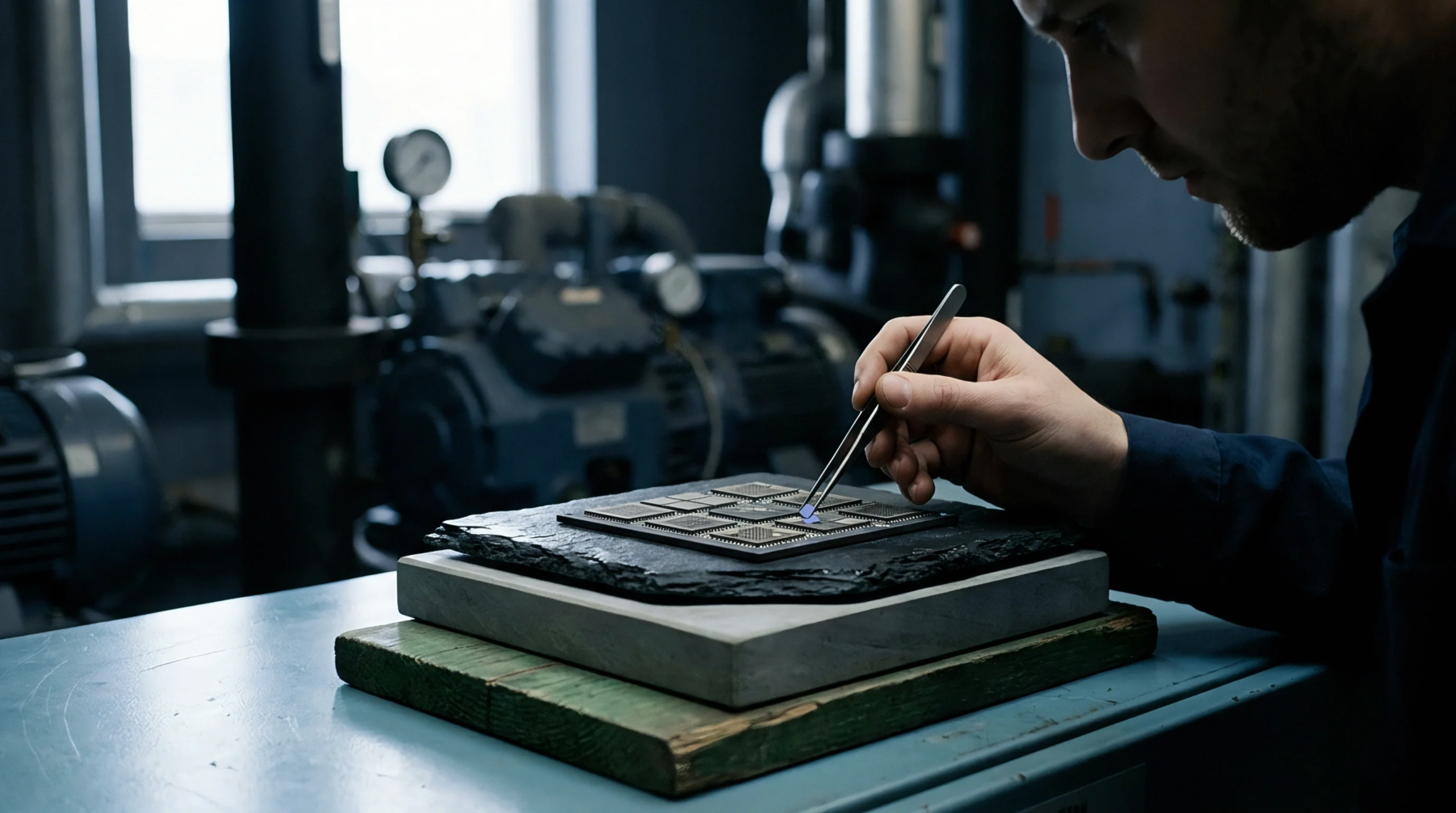
Microelectronic packaging integrates anisotropic conducting films to join fine-pitch sensor dies directly to substrate pads without creating lateral bridging short circuits. When thermal dissipation from a power-conditioning die must bypass an adjacent precision transducer, an anisotropic graphite layer channels heat along the board plane while suppressing normal conduction into the underlying layers. Non-uniform bonding pressure during thermocompression assembly causes local changes in particle percolation densities, producing uncalibrated resistance deviations.
Elevated operational temperatures can induce resin creep that relaxes compressive force, degrading z-axis conduction and introducing drift into millivolt-level transducer output signals.
Limit Condition
Extreme downscaling of interconnect dimensions introduces boundary scattering that overwhelms intrinsic anisotropic conductivity. When structural dimensions approach the mean free path of charge carriers or acoustic phonons, surface scattering mechanisms dominate bulk anisotropic tensors. Thermal cycling accelerates adhesive delamination at copper-die interfaces, transforming an intended low-resistance vertical pathway into an open circuit.
Under high-frequency signal regimes, capacitive coupling across dielectric binder gaps bypasses the directional transport mechanism entirely, nullifying the directional advantage designed into the package.