Dynamic Steam Permeation Testing for Hygienic Process Sensor Seals
Dynamic steam permeation testing verifies elastomer seal mass transport under cyclic SIP conditions to prevent moisture-induced sensor drift and cavity failure.
Ingress
A piezoresistive pressure transmitter installed on a clean-in-place dairy separator line registers zero-point output shift within forty operating cycles. The instrument casing shows zero external leakage, the diaphragm shows no mechanical denting, and the helium leak detector records background rates below 10-9 mbar·l/s at ambient temperature. Disassembly of the sensor neck reveals liquid water pooled directly behind the rear isolator seal, shorting the bridge excitation traces and producing an unrecoverable 4.2 percent span deviation.
Static vacuum leak checks pass while the instrument fails under live process conditions. High-temperature saturated steam behaves under thermodynamic conditions that static bench acceptance checks never replicate.
Sanitary sensor interfaces depend on elastomeric seals to isolate sensitive measurement transducers from live process media. Clean-in-place cycles drive caustic wash solutions across the seal face at 85 degrees Celsius, followed by steam-in-place sterilization reaching 121 to 135 degrees Celsius at pressures between 1.1 and 3.2 bar gauge. Elastomers exposed to pressurized saturated steam experience extreme chemical expansion, accelerated polymer chain scission, and high mass-transfer rates.
Moisture moves through the bulk polymer matrix as high-energy vapour, driven by steep chemical potential gradients that ambient helium tests fail to generate.
Cyclical steam exposure drives moisture through bulk elastomer matrices long before mechanical seal lips yield.
Transducer electronics sit in sealed internal cavities behind hygienic process diaphragms. Once steam moisture diffuses through the primary elastomer seal, vapor condenses against the colder metallic walls of the instrument interior. The accumulated moisture degrades insulation resistance between the transducer element and the housing body.
Millivolt-level bridge signals drift unpredictably. In severe cases, trapped condensate creates secondary hydrostatic pressure against the atmospheric side of the silicon strain gauge, mimicking true line pressure and distorting process measurements.
- Capacitive Bridge Shunting occurs when condensed steam forms micro-droplets across high-impedance transducer bridge resistors, forcing zero drift and elevated thermal span coefficients.
- Piezoresistive Substrate Delamination develops when trapped water vapor expands during subsequent thermal washdown phases, mechanically lifting bonded strain gauges from their silicon diaphragms.
- Galvanic Trace Corrosion accelerates inside unvented sensor housings as dissolved ions interact with copper traces and gold wire bonds under persistent moisture exposure.
- Reference Cavity Pressurization manifests in sealed-gauge transmitters when permeated vapor phase molecules cannot escape the internal housing volume, raising the baseline cavity pressure and driving downward output drift.
Procurement teams routinely buy sanitary pressure transmitters, level switches, and optical sensors carrying standard IP67 or IP69K ingress ratings under IEC 60529. These ingress tests evaluate external liquid water jets at ambient temperatures over ten-minute intervals. They tell a buyer nothing about molecular vapour transport through an elastomer seal operating under three bars of differential steam pressure at 135 degrees Celsius.
When factory qualification relies on cold static pressure checks, process facilities absorb the operational fallout through unbudgeted instrument swaps, drifting batch yields, and unscheduled plant shutdowns.

Transport
Mass transport of steam through a polymer gasket involves sorption at the upstream high-pressure interface, activated diffusion through the molecular free volume of the polymer network, and desorption at the downstream low-pressure side. The steady-state permeation flux follows Fickian diffusion relationships modified for thermodynamic activity. Steam molecules possess a kinetic diameter of 0.265 nanometers, small enough to slip through transient voids created by polymer thermal agitation.
Temperature increases raise the chain mobility of the elastomer, expanding this free volume and exponentially elevating the diffusion coefficient according to Arrhenius kinetics.
The chemical structure of the elastomer determines its baseline water vapour permeability. Non-polar elastomers like ethylene propylene diene monomer exhibit low affinity for water molecules, limiting equilibrium solubility within the polymer backbone. Polar compounds such as fluoroelastomers demonstrate different transport dynamics: while baseline gas permeability remains low at ambient conditions, fluoropolymers undergo accelerated plasticization when exposed to amine-bearing steam conditioning chemicals or elevated steam temperatures.
Perfluoroelastomers offer superior chemical resistance, yet their high glass transition temperatures and specific fluorination architectures alter diffusion rates under cyclic mechanical stress.

Why Do Thermal Pressure Transients Drive Permeation?
Static permeation models assume constant temperature, uniform pressure, and thermodynamic equilibrium. Real-world clean-in-place and steam-in-place cycles operate as violent thermodynamic transients. A rapid steam injection raises line temperature from 20 degrees Celsius to 130 degrees Celsius in under ninety seconds, spiking internal seal pressure while the transducer housing remains cold.
This establishes a transient thermal gradient across the seal cross-section alongside the chemical potential gradient.
Thermal gradients induce thermodiffusion, where volatile molecules migrate toward colder zones through the Soret effect. Condensation on the low-pressure side of the seal maintains a near-zero water vapour activity at the exit boundary, maintaining the maximum possible concentration gradient across the elastomeric barrier. Rapid depressurization cycles induce explosive decompression within the polymer matrix.
Absorbed moisture nucleates into microscopic steam pockets, micro-tearing the polymer chains and creating macroscopic pathways that permanently lower the seal diffusion resistance for subsequent thermal cycles.
Thermal expansion differences open momentary permeation pathways during rapid washdown transitions.
| Polymer Base Compound | Hardness (Shore A) | Diffusion Coefficient (cm²/s × 10⁻⁷) | Solubility Coefficient (cm³ STP / cm³·bar) | Water Vapour Permeation Rate (g·mm / m²·day) |
|---|---|---|---|---|
| EPDM (Sulphur Cured) | 70 ± 5 | 4.8 | 0.35 | 42.5 |
| EPDM (Peroxide Cured) | 75 ± 5 | 2.1 | 0.18 | 14.2 |
| FKM (Bisphenol Cured) | 75 ± 5 | 1.4 | 0.85 | 38.9 |
| FKM (Peroxide Cured) | 75 ± 5 | 0.9 | 0.62 | 21.8 |
| FFKM (Standard Grade) | 80 ± 5 | 0.4 | 0.22 | 4.1 |
| PTFE (Virgin Homopolymer) | 58 Shore D | 0.1 | 0.08 | 0.6 |
The comparative data illustrates the stark divergence between curing chemistries within identical polymer families. Peroxide-cured EPDM demonstrates a water vapour transmission rate less than half that of sulfur-cured compounds, driven by dense, direct carbon-carbon cross-links that resist hydrothermal cleavage. Bisphenol-cured FKM exhibits high steam solubility, yielding transmission rates nearly triple those of peroxide-cured EPDM under identical 130-degree saturated steam environments.
Specifying material grade by elastomer family alone leaves the permeation barrier uncontrolled.
Repeated thermal exposure shifts the glass transition temperature of saturated elastomers, moving the mechanical loss modulus peak closer to the operational cleaning temperature window.
Rig
Standardized permeation test chambers designed under ASTM E96 or ISO 15106 operate at atmospheric pressures and moderate temperatures, typically capping environmental conditions at 38 degrees Celsius and 90 percent relative humidity. These static bench methods fail to replicate the mechanical clamping loads, rapid temperature ramps, and aggressive differential steam pressures found in sanitary processing equipment. Dynamic steam permeation testing requires dedicated high-pressure test fixtures capable of simulating true hygienic clamp geometry while continuously quantifying mass transport on the downstream collection side.
The specialized test rig mounts the candidate sensor seal inside an electropolished 316L stainless steel sanitary clamp cell conforming to ASME BPE dimensions. The upstream face connects to an automated clean-in-place and steam dosing skid capable of delivering clean saturated steam up to 4 bar gauge at 145 degrees Celsius, interspersed with chilled water flushes at 4 degrees Celsius. The downstream volume consists of a hermetically sealed analytical chamber swept by an ultra-high-purity carrier gas, typically dry nitrogen or helium with moisture content below 5 parts per billion.
The sweep gas transports desorbed water molecules directly into a calibrated cavity ring-down spectrometer or an atmospheric pressure ionization mass spectrometer.
Downstream sweep cells must sustain dry baseline backgrounds below five parts per billion to resolve micro-permeation fluxes.
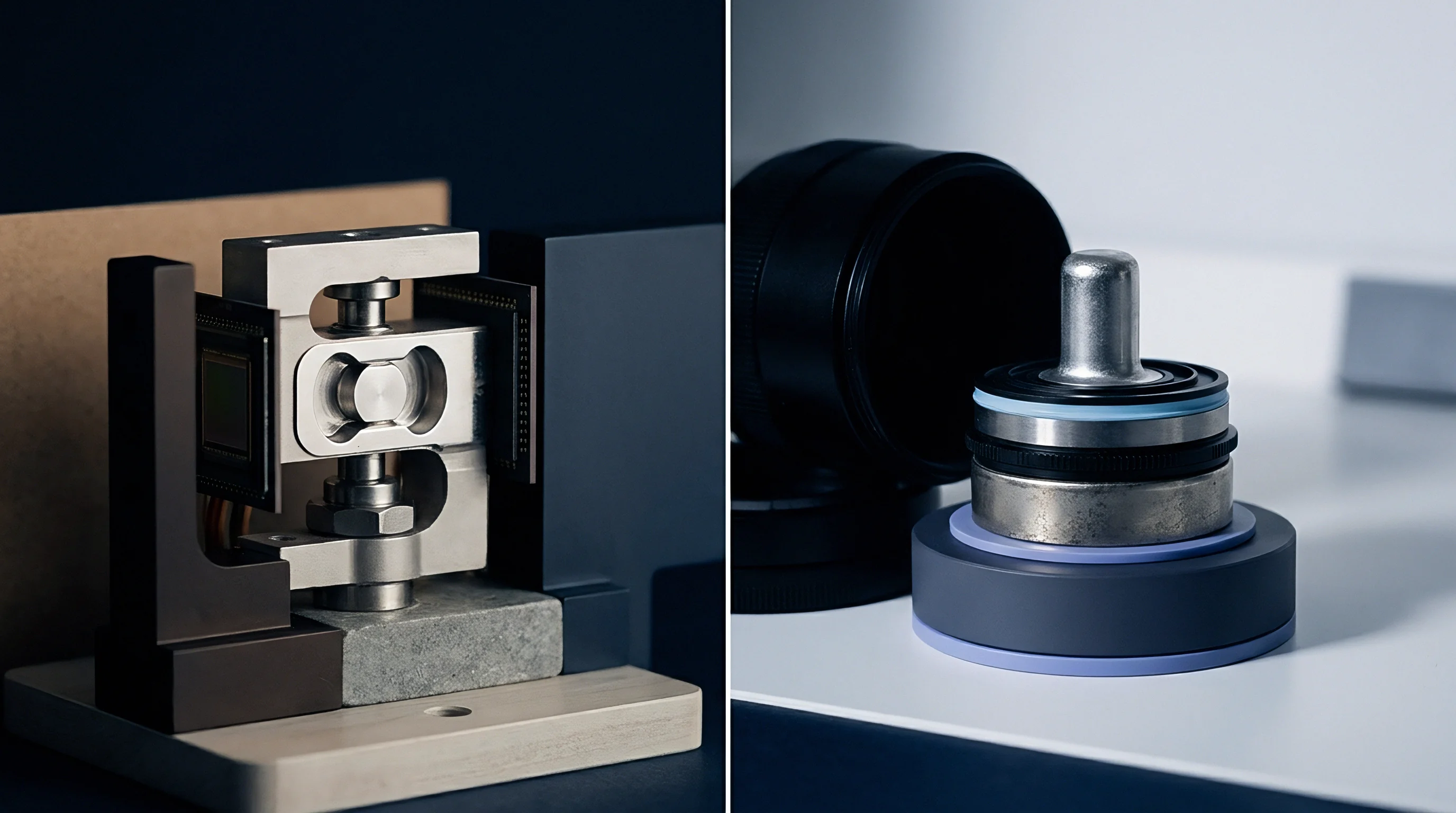
Accurate dynamic permeation measurement demands strict isolation of edge effects and flange clamping stresses. Over-compression of an elastomeric seal distorts internal void geometry, altering both diffusion path lengths and activation energies. The test rig incorporates calibrated piezoelectric load cells within the hygienic clamp assembly to continuously record bolt torque, compression force, and seal relaxation during thermal cycling.
Linear variable differential transformers track seal axial deflection in real time, separating viscoelastic creep from thermal expansion artifacts.
- Install the conditioned test gasket into the sanitized analytical cell using torque-controlled sanitary clamp fittings tightened to specified manufacturer bolt tensions.
- Evacuate the downstream collection chamber to a baseline pressure below 10-3 mbar while purging with ultra-high-purity nitrogen until the moisture detection baseline stabilizes.
- Energize the upstream steam generator, stepping the interface from 20 degrees Celsius to 130 degrees Celsius within sixty seconds at a regulated saturated steam pressure of 2.7 bar absolute.
- Log moisture concentration in the downstream carrier sweep gas continuously at 10 Hz acquisition frequency to record the transient breakthrough curve and the steady-state permeation plateau.
- Initiate rapid depressurization followed immediately by a chilled liquid rinse cycle at 10 degrees Celsius, holding for ten minutes to simulate process cooldown and induce maximum thermal shock.
- Repeat the thermal and pressure cycling sequence for a minimum of 250 continuous cycles to evaluate micro-structural fatigue and long-term transmission degradation.
Data reduction translates ppm moisture concentration readings from the sweep gas into an areal permeation rate. The calculation accounts for sweep gas mass flow rate, chamber geometric exposure area, seal thickness, and instantaneous upstream steam partial pressure. Instrument calibration relies on traceable gas-phase water vapour standards generated by dynamic split-flow moisture generators calibrated against primary chilled-mirror hygrometers traceable to national metrology institutes.
The resulting measurement yields an expanded uncertainty of 4.6 percent with a coverage factor of k = 2 across the full operating range.
Section 6.4 of the ASME BPE standard defines strict dimensional tolerances and cleanability criteria for hygienic seals, yet the document contains no performance threshold for steam vapour transmission rates across elastomer barriers during dynamic thermal cycles.

Distortion
Measurement uncertainty in sensor systems stems from both mechanical and electrical anomalies induced by seal permeation. When water vapour penetrates the secondary enclosure of a process transmitter, it interacts directly with internal sensor sub-assemblies. The electrical insulation resistance of high-purity ceramic feedthroughs drops from gigaohm baselines down to several hundred kiloohms.
In high-impedance circuits, such as pH glass electrode inputs or piezoelectric vibration crystals, this shunt resistance path introduces direct signal attenuation and erratic calibration drift.
Piezoresistive pressure transmitters experience zero-point wander when moisture condenses within the gauge reference volume. For an unvented gauge transmitter calibrated to a range of 0 to 2 bar, an internal pressure build-up of only 10 mbar due to trapped vapor condensation causes an offset error of 0.5 percent of full scale. This offset error shifts continuously as the ambient temperature outside the sensor housing fluctuates, producing apparent diurnal measurement drift that plant calibration technicians cannot isolate through routine zero trims.
Will Saturated Steam Condensation Degrade Insulation Resistance?
Condensation degrades insulation resistance through ionic bridging across bare conductor paths and micro-cracking within ceramic-to-metal seals. Clean saturated clean-in-place steam carries volatile treatment chemicals, including neutralizing amines like cyclohexylamine and morpholine. These alkaline species diffuse through polymer seals alongside water vapour.
Once inside the sensor cavity, they deposit conductive residues across printed circuit boards and strain-gauge flex circuits, establishing stable galvanic paths that persist even after the sensor dries out.
Under 130 degrees Celsius saturated steam exposure, sensor insulation resistance drops from ten gigaohms to eighty kiloohms in less than sixty operating cycles.
| Seal Material and Curing | Cycles to Moisture Breakthrough | Mean Zero Drift at Cycle 500 (% Span) | Insulation Resistance at Cycle 500 (MΩ) | Transducer Output Hysteresis (% Span) |
|---|---|---|---|---|
| Sulphur-Cured EPDM | 42 | +1.85 ± 0.12 | 0.45 | 0.62 |
| Peroxide-Cured EPDM | 185 | +0.32 ± 0.04 | 85.0 | 0.14 |
| Bisphenol-Cured FKM | 68 | +1.15 ± 0.08 | 2.10 | 0.48 |
| Peroxide-Cured FKM | 140 | +0.55 ± 0.05 | 18.5 | 0.22 |
| Standard FFKM | 310 | +0.12 ± 0.02 | 450.0 | 0.08 |
| PTFE Envelope Gasket | 420 | +0.05 ± 0.01 | 1200.0 | 0.04 |
The tabulated drift data reveals the direct coupling between seal formulation, moisture ingress kinetics, and measurement reliability. Transducers fitted with sulfur-cured EPDM seals manifest measurable moisture breakthrough within 42 cleaning cycles, driving zero drift to nearly two percent of full scale by cycle 500. Conversely, instruments sealed with peroxide-cured EPDM preserve acceptable metrological integrity past 180 cycles, exhibiting one-sixth the zero drift of their sulfur-cured counterparts.
PTFE envelope designs demonstrate exceptional resistance to vapor migration, yet their susceptibility to mechanical cold flow introduces separate joint relaxation vulnerabilities under cyclic thermal torque.
Suppliers frequently assert that internal drift results entirely from thermal hysteresis in the piezoresistive silicon diaphragm, maintaining that environmental seals pass all standard helium leak specifications.

Ledger
The commercial consequences of uncharacterized seal permeation concentrate in warranty settlements, shortened recalibration cycles, and batch rejection events. A hygienic sanitary pressure transmitter costs approximately 1,200 to 2,800 euros depending on materials, communication protocols, and hygienic process connections. The incremental manufacturing cost between a sulfur-cured EPDM seal and an optimized peroxide-cured compound sits below three euros per part.
Yet, specifying the incorrect curing chemistry shifts the maintenance burden entirely onto the operating facility.
Biopharmaceutical facilities operating under current good manufacturing practice regulations enforce strict critical quality attribute limits on sterile bioreactor parameters. A dissolved oxygen sensor or head-space pressure sensor that drifts beyond its calibrated tolerance window compromises batch validation records. In mammalian cell culture operations where individual harvest batches represent between 250,000 and 1,500,000 euros in commercial value, a measurement failure triggered by steam permeation behind an O-ring seal forces extensive deviation investigations and potential batch discard.
Calibration frequency adjustments drive running operating costs. Standard maintenance protocols schedule transmitter verification every twelve months. When steam permeation forces sensor zero wander, plant engineers shorten the recalibration window to monthly or bi-weekly intervals to track and trim the drift.
Each calibration event consumes technician time, requires mechanical line break interventions, and increases contamination risks during re-assembly.
- Compound Cure Chemistry must be explicitly declared on material test reports, mandating peroxide curing systems over sulfur cross-linking for all steam-facing elastomeric barriers.
- Permeation Transmission Verification should establish empirical maximum water vapour transmission rates below 15 g·mm/m²·day under live steam conditions on incoming component lots.
- Cavity Venting Design must incorporate hydrophobic, oleophobic Gore-style membrane breathers or hermetic ceramic glass-to-metal headers behind the primary seal to prevent moisture accumulation.
- Comprehensive Thermal Lifetime Validation requires seal suppliers to submit dynamic steam testing dossiers detailing performance across a minimum of 300 SIP cycles before vendor qualification approval.
The cost equation steepens when considering plant turnarounds. Replacing process sensor seals during every scheduled maintenance window appears inexpensive on the surface. Procurement catalogs price standard sanitary mini-clamps and O-rings at a few euros each.
However, the direct labor of swapping forty sensors across an automated processing train, torquing clamps to validated specifications, running loop checks, and executing post-maintenance sterilization cycles costs thousands of euros in downtime. Investing in seals validated by dynamic steam permeation testing yields immediate payback by extending service lifespans from weeks to years.
The remaining question centres on how non-linear thermal-mechanical stress coupling in modified fluoropolymers shifts the activation energy of water vapour diffusion over thousands of extended clean-in-place cycles.