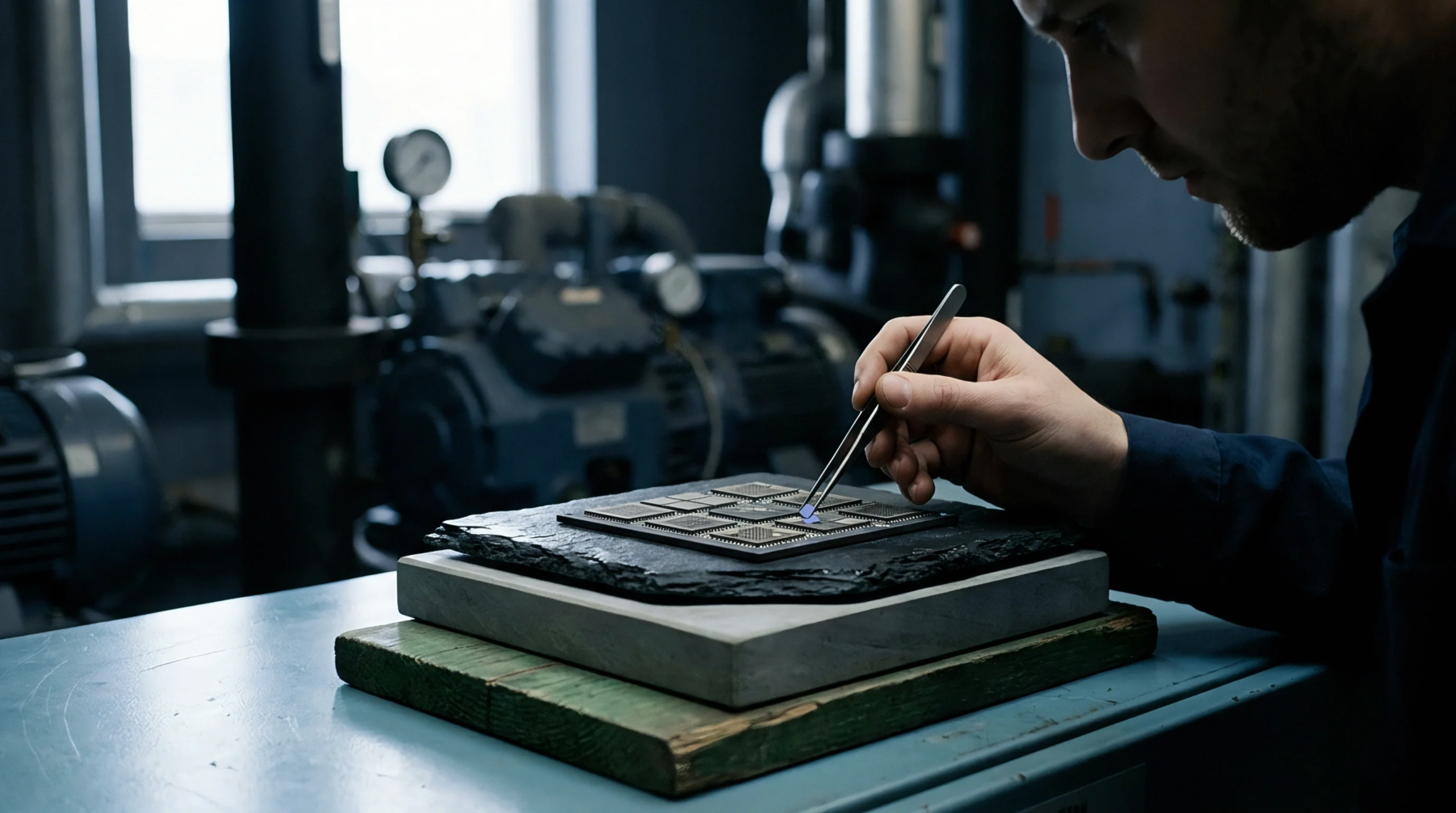
Piezoresistive Tensor Sensitivity Shifts Driven by Substrate Thermal Diffusion Fields
Substrate thermal diffusion fields distort piezoresistive sensitivity tensors via localized expansion stresses, requiring centrosymmetric bridge layouts.
Heat energy dissipating through microscale structures establishes time-dependent spatial distributions of temperature governed by thermal diffusivity and boundary conditions. The thermal diffusion fields describe continuous scalar temperature gradients formed within sensor membranes, structural substrates, and surrounding gas layers under dynamic heat transfer regimes. These profiles govern the response kinetics of thermal mass flow meters, thermopiles, gas sensors, and catalytic pellistor detectors.
The framework ceases to apply when characteristic system lengths fall below sub-continuum phonon mean free paths, where ballistic transport mechanisms replace Fourier diffusion equations, or inside isothermal equilibrium states devoid of spatial temperature variation.
Energy conservation formulations express thermal diffusion through parabolic partial differential equations linking temporal temperature variations to the Laplacian of spatial temperature fields scaled by thermal diffusivity. Diffusivity itself represents the quotient of thermal conductivity divided by the product of specific heat capacity and mass density. Microstructures engineered with low thermal mass and high isolation achieve rapid thermal response rates, establishing localized steady-state diffusion profiles within millisecond intervals.
Boundary conditions, such as structural anchors, gold wire bonds, and ambient fluid interfaces, act as dynamic thermal sinks that warp diffusion contours. Fluid flow traversing a heated micro-bridge alters these diffusion fields by sweeping thermal boundaries downstream, generating temperature differentials that scale with fluid velocity and fluid thermal properties.
Unintended shifts in surrounding thermal diffusion paths introduce measurement bias, offset drift, and signal distortion into sensitive transducer readouts. Variations in ambient gas composition alter the bulk thermal conductivity of the gaseous envelope, shifting the shape of the diffusion field independently of structural heater power. Uncontrolled drafts, package proximity to power electronics, and fluctuating external convection regimes introduce parasitic thermal gradients across differential sensing junctions.
In piezoresistive pressure transducers, asymmetric diffusion fields trigger localized thermal expansion mismatches, generating apparent pressure signals that compromise sensor zero-stability. Minimizing these interferences requires symmetric structural geometry, physical isolation cavities, and constant-temperature operation modes driven by active feedback circuits.
Verification of spatial and temporal thermal distributions relies on high-resolution infrared micro-radiometry, calibrated thermoreflectance imaging, and embedded thin-film resistive sensor arrays. Laser-induced thermoreflectance captures localized thermal transients with sub-micrometre spatial resolution and nanosecond temporal precision, mapping experimental isotherms against multi-physics finite element models. Environmental testing chambers expose devices to broad ambient temperature, humidity, and flow envelopes to verify that thermal boundary conditions remain stable under operational extremes.
Sensor qualification checks thermal response time constants by applying pulsed step-power inputs, confirming that rise and fall kinetics match design specifications. Stability protocols measure base output offsets during steady-state thermal soaking to confirm that drift remains within certified limits.
Substrate thermal diffusion fields distort piezoresistive sensitivity tensors via localized expansion stresses, requiring centrosymmetric bridge layouts.
Expertise is a utility, not a secret. sentiention™ publishes its working knowledge as open reference: intelligence layer covering the materials it sources, the markets it enters, and the reference that serves both.