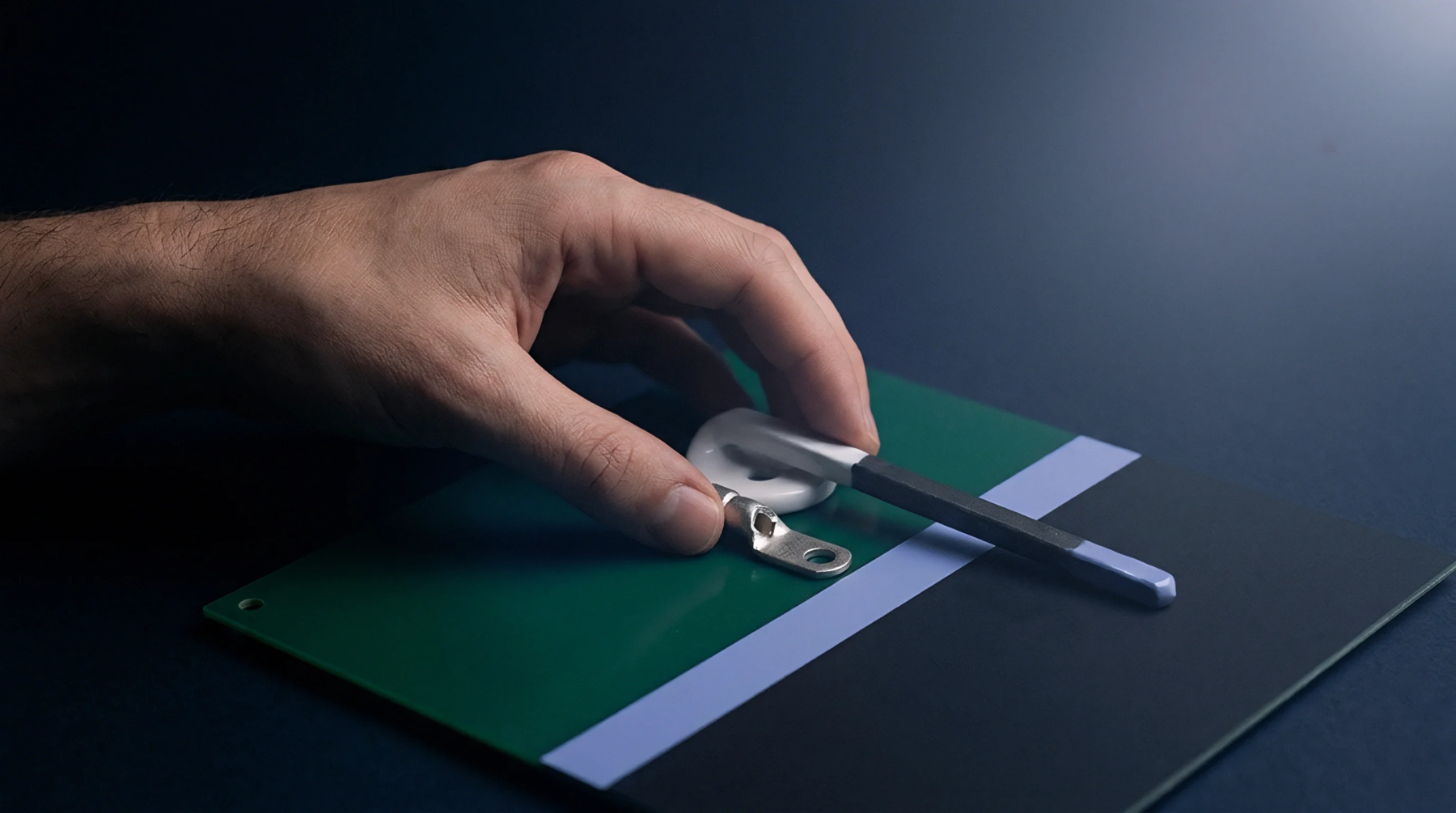
Substrate Material
High-frequency ceramic-filled woven glass hydrocarbon laminates provide stable dielectric properties for microwave and sensing printed circuit boards. The specific substrate designated as Rogers 4003c exhibits low dielectric tolerance and minimal electrical loss at multi-gigahertz frequencies. Circuit designers select this rigid laminate to manufacture low-loss planar antennas and high-Q sensing coils.
Material characteristics include a dielectric constant of 3.38 and a low loss tangent of 0.0027 at 10 GHz. Thermal processing boundaries match standard glass epoxy manufacturing processes without special surface treatment steps.
Dielectric Stability
Controlled dielectric constant distribution ensures consistent characteristic impedance along transmission line structures. Inside circuits fabricated on Rogers 4003c, signal dispersion remains low across broad RF bandwidths. Tight thickness tolerances control fringing fields in microstrip trace geometries.
Low moisture absorption preserves electrical performance in high-humidity operating environments.
Thermal Performance
Coefficients of thermal expansion matching copper minimize mechanical stress at internal via interfaces during thermal cycling. Dimensional stability prevents trace misalignment and circuit warping in multi-layer board stackups. High thermal conductivity aids heat dissipation away from active power components.
Operating temperature limits extend beyond standard FR-4 limits without structural degradation.
Qualification Testing
Electrical qualification follows IPC standards for high-frequency laminate performance verification. Standard test methods measure dielectric constant and dissipation factor using cavity resonators at microwave frequencies. Quality certificates record batch lot thickness, copper foil bond strength, and dielectric loss tangents.
Fabricators verify material parameters before committing laminates to high-reliability production runs.