Metrological Definition
Mechanical acceleration applied to an oscillator package alters the resonance frequency of the quartz crystal inside, and TCXO G Sensitivity measures the magnitude of this frequency shift per unit of gravitational force. Environmental vibration or physical shock imparts linear acceleration vectors along specific axes of the device, creating spurious phase modulation sidebands in the output spectrum. Manufacturers quantify this parameter in parts per billion per gram, abbreviated as ppb per g, across three orthogonal axes to establish the primary inertial performance boundary.
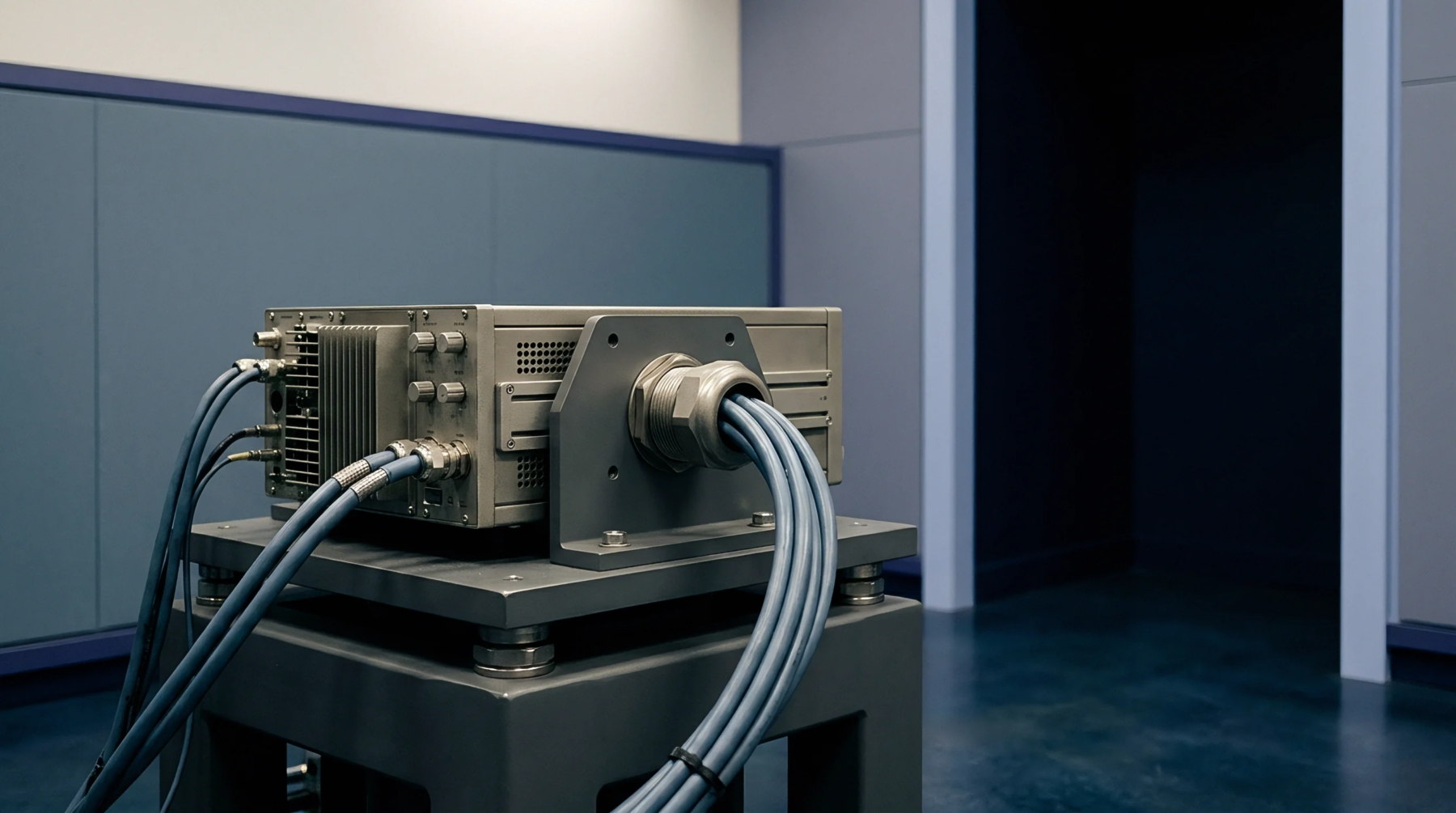
Laboratory test fixtures mount the component on a turntable or shaker table, subjecting the device to known centrifugal or vibrational loads while a high resolution frequency counter records the output deviation. When the acceleration vector aligns with the mounting plane, internal mechanical stresses deform the crystal blank, altering the cut angle and shifting the output frequency away from the nominal value. This susceptibility remains constant for a given manufactured lot, but ageing and mounting torque can alter the baseline response over the operational lifetime of the part.
Acceleration Vector
Gravitational sensitivity depends heavily on the direction of the applied force relative to the crystallographic axes of the resonator. Manufacturers typically specify sensitivity values for three distinct orthogonal axes, designated as gamma x, gamma y, and gamma z, because internal stress distribution varies with orientation. The vector sum of these directional measurements yields the total scalar sensitivity, which determines how the component behaves when mounted on a vibrating PCB.
Designers calculate the maximum expected frequency error by multiplying the peak acceleration value of the application environment by the highest axis coefficient. Field installations in avionics or vehicular telemetry expose the oscillator to complex random vibration profiles, where continuous acceleration changes induce microphonic phase noise peaks. Laboratory calibration isolates each axis by rotating the device through specific gravitational angles, eliminating extraneous noise sources that could distort the measurement.
Resonator Construction
Quartz crystal blank geometry and internal mounting structures dictate the baseline inertial vulnerability of the oscillator circuit. Stress relief cuts in the crystal mounting clips minimize the transfer of mechanical strain from the package housing to the vibrating element. Miniature surface mount packages experience higher internal stress during thermal reflow soldering, which can permanently offset the initial inertial response.
Double rotated crystal cuts, such as the SC cut, exhibit lower acceleration sensitivity than standard AT cut resonators because thermal and mechanical stress distributions balance differently across the blank. Internal circuit boards supporting the crystal and the temperature compensation network must maintain rigid mechanical stability to prevent differential displacement under shock loads.
System Integration
System architects utilize acceleration coefficients to predict timing jitter degradation in high frequency communication links operating in mobile environments. Base stations and satellite receivers require specialized phase locked loops to filter out the sidebands generated by ambient mechanical vibration acting on the local oscillator. Compensation algorithms can actively cancel measured inertial errors if the host system includes a multi axis accelerometer providing real time motion data to the digital signal processor.
Uncompensated frequency excursions degrade bit error rates in high order quadrature amplitude modulation systems, making precise inertial characterization necessary for mission critical hardware qualification. Final acceptance testing verifies that the assembled unit meets the maximum allowable frequency offset limit under simulated operational vibration profiles before deployment into the field.