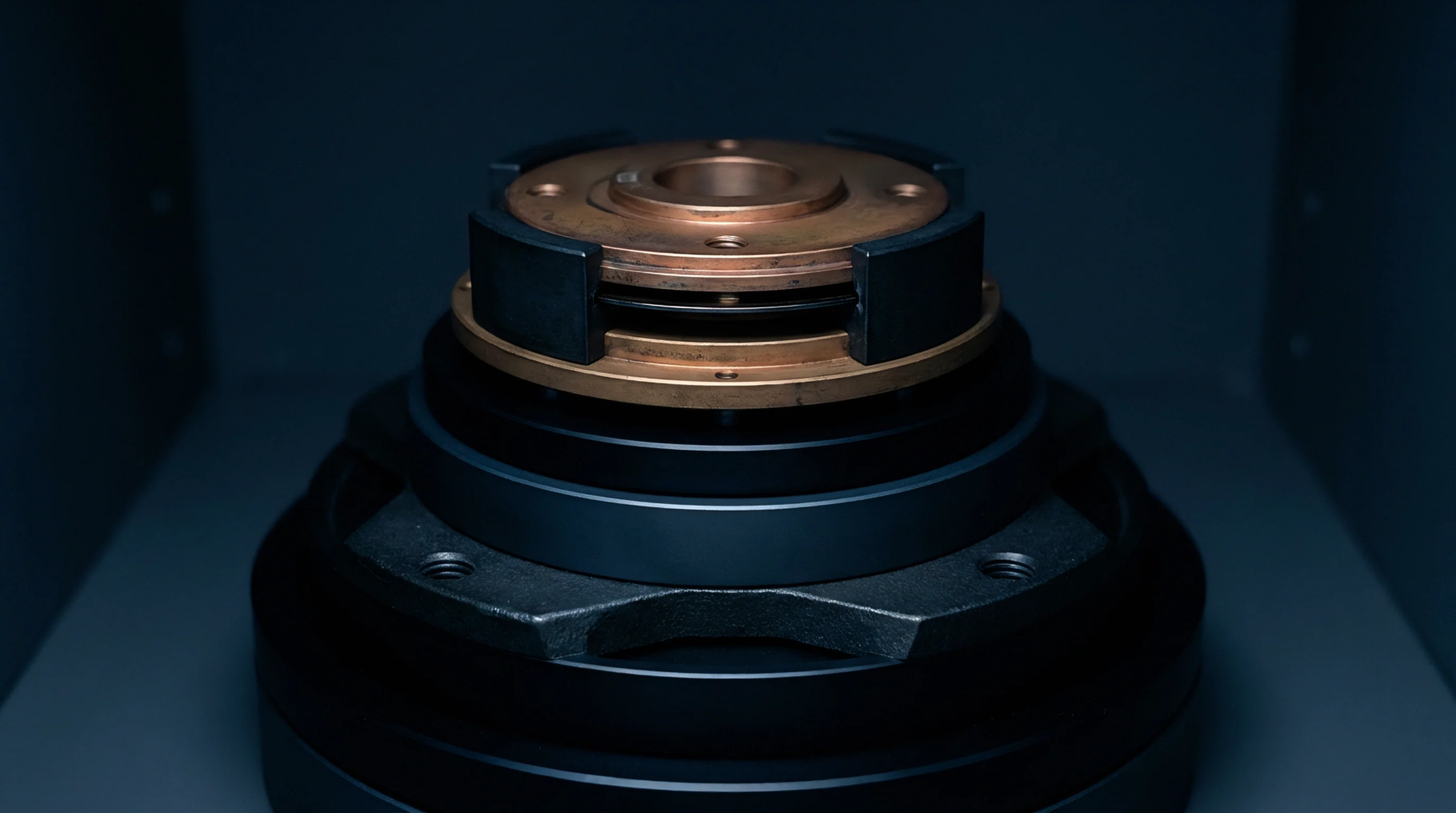
Thermal Relaxation Mechanics in Amorphous Soft Magnetic Core Alloys
Thermal relaxation in amorphous cores drives directional pair ordering that pins domain walls, shifting permeability and zero-point offset over time.
Generation of spectral energy at exactly twice the fundamental excitation frequency indicates structural or magnetic asymmetry across an electromagnetic measurement system. Second harmonic distortion arises when an instrument transfer function contains quadratic non-linearities, skewing positive and negative signal polarities asymmetrically. In symmetric magnetic systems, even harmonics remain absent under zero-bias conditions; hence, the amplitude of this specific component serves as the target transduction metric in fluxgate magnetometers and DC current transformers.
The validity of this signal mode terminates when higher-order intermodulation products or odd harmonics overlap through system cross-coupling, or when thermal drift obscures the second harmonic baseline.
Symmetrical magnetic core materials driven into deep saturation generate voltage outputs containing only odd harmonics of the excitation frequency. When an external direct-current or low-frequency magnetic field couples into the core, it offsets the dynamic hysteresis operating point, breaking temporal symmetry between positive and negative half-cycles. This offset induces even-harmonic voltages across secondary sensing coils, dominated by the second harmonic component.
The amplitude of the second harmonic distortion tracks the magnitude of the external magnetic field, while its electrical phase relative to the excitation source reveals the field direction. Synchronous demodulators lock onto this frequency to quantify field levels down to sub-nanotesla thresholds.
Unwanted second harmonic distortion in general linear instrumentation introduces severe systematic measurement errors. Stray magnetic fields from nearby conductors, permanent magnetic remanence inside core materials, or direct-current bias currents flowing through transformer windings shift the quiescent core operating point, generating parasitic second harmonics. Unequal core cross-sections or mismatched driver electronics in differential sensing topologies compromise symmetry cancellation.
Non-linearities in operational amplifier input stages and cross-talk between excitation and pick-up channels introduce spurious second-harmonic components unrelated to the target magnetic field. In high-precision audio and power monitoring transformers, this distortion distorts true signal reproduction and corrupts total harmonic distortion figures.
Instrument qualification relies on narrow-band spectrum analyzers, lock-in amplifiers, and digital signal processors configured to evaluate second-harmonic amplitudes. Zero-field shielding enclosures constructed from multiple concentric mu-metal layers isolate testing platforms from the ambient geomagnetic field during baseline calibration. Sensor cores undergo demagnetization sequences using decaying alternating-current fields to eliminate internal vector remanence that otherwise masquerades as external signal bias.
Acceptance standards define strict limits on residual second-harmonic offset voltage under verified zero-input conditions. Calibration protocols map the phase and magnitude linearity of the second harmonic response across the complete specified input dynamic range.
Thermal relaxation in amorphous cores drives directional pair ordering that pins domain walls, shifting permeability and zero-point offset over time.
Expertise is a utility, not a secret. sentiention™ publishes its working knowledge as open reference: intelligence layer covering the materials it sources, the markets it enters, and the reference that serves both.