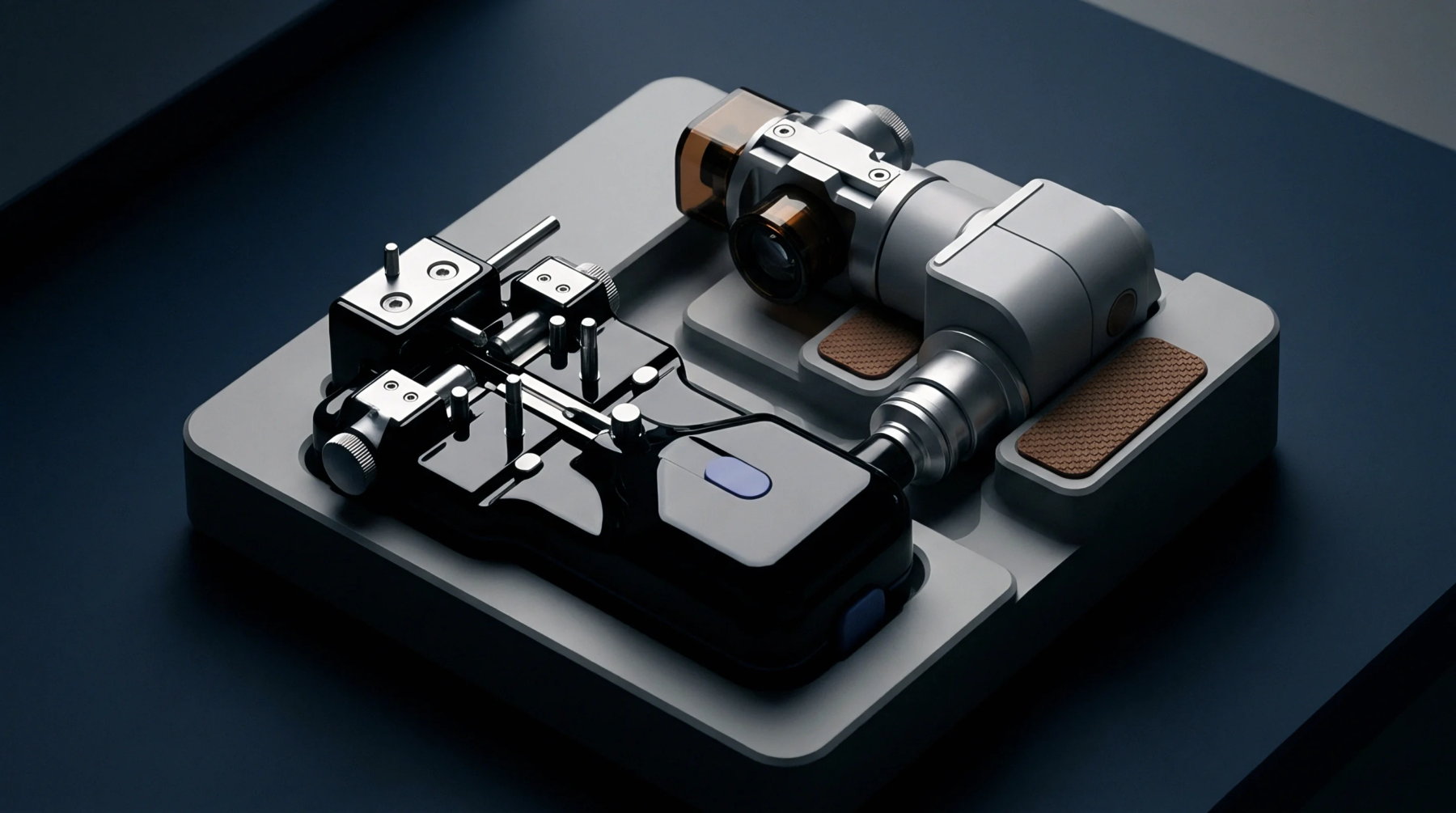
Contact Interface
Spring-loaded electrical probe assemblies mounted within rigid non-conductive blocks establish temporary, non-destructive connections between automated test equipment and circuit board test pads. Sourcing engineers qualify a pogo pin array to interface high-density bed-of-nails fixtures with printed circuit assemblies during in-circuit and functional verification. Gold-plated cylindrical plungers compress against internal helical springs inside drawn brass barrels, delivering consistent contact forces ranging between fifty and three hundred grams.
Array geometry maps test probes directly to printed board test lands, terminating where hardwired cabling interfaces with test instrument measurement cards.
Mechanical Compliance
Plunger travel absorption accommodates board warpage, height variation, and fixture manufacturing tolerances without crushing sensitive surface-mount devices. Probe tips feature serrated, needle, chisel, or crowned geometries engineered to pierce insulating flux residues and oxide coatings on exposed copper test pads. Repetitive compression cycles induce lateral plunger play inside barrel sleeves, which degrades nominal contact center targeting over hundreds of thousands of test cycles.
Metrology laboratories monitor fixture wear by measuring pin height uniformity with dial indicators and verifying tip true-position coordinates on coordinate measuring machines.
Contact Resistance
Electrical contact resistance through moving plungers, internal springs, and barrel walls remains below fifty milliohms under ideal clean operating conditions. Foreign particles, aerosolized solder fumes, and metal shavings accumulate within moving barrel clearances, causing erratic resistance spikes that masquerade as electronic circuit failures during automated testing. High-current power injection pins suffer internal localized heating when contaminated contacts restrict conductive surface areas, accelerating spring annealing and loss of mechanical compliance.
Periodic maintenance protocols mandate ultrasonic cleaning of probe blocks followed by contact resistance verification using four-wire Kelvin micro-ohmmeters.
Probe Pitch
Modern miniature circuit layouts require dense probe spacing down to center-to-center distances below one millimeter. Cross-talk between adjacent signal pins increases at high electrical frequencies, demanding alternating ground pins and coaxial pogo assemblies within the pogo pin array block. Pointing accuracy errors multiply when long-throw plungers extend outward from fixture guide plates toward micro-vias or miniature test pads.
Fixture fabricators minimize offset drift by precision-drilling polyimide or epoxy-glass holding plates on high-accuracy CNC drilling machines, ensuring probe arrays align with unit test points across extended production runs.