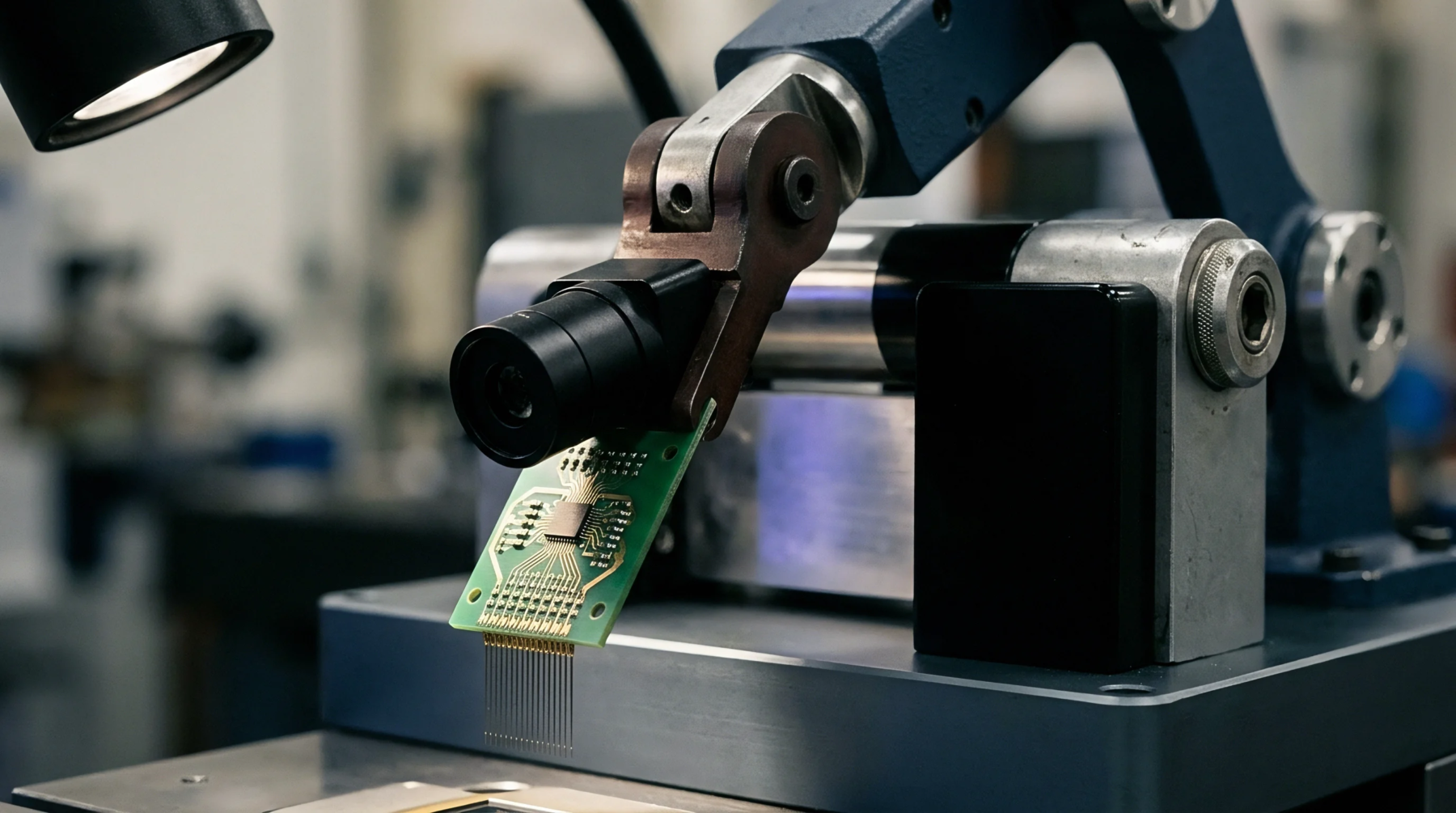
Mechanical Coupling
The design methodology that constrains exactly six degrees of freedom of a body using the minimum number of contact points defines the standard for high-precision optical alignment. A kinematic mounting prevents over-constraint and the resulting internal mechanical stresses that deform sensitive components. This technique utilizes three contact points, such as spheres resting in a combination of grooves and flat surfaces.
By defining each constraint uniquely, the mounted item can be removed and replaced with sub-micrometer repeatability.
Force Distribution
Contact force at each interface must be managed to prevent material deformation or yield. Preloading springs are used in a kinematic mounting to maintain contact between the reference surfaces without introducing excessive distortion. The magnitude of this preload must exceed the expected external forces to prevent separation of the contacts during operation.
Designers calculate the contact stress using Hertzian contact theory to select appropriate materials.
Surface Interaction
Wear of the contact surfaces over time degrades repeatability. Hard materials like sapphire are chosen for the kinematic mounting interfaces to minimize friction.
Thermal Stability
Structural expansion under temperature changes must not introduce bending moments into the supported optics. Thermal expansion is accommodated by the kinematic mounting as the contact points are free to slide along their predefined constraint directions. This sliding action allows the component to expand radially from a single virtual center without changing its optical alignment.
Stable material selection remains essential for maintaining long-term accuracy under varying temperatures.