Inductive Component
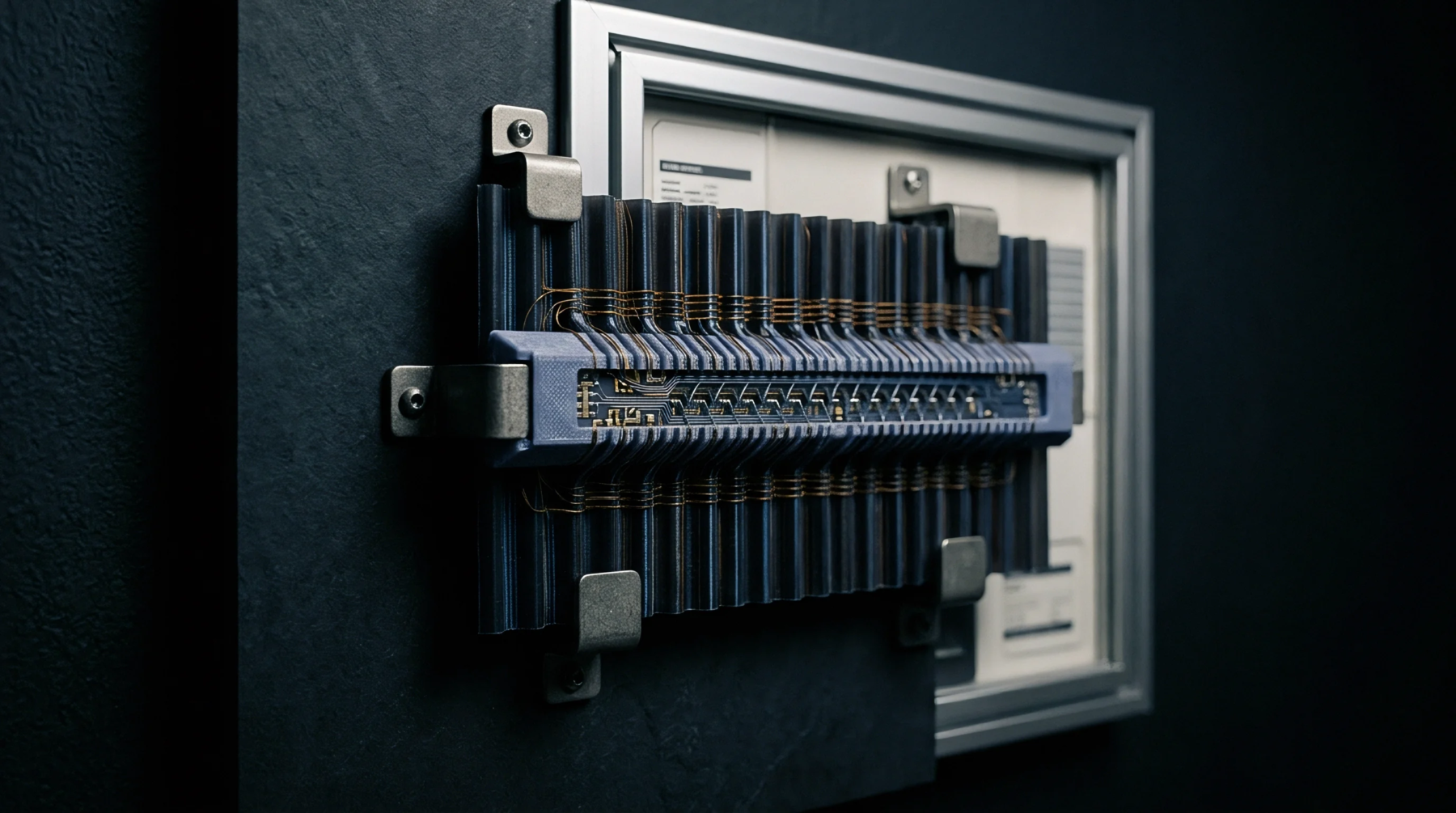
Conductive winding assemblies designed to generate or detect electromagnetic fields above one megahertz require specialized winding topologies to suppress internal parasitic impedances. Categorized as a high-frequency coil, the device delivers precise inductive reactance while mitigating self-capacitance and skin depth losses. Sensor applications include eddy-current displacement probes, non-contact inductive position transducers, and radio-frequency resonant circuits.
Planar spiral tracks on low-loss ceramic substrates or air-core wound geometries maintain structural phase stability under environmental excitation. Conductive shielding limits external stray magnetic coupling at the measurement perimeter. Usability ceases at the self-resonant frequency where parallel winding capacitance forces the net reactance into a capacitive state.
Loss Mechanism
Electromagnetic current density migrates toward conductor surfaces as excitation frequencies climb into the megahertz spectrum. Skin effect restricts electric conduction to a thin surface boundary, multiplying alternating-current resistance well above direct-current specifications. Proximity effect between adjacent turns compresses current into narrow lateral ribbons, escalating localized copper heating and thermal drift.
Stray capacitive coupling between neighboring turns forms distributed capacitive tanks that degrade resonant quality factors. Core materials switch from silicon steels to non-conductive ferrite formulations, powdered iron, or air to eliminate magnetic hysteresis and bulk eddy losses.
Tolerance Verification
Sourcing procedures require measurement of inductance, series resistance, and self-resonant peak frequencies across the full working bandwidth. Precision impedance analyzers verify these metrological values using four-terminal pair Kelvin fixtures calibrated against open, short, and load standards. Production tolerances for aerospace displacement transducers mandate series inductance repeatability within one percent across manufacturing lots.
Thermal cycling reveals dimensional expansion of coil formers, which shifts baseline inductance and induces sensor zero drift. Encapsulation inside low-dielectric epoxy resins protects wire turns from mechanical shock and ambient moisture absorption.
Field Installation
Mounting geometry alters coil performance during system integration into industrial machinery. Conductive housing materials within three coil diameters distort flux lines, lowering effective loop inductance and lowering operational sensitivity. Ground plane proximity adds parasitic capacitance that pulls the operating resonance downward into the measurement band.
Temperature gradients along sensor probes cause differential thermal expansion between winding copper and structural housings. Magnetic shielding using high-permeability sleeves mitigates side-target interference while focusing the electromagnetic measurement beam along the sensitive axis.