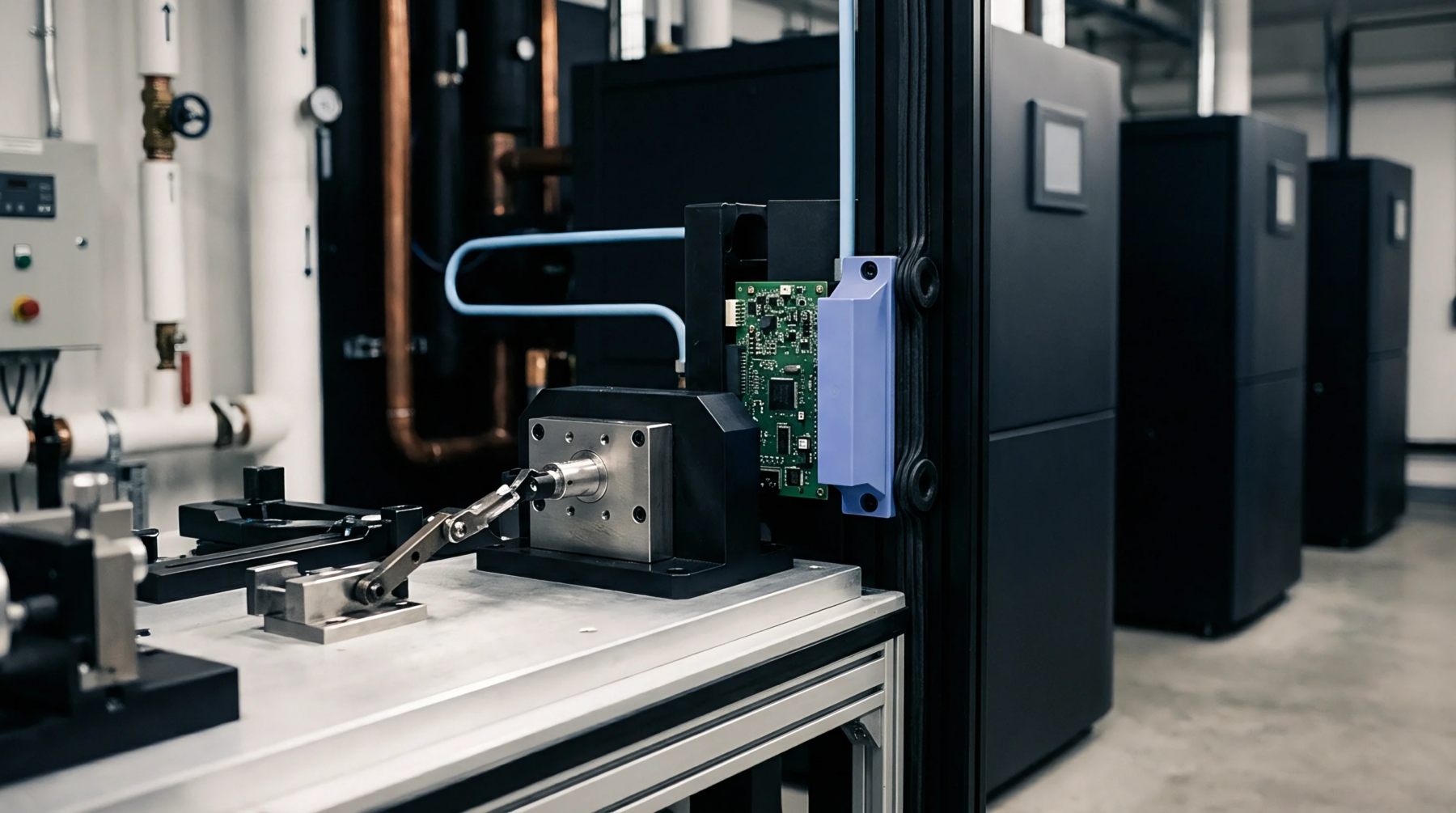
Board Flex Reaching the Die as Offset Error after Assembly
Board flexure transfers shear strain through solder joints into silicon dies, shifting zero-point offsets; isolate footprints using slots or diagonal placement.
Glass reinforced epoxy laminates depend fundamentally upon mechanical rigidity to survive thermal cycling during printed circuit board assembly. Stiff material properties define FR-4 Youngs modulus by establishing the ratio of tensile stress to axial strain within designated elastic boundaries. Manufacturers utilize standardized coupon testing procedures at ambient room temperature to determine this specific property for quality control certification.
Reference conditions demand precise alignment of test specimens because improper clamping introduces bending moments that corrupt the resulting numerical output. Specimen thickness variations alter the measured stiffness values during load application. Verification occurs in metrology laboratories holding specific calibration accreditation for mechanical testing apparatus.
Thermal aging degrades resin crosslinking density over time, shifting the baseline elasticity downwards from factory specifications. Creep deformation under sustained loading introduces permanent dimensional changes that complicate verification routines. Environmental humidity absorption plasticizes the resin matrix, reducing mechanical resistance relative to dry baseline specimens.
Metrologists apply correction factors to raw load cell data when testing samples extracted from finished circuit boards containing copper trace layers. Testing protocols specify loading rates designed to prevent viscoelastic relaxation from skewing the elastic modulus calculation.
Polymer crosslinking density dictates the mechanical response of woven glass composite substrates under mechanical stress. Elevated curing temperatures yield higher tensile stiffness by restricting molecular chain mobility throughout the epoxy network. Hardener stoichiometry directly influences final network density, meaning slight chemical imbalances reduce overall structural rigidity.
Filler additions modify internal stress distribution by arresting microcrack propagation during tensile deformation. Glass transition thresholds mark the boundary where thermal energy softens the polymer backbone, causing a sharp drop in elastic modulus values. Residual stresses resulting from rapid cooling phases alter localized strain measurements during initial mechanical loading.
Manufacturers adjust formulation chemistry to balance thermal expansion coefficients against acceptable stiffness parameters. Moisture diffusion pathways through microvoids accelerate degradation of interfacial bonding between glass fibres and resin matrices. Verification technicians record ambient humidity levels because moisture pickup alters specimen mass and mechanical compliance simultaneously.
Cross section analysis confirms fibre volume fraction consistency across production batches before destructive testing proceeds.
Internal metal planes embedded within multilayer printed circuit boards constrain lateral deformation during mechanical testing procedures. Heavy copper weight layers increase composite rigidity along specific axes, overriding the baseline properties of the surrounding dielectric material. Etching patterns determine local mechanical anisotropy because solid planes distribute loads differently than hatched grid geometries.
Adhesive bond layers transferring shear stress between metal foils and glass fabric dictate composite integrity under bending moments. Residual stresses locked into copper foils during electrodeposition create asymmetric deformation profiles during tensile verification runs. Thermal expansion mismatches between metal and dielectric layers generate internal preloads that distort elastic modulus measurements.
Technicians account for metal volume fractions by applying rule of mixtures calculations to isolate dielectric stiffness from composite test data.
Long term mechanical reliability depends upon maintaining structural stability throughout operational thermal cycles. Cyclic mechanical fatigue initiates microstructural damage at fibre bundles, gradually reducing effective stiffness over extended service intervals. Elevated operating temperatures accelerate polymer chain relaxation, manifesting as progressive modulus reduction under constant load.
Oxidation reactions embrittle exposed resin edges along routed board perimeters, altering localized boundary conditions. Verification procedures require post thermal exposure retesting to quantify permanent degradation resulting from assembly soldering operations. Accelerated life testing protocols simulate decades of field stress by applying high frequency mechanical vibration alongside thermal extremes.
Metrology equipment monitors resonant frequency shifts to detect microscopic degradation in structural rigidity before macroscopic failure occurs.
Board flexure transfers shear strain through solder joints into silicon dies, shifting zero-point offsets; isolate footprints using slots or diagonal placement.
Expertise is a utility, not a secret. sentiention™ publishes its working knowledge as open reference: intelligence layer covering the materials it sources, the markets it enters, and the reference that serves both.