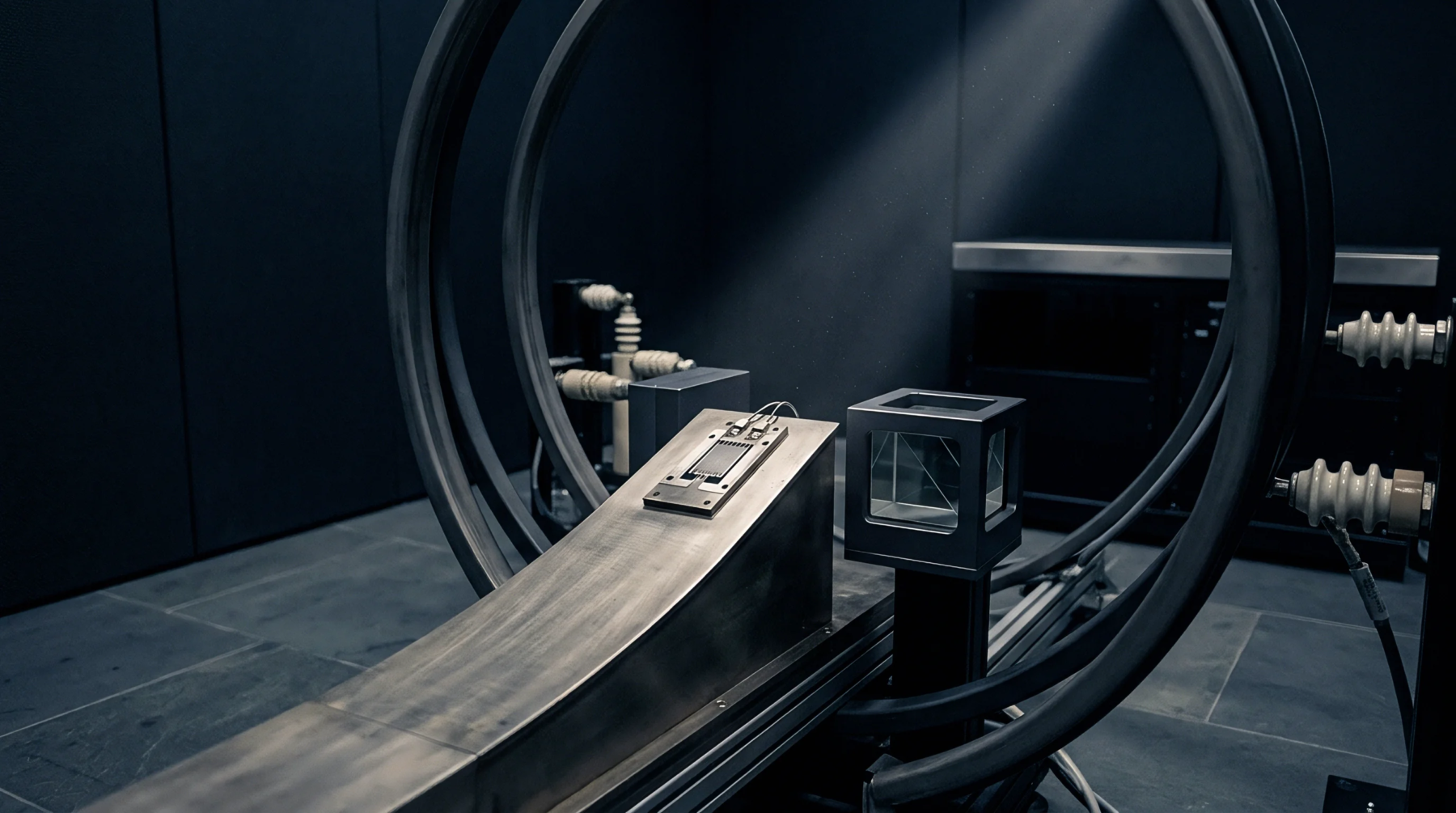
Spatial Thermal Gradient Effects on Precision MEMS Resonator Zero Rate Drift
Spatial thermal gradients shift MEMS zero rate drift by inducing asymmetric anchor stress, flexure mode coupling, and local frequency splitting.
Acoustic conversion inefficiency operates as a mechanical loss mechanism where cyclical strain within a vibrating resonator transforms elastic wave energy into thermal dissipation. Material damping governs this conversion process by relating internal friction directly to cyclic deformation rates under dynamic loading conditions. Thermoelastic attenuation specifically designates the portion of this damping arising from spatial temperature gradients induced by inhomogeneous stress fields.
Rapidly compressed micro-regions warm while stretched zones cool, driving irreversible heat flow across material boundaries until thermal equilibrium restores balance. Metrological verification of this effect requires high fidelity displacement sensors and thermal imaging equipment capable of detecting minute temperature oscillations synchronous with the applied acoustic frequency.
Frequency instability stems from cumulative thermal gradients altering the effective stiffness of the resonator during prolonged operation. Temperature coefficients of elasticity quantify this sensitivity by predicting how material moduli shift under varying ambient conditions. Sensor designers mitigate such errors by selecting single-crystal quartz orientations that minimize temperature dependence near specific turning points.
Calibration protocols mandate recording baseline resonance frequencies at reference ambient temperatures before applying dynamic mechanical excitation. Uncompensated thermal losses introduce systematic measurement drift that distorts sensor output, rendering raw frequency counts unreliable for precision timing applications.
Acoustic radiation into mounting hardware restricts quality factors in high precision piezoelectric resonators. Mounting structures intercept elastic waves propagating toward the periphery, converting the internal energy of the device into structural vibrations of the enclosure. Fixture design aims to isolate the vibrating element by positioning support structures precisely at nodal lines where displacement vanishes entirely.
Laboratory verification measures the unloaded quality factor of the resonator inside a vacuum chamber to eliminate aerodynamic drag and acoustic coupling with ambient air. Deviations between predicted theoretical damping and measured dissipation rates usually indicate parasitic energy leakage through clamping interfaces rather than intrinsic material friction.
Characteristic relaxation times depend on the thermal diffusion length, which relates material thermal conductivity directly to heat capacity and excitation frequency. Structural dimensions dictate whether a vibrating component operates in the isothermal regime or the adiabatic regime. Thin plate resonators experience rapid heat transfer across narrow dimensions, allowing complete thermal equilibration within each acoustic cycle, which maximizes local dissipation rates.
Thick structures trap thermal energy within localized micro-domains because diffusion distances exceed the spatial period of the elastic wave, suppressing internal heat flow and reducing overall loss. Analytical models predict peak attenuation when the thermal diffusion length matches the spatial wavelength of the mechanical strain field.
Spatial thermal gradients shift MEMS zero rate drift by inducing asymmetric anchor stress, flexure mode coupling, and local frequency splitting.
Expertise is a utility, not a secret. sentiention™ publishes its working knowledge as open reference: intelligence layer covering the materials it sources, the markets it enters, and the reference that serves both.