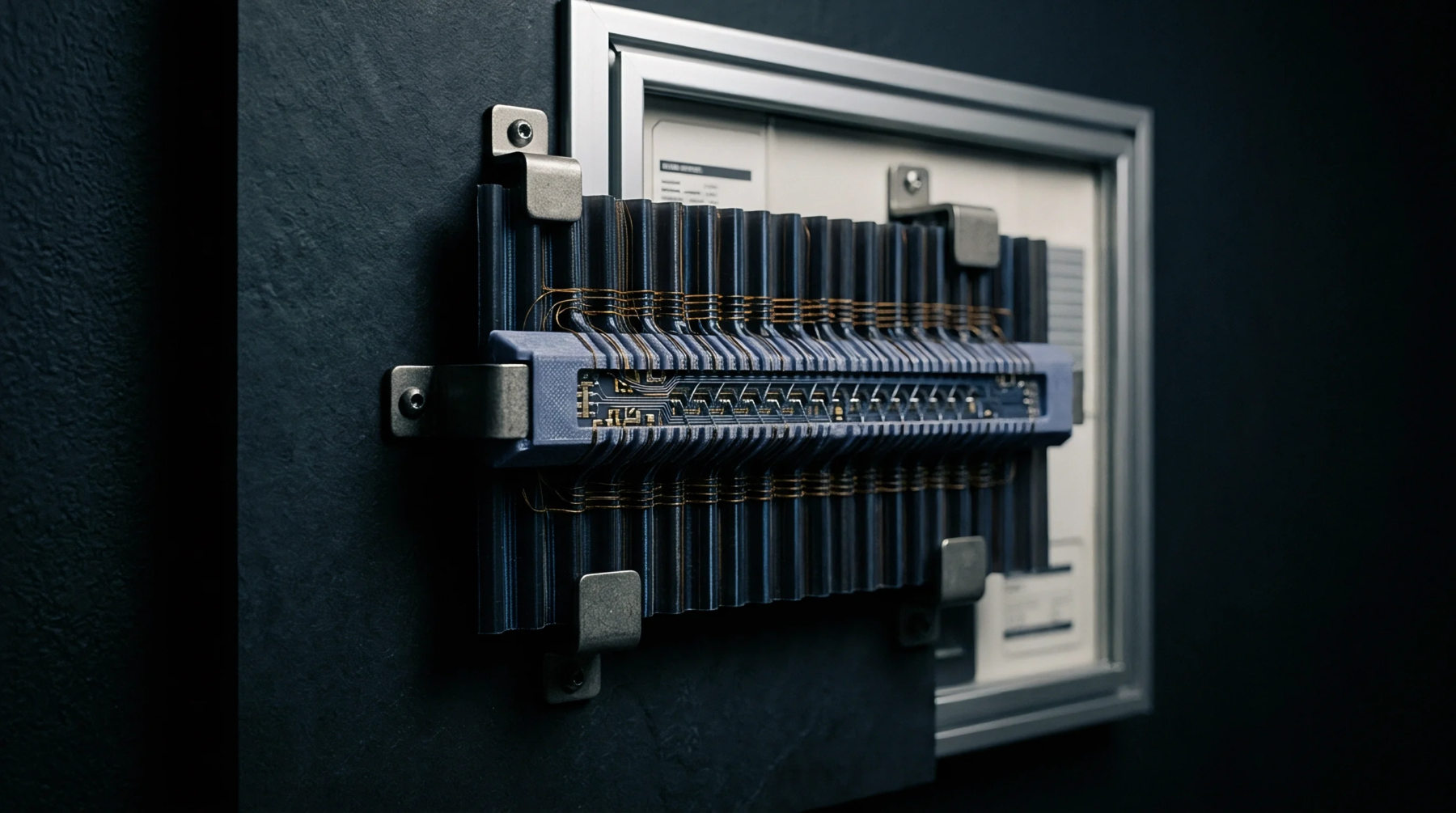
Position Change
Physical movement of an object relative to a reference coordinate system is monitored by measuring changes in electromagnetic fields. Tracking spatial displacement provides the feedback needed to control precision motion stages and robotic actuators. This measurement can be linear or angular depending on the sensor configuration.
Sensor Response
Alternating current sensors produce a variable voltage or phase shift as the target moves within the sensing zone. This electrical change is caused by the modification of the magnetic flux path or the capacitive coupling between the sensor and the target. The amplitude of the response is proportional to the distance moved.
Calibration Curve
Mathematical relationships map the electrical sensor signals to physical distance measurements during the instrument setup procedure. This mapping is established by recording the sensor output at known positions across the full measurement range. Since the raw response is often non-linear, polynomial equations or lookup tables are stored in the instrument memory to linearize the output data.
High-precision calibration standards are required to verify the accuracy of this curve across its entire span.
Dynamic Measurement
Rapid movements require high-bandwidth sensors to prevent signal delay and tracking errors during operation. The sensor output must be sampled at a rate that captures the full speed of the physical displacement. Speed limits of the processing electronics determine the dynamic accuracy of the system.